Skip to Content

Research & Commentary Results

Filter by
1060 Results
The ties that bind: The South Caucasus and the Middle East
Turkish Foreign Affairs Minister Mevlut Cavusoglu (C), Minister of Foreign Affairs of Iran, Javad Zarif (R) and Azerbaijani Minister of Foreign Affairs, Elmar Mammadyarov (L) pose for a photo prior the tripartite meeting of foreign ministers of Turkey, Azerbaijan and Iran in Istanbul, Turkey on October 30, 2018.
  • Analysis
  • The ties that bind: The South Caucasus and the Middle East

    As neighboring regions, the South Caucasus and the Middle East are inextricably intertwined — so much so that the former is sometimes even considered part of the Greater Middle East. While geographical proximity is the strongest driver of interconnectivity between the two regions, geopolitics, business ties, and energy interests also link countries from the South Caucasus and the Middle East and form the basis for important bilateral and regional relationships.

    January 24, 2020

    Iran’s “harsh revenge”: Is blocking the Strait of Hormuz really a plausible option?
    Iranian soldiers take part in the
  • Analysis
  • Iran’s “harsh revenge”: Is blocking the Strait of Hormuz really a plausible option?

    In the immediate aftermath of the assassination of Gen. Qassem Soleimani, head of the Islamic Revolutionary Guard Corps – Quds Force, on Jan. 3, Ayatollah Ali Khamenei warned the U.S. of Iran’s “harsh revenge.” There has been much speculation around the timing, location, and the type (or form) of Iran’s promised revenge. Amin Mohseni-Cheraghlou takes a closer look at the impact of the widely discussed strategy of blocking the Strait of Hormuz.

    January 23, 2020

    Yemen’s Stockholm Agreement one year on: Imaginary progress?
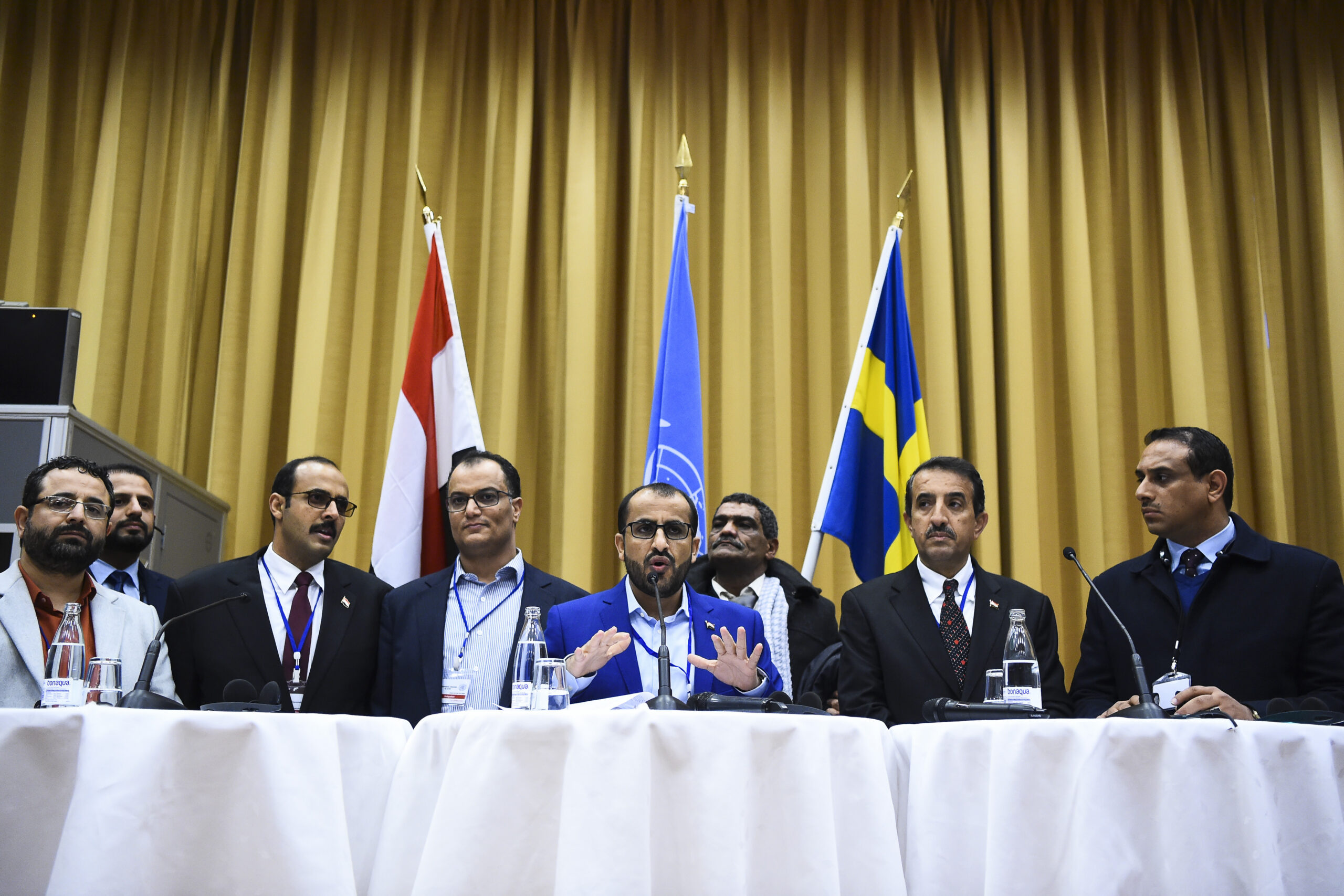
    Yemen's foreign minister Khaled al-Yamani (L) and the head orebel negotiator Mohammed Abdelsalam (R) shake hands under the eyes of United Nations Secretary General Antonio Guterres (C), during peace consultations taking place at Johannesberg Castle in Rimbo, north of Stockholm, Sweden, on December 13, 2018.
  • Analysis
  • Yemen’s Stockholm Agreement one year on: Imaginary progress?

    Just over a year ago, the international community rejoiced in the revival of the UN-led Yemen peace process with the conclusion of the Stockholm Agreement between the Yemeni government and the Houthi insurgency (Ansar Allah), brokered by UN Special Envoy Martin Griffiths. Although the deal marked the first political breakthrough in the peace process since the collapse of Geneva and Kuwait talks under Griffith’s predecessor, the ensuing hurdles in implementation meant that hopes for its success were short-lived. In evaluating the progress on the agreement’s three key components — covering prisoner exchange, Hodeida, and Taiz — it quickly becomes clear that the truism that implementing peace agreements is far more important, and difficult, than concluding them still rings true.

    January 22, 2020

    Foreign policy and commercial interests drive closer UAE-Syria ties
    The United Arab Emirates embassy is pictured in the Syrian capital Damascus on December 27, 2018 after its reopening, the latest sign of efforts to bring the Syrian government back into the Arab fold
  • Analysis
  • Foreign policy and commercial interests drive closer UAE-Syria ties

    On Dec. 2, a series of public statements from Emirati and Syrian officials brought widespread attention to the UAE’s rapprochement with Syria. In a video circulated by Russian state media outlet RT, the UAE’s charge d’affaires in Syria, Abdul-Hakim Naimi, praised the “wise leadership” of Syrian President Bashar al-Assad and hailed the Syria-UAE relationship as “solid, distinct, and strong.” Syrian Deputy Foreign Minister Faisal Mekdad responded enthusiastically to Naimi’s comments by praising the UAE for standing by the Syrian government in its war against terrorism.

    January 21, 2020

    Where will Iran hit next? Cyber
    A billboard bearing a portrait with the black mourning ribbon of slain Iranian military commander Qasem Soleimani (L) and Iraqi paramilitary chief Abu Mahdi al-Muhandis hangs on a main road in the Iranian capital Tehran on January 4, 2020, one day after Soleimani and other members of the pro-Iranian Iraqi paramilitary group Al-Hashed Al-Shaabi were killed in a US air strike near Baghdad international airport.
  • Analysis
  • Where will Iran hit next? Cyber

    Following the recent escalation in U.S.-Iran tensions, the threat of Iranian cyberattacks is likely to intensify in the near to medium term. There are three possible fronts where Iran might look to carry out cyber operations: targeting the energy infrastructure of America’s Gulf allies; deploying malware against U.S. private sector companies; and launching disinformation campaigns that would aim to influence public opinion in both the Middle East and the U.S. 

    Trends to Watch in the Middle East in 2020
    Middle East Institute
  • Podcast
  • Trends to Watch in the Middle East in 2020

    MEI experts Robert S. Ford, Fatima Abo Alasrar, and Emad Badi join host Alistair Taylor to survey what lies ahead for the Middle East in 2020, with particular attention to Iran, Syria, Yemen, Libya, Iraq and Algeria.

    January 17, 2020

    Oman’s new era
    Vice President of Turkey Fuat Oktay offers his condolences to Oman's new Sultan Haitham bin Tariq Al Said over the death of longtime ruler Qaboos bin Said al Said at the Al Alam Palace in Muscat, Oman on January 12, 2020.
  • Analysis
  • Oman’s new era

    The announcement of Sultan Qaboos bin Said al-Said’s passing on Jan. 10 marked the end of an era. Now that the Arab world lost its longest-serving leader, none of the Gulf states has a ruler that was on the throne when the Gulf Cooperation Council (GCC) was established in 1981. Most Omanis have never known another leader and this transition period, marked by three days of mourning, is an emotional time for those in the sultanate.

    January 13, 2020

    The future of the UK’s relationship with the Maghreb
    Algerian protesters wave national flags during an anti-government demonstration in the capital Algiers, on December 20, 2019.
  • Analysis
  • The future of the UK’s relationship with the Maghreb

    The UK’s impending exit from the EU will present a new chapter for British interests in and posture toward the region. If the UK is to find a trade-off for loss of diplomatic and economic heft, it will need to re-prioritize its engagement efforts. Policy continuity toward Morocco and Tunisia appears inevitable; Algeria, in contrast, promises great opportunity for an evolving relationship.

    January 6, 2020

    The intra-GCC competition over the Palestinian heart
    Palestinian President Mahmoud Abbas (L) meets Saudi Arabian King Salman bin Abdulaziz al-Saud (R) in Riyadh, Saudi Arabia on October 15, 2019.
  • Analysis
  • The intra-GCC competition over the Palestinian heart

    Since 2017 three separate blocs have emerged within the Gulf. Driven by the region’s divisions, rival power centers, and conflicting interests, the Gulf states are playing an ever-greater role in Palestinian affairs.

    December 18, 2019

    The Gulf looks over the cliff and retreats
     Saudi Arabian King Salman bin Abdulaziz al-Saud chairs the 40th Gulf Cooperation Council (GCC) annual summit in Riyadh, Saudi Arabia on December 10, 2019.
  • Commentary
  • The Gulf looks over the cliff and retreats

    The steps the Saudis have taken in 2019 may help to ease international pressure on the kingdom’s leadership and restore its image as a constructive player in the world.

    December 16, 2019

    Georgia through a Middle East lens
    This aerial photograph taken on September 22, 2018, shows The River Kura (Mtkvari) in the Georgian capital Tbilisi.
  • Analysis
  • Georgia through a Middle East lens

    Given their territorial proximity, the regional actors of the Middle East have always had an interest in Georgia and the South Caucasus as a window to Europe. The collapse of the Soviet Union brought an end to Georgia’s isolation, and in the years since the country has gradually started reclaiming its historical role as a cultural and economic crossroads between Asia, the Middle East, and Europe.

    December 16, 2019

    Blockchain adoption in the Gulf states
  • Analysis
  • Blockchain adoption in the Gulf states

    The subject of extensive international interest and attention over the past few years, blockchain technology is regarded as a key component of the fourth industrial revolution. This article seeks to shed light on the use of blockchain technology in the Gulf states by analyzing current trends of blockchain adoption in the region compared to those internationally. In so doing, it will determine Gulf institutions’ capacity for keeping pace with the changes and developments blockchain adoption has introduced.

    December 10, 2019