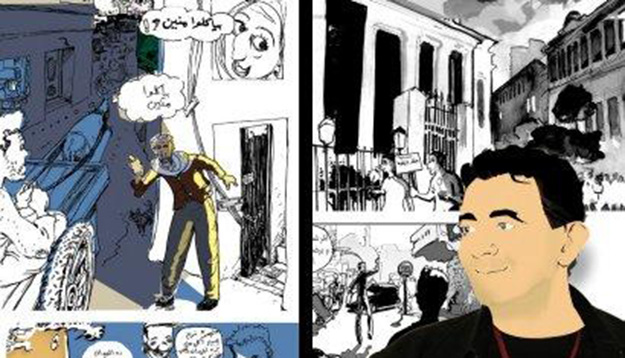
Graphic (Novel) Repression in Egypt
This article first appeared in Foreign Policy.
In April, Egyptian graphic novelist Magdy el-Shafee went to Abdel Moneim Riad Square in downtown Cairo to protest a draft law put forth by the Muslim Brotherhood’s political arm, the Freedom and Justice Party (FJP). It would only be two months until the Brotherhood president, Mohamed Morsi, would be ousted by the Egyptian military.

The Continued Descent of Egyptian Media
Think of American mainstream media in the aftermath of 9/11 and you might get a general idea of the state of the Egyptian equivalent since the June 30 uprising against Muslim Brotherhood rule—allowing, that is, for less sophistication and a considerably greater measure of crudity. The fluttering flags at the top of television screens, along with variations on the “war on terror” banner, were copied almost identically, if less tastefully, by both state-owned and private Egyptian television stations from CNN, FOX, and the rest.
Collection Spotlight: Contentious Politics in the Middle East

A Nonviolent Muslim Brotherhood?
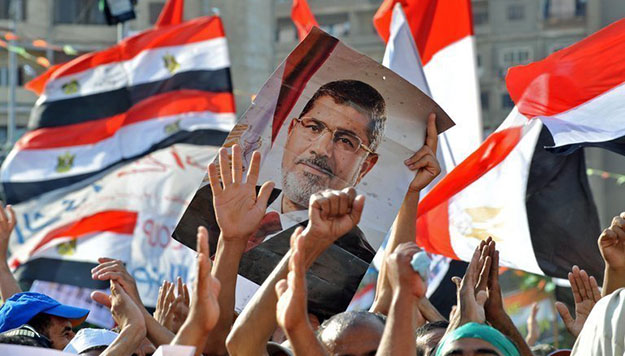
Three months after the ousting of President Mohamed Morsi, Egypt’s Muslim Brotherhood remains in shock. In two and a half years, the group went full circle, from an outlawed organization to one that won a plurality in parliamentary elections and saw its candidate win the presidential election, to that president’s ouster a year later and the subsequent court verdict ordering the group’s shutdown. During this short journey, the Brotherhood shifted alliances.
A Conversation on Yemen
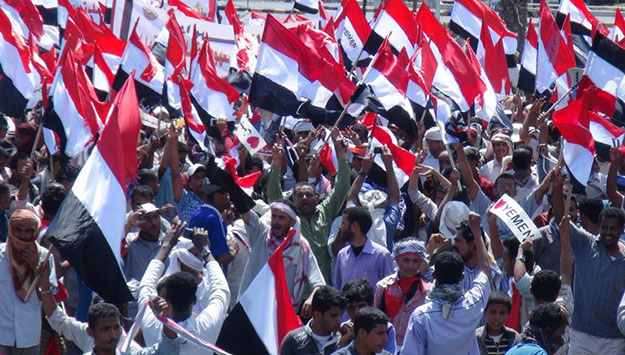
Last week, MEI scholars Allen Keiswetter, a retired Foreign Service officer, David Newton, former ambassador to Yemen, and Roby Barrett, author of Yemen: A Different Political Paradigm in Context (2011), gathered for an informal discussion about Yemen’s National Dialogue Conference (NDC), which began in March.
Saudi Arabia and the Syrian Brotherhood
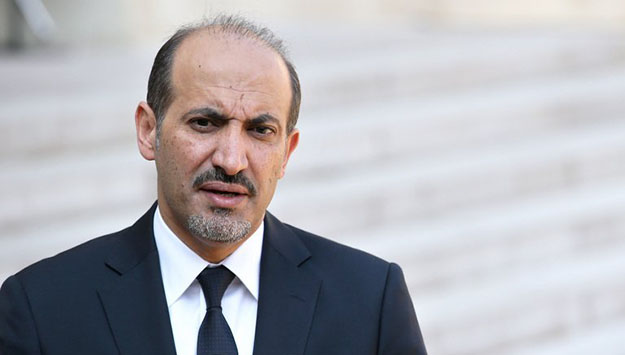
The openly difficult relationship between Saudi Arabia and Muslim Brotherhood chapters across the region has become a salient feature of Middle East politics since the advent of the “Arab Spring.” This mutual mistrust has increased in the wake of the Kingdom’s recent support for the military takeover in Cairo and the generals’ subsequent repression of the Brotherhood there. But how is the Islamist organization affected by this dynamic in Syria, where the Muslim Brothers and the Saudis both battle against Bashar al-Assad?
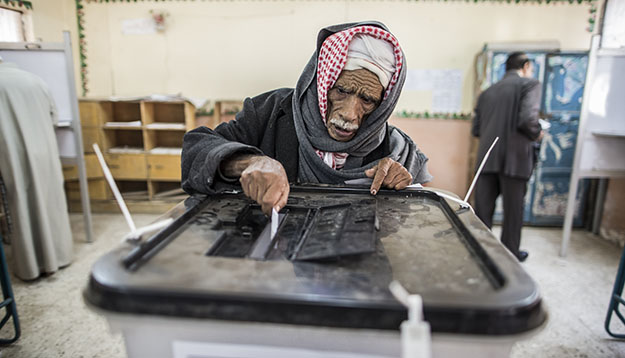
Rural Egypt and Electoral “Counting”
In early 2012, Hagg Hassan had a complaint. A resident of the village of Ab’adeyet Wally Mizar in Fayoum, 65 miles southwest of Cairo, Hagg Hassan had been receiving a monthly pension of 300 Egyptian pounds. But one day, he was given only 250. Hagg Hassan was livid. The budget cut would also apply to his wife and widowed daughter—a loss of 150 pounds for the household. Hagg Hassan lit a cigarette and asked his daughter to write a petition.
The Saudis Aren't Going Anywhere
This article first appeared on Lobe Log.
Whenever a Saudi Arabian king or senior prince publicly criticizes U.S. policy, they inevitably touch off speculation about how the Saudis may be rethinking their security alliance with the United States.
Deeper Militarism in Egypt
There can be no doubt that revolutionary activities gripped Egypt after the January 2011 uprising began. Yet, just as revolutionary waves pushed for greater freedoms and social justice, counterrevolutionary forces responded to maintain some semblance of a Mubarakist-regime without Mubarak. The prospects for increased political freedom look dim at the moment.
Panel IV: Engaging the International Community
Panel IV: Engaging the International CommunityModerated by Michael Hanna, The Century Foundation Jason Brownlee, University of Texas at AustinAmy Hawthorne, Atlantic CouncilMohamed Elmenshawy, Middle East InstituteAbdel Monem Said, al Masry al YoumClosing remarks by Kate Seelye, The Middle East Institute.
Panel IV: Engaging the International Community
Panel IV: Engaging the International CommunityModerated by Michael Hanna, The Century Foundation Jason Brownlee, University of Texas at AustinAmy Hawthorne, Atlantic CouncilMohamed Elmenshawy, Middle East InstituteAbdel Monem Said, al Masry al YoumClosing remarks by Kate Seelye, The Middle East Institute.
Panel IV: Engaging the International Community
Panel IV: Engaging the International CommunityModerated by Michael Hanna, The Century Foundation Jason Brownlee, University of Texas at AustinAmy Hawthorne, Atlantic CouncilMohamed Elmenshawy, Middle East InstituteAbdel Monem Said, al Masry al YoumClosing remarks by Kate Seelye, The Middle East Institute.
Panel IV: Engaging the International Community
Panel IV: Engaging the International CommunityModerated by Michael Hanna, The Century Foundation Jason Brownlee, University of Texas at AustinAmy Hawthorne, Atlantic CouncilMohamed Elmenshawy, Middle East InstituteAbdel Monem Said, al Masry al YoumClosing remarks by Kate Seelye, The Middle East Institute.
Panel III: Meeting the Needs of the People
Moderator: Robin Wright, USIP-Wilson Center Distinguished ScholarHossam Bahgat, Egyptian Initiative for Personal RightsMirette Mabrouk, Atlantic Council Jawad Nabulsi, al Nebny Foundation Diane Singerman, American University