Center for Turkish Studies Second Annual Conference on Turkey
The 2011 Second Annual Conference on Turkey, entitled “Change Within and Beyond and Borders: Turkey’s Domestic and Foreign Policy Agenda,” was organized by the Center for Turkish Studies at the Middle East Institute on June 23rd, 2011 at the University Club. As the Conference coincided with recent important developments in Turkey, especially the general elections, about 300 participants from think tanks, universities, U.S. and foreign government officials as well as private sectors attended the Conference.
Troubled Triangle: The US, Turkey, and Israel in the New Middle East
The trilateral relationship between Turkey, Israel and the United States has deteriorated in recent years as Israel's and Turkey's foreign policy goals in the Middle East continue to diverge. Despite repeated attempts, the United States has failed to reconcile these two important regional allies since the divisive Mavi Marmara incident in May 2010. MEI and The Stimson Center held a discussion of this critical yet troubled trilateral relationship in a time of unprecedented change in the Middle East featuring Prof. William B. Quandt, Edward R.
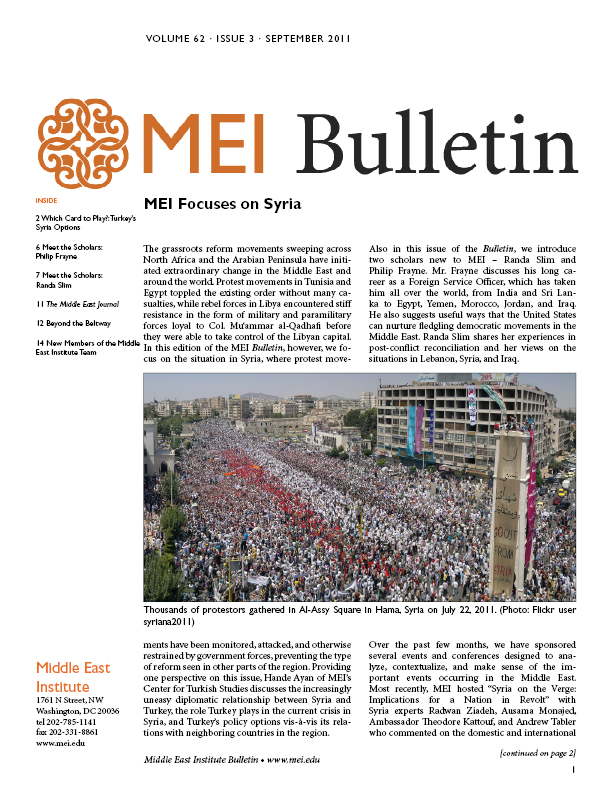
Amidst ongoing violence against protestors in Syria, Hande Ayan of the Center for Turkish Studies discusses the uneasy diplomatic relationship between Turkey and Syria and Turkey’s role in the political situation there. The September 2011 Bulletin also introduces MEI scholars Philip Frayne, who speaks on his Foreign Service career and offers his insights on how the US can support democratic transitions in the Middle East, and Randa Slim, who is interviewed on her experience in post-conflict reconciliation.
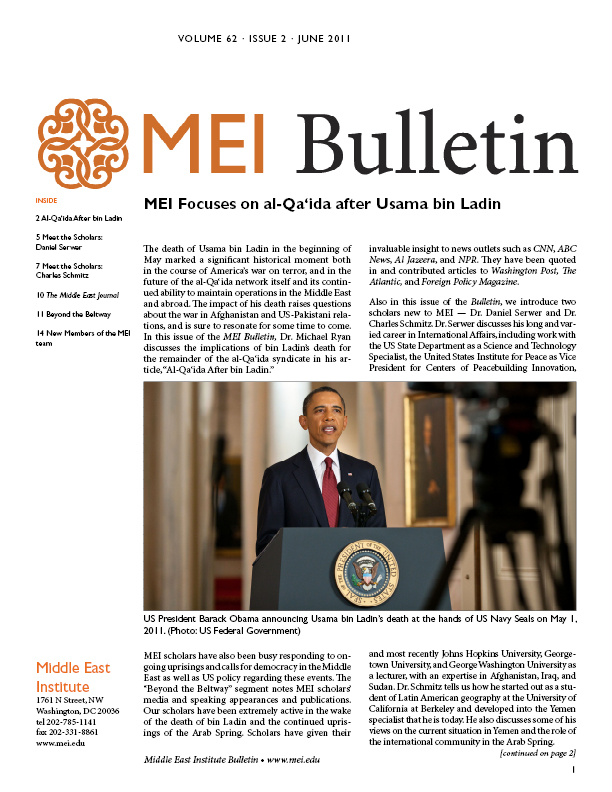
In the June 2011 Bulletin, Dr. Michael Ryan discusses the implications of bin Ladin’s death for the remainder of the al-Qa’ida network. It also introduces new MEI scholars Dr. Daniel Serwer, who is interviewed on his career in technology and peacebuilding, and Dr. Charles Schmitz, who speaks about his work on Yemen.
When President Obama met with Turkish Prime Minister Recep Tayyip Erdogan on Tuesday, the two discussed cooperation on Syria, counter-terrorism and supporting the Arab spring. But a central theme of the talks, and what most concerns the U.S. at the moment, is a sharply deteriorating Turkish relationship with Israel that the U.S. hopes to reverse. Conversely, this deterioration was the source of much acclaim when Erdogan visited Arab spring countries last week.
The release of last week’s UN Palmer Report, assessing Israel’s attack on the Mavi Marmara and five other ships carrying aid to Gaza, sparked outrage in Turkey. Many criticized the report’s alleged bias, and claimed it failed to provide a credible legal analysis of the Mavi Marmara incident in which nine Turkish citizens were shot to death by Israeli commandos, some at close range and from behind.
F. Stephen Larrabee, Distinguished Chair in European Security at the RAND Corporation, and Gonul Tol, Executive Director of the Middle East Institute’s Center for Turkish Studies, highlight the importance of drafting a new civilian constitution to solve Turkey’s Kurdish issue.
After the Arab Spring: Toward Political & Economic Inclusion in the Arab World
The Middle East Institute and the UNDP are proud to host a discussion with UNDP Administrator Helen Clark, Under Secretary for Economic, Energy and Agricultural Affairs Robert D. Hormats, and Middle East Institute Scholar Amb. Edward Walker about how best to address political, economic and human development needs in the Arab world today.