After Mubarak:What do the Egyptian People Really Want?
The Middle East Institute is proud to host Steven Kull and Shibley Telhami for an examination of Egyptian views and attitudes towards governance and their future. As Egyptian demonstrators celebrate the resignation of President Hosni Mubarak, many wonder what kind of system the Egyptian people really want. How do they view the Muslim Brotherhood? If Egypt were to become more democratic what are we likely to see in terms of its relation with the US, Israel and other countries in the region?
The Middle East Institute is proud to host Amb. Alan Goulty and Amb. Edward Walker for an examination of the unrest roiling Tunisia and Egypt and its implications for the region at large. Between them, Goulty and Walker have more than 60 years of experience serving in the Arab world. They will draw upon their unique experience and understanding of the region to examine the evolving crises in Tunisia and Egypt, the impact of the street protests on regional governments and the role that Western governments can play during this period of transition.
Kān Yāmā Kān: Curriculum Development in the GCC – Adopting (Adapting) Models of Higher Education
Once upon a time in the land where the light of creation first shone, the fertile grounds around Baghdad nurtured the House of Wisdom.[1] Even as Europeans were looking for the light at the end of the Dark Ages, Caliph Haroon al-Rasheed and his son Caliph al-Mamoon had made Baghdad a center of learning. In Baghdad, scholars put words on “real” paper. They preserved Aristotle, Plato, Hippocrates, Euclid, Ptolemy, Pythagoras, and Brahmagupta and translated Greek, Persian, and Indian manuscripts.
Women’s education in the Arab world has increased substantially in the last several decades, both in absolute terms and relative to men. However, when looking at the Arab world, understanding that there are vast differences culturally, politically, and socially among the countries is essential. This essay looks at the Gulf Cooperation Council (GCC) countries, where women share a similar cultural and socio-economic context.
The Middle East Institute is proud to host Ambassador Robert E. Hunter, Senior Adviser at the RAND Corporation, to present a new study that lays out the criteria and parameters for a new security structure for the Persian Gulf region. His recent study, Building Security in the Persian Gulf, makes recommendations for a new security structure for the region in order to promote long-term stability while also reducing
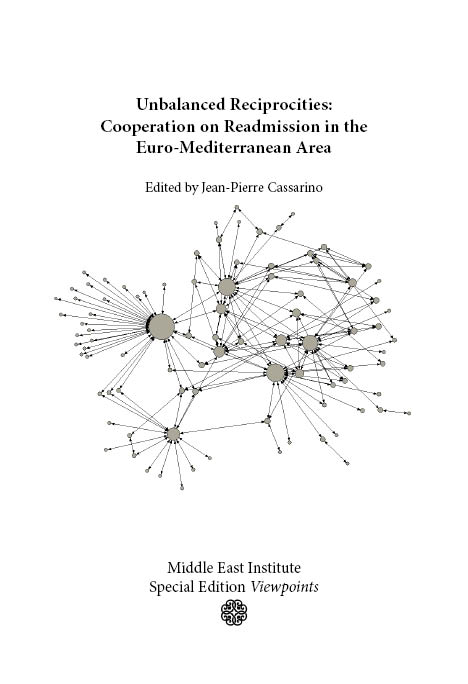
Unbalanced Reciprocities: Cooperation on Readmission in the Euro-Mediterranean Area
Readmission Agreements are a mechanism for countering illegal immigration. Such agreements involve reciprocal undertakings to return illegal residents (or irregular migrants) to their country of origin or transit. This special edition of MEI Viewpoints brings together extensive research on agreements between European and North African states. The following chapters explore what can be argued as the unbalanced costs and benefits for all parties.
Higher Education and the Middle East: Serving the Knowledge-based Economy
This is the first of three volumes examining the internationalization of higher education and the Middle East. The 12 essays included in this volume explore some of the changes that are taking place and the challenges that lie ahead as Middle Eastern countries seek to build sustainable higher education systems and strengthen their economies. Within the dynamic global higher education landscape, is the Middle East a stagnant backwater or a center of creative initiative? What are, and should be the roles of foreign partners and providers?
The Middle East Institute is proud to host Justin Dargin, research fellow at the Dubai Initiative, for a discussion of greenhouse gas (GHG) emissions in the Gulf and the pursuit of an effective carbon trading plan. Dargin will also examine the effect which this hot-button issue has upon the region's geopolitical relations, energy efficiency, natural gas utilization, renewable energy, and conservation of natural resources.
The Republic of Yemen occupies the southwest corner of the Arabian Peninsula. Unlike its oil-rich neighbors, Yemen is the poorest country in the Arab world. Like other countries football (soccer) is Yemen’s most popular sport. Football has been played in parts of Yemen since before the turn of the 20th century, and since the 1970s, the game’s popularity has increased significantly.
Several months ago on a Tuesday afternoon, a local girls football team was practicing on a dirt field in Sidi Moumen, a notorious 350,000-person shantytown on the outskirts of Casablanca, Morocco. A crowd of boys had gathered along the fence. One of the boys began making comments. “Look at her touch on the ball,” he mumbled to his friend, “where did she learn to play football?” “My five-year old brother has better control,” shot back the other, slapping his friend’s hand and laughing.
The Middle East Institute is proud to host Sean Foley, author of The Arab States: Beyond Oil and Islam (Lynne Rienner, 2010), for a discussion about the politics of the Gulf states and their role in the global economy. In the book, Foley presents a fresh picture of these states as cosmopolitan and tolerant societies that face many of the same socio-economic problems that other states do – including those that lack oil.
Transnational Networks and Local Challenges: Iraqis in Cairo
Originally posted March 2010
It is estimated that over four million Iraqi refugees have fled to neighboring countries in the region since the 2003 war began. While migration continued after the war, the peak of this influx was witnessed particularly in and after 2006 due to the acceleration of violence in central and southern Iraq. More particularly, the majority of these refugees fled due to direct threats to their lives and their immediate families.