The Russian government, like its counterparts in the West, the Middle East, and elsewhere, was caught off guard by the outburst of Arab uprisings beginning in January 2011 that swept away long-ruling authoritarian regimes in Tunisia, Egypt, Libya, and (it appears) Yemen, and have threatened to topple those in Bahrain and Syria. The response of the Russian government to these events has, like that of Western governments, often been confused and inconsistent. Just as Western governments have done, Moscow has sought to protect its interests in the region.
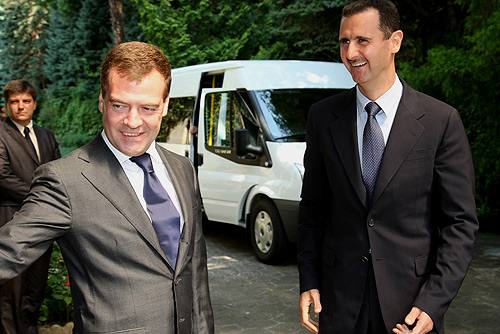
Russia's relations with Syria – even under the Assad regime – have been more troubled than current press accounts of Moscow-Damascus ties indicate. But despite the internal and external opposition to the Assad regime that has risen up over the past year, the Russian government has defended it staunchly via its Security Council veto and other means. In his talk, Mark Katz will discuss why Moscow supports the Assad regime so strongly as well as why it is willing to incur the costs of doing so.
Introduction to Revolution and Political Transformation in the Middle East: Government Action and Response
Originally posted September 2011
On August 21, 2011, rebel forces in Libya rolled into the capital Tripoli, seemingly finishing off months of armed combat and foreign intervention and bringing down yet another Arab head of state. At the same time, sporadic but violent repression of protests in Syria continues, while other states remain calm or have seen their protest movements fizzle. We open this second volume of our series, Revolution and Political Transformation¸ at a time of uncertainty and transition for the region.
In his article for NPR.com, Middle East Institute scholar Greg Myre examines the new dynamics of war reporting. As the nature of warfare shifts from traditional army-to-army combat to more assymetrical government vs. non-state opposition warfare, journalists are having to embed – alone – with rebels groups in order to get the story. In the wake of multiple journalist deaths in Syria, Myre looks at the increasing risk faced by war correspondents in covering the front lines of conflict.
Reflections on the Role of American Universities in the Middle East
American higher education has been present in the region since 1866, when the American University of Beirut set the precedent for successful localization by planting roots and adapting to local society. Today, Arab governments themselves often direct and fund the cross-cultural educational export process, with far-reaching economic and social goals. For example, Qatar's U.S. branch campuses are an integral part of its broad education reform strategy designed to transform the country into a knowledge producing society. The UAE, in contrast, has adopted a business-model view of U.S.
Following last week's Russian-Chinese veto of an Arab-backed U.N. resolution, the international community is struggling to find ways to stem the ongoing violence and bloodshed. European states are considering a fresh round of sanctions, while Turkey says it's preparing a new initiative to address the crisis. Nerguizian, Slim and Yacoubian will discuss the international community's options, as well as examine the status of the Syrian opposition and the role of regional players.
Reflections on Palestinian Unity, the Statehood Bid, and Prospects for Peace
In the wake of the February 6 announcement that Palestinian President Mahmoud Abbas will head an interim unity government there is renewed hope for political cooperation between rival parties Fatah and Hamas. The formation of the unity government however threatens U.S. aid to Palestine, as the United States has said that it refuses to send money to Hamas, which it considers a terrorist organization. The PLO's continued pursuit of statehood recognition in the UN Security Council has also isolated it from the United States even as it earned popular and international support.
Kurdish Issues: Turkey and the Kurdistan Regional Government in a Changing Middle East
The Arab Spring has driven a wedge between Turkey and its once-close allies, Iran and Syria. Ankara's ties with Baghdad are strained, as well. Panelists will address the impact of external upheaval on Turkey's internal Kurdish issue and examine the situation in the context of Turkey's changing relationship with the Kurdistan Regional Government (KRG) of Iraq. Given the realities of the new regional dynamics, what are the prospects for Turkey's "Kurdish Opening?" What impact will increased bilateral Turkey-KRG cooperation have on the security situation?