
Cultural Body Maps, Schemata, and the Art & Essay Contest
Originally posted June 2011
If there is a Horizontal Line that runs from the MAP off your body straight through the Land shooting up right through my heart Will this Horizontal Line when asked know how to find Where you end where I begin
— Tori Amos[1]
Turkish Policy towards Iran: What is at Stake?
In the wake of the recent Nuclear Security Summit in Washington DC, Turkish-Iranian relations once again came under scrutiny. As the US and the EU have intensified their efforts to impose sanctions on Iran through the UN Security Council, Turkey’s role in this issue has come into question. Notwithstanding Turkish temporary membership in the Security Council, the Turkish position will be critical for any effective implementation of sanctions.
Turkey and the Arab Spring
*This article originally appeared in the Project Syndicate online on May 23, 2011.
As the Arab Spring enters its fourth month, it faces challenges but also presents opportunities. Despite setbacks in Libya, Yemen, and Syria, the democratic wave has already begun to change the Middle East’s political landscape.
The Upcoming Turkish Elections: Implications for Domestic and Foreign Policy
The Middle East Institute's Center for Turkish Studies is proud to host Mr.Taha Ozhan, Director General of the Foundation for Political, Economic and Social Research (SETA Ankara), for a discussion on Turkey's upcoming elections on June 12.
This Burning Land: Lessons from the Front Lines of the Transformed Israeli-Palestinian Conflict
The Middle East Institute is proud to host Greg Myre and Jennifer Griffin for a discussion about the ongoing challenges in the Israeli-Palestinian conflict based on their knowledge and experiences recounted in their new book, This Burning Land: Lessons from the Front Lines of the Transformed Israeli-Palestinian Conflict. Myre and Griffin, journalists who are husband and wife, traveled to Jerusalem in 1999 in hopes of finally seeing Middle East peace. Instead, the pair watched as violence in the area escalated and the peace process disintegrated.
A Two State Peace: Defining the Border
The Obama administration's efforts to win a settlement freeze as a confidence-building measure have failed, and the U.S.has not presented a new vision for resuming the moribund peace process. Nevertheless, many analysts now recommend shifting the diplomatic focus to negotiations to define the border between Israel and the future state of Palestine. Resolving the border would address the issues of settlements and Jerusalem as well as potential land swaps between the two states.
Turkey as an Alternative Democratization Model for the Middle East
The popular uprisings against authoritarian regimes in Tunisia, Yemen, Jordan and Egypt herald the beginning of a new political era in the Middle East. At the center of this new political order is a generation of young Arabs, educated, highly marginalized, and numerous. The members of the so-called Arab “youth bulge” are demanding neither the unification of the Arab world as espoused by the pan-Arabists of the 1960s, nor an Islamic state of the 1980s, but rather a dignified life, social justice, and freedom.
Why Turkey Is Not Turning Islamist
This Commentary first appeared as an op-ed in Foreign Policy's Middle East Channel on December 21, 2010
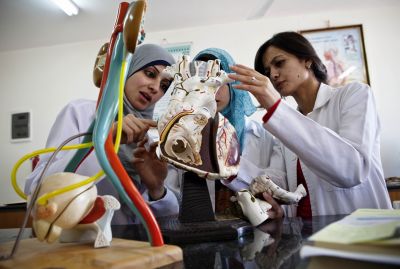
Travelogue of a Nigerian Codesria Laureate in Lebanon (January–July 2006, July–November 2008)
On December 18th 2004, I discovered the Lebanese Emigration Research Centre (LERC), Notre Dame University, Zouk over the internet while searching for a post-doctoral research fellowship program on Lebanese studies in either Australia or New Zealand. I contacted the Director, Guita Hourani, who was instrumental in my winning the Codesria post-doctoral fellowship award. Elated, I departed for Beirut, Lebanon on February 21, 2006.
Creating a Legacy of Understanding: The Istanbul Center of Atlanta's Art and Essay Contest
Originally posted December, 2010
