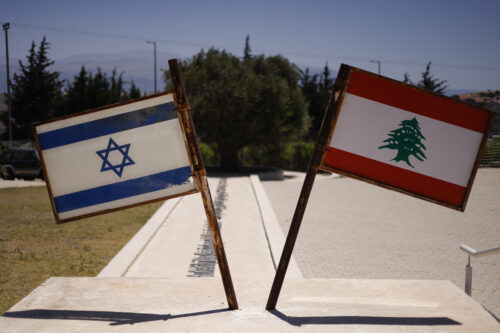
This article is part of a report outlining an actionable US roadmap to win in Lebanon, comprising eight chapters of specific policy interventions across the security, economic, and political dimensions needed to secure a sovereign Lebanon, lock in US gains against Iran, and permanently end the Israel-Lebanon conflict.
Key Takeaways
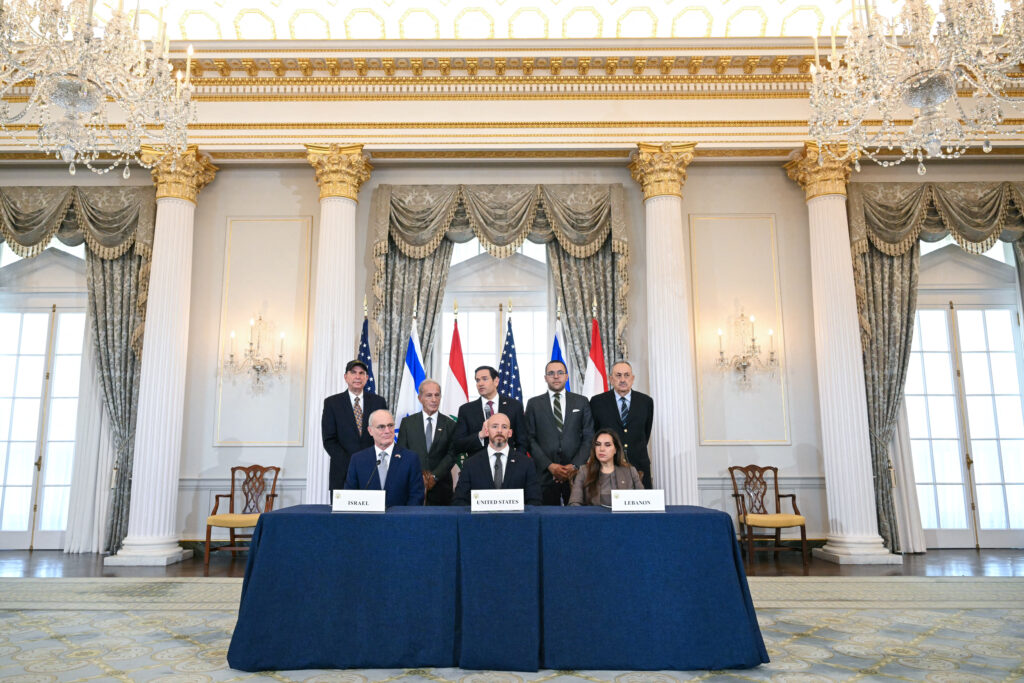
- The June 26 Trilateral Framework signed by Lebanon, Israel, and the United States is a remarkable breakthrough toward peace, but much work remains ahead.
- If the restoration of Lebanese state sovereignty by disarming Hizballah continues, obstacles to peace between Israel and Lebanon will recede further.
- Israel seeks security, not territory; Lebanon seeks sovereignty and peace. Their common problem is Iran and its proxy, Hizballah. Without sovereignty, Lebanon cannot attain peace; without peace, Lebanon is unlikely to sustain restored sovereignty or revive its economy. And only a peace treaty — not a cease-fire or armistice — offers durable protection against renewed violence.
- Iran and Hizballah will use every opportunity, including negotiations with the US over the Strait of Hormuz and Iran’s nuclear program, as well as violence, to torpedo the Trilateral Framework. They want to dominate Lebanon, not protect it, and to keep an active front against Israel. Without external enemies, the revolutionary regime loses its organizing principle at home.
- If Iran’s reversal of fortunes since 2023 continues through the US-Iran negotiations, peace between Lebanon and Israel can be achieved. But it will take more than just negotiations: sustained pressure on Hizballah and Iran, internal reforms in Lebanon, Arab state help, and more proactive American support — not just money, but advice — for the Lebanese army.
Introduction
Although Lebanon and Israel have been in a state of war since 1948, the Israel Defense Forces (IDF) and Lebanese Armed Forces (LAF) rarely have been in direct conflict as protagonists. The wars Israel has fought in Lebanon have been regional conflicts conducted between Israel and Palestinians, Syrians, Iranians, and their non-state Lebanese allies. Lebanon became the landscape for and victim of these clashes because of the rapacity of its neighbors, geography, sectarian demographics, and absence of sovereign control over its territory. This point is not to minimize the horrific losses and damage, including to the integrity of the Lebanese state; but the two governments have not, in fact, been fighting each other.
Two broad conclusions can be drawn from this history: a) Lebanon cannot attain peace until it reclaims state sovereignty, and b) achieving that peace requires neutralizing Iran’s ability to manufacture crises there. Conversely, if the Lebanese government restores sovereignty and Iran can no longer use Lebanon for its own purposes, it is hard to argue against an Israeli-Lebanese peace. The heavy weight of emotion, human and material losses, and the absence of imagination, creativity, desire, and risk-taking are real factors, but they are not exactly serious arguments. Yet, if not overcome, that backward-looking, limited view will perpetuate a status quo that guarantees continuation of the same cycles of violence that have existed for more than 50 years.
To the dismay of Lebanon’s sovereign president, Joseph Aoun, the country suddenly became a “bargaining chip” in the June 2026 US-Iran memorandum of understanding (MoU). However, that problem was not only swiftly rectified by the June 26 Trilateral Framework; strong strides were made to advance toward a shared Lebanese and Israeli ambition to end their conflict, ensure their mutual sovereignty and security, and establish peaceful neighborly relations.
This rare act of statesmanship in the Middle East should be implemented quickly to maintain momentum. The opportunities and risks have real geostrategic significance.
Here are some key considerations:
First Things First: Withdrawal Linked to Disarmament
Washington seems to have had a momentary case of amnesia about Lebanon when signing the MoU with Iran. The document contains scattered and ambiguous references to the country, including calls for a cease-fire between Israel and Hizballah and language about territorial integrity that Tehran tried to twist into a requirement for a unilateral IDF withdrawal. Iran’s approach was meant to conceal two realities. First, over 100 Islamic Revolutionary Guard Corps (IRGC) fighters are also in Lebanon, training their proxy, Hizballah, which serves Tehran, not Beirut. Second, just two weeks earlier, America had brokered a well-conceived cease-fire between two states, Lebanon and Israel, that conditioned a phased withdrawal of the IDF on the phased disarming of Hizballah, the shared objective of both. Statesmen soon came to the rescue to jog memories and clarify facts. Not only did the June 26 framework codify a planned, agreed, and phased approach to IDF withdrawal and LAF deployment in pilot areas as Hizballah is disarmed, it opened a horizon to resolve the issues hindering peaceful relations. Even as working groups assemble to tackle those longer-term issues, the immediate starting point must be successful transitions from IDF to LAF control in the pilot areas and beyond.
This opportunity must not be eclipsed in pursuit of a larger deal with Iran. Tehran is trying to use America’s eagerness for a resolution of the standoff in the Persian Gulf as leverage to save its struggling proxy and resume the domination of Lebanon it had until 2023. The stakes are fundamental if we want to see a true shift away from Iran’s former power to make decisions of war and peace, life or death over Lebanese and Israelis alike. Tehran’s immediate instinct to reassert illegitimate influence in Lebanon should be a warning sign of its true intentions. Anyone familiar with Iran’s treatment of Lebanon will recognize the MoU’s language as classic Iranian weasel words. When Iran’s government talks of a “cease-fire” and “sovereignty and territorial integrity,” we know from experience they seek the opposite. They are deeply threatened by the Trilateral Framework. The solution to Lebanon’s predicament is to get Iran out, not bring it back in. And one lesson of the past year is that the LAF needs much more help than anticipated to achieve a monopoly of arms. A deeper non-combat, advisory role — not just monitoring — by American military officers can help the Lebanese army with intelligence and operational advice as well as stiffen its resolve for the effort ahead.1
Making the Argument: It Is About Restoring Sovereignty
Attributes of sovereignty include not just regaining control of a nation’s territory but also conducting relations with neighbors. Lebanon’s two neighbors, Israel and Syria, undertook long-term occupations because of their perceptions of insecurity arising from a stateless Lebanon. Both eventually withdrew, the former after 22 years, the latter after 30; although Syria and its Iranian ally retained in place Hizballah — a proxy able to shape Lebanon’s politics and attack Israel without exposing themselves to the inevitable reaction. With the Lebanese finally able to exercise sovereignty, they will face a basic question about their future relations with their neighbors. The urgent task is Israel because of the state of war that exists and the ever-present risk of reignited conflict. Without a durable new framework for relations, Lebanon will always be at risk of getting sucked into the whirlwind of regional conflict — as we saw again in June 2026. But relations like those Egypt and Jordan established with Israel put strong guardrails in place against a resumption of conflict. Despite upheaval in the region and even inside Egypt, those agreements stood the test of time; however heated public opinion became, leaders and societies understood the value of peace and the costs of war, having lived through both.
Do Not Get Caught up in Labels
The taboo in Lebanon against talking about something more positive than the status quo relationship with Israel has eroded in the last 18 months, but many Lebanese can still get hung up on labels. The May 17, 1983, US-brokered agreement between Israel and Lebanon was not called a peace treaty, even though that is what it was, and was discredited not long after it was signed. The term “Abraham Accords,” rightly much embraced in Washington, grates on Lebanese ears. It is hard to identify an Emirati or Bahraini who was killed in combat with Israel; as visionary and transformational as the accords were, that model does not quite apply to this case, given the losses Lebanese and Israelis have suffered. Some Lebanese think they can just freshen up the 1949 Armistice Agreement mediated by the United Nations, but that approach is obsolete. Lebanese and Israeli negotiators have moved past an armistice to affirm an ambition to end their conflict and establish peaceful, neighborly relations based on mutual sovereignty and security. Returning to the status quo ante of the armistice — which failed to prevent the cycles of violence that have consumed Lebanon and Israel since the 1960s — seems quixotic. What to call it can be the last step; it should not be a distracting bone of contention at the start.
The Issues Are Primarily Psychological and Emotional, Not Substantive
The two populations are deeply traumatized by their history and experience of war, and strategies must be devised to overcome the resulting barriers to peace. This outcome will be impossible so long as Hizballah can use Lebanon to threaten Israel, and Israel identifies a need to act in self-defense in proactive and expansive ways. But with the June 26 framework agreed, negotiators will begin to explore from behind the scenes what peaceful relations will look like. The issues confronting Israeli and Lebanese leaders are in essence mutual security for mutual recognition. Contrast that equation with what faces Israeli and Syrian and Israeli and Palestinian leaders. On the Syria front, the territorial dispute stymied the Clinton administration’s eight-year effort to achieve an Israeli-Syrian peace. As for Palestinians and Israel, the issues are not just territorial but existential. With the case of Lebanon, my own interaction with Israeli leaders over 40 years has convinced me they have no territorial ambitions in Lebanon; their issue is security. Leftover border anomalies from colonial maps are trivial and can be easily managed with good will.2 There are issues about claims for losses on both sides as well as regarding transfers of remains and prisoners. Beyond that, it will be up to the states of Lebanon and Israel to decide how far to go in normalization of contact, transportation, commerce, and diplomacy. Mutual recognition will be an Israeli requirement, but a wide spectrum exists for its manifestation, which may in the end reflect the diversity of Lebanon itself. Some communities may be prepared for higher levels of unofficial interaction with Israelis than others. Why should a lowest common denominator rule?
The Economic Case
Economic considerations may not change minds in the Middle East when it comes to achieving peace, but they can help stabilize an existing peace. Because the bonanza days of never-ending US aid in exchange for Middle East peace are behind us, the Trump administration is more likely to emphasize private-sector opportunities. If Lebanon and Israel can go no further than a cease-fire or cessation of hostilities, the remaining uncertainty about the future will dampen private-sector enthusiasm to help rebuild Lebanon. However, an enduring agreement can awaken the private sector to the opportunities there, chiefly through the diaspora. A special economic or free trade zone for southern Lebanon might be appealing as a way to overcome concerns about Lebanese bureaucracy and corruption but should be carefully presented so as to avoid accusations of foreign occupation of the south under another guise.
Reform the Lebanese State
Polling data shows strong support among non-Shi’a communities in Lebanon for disarming Hizballah. Opposition among the Shi’a appears to be not so much a reflection of support for Hizballah but rather distrust of a state viewed as distant and corrupt. Reaching a condition of perfection overnight is unrealistic, but greater effort to address the dysfunctional and corrupt ways of Lebanese governance will be an essential component to gaining support for bold decisions on the future with Israel. With parliamentary elections postponed for two years until mid-2028, deputies no longer have the excuse of an imminent electoral contest to avoid tough but necessary decisions. Alongside economic reform, Lebanese should consider how to structure a new social contract with the Shi’a that reassures them of respect for their democratic voice in the state’s power-sharing formula that does not rely on arms. That means revenge for Hizballah’s past sins should not be inflicted on a whole community.
Enlist Arab State Support
Events in the region are moving rapidly and not always in a straight line. The bandwidth of decision-makers is being strained. One lesson from decades of American peace-making in the Middle East is the valuable commodity of Arab state support. Without it, we saw how Camp David agreements faced severe headwinds; with it, we saw how a Madrid process can help sustain efforts that have inherent risks. America should be encouraging the Gulf states, Egypt, and Jordan to do more now to rally around President Aoun and his colleagues. They all have friends and followers in Lebanon, and well-timed leadership visits to Beirut now can help demonstrate that Aoun’s path is the right one.
Educate American Decision-Makers
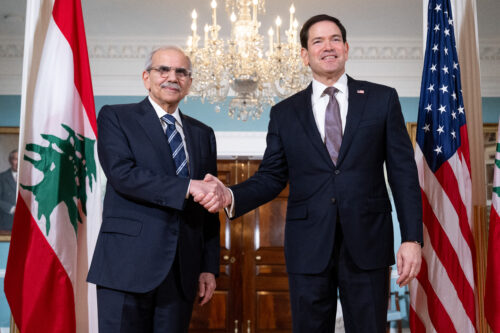
After initial confusion about the implications for Lebanon of the US-Iran MoU, Secretary of State Marco Rubio’s statements have shown an accurate perception of the realities, opportunities, and risks at this moment for Lebanon and its fledgling sovereignty. President Donald Trump has an affinity for Lebanon and the Lebanese, but no American president should be expected to understand the country’s intricacies. Others in the US Congress and the executive branch need to be sure that negotiators working with Iran are well aware of the traps and Iran’s real intentions in Lebanon, which are not benign.
Brace for the Worst
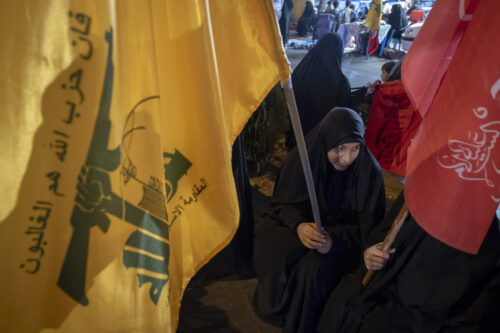
The reaction of Hizballah’s leaders to the Trilateral Framework has revealed their true colors. Naim Qassem’s declaration that it was “null and void” suggests this person, never elected to any role, thinks he is above the president of the republic. He and Member of Parliament Hassan Fadlallah have threatened to use arms and are inciting civil strife. This was to be expected but must be challenged. Parliament will have its day to review and approve whatever comes of the negotiations with Israel; that is the valid arena to express differences and take positions. Rhetoric that resorts instantly to threats of arms just underscores the problem Hizballah poses to the state.
Iran has shown yet again it has a hand on the spigot of violence in southern Lebanon and knows exactly how to use it to prompt an Israeli response and generate tension between America and Israel. Iran will do so whenever it wants to gain leverage, divert attention, or avoid pressure in the negotiations with the US. More of these episodes will come, despite the creation of a deconfliction mechanism with the Qataris. The American side should be prepared for it, not let the Iranians play that game, and avoid any appearance that Lebanon is trade bait with Tehran.
It Is All About Power
While the Lebanon-Israel and US-Iran negotiating tracks should be kept separate, the objective linkage of power trends in the Middle East to events in Lebanon is undeniable. Widening the aperture, we can see a significant change in the regional power balance against Iran since 2023. It can no longer use its tactics of violence and intimidation to set the agenda and timetable for the region every day. It no longer holds sway as it did before in Beirut, Damascus, and Gaza. How US-Iran negotiations unfold will determine whether or not the momentum continues in a direction unfavorable to Iran. Of course, Tehran will do all it can to reverse the trend, delay agreements, and wear down American patience. Iran’s revolutionary, clerical leaders — both of them — learned to outwait all eight American presidents they had to contend with.
President Trump has done more than any other American president to degrade Iran’s ability to project power. Secretary Rubio has shown a sophisticated understanding of the realities in Lebanon. However, continued success will require several things: persistence, retention of a credible threat of military action, adherence to results and performance-linked use of economic inducements or pressure, attention to detail, and keen awareness of the interconnectivity of the various theaters in the Middle East, which Iran will try to exploit. With or without a nuclear deal, it is essential that America continue to manage the threats posed by Iran and instill confidence in regional partners who have shown readiness to take risks to contain Tehran. However, they seek reassurance Washington will not leave the job half done, abandoning them to deal with the consequences.
Lebanon is a primary test case for American, Lebanese, and Israeli leaders to show they can stay the course and secure the benefits of freedom from Iranian domination. With wisdom, they can open the door to lasting peace. If not, we will have lost a rare opportunity for all concerned.
Endnotes
1. For more on military support for the LAF, see the paper in this report on “Setting the Lebanese Armed Forces up for Success.”
2. For more on how to realistically resolve the border issue, see the paper in this report on “Lebanon-Israel Border Disputes: A Guide for American Mediation.”
3. For more on supporting Lebanon’s economic reform, see the paper in this report on “Owning the Recovery: Supporting Lebanese-Led Reconstruction Without Repeating the Past.”
Ambassador David Hale is a Distinguished Diplomatic Fellow at the Middle East Institute. He was the Under Secretary of State for Political Affairs from August 2018 to May 2021 and served as Ambassador to Pakistan (2015-18), Ambassador to Lebanon (2013-15), Special Envoy for Middle East Peace (2011-13), Deputy Special Envoy (2009-11), Deputy Assistant Secretary of State covering Egypt, Israel, Jordan, Syria, Lebanon, and the Palestinians (2008-09), Ambassador to Jordan (2005-08), and Director for Israeli-Palestinian Affairs (2001-03). He is the author of American Diplomacy toward Lebanon: Lessons in Foreign Policy and the Middle East, and his bi-weekly column appears on the Lebanese online news and opinion outlet This is Beirut.
Top photo by by Yuichiro Chino/Moment via Getty Images.
The Middle East Institute (MEI) is an independent, non-partisan, not-for-profit, educational organization. It does not engage in advocacy and its scholars’ opinions are their own. MEI welcomes financial donations, but retains sole editorial control over its work and its publications reflect only the authors’ views. For a listing of MEI donors, please click here.
How Lebanon can be Trump’s first success in a troubled region