Trump’s South Caucasus Peacemaking Is His Most Successful, but It Remains Unfinished
External Publication
August 25, 2026
Share
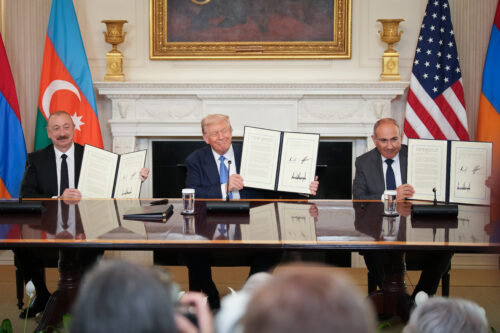
Of all the fronts in President Trump’s peacemaking agenda, the South Caucasus has delivered the most concrete results. The August 2025 Washington Declaration, signed between Armenia and Azerbaijan and witnessed by Trump, marked an important step toward peace in the region. The two sides initialed a peace agreement and advanced plans to unblock regional connectivity, including through the establishment of the Trump Route for International Peace and Prosperity (TRIPP), which would connect Azerbaijan to its Nakhijevan exclave through southern Armenia. Implementation of TRIPP has since made notable progress, but construction has yet to start. A breakthrough on those two tracks would, in turn, unlock Armenia–Türkiye normalization, transforming a long-fractured region into an area of trade and interdependence.
Achieving such breakthroughs, however, will require greater US diplomatic engagement to inject fresh momentum on both the Armenia–Azerbaijan and Armenia–Türkiye tracks. It will also need to address Tehran’s perceived concerns that TRIPP could alter the region’s geopolitical balance, undermine existing borders and state sovereignty, or open the door to a US military or security presence near its frontier. Without at least partly assuaging these concerns, the project will not only be difficult to implement but could also become a new source of regional tension, thereby failing to achieve its stated objective of delivering international peace and prosperity.
The Middle East Institute (MEI) is an independent, non-partisan, not-for-profit, educational organization. It does not engage in advocacy and its scholars’ opinions are their own. MEI welcomes financial donations, but retains sole editorial control over its work and its publications reflect only the authors’ views. For a listing of MEI donors, please click here.