This article is part of a collection of short essays written by the Fellows of the Middle East Institute to explore aspects of the ongoing war with Iran. The intent of the collection is to help readers see new and unexpected elements of the dynamics and impact of the ongoing hostilities and to think harder, deeper, and broader about the implications of the conflict. To read the other essays from this collection, as well as download the full report, please click here.
When the United States and Israel launched military action against Iran on February 28, 2026, it set in motion a chain of events that saw violence spread across the Middle East. Yet as the region found itself engulfed in conflict and with hostilities continuing in Gaza and Lebanon, Syria remained quiet. In fact, as the fighting raged and Iran’s shuttering of the Strait of Hormuz created unprecedented panic in global markets, Syria experienced its most peaceful months in 15 years.
This extraordinary situation was the result both of the country’s internal process of stabilization and of its consistent policy of isolating itself from external problems and of refraining from interference in others’ affairs. While Syria clearly sought to avoid being dragged into the regional melee, the war and its destabilizing effects created significant opportunities for a transitional government in Damascus determined to stay its course toward recovery.
“The Syrian Opportunity”
At the core of that opportunity was a vision that Syrian President Ahmed al-Sharaa and his government have sought to project consistently since coming to power after the fall of Bashar al-Assad in December 2024: that Syria can turn from a decades-long open wound in the heart of the Middle East into an island of stability whose recovery and reintegration will benefit all its neighbors. It was this message and ambition that arguably convinced the region and much of the international community to engage Damascus’s new leadership so early on. Syria’s ability to insulate itself from the regional war — and to keep stabilizing in spite of it — served as further evidence, for those open to it, that the vision was genuine and achievable. Damascus secured at least $28 billion in investment in 2025, and deals worth even more have already been sealed in 2026.
This vision of stability and neutrality serves as the framing for Damascus’s ultimate geopolitical objective: to position Syria as a hub of transnational commercial connectivity, leveraging its geographic position at the center of the region, with access north and west to Europe and the Mediterranean and south and east to the Gulf and Asia. This “Syrian Opportunity” has already won over many within the international community, but in the wake of this latest war with Iran, the shuttering of the Strait of Hormuz, and Houthi threats to Red Sea traffic, Syria has emerged as central to many potential solutions to the threats facing global trade, energy, and food security. With that in mind, President Sharaa was invited to present his vision of Syria becoming “an alternative and secure artery connecting Central Asia and the Gulf to the heart of the European continent” at an extraordinary European Union summit in Cyprus in April. The following month, Syria’s finance minister was similarly invited to brief the Group of 7 (G7) Summit in France.
Domestically, Syria is in the early stages of rehabilitating its oil and gas sector, with Gulfsands already back at the Dijla oilfields and ADES taking control of Homs’s gas fields. Following rapid rehabilitation work, Syria’s largest natural gas facility in Tabiyeh in Deir ez-Zor Governorate resumed operational activities in September 2026. Meanwhile, agreements have been made with Chevron, QatarEnergy, ConocoPhillips, Novaterra, TotalEnergies, HKN, Dana Gas, and Power International to develop additional oil and gas infrastructure and to conduct onshore and offshore exploration.
Looking beyond Syria, however, developments could prove transformative, with three transnational pipeline projects — the Trans-Arabian Pipeline from Saudi Arabia to Syria and Lebanon via Jordan; the Arab Gas Pipeline from Egypt to Turkey via Jordan and Syria; and the Qatar-Turkey pipeline via Saudi Arabia, Jordan, and Syria — all being actively studied for rehabilitation and expansion, according to interviews with senior Syrian government officials. On July 17, Iraq and Syria signed an agreement to begin assessments on reactivating an expanded Kirkuk-Baniyas pipeline with an extension south to Basra, while the Trans-Anatolian Natural Gas Pipeline between Azerbaijan and Turkey has already been extended south to Aleppo.
Beyond oil and gas, significant diplomatic attention has been devoted to new regional railway and roadway mega-projects aimed at diverting commerce away from the Strait of Hormuz, using land routes west toward the Mediterranean. Given its geographic location, Syria is situated at the center of most of these proposed projects, which include a Saudi high-speed railway line linking Arar to Syria’s coast through Jordan, as well as proposals by the United Arab Emirates to integrate Syria into its Iraq-Gulf Transit Corridor plans. Meanwhile, Jordan, Turkey, and Syria have formed a trilateral committee to coordinate a trade corridor by road and, eventually, via a revitalized Hijaz Railway line linking the Port of Aqaba to Europe. Lebanon looks set to integrate into that network, following an agreement in August 2026 to revive cross-border railway connectivity. Saudi Arabia has signed an agreement with Turkey to extend that historic railway’s connectivity to the kingdom’s Gulf ports. After a deal was reached in April to transport Iraqi oil exports via Syria to the Mediterranean, Syria already accounted for more than a quarter of the Middle East’s fuel oil export market in July, with some of those exports sold as far away as the US.
Despite Abu Dhabi’s earlier caution over the new leadership in Damascus, the UAE has become increasingly assertive in its positioning of Syria — as well as Turkey — as part of its drive to reduce its reliance on the Strait of Hormuz. On top of its $800 million deal, through DP World, to take operational control of the Port of Tartus, the UAE is also investing in free zones in “several” areas of Syria and working to create a land transport route connecting its Khalifa Port to the Mediterranean via Syria.
Tying all of this commercial interconnectivity together is the relaunch of an old idea, the Four Seas Project — positioning Syria as the corridor connecting global markets into, through, and from the Middle East via maritime channels in the Gulf, Mediterranean, Black Sea, and Caspian. The visit to Damascus by Ukrainian President Volodymyr Zelensky in April and Turkey’s subsequent lifting of customs restrictions on Armenia in May opened up for the first time the necessary geographic pathways for access to the Black Sea and Caspian Sea.
One other element of Syria’s geoeconomic positioning is the potentially transformative effect it could have as a telecommunications corridor for the Gulf. Under what Syria’s Ministry of Communications and Information Technology calls Project Silk Link, over a billion dollars of early Saudi investment aims to turn the country into a “strategic data connector.” This would entail laying new submarine fiber-optic cabling from Spain across the Mediterranean and onward to the Gulf, replacing the inefficient and vulnerable cabling that runs circuitously through the Suez Canal and Red Sea before winding around into the Gulf. Doing so would reduce internet latency there by as much as 40 milliseconds, making Gulf states’ visions of hosting global data centers, artificial intelligence (AI) hubs, and revolutionary smart cities realistic.
While the US and Europe have consistently embraced and supported these Syrian ambitions, the vision is, at its core, a strategy that could unite the Arab Middle East and Turkey. Though it took longer than most would have expected, that convergence has begun to trigger concerns in Israel, whose central role in the once-vaunted India-Middle East-Europe Economic Corridor (IMEC) now looks increasingly uncertain. If the early and assertive role of Saudi Arabia and Turkey in leveraging Syria’s positioning as a strategic economic opportunity generated agitation in Israel, the more recent vocal backing of the UAE has only deepened it.
Enter the Spoilers
While the opportunities arising amid regional conflict are clear, the prospect of Syria stabilizing, recovering, and prospering — and the breadth of international support that ambition has drawn — risks emboldening spoilers. Broadly speaking, the malign actors best positioned and most determined to undermine Syria’s success are the Islamic State (ISIS) and the Iran-Hizballah alliance.
The pursuit of chaos and all-out war with nation states is at the very core of ISIS’s modus operandi, but Syria offers the terror group a unique set of conditions to exploit. On one level, the transitional government in Damascus is led by individuals whose earliest roots lie within ISIS’s predecessor movements but who have been its adversaries since 2014 and are now embraced by America and the West. That breeds extreme animosity and explains why President Sharaa and senior officials such as Interior Minister Anas Khattab have been targets of repeated ISIS plots in recent months.
On another level, in ISIS’s eyes post-Assad Syria looks much like post-Saddam Iraq — where a flip from minority to majority rule is paired with ethnic and sectarian complexities, damage done by years of civil conflict, foreign intervention and influence, and high levels of global attention and stakes. For ISIS, the desire and opportunity to exploit all these complex, fragile, and combustible fissures drives its continued activity on Syrian soil — to tear down the transition and ignite a ruinous and brutal return to civil war.
However, ISIS has struggled to achieve momentum amid Syria’s transition. After spending 2024 as a resurgent force — tripling its 2023 operational tempo and doubling the deadliness of its attacks — the group suffered a crippling blow with the December 2024 fall of Assad’s regime, whose brutality and persistence had driven recruitment and given ISIS a justification for its attacks. While the group sought to recover in the months after Assad’s fall, the de facto military defeat of the Kurdish-led Syrian Democratic Forces (SDF) at the hands of Syrian government forces in January 2026 and the subsequent withdrawal in April of the US troop presence, seen by many Arabs as the enabler of SDF rule, removed yet another core driver of ISIS activity. Since then, the group’s operations in Syria have fallen to record low levels, with an average of just 7 attacks and 4 deaths per month since April 2026 — a far cry from the 2024 average of 58 attacks and 63 deaths per month, according to data collected and published by the author in Syria Weekly.
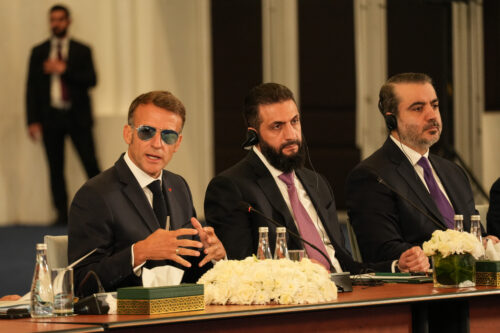
Even so, ISIS remains determined to recover and appears invested in a three-pronged strategy, attacking government security personnel, minority communities, and other symbolic targets to undermine confidence in Syria’s government. This last element was most palpably demonstrated on July 7, 2026, when two small explosive devices were detonated in central Damascus during a visit by French President Emmanuel Macron. Though both devices were rudimentary, caused no fatalities, and detonated outside President Macron’s security perimeter, the attack was nonetheless effective in raising questions about Syria’s capacity to secure its own capital. The Interior Ministry’s capture of the cell responsible 48 hours later, along with one of ISIS’s most senior surviving Syrian operatives, was encouraging, but did not change the fact that the attack was successful. The arrests also revealed that ISIS cells were so financially strained that they were turning to petty theft, robbing jewelry stores to fund their operations.
Beyond ISIS, Syria also faces a determined challenge to its recovery from Iran and its Lebanese proxy, Hizballah. Setting the ongoing war with Iran aside, the fact that Tehran and Hizballah would oppose the transitional government in Damascus is unsurprising — the fall of Assad’s regime was arguably the single greatest blow to Tehran’s regional agenda, and one achieved by the very same actors that Iran had spent more than a decade helping Assad fight. For Hizballah, the loss of Syria was potentially existential, especially when paired with the losses it had incurred from Israel’s campaign earlier in 2024.
In the early phase of the post-Assad era, Hizballah and potentially Iran directed their energies into backing Syria’s domestic anti-government insurgency. The backbone of this insurgent effort was formed by remnants of the Fourth Division — the Assad regime’s most elite military unit, previously led by Maher al-Assad and supported directly by the Islamic Revolutionary Guard Corps (IRGC) — and the Republican Guard. The peak of the insurgency came on March 6, 2025, when dozens of simultaneous attacks were launched on nearly every government security position along the coast, a sudden and dramatic campaign perceived within the Alawite community as a “coup,” triggering a huge wave of violence that left approximately 1,400 dead. Amid the outcry over the killings, most by forces tied to the new government, the violence also precipitated a weeks-long process of disarming coastal towns mediated by notables from the Ismaili community. A sustained government campaign of targeted raids on insurgent cells followed. The insurgency never recovered, carrying out an average of 7 attacks per month, killing 3 people, through the remainder of 2025, and in 2026 mounting a total of just 9 attacks, killing 2 people, from January through July.
However, that was not the end of efforts by Iran and Hizballah to undermine Syria’s transition. With the domestic Syrian insurgency faltering, Hizballah took the lead in directing a new campaign in which it provided training to remnants of Assad’s regime on Lebanese soil, before smuggling them back over the border with weapons and explosives, as well as a list of pre-selected targets. The first sign of this externally directed campaign came on May 5, 2026, when a shipment of 1,000 identical machine-made improvised explosive devices (IEDs) was seized after arriving in Latakia from Lebanon. Two months later, a Hizballah operative was captured after smuggling himself into Syria armed with seven sophisticated explosively formed projectiles (EFPs) — a signature weapon of Iran and its proxies since their extensive use against US forces in Iraq in 2004-11.
Since then, according to Syria’s Interior Ministry and General Intelligence Directorate, Hizballah has dispatched specially trained cells to conduct rocket attacks into central Damascus (September 2025-January 2026); explosive-laden drone attacks (January-February 2026); targeted IED assassinations of government officials as well as Christian and Jewish community figures (March-May 2026); and artillery strikes into Israel (April 2026). With the exception of three minor rocket attacks on November 14 and December 9, 2025, and January 3, 2026, nearly all other plots were foiled. Intriguingly, cells captured in Tartus in March 2026, in Damascus in April, and in Rif Dimashq, Aleppo, Homs, Tartus, and Latakia in May were in possession of identical IEDs, manufactured with the same materials, even down to plywood wrapping labeled “Ecoply.” In September 2026, Lebanese authorities detained a cell of Lebanese and Syrian nationals engaged in coordinating attack plots in Syria, through training in explosives and drone use. The cell’s links to a senior Assad regime figure currently based in Moscow, Russia, raised significant questions.
Although almost everything connected to this Hizballah-directed campaign has been disrupted, Syrian authorities suspect an unclaimed bomb attack on a café near Damascus’s Palace of Justice on July 2 was the work of Hizballah-backed cells. The attack killed 10 people, 7 of them lawyers. The café was known to be popular with judiciary staff and visitors. The nearby court was at the time hearing three high-profile trials each week. The defendants were Bashar al-Assad’s cousin and organized-crime leader Wassim al-Assad; Assad’s former Grand Mufti Ahmed Hassoun; and another Assad cousin and former intelligence leader Atef Najib.
The challenge posed by Iran and Hizballah to Syria’s transition and recovery also comes in the form of weapons trafficking and organized crime. To cement Iran’s loss of its secure “land bridge” to Hizballah when Assad fell, the new government in Damascus quickly demonstrated its determination to put an end to Syria’s use as a corridor for weapons smuggling. In their first 12 months in power, the Syrian authorities seized more than 4,000 weapons systems headed to Hizballah in Lebanon. While those efforts have continued, Syria’s July 16 announcement that it had seized 100 fiber-optic drones and dozens of brand-new Iranian-manufactured anti-tank missiles and long-range drone components inside an Iraqi oil tanker crossing the border raised serious concerns. If Iranian actors were seeking to exploit Iraq’s oil tanker transit arrangement with Syria, it could jeopardize a vital source of government revenue and undermine fast-growing Iraqi-Syrian ties.
With regard to organized crime, Hizballah plays an equally significant and potentially destabilizing role. While Assad presided over Syria’s emergence as the world’s most prolific narco-state, drug production virtually ended after his departure amid a concerted campaign by the new government to destroy production facilities and detain their operators. Since then, at least 35% of drugs seized in Syria have arrived from Lebanon along Hizballah-controlled smuggling routes. Moreover, the emergence of Druze-controlled Suwayda Governorate as Syria’s new hub of drug production and trafficking activity has benefited in large part from ties to the same organized crime actors in Lebanon, who have been revealed as the source of the latest innovation in cross-border smuggling toward Jordan: heavy-lift GPS-guided helium balloons.
A Clear Opportunity, but a Long Road Ahead
The world’s calamity has so far proven to be Syria’s boon. The Iran war has underscored how transformative the “Syrian Opportunity” could be — not just for Syria, but for governments in the Middle East, Europe, and beyond. That the opportunity has grown even clearer in recent months has spurred stakeholders to engage, to explore new proposals, and to invest and act. But the path ahead is long, and it will take many years for the vision to become reality.
For Syria, every step taken to support this vision will mark incremental progress toward recovery, but ultimately, it will matter little if the transition process fails. The government in Damascus faces pressures at home from every direction, and if it stumbles on issues such as political representation, transitional justice, and constitutional reform, all of the progress made on interconnectivity, trade, and exchange will count for nothing.
Syria’s transition and successful integration into a rapidly interconnecting Middle East are strategically vital US national security interests. A truly stable Middle East will depend on achieving both these goals. This will mean far greater “burden shifting,” creating the space for US attention to pivot to global challenges elsewhere.
To ensure Syria remains on the right path, the US must expedite the process of establishing a permanent diplomatic presence in Damascus. Presidential Envoy Thomas Barrack has played an enterprising role in shaping and consolidating bilateral ties, but the real work ahead requires more intensive, direct, and grounded engagement. A more comprehensive and present US engagement will also strengthen America’s ability to monitor and assess the Syrian government’s actions and to influence — or if necessary, coerce — its behavior in the right directions. It would also benefit developments on the economic front, with American companies and investors keen to engage, but lacking an on-the-ground touch point to more efficiently facilitate deal-making and the actual investment process.
On the security front, Syria shares the very same interests as the US and our many regional partners — combating terrorism, challenging the malign agendas of Iran and its proxies, tackling threats posed by weapons of mass destruction, and confronting transnational organized crime. Syria’s national security apparatus — comprising the interior and defense ministries, as well as the General Intelligence Directorate — has demonstrated its determination to tackle all of these challenges, but its constituent entities are still in their infancy and require help. With the provision of training, capacity-building, and support with weaponry and intelligence, surveillance, and reconnaissance (ISR) capabilities, Syria’s capacity to deal internally with the threats America continues to worry about will improve markedly. Several regional states are already stepping in to assist, but a US role would be transformative.
Charles Lister is a Senior Fellow at the Middle East Institute.
Top image: French President Emmanuel Macron (L) speaks alongside Syrian President Ahmed al-Sharaa (C) and Syrian Foreign Minister Asaad al-Shaibani during the Syrian-French investment conference at the presidential palace in Damascus, July 7, 2026. Photo by Moawia Atrash/picture alliance via Getty Images.
The Middle East Institute (MEI) is an independent, non-partisan, not-for-profit, educational organization. It does not engage in advocacy and its scholars’ opinions are their own. MEI welcomes financial donations, but retains sole editorial control over its work and its publications reflect only the authors’ views. For a listing of MEI donors, please click here.
Yemen: The Houthis’ Role in the Next Evolution of the Axis of Resistance
US Regional Defense Policy: Strategic Prioritization and the Promotion of Collective Defense