Ansar Allah (“Partisans of God”), otherwise known as the Houthis, is a political-military faction and Zaydi religious movement founded in northwestern Yemen in the 1980s to fight corruption and foreign influence. After a period of expansion focused on religious revival and political mobilization, the group began launching attacks against Yemen’s government in 2004 and against Saudi Arabia in 2009. In the wake of instability resulting from the Arab Spring, the Houthis captured northern Yemen and took control of the capital, Sana’a, in 2014. After they seized the presidential palace and forced the president to flee in January 2015, Saudi Arabia initiated a US-backed coalition operation against the group in March 2015. The resulting disruption in the flow of goods, extensive airstrikes, and civil war led to a severe humanitarian crisis in Yemen. Although the Yemeni civil war largely ground to a stalemate in 2021, the Houthis have continued to pose a threat to Western interests on a global scale.
The Houthis are a key member of Iran’s Axis of Resistance and have also developed links with other militant organizations in the Horn of Africa. Following the Hamas attack on Israel on October 7, 2023, the group launched a campaign of missile and drone strikes that disrupted 50% of trade passing through the Suez Canal in 2024. After threatening to renew attacks on Israel and Red Sea shipping following the onset of the US-Israeli war on Iran in February 2026, the Houthis launched the first of a series of missile strikes against Israel at the end of March. According to analysts, their limited involvement in the conflict may be because Iran views the Houthis as a strategic reserve — a force that can be called upon as a last resort if it escalates further.
History
Formation
The Houthis subscribe to the Zaydi branch of Shi’a Islam, which was the dominant sect in northern Yemen prior to the removal of the Zaydi Imamate in 1962. In the 1980s, Badreddin al-Houthi, who claimed absolute authority as a descendant of the Prophet Muhammad, took part in a Zaydi revivalist movement to fight corruption and oppose Salafi influence. In 1986, he joined the Union of the Believing Youth (BY), a study group formed by Zaydi religious scholars focused on the Iranian revolution. He and his son, Hussein, would later take control of and radicalize the organization in 2000, turning it into a movement that capitalized on widespread frustration with the Yemeni government’s corruption and inefficiency. Their activities were also fueled by personal grievances, namely their perceived loss of right to rule Yemen following the toppling of the Zaydi Imamate. In 2004, after an attempt by the Yemeni government to arrest Hussein, the movement launched an armed rebellion. Hussein was killed shortly after its outbreak, and from 2004 to 2010, the Houthi movement fought six conflicts against the Yemeni government known as the Saada Wars.
Iran and the Axis of Resistance
While maintaining a degree of independence, the Houthis are considered a key member of Iran’s regional alliance of armed extremist organizations, the Axis of Resistance. Iranian assistance started as early as 2004 and has included intelligence, weapons, logistics, funding, diplomatic backing, training, and fuel. Iran has also provided advisors and trainers from the Islamic Revolutionary Guard Corps (IRGC) and the Lebanese Shi’a militant group Hizballah. Iran and the Houthis have developed an intricate and diversified smuggling network to deliver small arms, missiles, and disassembled drone systems to Yemen, enabling the group to build a domestic weapons manufacturing capacity that has survived international sanctions and coalition bombing campaigns.
In a bid to diversify beyond Iran, the Houthis have developed relationships with other militant groups in the Horn of Africa, including al-Shabaab, al-Qaeda in the Arabian Peninsula (AQAP), and the Islamic State in Somalia (IS Somalia). Although these groups have distinct ideological and sectarian agendas and have at times clashed, they share a hostility to the US and Israel that has enabled them to collaborate on weapons smuggling, technology transfer, piracy, information sharing, illicit funding channels, and other destabilizing activities. In exchange for a flow of Iranian- and Chinese-sourced weapons, al-Shabaab and the other groups extend the Houthis’ ability to disrupt traffic through international waterways, and all the collaborators benefit from expanded illicit smuggling and financial networks.
Civil War (2014-)
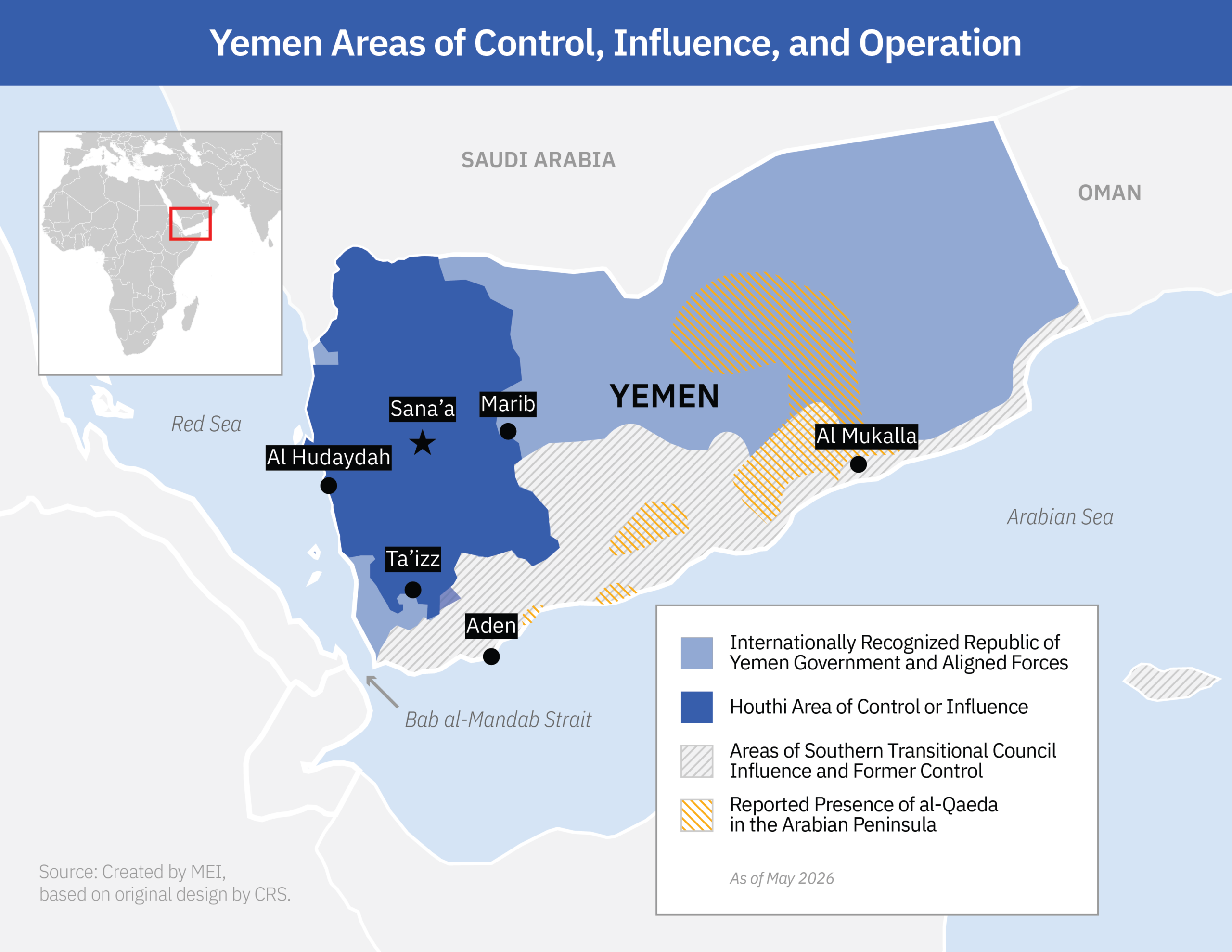
Yemen’s long-time president, Ali Abdullah Saleh, was forced to step down in 2012 in the wake of the Arab Spring protests that swept the region beginning in 2011. After several years of fighting during which Saleh and his loyalists allied with the Houthis in an attempt to regain power, the Houthis took Sana’a in September 2014, and by 2015 the group had established a shadow state controllingone-third of the country’s territory and the vast majority of the population.
“The ongoing civil war in Yemen and associated sanctions and international military interventions have produced one of the world’s worst humanitarian crises, resulting in widespread displacement, famine, and significant civilian casualties.”
The ongoing civil war in Yemen and associated sanctions and international military interventions have produced one of the world’s worst humanitarian crises, resulting in widespread displacement, famine, and significant civilian casualties, and have left the country littered with improvised explosive devices and unexploded ordnance. The Houthis’ blockade of Yemen’s oil terminals in 2022 has prevented the internationally recognized government, known as the Republic of Yemen Government (ROYG), from exporting oil, the country’s primary revenue source, reducing its ability to rebuild infrastructure or provide social services.
Intervention by Saudi Arabia and the United Arab Emirates
Saudi Arabia spearheaded an effort to remove the Houthis from power, building a coalition backed by the US and supported by other Arab states, most prominently the UAE. Operation Decisive Storm, launched in March 2015, involved an intensive bombing campaign targeting Houthi positions and infrastructure. Coalition forces recaptured Aden in July 2015, partially restoring the ROYG and pushing back Houthi control. In 2017, former President Saleh made statements indicating a shift toward the Saudi-led coalition; Saleh was killed by the Houthis days later.
In 2017, after it had begun forming and training independent southern forces, the UAE shifted its support to a new separatist group, the Southern Transitional Council (STC), which captured territory previously held by the ROYG. The STC was later nominally incorporated into the ROYG under the November 2019 Riyadh Agreement, but tensions between the Saudi-backed Yemeni government and the UAE-backed STC continued to grow.
By 2021, the civil war had effectively entered an uneasy stalemate. In April 2022, the United Nations brokered a temporary cease-fire that formally ended in October 2022, though the parties continued to adhere to the terms until October 2023, when the Houthis resumed attacks on Red Sea shipping following the outbreak of the Gaza war.
The increasing divergence between Emirati and Saudi strategy in Yemen, with the UAE focused on establishing a maritime security presence as well as a regional alliance of friendly regimes and Saudi Arabia interested primarily in removing the militant threat from its border, eventually led to an outright split. After the STC seized the eastern provinces of Hadramawt and Mahra from government forces in December 2025, Saudi Arabia struck ships it claimed were carrying weapons intended for the separatist group and accused Abu Dhabi of encouraging them to take actions that threatened its security. On December 30, the ROYG ordered UAE forces to leave the country within 24 hours. The UAE denied the Saudi accusations but said it was withdrawing its remaining military forces. The STC subsequently announced its dissolution.
Leadership and Governance
The Houthis are simultaneously a political-religious movement, a military organization, and a government. Abdul-Malik al-Houthi assumed leadership of the group in 2004, though he has no formal title. He was sanctioned by the United States in 2015 and listed as a Specially Designated Global Terrorist in 2021. Other members of the Houthi family and those related by marriage hold key positions throughout the leadership structure.
The group’s supreme command authority, the Jihad Council, was established around 2010-11 and took on more authority following the end of the group’s alliance with Saleh in 2017. The council has nine members and is similar in form and function to Hizballah’s Jihad Council. Like those of other Iranian proxy groups in Iraq and Lebanon, the council includes a “jihad assistant” — an IRGC-Quds Force officer who serves as a senior military advisor to the Houthis.
To maintain administrative control over the government, Houthi supervisors (mushrifin), typically drawn from Hashemite families from Saada and Hajja, are placed in every department. A general supervisor (al-mushrif al-amm) serves as the shadow counterpart to state governors. This unofficial network reports directly to the Houthi leadership and is increasingly merging with the formal government. The Houthi government organization includes offices or departments for external relations, health, education, social services, intelligence, and media. The group controls television, radio, and social media platforms, as well as telecommunications networks within its territory, through which it censors information and uses propaganda to control the narrative about its activities.
The civil war and the COVID-19 pandemic caused severe disruptions to Yemen’s economy, including currency devaluation and shortages of food and fuel. Prior to the outbreak of hostilities in the region resulting from the October 2023 Hamas attacks on Israel, protests about the deteriorating economic conditions erupted in both Houthi- and ROYG-controlled areas. The Houthis responded to the unrest with force and arrests of demonstrators and journalists.
To build up a more enduring grip over the population, the Houthis use summer camps to indoctrinate and recruit children; approximately 65% of Yemeni children under the group’s control attend these camps. The group has also attempted to leverage widespread support in Yemen for the Palestinian cause to bolster its weak domestic position, aiming to legitimize its actions and distract from its governance failures. At the same time, the Houthis intensified domestic repression following the onset of the Gaza war, using it to justify a crackdown at home.
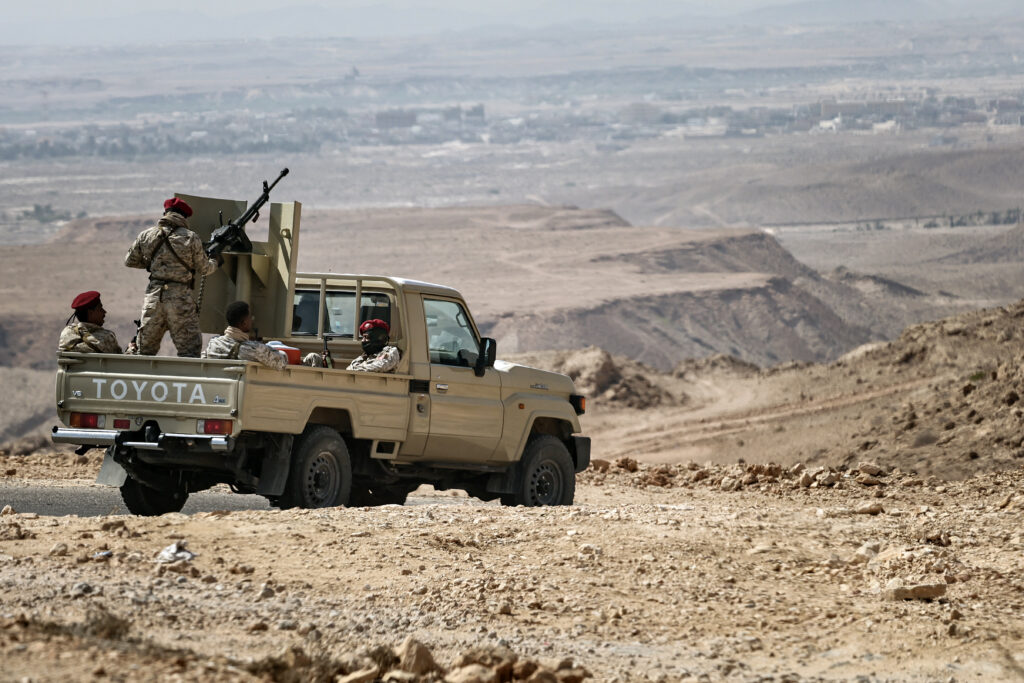
Saudi-backed Yemeni forces in the city of Mukalla in Yemen’s coastal southern Hadramawt Province, on January 20, 2026. Source: Fadel Senna/AFP via Getty Images.
Military Capacity
The Houthi military is divided across seven regions and gathers intelligence through its Security and Intelligence Service (SIS), which comprises a Military Intelligence branch and the Preventive Intelligence Service, a unit that monitors the Houthi movement itself to protect against infiltration. Houthi troop strength was estimated at 350,000 soldiers as of April 2025, while Saudi-backed government forces controlled around 300,000 personnel. Various Saudi- and Emirati-backed militias, in turn, could call on between 150,000 and 200,000 fighters. The Houthi military includes child soldiers, forced-conscript African refugees, and foreign mercenaries. Limited supplies of food and energy, given Yemen’s reliance on imports for both, are a significant constraint on military capacity.
“Iran has provided critical military assistance to the Houthis, particularly with the delivery of missiles and unmanned aerial vehicle systems.”
Iran has provided critical military assistance to the Houthis, particularly with the delivery of missiles and unmanned aerial vehicle (UAV) systems. Missile and UAV parts are designed and manufactured in Iran and smuggled into Yemen via small boats, container ships, or over the Oman-Yemen border, where they are assembled and often tested and sold to other nonstate armed groups. Houthi ballistic missile systems include the Asif, Burkan (versions 1-3), Hatem (1-2), Karar, Mohit, and Toofan. Houthi cruise missile systems include the al-Mandab-1 and Quds (1-4). Houthi UAV systems include the Qasef (versions 1 and 2k), Sammad (2-4), and Waid (1-2). The Houthis have also diversified their supply lines by seeking parts and assistance from China and Russia.
Ideology
The Houthis adhere to Zaydism, a branch of Shi’a Islam that believes both spiritual and temporal leadership should be held by descendants of the Prophet Muhammad, and developed as a militant, radicalized offshoot of a Zaydi revivalist movement. The group’s ideology draws on Islamic traditions about the end times — including hadith referencing Yemen’s role in them — and frames the liberation of Jerusalem as a religious obligation. The Houthis believe the war in Gaza has brought this closer to fulfillment and have used it as a recruitment tool as well as a justification for their Red Sea attacks. The group has also been influenced by the form of governance established by Ayatollah Ruhollah Khomeini in Iran after its 1979 revolution, although there are some differences between the two Shi’a sects. Nonetheless, the Houthis’ original objectives to establish control over Yemen and spread the Zaydi doctrine, bogged down by internal divisions and years of civil war, have been overshadowed by the group’s relationship with Iran and attacks on Israel and Red Sea shipping assets in solidarity with the Palestinians.
Those religious-ideological motivations notwithstanding, the profit incentive for the Houthis’ actions should not be underestimated. Tolls on commercial shipping levied by the militia generated as much as $2.1 billion per year as of January 2025, doubling the Houthis’ estimated government revenue of $1.8 billion.
“The Houthis have attacked civil society and humanitarian organizations, repeatedly raiding the offices of the UN and other aid agencies operating in the areas they control.”
Tactics
Kidnapping and Hijacking
The Houthis have attacked civil society and humanitarian organizations, repeatedly raiding the offices of the United Nations and other aid agencies operating in the areas they control and kidnapping more than 100 employees as of late 2025. The group has falsely accused aid workers of spying on behalf of the US, Saudi Arabia, and Israel, and has sentenced some to death. The Houthis have also hijacked several ships and abducted or killed the crew, releasing stylized videos celebrating some of the incidents. In addition, the group has seized property owned by individuals and tribes or designated for infrastructure projects or religious endowments and redistributed it for the militia’s use and as political spoils.
Extortion and Sanctions Evasion — FSO Safer
The FSO Safer is an aging oil tanker used to offload Yemen’s oil exports. The civil war left the ship and 1.1 million barrels of oil stranded off Hudaydah, under the control of the Houthis but prevented from leaving the port through ROYG-controlled waters. While ownership claims remained in dispute, the Houthis used the risk of a catastrophic spill from the decaying vessel with a potential $20 billion clean-up cost to extort concessions from international organizations. In August 2023, the United Nations moved the fuel to another vessel and transferred ownership to the ROYG. As of mid-2025, the Houthis maintained possession of the ship and were using it to store sanctioned Russian oil.
Missile and Drone Attacks
The Houthis’ use of drones and missiles has evolved since the start of the conflict, beginning with the depletion of the Yemeni government’s stockpile of unguided rocket and ballistic missiles and then transitioning to increasingly sophisticated drones and guided munitions imported from Iran or manufactured domestically using Iranian technology, training, and parts. The target radius also evolved, eventually expanding beyond military installations in Saudi Arabia to include oil facilities and other infrastructure in the kingdom in 2017 and in the UAE in 2018. In September 2019, the group claimed attacks on Saudi Arabia’s Abqaiq and Khurais processing facilities that caused significant disruptions to global oil supplies. The Houthis launched nearly 1,000 rockets and missiles and more than 350 drones between the first Scud fired at Saudi Arabia’s King Khalid Air Base in May 2015 and the start of the UN-brokered cease-fire in April 2022.
On October 19, 2023, the Houthis began launching missiles and drones at Israel, demanding the end of its retaliatory campaign against Gaza following the Hamas attack of October 7. The Houthi offensive expanded to aerial strikes on commercial vessels in the Red Sea. On January 26, 2024, the Houthis began firing on US Navy warships directly. By April 2025, they had targeted more than a hundred ships in the Red Sea, Gulf of Aden, and Arabian Sea. As of early 2026, the Houthis had not successfully hit a US warship, despite claims to the contrary.
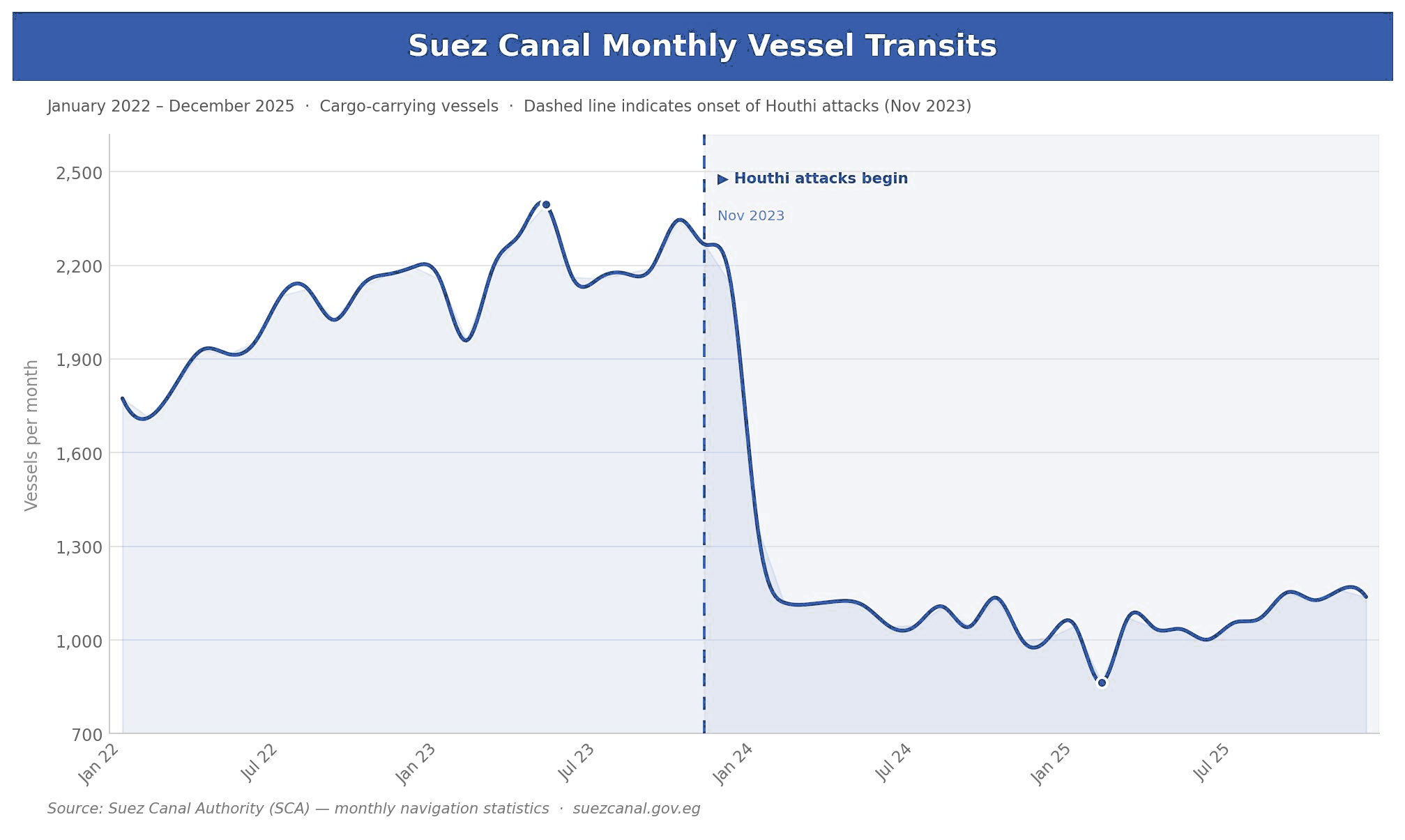
In the first two-thirds of 2023, approximately 2,000 vessels passed through the Red Sea and Bab al-Mandab Strait, on their way to or from the Suez Canal, carrying goods that amounted to 12-15% of global trade. After the crisis precipitated by the October 7 Hamas attack on Israel, however, Houthi strikes on Red Sea shipping collapsed transits from 2,068 in November 2023 to 877 in October 2024. Egypt, which is heavily reliant on revenue from the canal, estimated it had lost approximately $9 billion in potential transit fees as of March 2026 due to reduced traffic. The Houthis demanded a “fee” for safe passage, which UN experts estimated in November 2024 generated revenue of $180 million per month, or $2.1 billion per year. Reportedly, sanctioned Iranian spy ships may have assisted in collecting and disseminating intelligence to the Houthis in their efforts.
Not all parties suffered equally as a result of the Houthi Red Sea attacks. By the end of 2024, Chinese commerce as a percentage of ships transiting the Red Sea increased, as their war risk insurance costs were as low as 0.35% compared to American and British rates of up to 2%. Russian transits grew to account for the majority of crude oil going through the Suez Canal.
In November 2025, the Houthis paused attacks on maritime traffic following a regional de-escalation linked to a cease-fire and hostage-release deal that ended the Israel-Hamas conflict. As of mid-May 2026, there were no confirmed Houthi attacks on ships in the Red Sea, although the group did launch a series of missile strikes against Israel starting in late March in support of Iran.
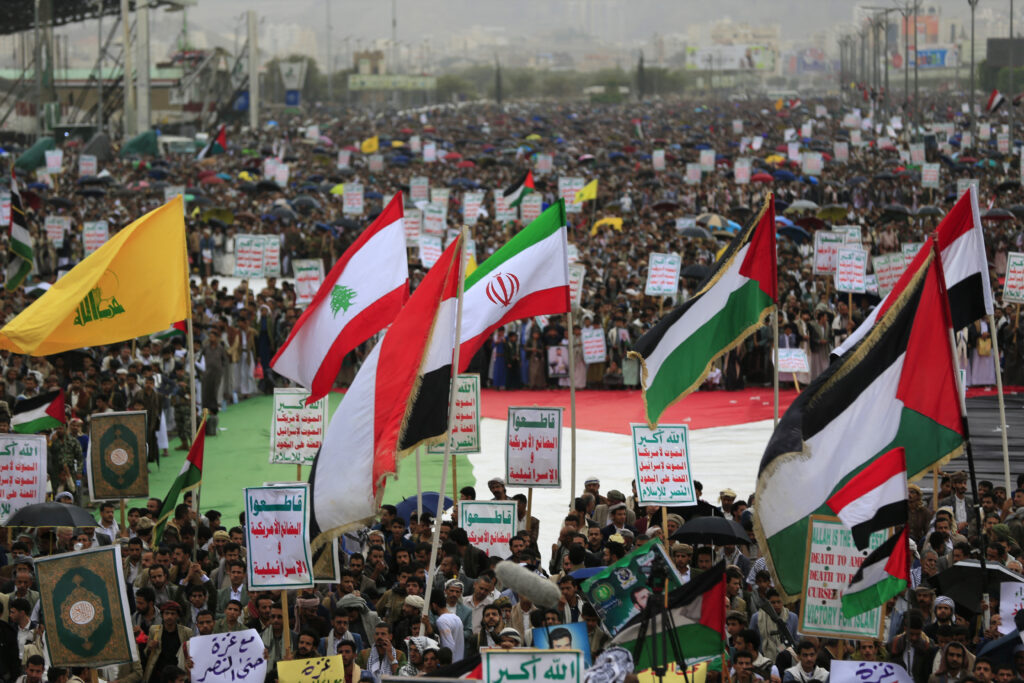
Yemenis wave the flags of Hizballah, Lebanon, Iran, Palestine, and Yemen during a rally in solidarity with Palestinians in the Gaza Strip in Sana’a on July 4, 2025. Source: Mohammed Huawis/AFP via Getty Images.
International Response
In response to Houthi attacks on commercial shipping, the US has led the international effort to protect freedom of navigation in the Red Sea, launching Operation Prosperity Guardian, a joint initiative with the United Kingdom on December 18, 2023, and including Bahrain, Canada, France, Italy, the Netherlands, Norway, the Seychelles, and Spain, and Operation Rough Rider, launched on March 15, 2025. In December 2023, India provided 21 warships to the region to participate in an effort named Operation Sankalp. The European Union’s Naval Force (EUNAVFOR) mounted Operation Aspides to help restore navigational freedom in the critical waterways on February 19, 2024. Israel has executed a series of operations against the Houthis, beginning with Outstretched Arm targeting infrastructure in Hudaydah in July 2024 and an attack on Sana’a in August 2025 that killed 12 of 16 Houthi government ministers.
International strikes on Houthi weapons depots, command-and-control facilities, and missile-launch systems have degraded the group’s capabilities. President Donald Trump’s second administration increased the intensity of strikes after redesignating the Houthis a terrorist organization on January 22, 2025. Between mid-March and late April 2025, the US military reported it had struck 800 targets in Yemen. In April 2025, the administration ordered strikes on the Ras Isa oil terminal and the port city of Hudaydah, severely limiting energy imports into Houthi-controlled territory. On April 3, 2025, Iran announced it was removing its advisors from Yemen, though this claim was met with skepticism.
The air campaign was suspended in May 2025 after the Houthis agreed to stop targeting US ships. Though the combined US and international assaults on the Houthis caused significant damage to the group’s ability to operate, at great expense and a considerable expenditure of munitions, they did not eliminate it.
US Government Policies and Congressional Legislation
In addition to supporting the Saudi-led military campaign against the Houthis and participating in various negotiation mechanisms, the United States government has passed legislation against and imposed sanctions on the group. The first Trump administration designated the Houthis as a foreign terrorist organization in January 2021, shortly before leaving office. President Joe Biden’s administration removed the designation in February 2021 in response to warnings the label would disrupt the delivery of aid but then listed the group as a Specially Designated Global Terrorist organization on January 17, 2024. The revised categorization theoretically enabled the government to more easily remove it in exchange for deescalation of hostilities and to obtain waivers for humanitarian assistance. The Department of State designated the Houthis as an “entity of particular concern” under section 301 of the Frank R. Wolf International Religious Freedom Act of 2016 (P.L. 114-281) in November 2022.
On the Congressional side, as of early 2024, the No Funds for Iranian Terrorism Act (H.R. 5961) had passed the House of Representatives but had not passed the Senate. In 2024, the Senate was considering a bill, the Mahsa Amini Human Rights and Security Accountability Act (MAHSA Act S.2626), to impose sanctions on Iranian officials for human rights abuses and terrorism.
Upon returning to office for a second term, President Trump issued an Executive Order calling for the redesignation of the Houthis; the order took effect on March 4, 2025. In April 2025, 37 members of Congress sponsored the Maximum Pressure Act to codify an Executive Order passed by President Trump in February calling for the imposition of new sanctions against Iran.
Conclusion
The Houthis have evolved from a local insurgent Zaydi theological revivalist movement equipped with rocket-propelled grenades to a major armed force and key member of Iran’s Axis of Resistance with the ability to disrupt international trade and resist intense and expensive military campaigns designed to eliminate it. In the midst of shifting power balances in Yemen and another war in the Middle East, the Houthis have not only survived but have strengthened their position as a strategic reserve for Iran and constitute a persistent menace to US and Western interests.
This backgrounder was researched and written by MEI intern Luke Zakedis and edited by Rebekah Wharton, with input from MEI Associate Fellow Nadwa Al-Dawsari.
Main photo: Yemenis brandish copies of the Quran during a demonstration in Sana’a on December 19, 2025. Source: Mohammed Huwais/AFP via Getty Images.