Introduction
United States Central Command (CENTCOM), one of the US Department of Defense’s (DoD) six geographical combatant commands, is responsible for countering threats, responding to crises, and strengthening regional stability in the Middle East, Central Asia, and parts of South Asia.
The creation of CENTCOM reflected America’s strategic shift toward sustained engagement with the Middle East in the latter half of the 20th century. The Iran hostage crisis in November 1979 and the Soviet invasion of Afghanistan the following month exposed critical vulnerabilities in the US regional military presence. In response, President Jimmy Carter established the Rapid Deployment Joint Task Force (RDJTF) on March 1, 1980, to protect US interests. President Ronald Reagan later transformed this into a permanent unified command, intended to create a lasting strategic framework for US involvement in the region. CENTCOM was formally activated on January 1, 1983. Today, the command directs and enables military operations in coordination with allies and partners in pursuit of greater regional security and stability.
Priorities and Areas of Focus
CENTCOM’s command priorities are threefold: defend the homeland, deter conflict with Iran and its proxies, and compete strategically with China. To achieve them, it emphasizes integrating partner air-defense capabilities, developing advanced technology, aligning military with economic and infrastructure security, and countering Chinese influence and regional strategic projects like the Belt and Road Initiative. CENTCOM also relies on what it calls “layered assurance,” through which it aims to combine institutions, innovation, and influence, to demonstrate American commitment and support to allies and partners in the region and maintain the position of “security partner of choice,” according to its 2023 Theater Strategy.
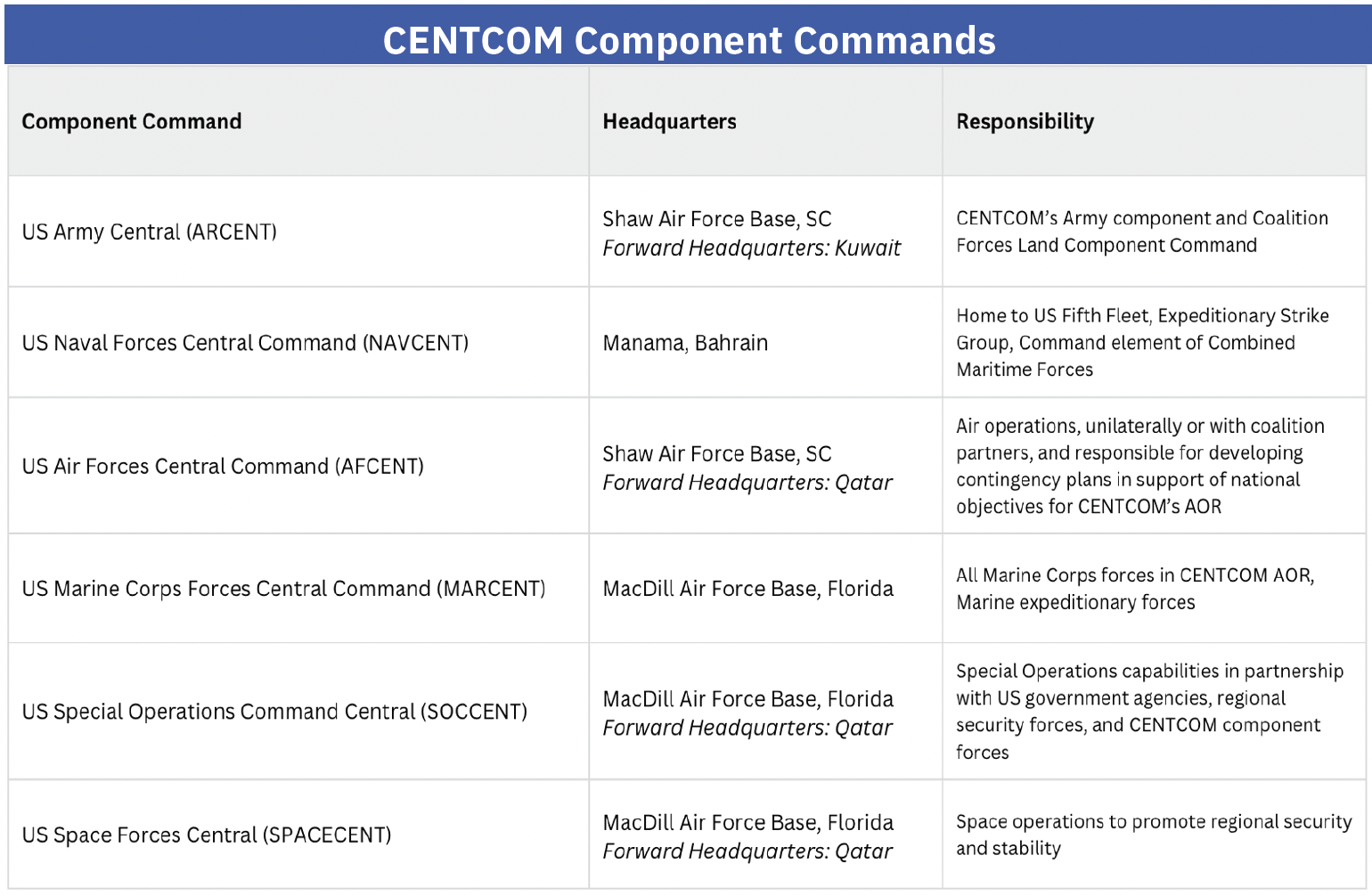
CENTCOM’s key areas of focus include violent extremist organizations (VEOs), nuclear threats, the security of energy flows, and humanitarian challenges. Unlike other geographic combatant commands, it is continuously engaged in active operations. Beyond conventional military activities, it conducts interoperability trainings, security cooperation, and humanitarian assistance. CENTCOM maintains six component commands, including US Naval Forces Central Command (NAVCENT), the Navy’s Fifth Fleet, and US Army Forces CENTCOM Command (ARCENT), the Third United States Army.
Area of Responsibility
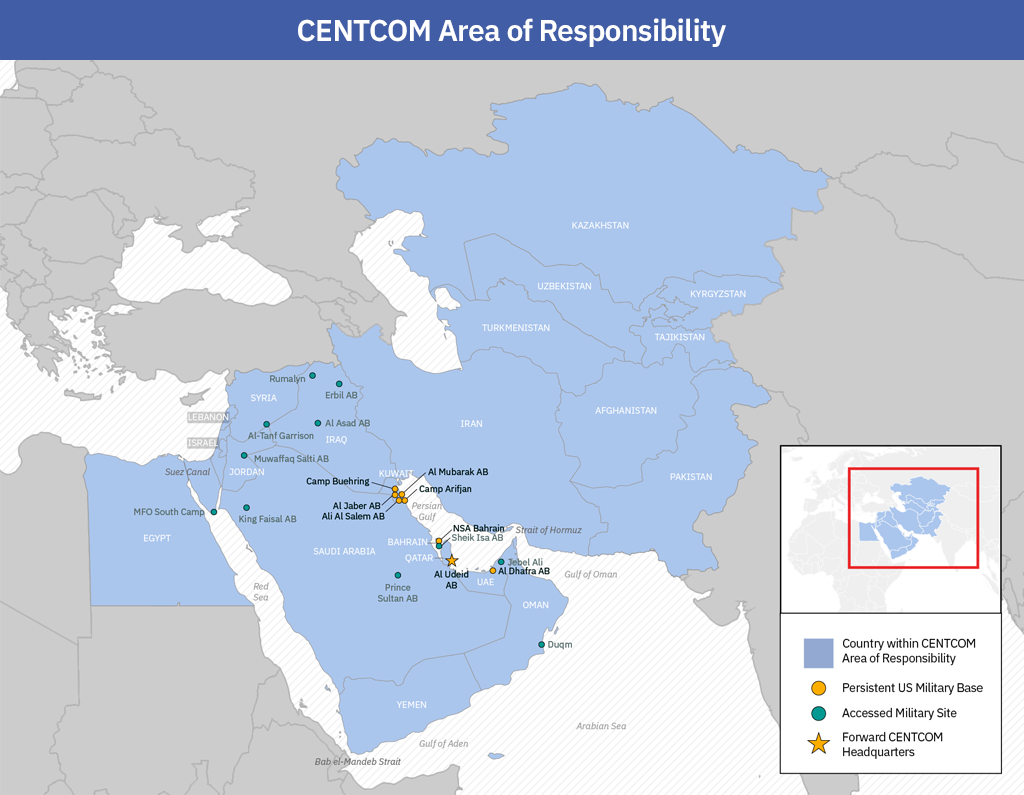
CENTCOM’s area of responsibility (AOR) spans three continents, ranging from Northeast Africa to Central and South Asia, encompassing 21 nations, over 550 million people, roughly 25 ethnic groups, hundreds of languages and dialects, and nearly every form of government. The AOR comprises Afghanistan, Bahrain, Egypt, Iran, Iraq, Israel, Jordan, Kazakhstan, Kuwait, Kyrgyzstan, Lebanon, Oman, Pakistan, Qatar, Saudi Arabia, Syria, Tajikistan, Turkmenistan, the United Arab Emirates, Uzbekistan, and Yemen.
The CENTCOM AOR has a dense concentration of strategic transit routes and economic assets exposed to recurring conflict or terrorism. Vital corridors connecting Europe, Asia, and Africa run through the region, most notably the Strait of Hormuz, Bab el-Mandeb, and Suez Canal, as well as critical crude oil pipelines and key Gulf air and land routes. The AOR produces nearly 30% of the world’s oil, and 30-35% of global maritime trade transits it.
The United States has long-standing security and defense ties with countries across the region. CENTCOM has working security relationships with 20 out of the 21 countries in its AOR, excluding Iran. Washington maintains eight persistent bases at which the DoD has exercised some degree of operational control for at least 15 years and has access to 11 other military sites in the Middle East.
“The Arab Gulf states have been among the most important regional partners for CENTCOM, providing permanent basing access and collaborating on air and missile defense and counterterrorism.”
The Arab Gulf states have been among the most important regional partners for CENTCOM, providing permanent basing access and collaborating on air and missile defense and counterterrorism. Bahrain hosts the US Navy’s Fifth Fleet and supports coalition maritime operations; Qatar hosts al-Udeid Air Base, CENTCOM’s forward headquarters and the largest regional military base; and Kuwait maintains Camp Arifjan, a major logistics hub, and Ali al-Salem Air Base. The UAE’s al-Dhafra Air Base supports air operations and intelligence, surveillance, and reconnaissance (ISR) missions, and hosts the Gulf Air Warfare Center for air- and missile-defense training. Oman and Saudi Arabia are also active partners in missile-defense and security cooperation.
Force Structure and Missions
CENTCOM is composed of six component commands connected to the Army, Navy, Air Force, Marine Corps, Special Operations, and Space Force. These component commands are the mechanisms through which CENTCOM executes and supports operations, and each of them plays a critical role.
NAVCENT, for example, has been key to supporting freedom of navigation in the Bab el-Mandeb chokepoint in the Gulf of Aden. US Air Forces Central (AFCENT) provided the airpower for strikes against Houthi targets during Operation Rough Rider and throughout Operation Hawkeye Strike against the Islamic State (ISIS) in Syria. ARCENT maintains a forward headquarters in Kuwait, leading any land-based operations in the region, while US Marine Corps Central (MARCENT) manages all Marine Corps forces and amphibious readiness. Special Operations Command Central (SOCCENT) focuses on special operations and counterterrorism, including the Defeat-ISIS campaign in Iraq and Syria, while the US Space Forces Central, the newest command, integrates military space power to defend national interests and recently established a campus at al-Udeid. CENTCOM also frequently conducts bilateral and multilateral exercises, including interoperability training, senior military interaction, security cooperation, and humanitarian assistance, in addition to conventional military operations to sustain steady state, crisis, and contingency capabilities.
Security Cooperation
Security cooperation with AOR partners is indispensable to CENTCOM operations. Among non-Gulf states, it centers on counterterrorism efforts and strategic missions. Both Jordan and Egypt are key bilateral partners; Egyptian military forces regularly join US training and assistance programs, such as Bright Star, to build interoperability and enhance communication. Iraq has hosted US and other coalition forces as part of the counter-ISIS mission under Operation Inherent Resolve (OIR), which is set to conclude by September 30, 2026. To help stabilize the region and undermine Iranian reach, the US has supported the Lebanese Armed Forces (LAF) in its efforts to disarm Tehran-backed Hizballah. In Syria, the US operated from a series of installations as part of its efforts against ISIS; on April 16, 2026, the US evacuated its last remaining forces from Qasrak base in Hasakah Province, transferring control to the Syrian army after a deal was reached between Damascus and the Kurdish-led Syrian Democratic Forces (SDF).
US defense materiel and foreign military aid are a central pillar of security cooperation across the AOR. The Foreign Military Financing (FMF) program funds partner purchases of US military equipment and services through the Foreign Military Sales (FMS) program, or through direct commercial contracts. CENTCOM commanders have significant influence over how these funds are prioritized, reinforcing their influence with regional partners and the personal relationships they forge with regional leaders, a practice first established by former CENTCOM Commander Gen. Anthony Zinni.
Leadership and Force Presence
Leadership
CENTCOM’s leadership comprises a commander, deputy commander, chief of staff, and senior enlisted officer. The command is led by a four-star admiral or general, out of MacDill Air Force Base in Tampa, Florida, who reports directly to the secretary of defense and the president. While the Army, Navy, and Air Force train and equip their forces, CENTCOM decides how to deploy them across the AOR.
Command Structure
When the president authorizes military action, the order flows from the secretary of defense down to the CENTCOM commander. The CENTCOM commander directs component commands and has the authority to stand up a joint task force for special operations.
Troop levels in the AOR fluctuate with the security environment and defense priorities. At the height of major operations, there were nearly 160,000 troops in Iraq in 2007 and 100,000 troops in Afghanistan in 2011. Permanently stationed forces number around 5,000-6,000, with the total US force presence typically between 30,000 and 40,000 including temporary deployments. No infantry units are permanently based in the region, and deployed US forces consist primarily of air and logistical elements.
The FY2026 Defense Budget assumed further reductions to “right-size” the forward military presence given the strategic shift toward the Indo-Pacific — though unplanned contingencies regularly upend such assumptions.
“Troop levels in the area of responsibility fluctuate with the security environment and defense priorities. At the height of major operations, there were nearly 160,000 troops in Iraq in 2007 and 100,000 troops in Afghanistan in 2011.”
CENTCOM’s Mission History
Gulf War Era (1990-2001)
After Iraqi forces invaded Kuwait on August 2, 1990, Washington quickly responded by launching Operation Desert Shield on August 7, 1990, followed by Operation Desert Storm on January 17, 1991. A US-led coalition of 40 nations deterred an Iraqi invasion of Saudi Arabia and liberated Kuwait on February 27, 1991.
CENTCOM remained engaged in Iraq throughout the 1990s — providing humanitarian assistance to the Kurds and enforcing a “no-fly” zone north of the 36th parallel under Operation Provide Comfort (1991), enforcing United Nations Security Council resolutions (UNSCRs), and deterring Saddam Hussein. Regional terrorism also shaped the command’s posture: after the 1996 terrorist bombing of Khobar Towers in Saudi Arabia killed 19 American airmen, Operation Desert Focus (1996) repositioned US forces on the Arabian Peninsula to reduce vulnerabilities.
Post-9/11 Era (2001-14)
In response to the attacks of September 11, 2001, President George W. Bush launched Operation Enduring Freedom (2001) to kill or capture the leadership of al-Qaeda sheltered by the Afghan Taliban. US forces swiftly toppled the Taliban government in Kabul. In December 2001 the US and its North Atlantic Treaty Organization (NATO) and associated allies established the International Security Assistance Force (ISAF) to support reconstruction under a UN mandate, while US forces continued counterterrorism operations against remnants of al-Qaeda — a mission that carried on as Operation Freedom’s Sentinel (OFS) after combat operations formally concluded in 2014.
In 2003, a US-led coalition invaded Iraq under Operation Iraqi Freedom, citing Baghdad’s refusal to comply with UN Security Council resolutions on weapons of mass destruction (WMDs) — none of which were found. Following the defeat of Saddam Hussein’s government in Iraq on April 8, 2003, CENTCOM oversaw a prolonged stabilization mission until US forces withdrew in December 2011. They returned in 2014 under OIR in response to the advance of ISIS.
The Fight Against ISIS (2014-19)
ISIS rose rapidly in 2013, exploiting sectarian conflicts to seize territory across eastern Syria and northwestern Iraq. At its peak in 2014-15 it ruled a population of millions through a brutal form of governance, including use of mass atrocities and cultural destruction. In 2014, the DoD formally established the Combined Joint Task Force – OIR (CJTF-OIR) to counter the group.
Working through local partners — the Iraqi Security Forces (ISF) in Iraq and the SDF in Syria — CJTF-OIR and coalition forces reclaimed lost territory and dismantled the group’s infrastructure. Iraq declared victory over ISIS on December 9, 2017, and the US-led coalition formally marked the end of major combat operations in the country in April 2018, transitioning to a train-and-advise mission. The fight in Syria ran longer, ending when the last pocket of ISIS territorial control at Baghuz fell on March 23, 2019.
As OIR transitions toward a bilateral partnership, it continues to advise, assist, and equip partner forces like the ISF to defeat ISIS remnants ahead of the mission’s planned conclusion at the end of September.
CENTCOM in the Current Era (2019-26)
In late 2019 and early 2020, the killing of two high-profile figures by US forces transformed the region’s strategic environment. Abu Bakr al-Baghdadi, the founder and leader of ISIS, was killed in a raid in Syria on October 26, 2019. Less than three months later, on January 2, 2020, in a military drone strike near the Baghdad International Airport, the US assassinated Gen. Qasem Soleimani, the leader of the Islamic Revolutionary Guard Corps’ (IRGC) Quds Force.
In July 2021, the last US troops departed Afghanistan under President Joe Biden according to an agreement with the Taliban drawn up during President Trump’s first administration, finally ending America’s longest war in its 245-year history. The February 2020 Doha Agreement that ended the war was widely criticized — the internationally recognized Afghan government was excluded entirely at the Taliban’s insistence, further eroding the former’s legitimacy and elevating the latter as a co-equal negotiating partner. Kabul fell to the Taliban in August 2021, and they remain in charge today, continuing their systemic attacks on the rights of women, girls, and religious minorities.
Two years later, amid escalating Houthi attacks in the Red Sea, Bab el-Mandeb, and Gulf of Aden, the US and UK launched Operation Prosperity Guardian to target the Iran-backed Yemeni militia. Despite 931 airstrikes, support from a multinational coalition of over 20 partner nations, and a total cost of nearly $7 billion, analysts broadly agree that the operation failed to secure freedom of navigation in the Red Sea or seriously degrade Houthi attack and resupply capabilities.
On April 14, 2024, following the Israeli bombing of the Iranian embassy complex in Damascus earlier that month, Iran retaliated by launching more than 300 missiles and drones toward Israel. The attack marked the first time the two countries had attacked one another directly since the beginning of their proxy conflict. Israel sustained only moderate damage, a result of its multi-layered air defense network. One layer of this network is the US-made terminal high-altitude area defense (THAAD) system first deployed to Israel in October 2024. Regional missile defense — historically incorporating US naval assets and ground-based systems — has been critical to US security cooperation with Israel and several key Arab partners. Each partner has heavily invested in their own air defense systems and can coordinate effectively when needed, but they have yet to achieve full regional integration.
In March 2025, amid intensifying Houthi attacks on Red Sea shipping, the US targeted the Yemeni militant group once again, in Operation Rough Rider. US forces hit its leaders, fighters, and military infrastructure in a series of air and naval strikes before eventually reaching a cease-fire with the group, brokered by Oman, that May.
“In June 2025, in the midst of Israel’s 12-day war with Iran, the United States carried out strikes on three key Iranian nuclear enrichment facilities: Fordow, Natanz, and Isfahan.”
In June 2025, in the midst of Israel’s 12-day war with Iran, the United States carried out strikes on three key Iranian nuclear enrichment facilities: Fordow, Natanz, and Isfahan. Operation Midnight Hammer intended to neutralize the threat posed by Iran’s nuclear program to the US and its allies and partners. While the strikes reportedly inflicted significant damage to uranium enrichment and processing sites and Israel killed nine senior Iranian nuclear scientists, Iran likely still possesses a stockpile of 400 kg of 60% enriched uranium at an unknown location. It has since accelerated construction at Pickaxe Mountain, an underground facility just one mile south of the Natanz uranium enrichment site, and has banned international inspectors from accessing it.
Most recently, CENTCOM commenced Operation Epic Fury (2026) against Iran on February 28, 2026, in coordination with Israel. On the first day of the conflict, Israeli forces killed Supreme Leader Ali Khamenei, in power since 1989 and Iran’s second supreme leader, along with other senior officials. Also on the same day, a Tomahawk cruise missile struck a girls’ elementary school in Minab, Iran. A preliminary US military inquiry concluded that American forces were likely responsible and that the strike was caused by a targeting error due to old intelligence data, resulting in the death of at least 165 civilians. Operation Epic Fury’s stated objectives were to destroy Iran’s missile infrastructure, dismantle its navy and security apparatus, and ensure that Tehran could never acquire nuclear weapons — though regime change was widely understood to be the campaign’s ultimate goal.
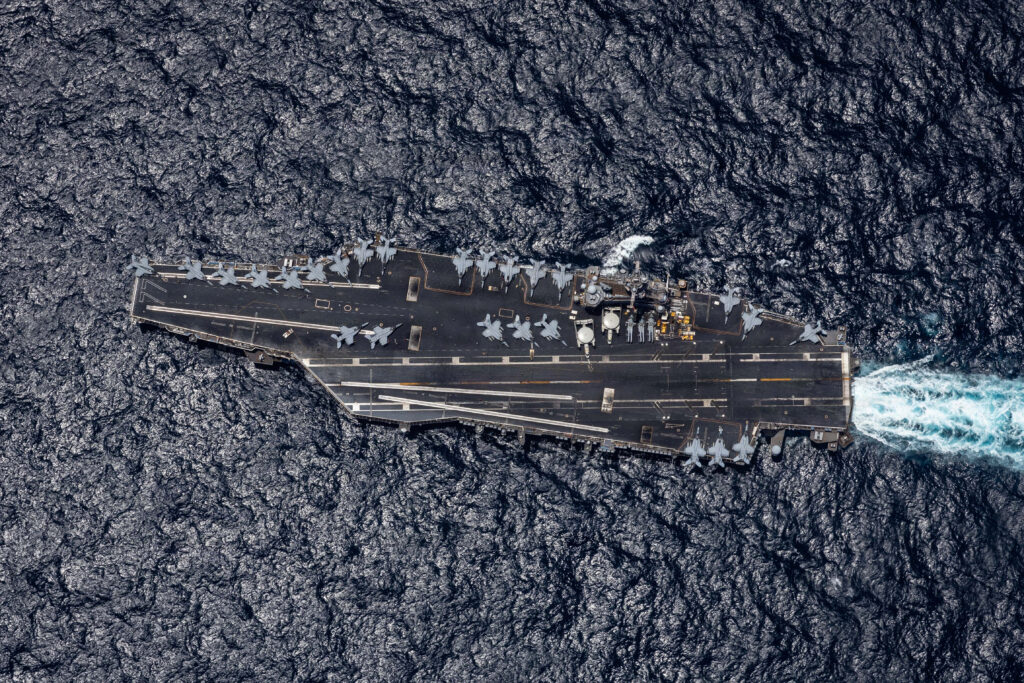
Iran responded with missile and drone strikes against US-allied Arab states, US bases, and Israel, alongside the closure of the Strait of Hormuz. Strikes hit Gulf military installations, including al-Udeid Air Base in Qatar, the headquarters of the US Navy’s 5th Fleet, and Ali al-Salem Air Base in Kuwait, as well as civilian infrastructure, including Jebel Ali port in Dubai. All six Gulf Cooperation Council (GCC) states were directly targeted. Commercial traffic through the Strait of Hormuz fell more than 90%, disrupting critical global trade and energy supply chains. The US subsequently imposed a naval blockade on Iran in April 2026 in an effort to cut off its export revenue. On June 17, Washington and Tehran signed a memorandum of understanding, aimed at ending hostilities, reopening the strait, and beginning more comprehensive talks over Iran’s nuclear program. As of mid-July, the agreement appeared to have collapsed, however, due to disputes over the Strait of Hormuz, leading to renewed strikes across the region.
Current Strategic Environment
Violent extremist groups such as ISIS, al-Qaeda, and other Iran-backed terrorist organizations, like the Houthis, Hizballah, Hamas, and various Iraqi militias, remain an ongoing challenge in the AOR. Consistent counterterrorism pressure and security cooperation allow CENTCOM to monitor these threats to allies, US troops and assets in the region, and potentially to the homeland. The CENTCOM AOR is also a major theater for great power competition, with China and Russia poised to fill potential security vacuums. Recently, China has increased its basing access near key maritime transit routes, such as in Djibouti. Other key partners have been increasingly diversifying their sources of defense materiel in response to constraints on FMS processes as well as concerns over the US’s perceived unreliability and proclaimed disengagement from the region.
The presence of WMDs and risk of nuclear proliferation also present major potential threats to the region. The AOR has a history of both state and non-state actors employing or advancing WMD capabilities — including Iran’s nuclear ambitions, Syria’s employment of chemical weapons in 2017 and 2018, the risk of escalation between nuclear-armed India and Pakistan, and Israel’s unconfirmed possession of a nuclear arsenal — with implications that extend far beyond the Middle East. Conflicts, transboundary challenges, and humanitarian crises have contributed to the region’s chronic instability as well.
Conclusion
CENTCOM was created for a region Washington had decided it could not afford to ignore. More than four decades later, it remains the only geographic combatant command in continuous active operations — even as successive administrations have repeatedly declared their intent to shift American attention and resources elsewhere.
This tension between the region’s stated priority and the US commitment to it, a long-running issue in American Middle East policy, only seems to be increasing. The 2026 National Defense Strategy (NDS), released in late January, asserted that conflict no longer defines the Middle East and listed the region fourth among five global priority regions. Yet just weeks later the US was at war with Iran, the Strait of Hormuz was closed, and every GCC state had been struck — while most of the US military’s deployable assets sat in the Western Hemisphere to support the effort to capture Venezuelan President Nicolás Maduro.
This backgrounder was researched and written by MEI spring/summer 2026 intern Naomi Banner, with input from Senior Fellow Jason H. Campbell.
Top image: Seal of the United States Central Command. Source: CENTCOM.
Access Additional MEI Expertise
The Middle East Institute has a number of renowned experts who are well versed on the topic of the Gulf and the Arabian Peninsula, including MEI Senior Fellow Jason H. Campbell and Vice President for Policy Kenneth M. Pollack. Our experts are available for interviews or commentary.
For assistance with reaching Dr. Campbell or any of our scholars, please send an email to [email protected] or call 202-785-1141 ext. 241.
The Mecca Joint Défense Agreement: A New Geometry of Middle Eastern Power?