This article is part of a collection of short essays written by the Fellows of the Middle East Institute to explore aspects of the ongoing war with Iran. The intent of the collection is to help readers see new and unexpected elements of the dynamics and impact of the ongoing hostilities and to think harder, deeper, and broader about the implications of the conflict. To read the other essays from this collection, as well as download the full report, please click here.
Iran Found Its Lever
The American-Israeli campaign against Iran that began in February 2026 resulted in a regional conflict its authors never intended. The war’s chief product is not what the United States and Israel destroyed, though that was significant, but what Iran proved: that it holds a strategic lever over its neighbors, the world economy, and the US. Iran, after suffering a decapitation of its leadership, decided to use the doomsday assets it already had available in the absence of nuclear weapons: the selective closure of the Strait of Hormuz and attacks on neighboring countries’ energy infrastructure and civilian targets. These tools proved effective, if not immune to countermeasures.
Thus, while Israel again showed its remarkable military capacity and ability to strike Iran, its comparative position is more complicated today than before the war. Simple facts of Gulf coastal geography appear to have had a more significant impact than the most advanced military capabilities.
The war’s “day after” (still not arrived, as of the time of writing) was always likely to hinge on two questions: Would the regime in Iran change? And, if not, would the United States under President Donald Trump have the patience and long-term commitment to stay the course alongside Israel and seek that outcome over time? Regime change, thus far, seems a distant prospect. The second question, despite Trump’s unpredictability, was always likely to be answered in the negative, and for good reason: the American public today has a broad aversion to a lengthy war in the Middle East.
Indeed, while the United States and Israel shared many of the goals of this war, they diverged considerably on others. “Hormuz” as a blanket term for the regional and global economic effects of the conflict was always far more of an American and global concern than it was an Israeli one. Similarly, while the US and Israel share strategic aspirations and ideal outcomes, namely regime change in the Islamic Republic of Iran, they have different prioritizations and sensitivities to time. Israel considers the Iranian threat its number-one national security concern, bar none. It will be beset by this confrontation for years or even decades, unless Tehran’s strategic posture and even its ideology undergo deep change.
The United States has been involved in a rivalry with Iran since 1979, but Iran has never been its top national security concern, and the current president is not known for patience. Trump was, all accounts suggest, hoping for a quick victory, despite warnings to the contrary from his closest aides. And when that victory did not arrive, his view of what a prolonged standoff with Iran would mean differed markedly from that of the Israelis. Israel gambled that regime change would happen within the bounds of a campaign the US would be willing to sustain. That momentous bet has thus far failed to pay off.
There is now no putting the genie back in the bottle. Iran has been weakened in important ways, but it maintains the ability to undermine the strategies of its neighbors, the United States, and Israel.
Israeli Strategy in the Aftermath
Israel’s long campaign since October 7, 2023, is seen domestically as a seven-front war against an axis with a single core: the Islamic Republic of Iran. The elements of Iran’s “ring of fire” around Israel, encompassing Hizballah, Hamas, Iranian attempts to stoke further violence in the West Bank, Iran-backed militias in Iraq and previously in Syria, the Houthis, and Iran itself, were all, in Israel’s eyes, intimately tied together. Israel’s attempt at regime change in Iran was thus the culmination — wildly unrealistic perhaps, if recent reports are the full story, but logically consistent — of its three-year campaign.
This framing also downplayed the importance of the Palestinian issue to regional affairs, a common theme in Prime Minister Benjamin Netanyahu’s thinking. In his 1993 book, A Place Among the Nations: Israel and the World, he included a chapter titled “The Theory of Palestinian Centrality,” in which he argued that this supposition was wrong, insisting the Palestinian issue was a distraction from the bigger issues of the Middle East, not their core. His position has only hardened since, with the Islamic Republic of Iran being the source of many of the regional crises, in his mind, and certainly of Israel’s national security threats.
Israel entered the war seemingly at a high point in its regional campaign against Iran’s proxies and Iran itself. It dealt huge blows to Hizballah’s leadership and infrastructure in September 2024, and effectively, if only partially, degraded Iran’s nuclear and ballistic missile capabilities in the 12-day war of June 2025. Yet having failed to topple the Islamic Republic or fully wipe out its extensive ballistic missile arsenal in the current war, Israel now faces an Iran that has conclusively demonstrated it controls a strategic lever.
Moreover, the longer the war has lasted and the further US and Israeli interests have diverged, the more it has strained US patience with Israel — not only public patience but also that of the administration. Indeed, after nearly three years of long, devastating war, the conflict has not only further damaged Israel’s international standing generally but also undermined the ability of Israel’s own society and military to sustain a lengthy campaign.
The war now leaves Israel, and with it the other parties, in an in-between state, neither full-scale war, for now, nor the promise of long-term quiet. Israel’s fundamentally correct reading of the threat map is unchanged, with Iran at the center of a network of proxies confronting Israel, dramatically weakened but still standing. Israel will not remove its focus from Iran, Hizballah, or the rest of the regime’s regional activity. Its adversaries’ goals have not changed, and simple facts of geography mean that Israel cannot step away from the issue.
Yet the 2025-26 Iran wars and the long multi-front campaign since October 7, 2023, are not sustainable, even on strategic and military grounds alone. The wars have clearly demonstrated Israel’s dependence on the United States. Crucial to Israeli operations in the short and medium terms are US materiel, now stretched thin; US patience; and, indirectly, US public support for Israeli policy, in decline and with significant future consequences. These will not necessarily prevent a return to war, but they do mean that in the longer term Israel will have to rely on an array of options to confront Iran’s network, overt and covert, military and diplomatic, not just sustained fighting. Limits on the ability to conduct full-scale war do not mean Israel must change its understanding of its interests, but it must read the new realities that emerged from the war when charting its strategic course.
There remains, in fact, a woefully inadequate understanding in Israel of the tension between their current policies and continued American support for them. The tension is obscured by the unprecedented cooperation between the Trump administration and Netanyahu’s government in conducting this joint war, a high point of the historic relationship in one sense. Yet this close cooperation both masks and deepens foundational fissures that in the last three years have opened into a chasm now threatening the de facto alliance between the countries. For Israel to pursue a sound policy in service of its own interests with Iran, and for other reasons, it must come to terms with the dramatic change in the American landscape.
The failure to produce regime change must also result in a greater Israeli understanding of the true utility and limits of force. Israel will have to reduce the number of fronts on which it is actively fighting at any given moment. That failure will also do nothing to change the real and prominent place the Palestinian issue holds in both regional affairs and Israel’s own future.
At the same time, Israel will continue to have a very low tolerance for existing and potential threats to its security, especially along its borders with Lebanon, Syria, and the Gaza Strip, a direct result of October 7. Still, reluctance to accept lower-probability security risks need not translate into open-ended fighting. After three years of war and the national election scheduled for October 2026, Israel may begin to wind down some of its military commitments, in Lebanon, especially, and aim to concentrate its efforts on a smaller number of fronts.
It would do well to couple a concentration of effort with a robust attempt to support American diplomatic initiatives, in Gaza and in Syria as well as in Lebanon, where some progress has been made. An Israeli decision to energize these efforts, especially in Gaza, could transform them into something far more meaningful, if still very far from perfect.
The Gulf Dilemma and Israel
The war has also presented Israel with a pair of important strategic questions: how will Gulf countries react to the war in the medium and long term, and how will their reactions affect Israel? Will they distance themselves from Israel, viewing it as a destabilizing force that, along with the US, started a war they were not consulted about and for which they paid a big price? The Gulf states not only sustained most of the direct Iranian fire but also suffered damage to their “business model” as hubs of stability, business, and tourism in the region. Or will they seek closer, if quiet, ties, considering Israel’s proven capacity to help in their defense and given Iran’s proven will and capacity to strike them directly? The answer thus far is decidedly mixed.
Israeli planners tend to be sanguine, pointing to the extensive covert cooperation between Israel and the Gulf, some of it reported. Israel deployed troops and Israeli-made Iron Dome systems in defense of the United Arab Emirates, a remarkable historic precedent of the Israel Defense Forces fighting in active defense of an Arab country against attacks from a non-Arab neighbor. Via US Central Command and in coordination with the US and its other partners, Israel participated in the active defense of many other countries as well. Israelis are partially correct to downplay public warnings of the demise of Arab-Israeli cooperation. That cooperation has continued throughout the years since October 7, 2023, and after the war began in February 2026.
Yet Israeli planners risk underestimating the downside as well. The UAE, the exemplar for close cooperation with Israel, is not the whole Gulf. The response to the war will vary across Gulf countries, with many of them likely to seek some form of quiet post-war accommodation with Iran. Moreover, the effect of public opinion on decision-making in authoritarian countries, while limited, should not be dismissed. The Iran war, following years of devastation in Gaza, has only made cooperation with Israel more difficult for the leaders of these countries. Intra-Gulf tensions may further complicate Israel’s position if the UAE finds itself increasingly isolated from Saudi Arabia and others and singled out for its close ties to Israel.
Finally, Israel’s attractiveness to some of the Gulf states rests not only on its technological and other capabilities but also on their assessment that “the road to Washington passes through Jerusalem.” As was the case with Egypt in the late 1970s, close ties with the US, as a by-product of relations with Israel, were as much an incentive for peace with Israel as was peace itself. Yet this calculation depends on assumptions about the value of close ties to the US and the effect of relations with Israel on those ties. Both assumptions, while still valid, are less obvious than they have been in the past.
The United States demonstrated again its unparalleled might, but given Iran’s ability to withstand months of war and to use its strategic lever, the campaign has also heightened fears about Washington’s willingness to remain militarily engaged in the region in the long run. The countries in the Gulf are unlikely to try to replace the US with any other external backer, but they will probably try to enhance their self-reliance as a hedge. And although relations with Israel could help them greatly in this regard, any diminution of US centrality to the Gulf states, and any diminution in the US-Israeli relationship, could harm Israeli prospects with them as well.
In the short term, there is no easy choice for the Gulf states. America’s desire to end the war points them toward accommodating Iran, as unappetizing as that may be. They are surely aware of the severe downsides of trying to appease Iran. That course of action will not prevent Israel from remaining focused on Iran’s nuclear program, its ballistic missiles, and its regional involvement around Israel, whether through war or other means. Moreover, while the US may deemphasize the issue, there is no guarantee it will not face another confrontation with Iran in the future, either under Trump or another president. Try to accommodate Iran though they may, the Gulf states could still be the targets of renewed Iranian attacks in the future.
They are therefore stuck on middle ground: neither full war nor appeasement is an attractive option. A stable equilibrium may be difficult to find or sustain.
For Israel, this Gulf dilemma has profound ramifications for its regional strategy. Both Israel and the United States hoped to build on Israeli integration in the region, with normalization with Saudi Arabia being the grand prize. Before October 7, senior officials in all three countries believed such a possibility was imminent. After October 7, it remained a core priority for the Biden administration, albeit more remote. Such regional integration had transformative potential for Arab-Israeli relations and for regional economic opportunities.
The Gulf dilemma after the Iran war complicates the possibility of normalization, already a far more remote possibility than it was. If, before the war, cooperation with the US and Israel to stave off Iranian threats and confront them if they emerged was an important motivation for normalization, now that motivation is tempered by the need to hedge. If the US succeeds in extricating itself from the conflict, as it appears to want to do, accommodation with Iran may be required, with Israel losing out.
An Irony of Deterrence
There is an irony in how this war has affected the strength of Israel’s deterrence. On the one hand, its capabilities have proven remarkably effective. Israel, in coordination with the United States, asserted control over Iranian airspace and conducted both the 12-day war and this latest and longer conflict with not a single Israeli aircraft shot down. The campaign demonstrated again the Mossad’s remarkable penetration of the leadership in Tehran, and, together with the US, Israel was able to deal a massive blow to both Iran’s ballistic missile production capacity and aspects of its nuclear program.
Still, deterrence rests in no small part on the threat of the use of force: it is the unknown quality of this threat and the potential pain it involves that lend it some of its power. Once the threat is carried out, the adversary can find itself either cornered or, having been dealt a severe blow and withstood it, less fearful of the next one. In this regard, Israel’s deterrent toward Iran has been diminished. Despite all its capabilities, its ability to inflict enough damage to force Tehran’s new leadership to change its behavior has proven wanting.
This is a recipe for continued confrontation, even if it returns to less overt means. An Iran that faced a full assault and survived, and an Israel still militarily superior and determined to counter Iran’s threat but having failed to end it, both remain determined to stay in the ring. The US, while eager to walk away, perhaps will find itself dealing with this ongoing confrontation going forward. Little has been settled by the Iran war thus far, except Iran’s newly demonstrated lever of power in regional and global affairs.
Natan Sachs is a Senior Fellow at the Middle East Institute.
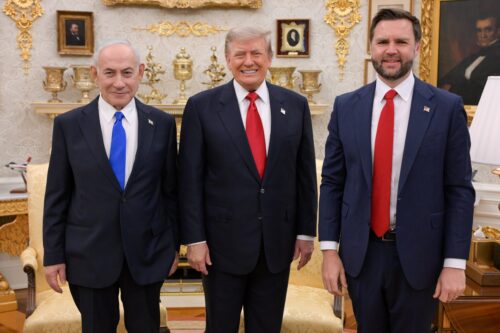
Top image: US President Donald Trump and Vice President JD Vance (R) meet Israeli Prime Minister Benjamin Netanyahu at the White House in Washington, DC, on July 28, 2026. Photo by Maâayan Toaf (GPO) /Handout /Anadolu via Getty Images.
The Middle East Institute (MEI) is an independent, non-partisan, not-for-profit, educational organization. It does not engage in advocacy and its scholars’ opinions are their own. MEI welcomes financial donations, but retains sole editorial control over its work and its publications reflect only the authors’ views. For a listing of MEI donors, please click here.
Yemen: The Houthis’ Role in the Next Evolution of the Axis of Resistance
US Regional Defense Policy: Strategic Prioritization and the Promotion of Collective Defense