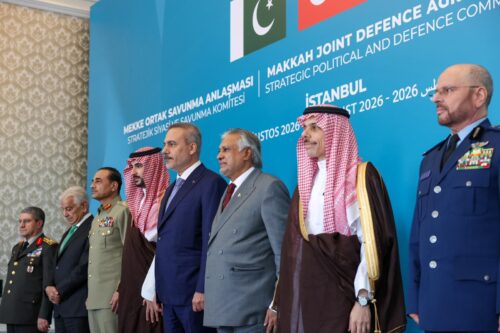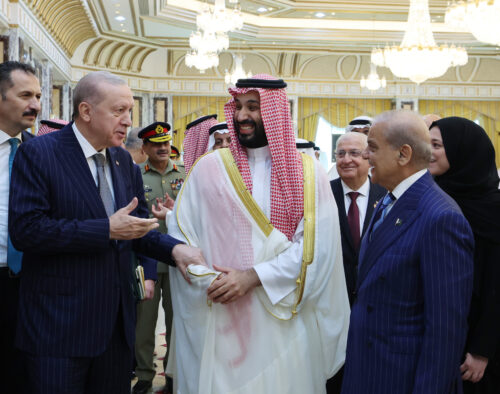
Last August, Pakistan, Saudi Arabia, and Turkey signed the Mecca Joint Defense Agreement, subsequently rechristened the Mecca Defense Alliance, which built on an earlier military pact between Pakistan and Saudi Arabia. The trilateral Mecca alliance has attracted widescale attention in part because its language — still not officially released — allegedly contains a clause closely akin to the North Atlantic Treaty Organization’s Article 5, wherein an attack on one member shall be treated as an attack on all.
While groundbreaking, it raised myriad questions. What constitutes an attack? What would be the nature of the Mecca allies’ support for one another: technical, logistical, or military? Why has Egypt, though seemingly a natural and increasingly close security partner of Saudi Arabia, conspicuously not joined the grouping as its fourth member? And to the degree that the Mecca Defense Alliance signals a regional desire to no longer rely on the United States as a security guarantor, does this trilateral collective defense pact actually challenge or undermine long-running US relationships with key Middle Eastern players?
Speaker Biographies
Dr. Yasmine Farouk has over 20 years of experience in research and practice focused on the Gulf region and Egypt. Her previous roles include consulting for the Cabinet of the Egyptian Prime Minister and serving as the research director at the Cairo International Center for Conflict Resolution, Peacekeeping, and Peacebuilding (CCCPA) at the Egyptian Ministry of Foreign Affairs.
Mirette F. Mabrouk is a senior fellow at the Middle East Institute (MEI), where she focuses on economic development, regional security, and sustainable development issues in the Middle East and North Africa. Prior to joining MEI, Ms. Mabrouk served as the deputy director and director for research and programs at the Rafik Hariri Center for the Middle East at the Atlantic Council. She was also a fellow at the Project for US Relations with the Middle East at the Brookings Institution.
Dr. Gönül Tol is a senior fellow at the Middle East Institute (MEI), where she focuses on Turkish politics, US-Turkey relations and regional dynamics in the Middle East. A frequent commentator, Dr. Tol has written extensively on Turkish domestic and foreign policy for publications such as Foreign Affairs, The New York Times, Foreign Policy, and The Financial Times.
Ambassador (ret.) Joey R. Hood (Moderator) served in diplomatic leadership positions across the Middle East and North Africa. In Washington, he was the Acting Assistant Secretary of State for Near East Affairs in 2021. In that capacity, he was the first senior official to visit Libya in over seven years, and visited Morocco to affirm the new Administration’s views on the Kingdom’s southern provinces, also known as Western Sahara.


Special Episode: Saudi Oil After the East-West Pipeline Attack
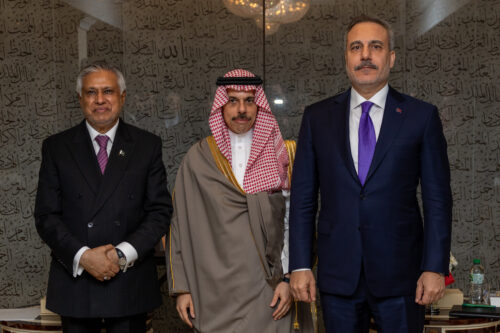
The Mecca Joint Défense Agreement: A New Geometry of Middle Eastern Power?