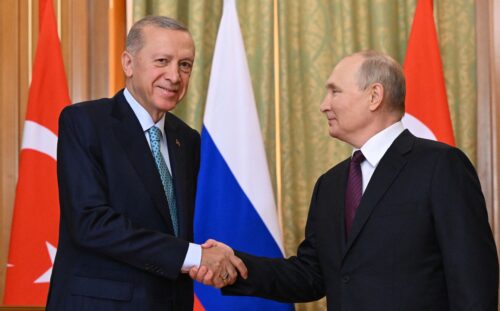
After a decade of post-Arab Spring isolation, Turkey’s leaders have recognized that their ambition to position the country as an agenda-setter on the world stage requires active engagement in all directions. President Recep Tayyip Erdoğan’s consolidation of executive authority has centralized foreign policy decision-making and tied it to his domestic political priorities, transforming the country’s revisionist approach to one shaped primarily by personal and pragmatic interests. Confronted with economic challenges, sanctions, and military overextension, Ankara entered the 2020s aiming to convert previous assertiveness, once a source of regional alienation, into a broader stabilization campaign.
Today, Turkey positions itself as a broker, arms supplier, and mediator. It balances rival blocs, maintains North Atlantic Treaty Organization (NATO) commitments while bidding for membership in the BRICS grouping of major emerging economies, and pursues independent diplomacy across key ge0political zones of competition, from Syria to the Sahel. Turkey has reemerged as a pivotal power determined to achieve greater autonomy not by exiting the Western system but by repositioning itself within it.
Ideological Foundations
Turkey’s multidirectional foreign policy reflects the interaction between long-standing ideological traditions and Erdoğan’s populist practice of adapting them to shifting circumstances — especially his perception of his domestic political circumstances. Turkish Islamism, Ottomanist nostalgia, civilizational discourse, nationalist-maritime doctrines, and selective Westernism all supply vocabularies and symbols. But Erdoğan has drawn on these traditions selectively and instrumentally, manipulating them to sustain coalitions, neutralize rivals, and assert political dominance accordingly.
Long before Turkish officials spoke of the importance of strategic autonomy from the West, Ottoman and early Republican thinkers envisionedIttihad-i İslam (Unity of Islam) as a response to European imperial dominance. Figures such as poet‑activist Necip Fazıl Kısakürek and Necmettin Erbakan, who served as prime minister from 1996 to 1997, laid the cultural and political foundations of Turkish Islamism, respectively. Kısakürek, whom Erdoğan has referred to as “my master,” advanced a leader-centric political vision that framed Turkish society as one that struggled between a corrupt Westernized elite and an authentic, pious public, while Erbakan and his Milli Görüş (National View) movement supplied a modern political framework that emphasized Muslim industrial self‑reliance. Such ideas shaped the intellectual environment of Erdoğan’s Justice and Development Party (AKP), which was founded in 2001 and came to power in elections the following year, and they provided him with a reservoir of symbols he could appropriate selectively to serve shifting populist aims.
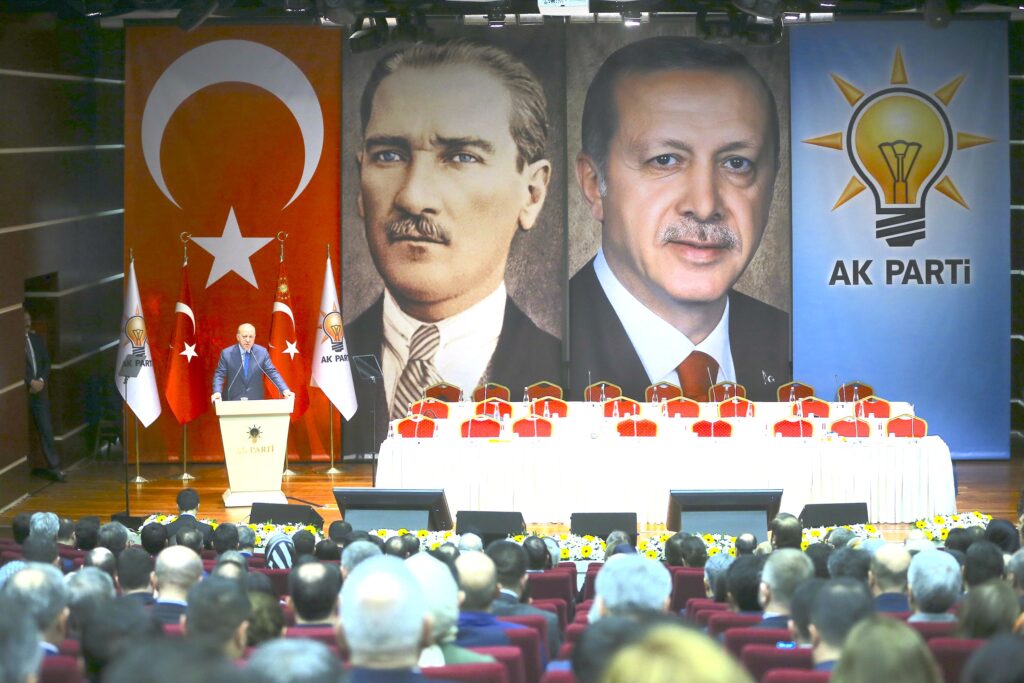
Turkish President Recep Tayyip Erdoğan delivers a speech during a meeting with provincial heads at the ruling Justice and Development Party (AKP) headquarters in Ankara, Turkey, on March 11, 2020. Source: Halil Sagirkaya/Anadolu Agency via Getty Images.
Ahmet Davutoğlu, an academic theorist best known for his 2001 book Strategic Depth before serving as Erdoğan’s advisor, foreign minister from 2009 to 2014, and prime minister from 2014 to 2016, translated these currents into a strategy of de-escalation and regional integration known as “Zero Problems with Neighbors.” Though Davutoğlu avoided the overtly religious language of Kısakürek or Erbakan, his civilizational framework drew on the same Islamist critique of the post-Ottoman order and on the rejection of the Turkish Republic’s founding-era instinct to maintain a distance from the Middle East. He argued that the region possessed a historically natural unity disrupted by an “abnormal” century shaped by Western intervention and the Cold War. Therefore, he sought to stabilize Turkey’s periphery in anticipation of an eventual moment of “normalization,” when authoritarian regimes would give way to popular rule, closing a century shaped by colonial borders and reopening space for Turkish leadership in the region. In this sense, Davutoğlu translated the Islamist intellectual inheritance into a strategic doctrine that Erdoğan could mobilize for populist and geopolitical ends.
A separate tradition, the Mavi Vatan (Blue Homeland) maritime doctrine emerged in the late 2000s from the Eurasianist movement — a nationalist-leftist and anti-Western movement advocating closer alignment with Russia and China — and gained political salience after 2016. It casts Turkey as a besieged maritime nation constrained by Greece and its allies. Erdoğan selectively integrated its anti-Western themes in the late 2010s because they resonated with his nationalist coalition partners and reinforced a populist narrative of encirclement that justified a more assertive and militarized regional posture.
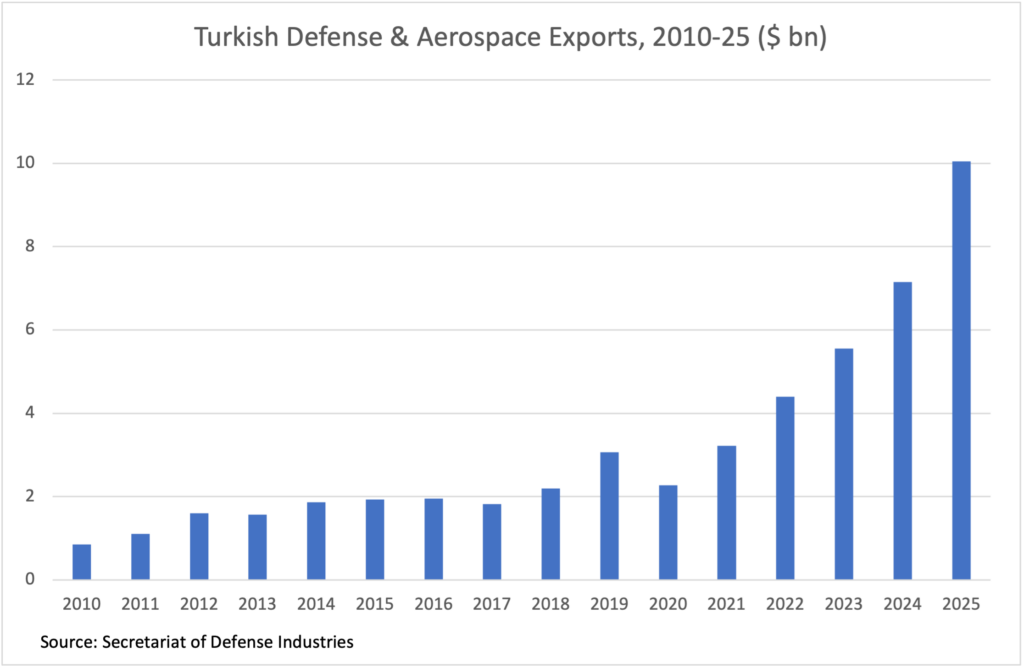
Taken together, these traditions form a hybrid ideological toolkit which Erdoğan draws from as circumstances demand. Key figures in his circle have been shaped by this ideological inheritance, including İbrahim Kalın, a scholar of Islamic philosophy-turned foreign policy advisor who now serves as director of the National Intelligence Organization (MİT), and technocratic actors like the Bayraktar brothers, whose drone exports are on the path to realizing Erbakan’s dream of self-reliance and have made Selçuk Bayraktar (Baykar chair and chief technology officer and Erdoğan’s son-in-law) a household name. Even Foreign Minister Hakan Fidan, a figure famous for his pragmatism rather than ideological conviction, is well versed in the language of Turkish-Islamic civilizational independence.
Erdoğan has some flexibility to manipulate these ideological tenets to suit his needs but is ultimately constrained by them as well. It is this interplay, rather than any fixed doctrine, that underpins Turkey’s foreign policy and shaped how Erdoğan navigated the dramatic regional upheavals of the Arab Spring era, when he briefly aligned ideological symbolism with ambitious regional strategy only to discover that neither was sustainable once the uprisings failed to unfold as he had expected.
“During the 2000s, the ‘Zero Problems’ doctrine allowed Erdoğan to pair pro-European Union and pro-NATO credentials with outreach to Muslim-majority states.”
Activism to Isolation: 2010 to 2016
During the 2000s, the “Zero Problems” doctrine allowed Erdoğan to pair pro-European Union and pro-NATO credentials with outreach to Muslim-majority states, offering a platform for expanding Turkey’s influence without challenging the regional status quo. The collapse of that status quo to the Arab Spring revolutions in 2011 forced a decisive break from the logic that had underpinned the AKP’s foreign policy in its first decade in power.
Erdoğan’s populist instinct to champion the “authentic” Muslim street, combined with Davutoğlu’s Ottoman-Islamic civilizational reading of the moment, pulled Turkey into an overtly moralized and revisionist foreign policy posture.
Across the region, Turkey backed Muslim Brotherhood-linked actors such as Egypt’s Freedom and Justice Party, led by Mohamed Morsi, and Tunisia’s Ennahda Movement. For the AKP, the Muslim Brotherhood represented a parallel model of Islamist governance that combined electoral legitimacy with religious conservatism; their affinity for one another continues to be rooted in shared assumptions about political order, popular sovereignty, and the role of religion in public life.
In Syria, however, where no comparable Brotherhood actor existed for Ankara to support, Turkey backed a fragmented opposition against Bashar al-Assad, expecting that the uprisings would nonetheless yield a sympathetic post-authoritarian government.
Arab publics cheered for Erdoğan as Turkey shifted from a status quo power to a champion of regional transformation. But Turkey’s gamble soon backfired as the uprisings failed to deliver Ankara’s desired outcomes.
The emerging Syrian civil war brought refugee inflows, jihadist spillover, and deepening discord with Washington over cooperation between the United States and the Kurdish People’s Protection Units (YPG); Ankara viewed Washington’s partnership with the Syrian Kurdish militia — a group Turkey considers an extension of the Kurdistan Workers’ Party (PKK), which for four decades led an insurgency against the Turkish state — as a direct threat to its territorial integrity and evidence that the US was subordinating its alliance commitments to short-term counterterrorism priorities.
“Turkey’s continued support for the Muslim Brotherhood after Morsi’s 2013 ouster triggered a rupture with Cairo’s new leadership and accelerated estrangement from Riyadh and Abu Dhabi.”
Meanwhile, Turkey’s continued support for the Muslim Brotherhood after Morsi’s 2013 ouster triggered a rupture with Cairo’s new leadership and accelerated estrangement from Riyadh and Abu Dhabi, which viewed Erdoğan’s overt support for the transnational Islamist movement, combined with the AKP’s own blend of Sunni populism and republican legitimacy, as an existential threat to their monarchical systems.
As regional and Western partners turned away, Turkish officials defended the country’s growing estrangement as moral virtue and proof that Ankara was committed to upholding Turkish-Islamic principles, with then-presidential advisor Kalın referring to his country’s predicament as “precious loneliness.”
Domestically, Turkey entered a period of deep political instability, which strained state capacity and often heightened international scrutiny of Erdoğan and his government. The violent crackdown on the 2013 Gezi protests signaled a turn away from tolerance of civic pluralism and intensified Western concerns about democratic backsliding; the AKP’s fallout with cleric Fethullah Gülen’s Islamic movement later that same year led to a power struggle over state control; and the collapse of the Kurdish peace process in 2015 renewed conflict in Turkey’s southeast. These crises culminated in the July 2016 coup attempt, which shifted Ankara toward a far greater focus on regime security in both its internal and external policies.
Presidentialization and Militarization: 2016 to 2021
Erdoğan had long used foreign policy as a tool for domestic political consolidation, but after the 2016 coup attempt, this linkage became fully institutionalized: regime security and national security were fused into a single framework. Erdoğan purged a significant portion of the state bureaucracy and began to shift from a separation of powers under a parliamentary system to an executive presidency. Formalized in 2018, this transition concentrated foreign policy decision‑making, as well as defense procurement, in the hands of the president; meanwhile, the Ministry of Foreign Affairs was hollowed out, its role diminished, and career diplomats replaced by AKP loyalists.
At the same time, the AKP formed a governing coalition with the Nationalist Action Party (MHP) and Eurasianist networks, which increasingly became embedded within the security, intelligence, and defense bureaucracies after 2016. The MHP viewed Turkey as encircled by the United States via the YPG in Syria and by the EU through its member states Greece and Cyprus in the Eastern Mediterranean. According to their thinking, this legitimized the coercive posture of the Mavi Vatan doctrine as well as Turkey’s expeditionary operations in Syria, Iraq, the South Caucasus, and Libya, where Ankara’s drone exports helped its partners win decisive victories.
This coercive posture was complemented by a centrally coordinated influence apparatus. Through the Presidency of Religious Affairs (Diyanet), Turkey expanded its religious and cultural influence across the Balkans, Central Asia, and Western Europe, straining relations with key host countries for the Turkish diaspora, like Germany. Meanwhile, humanitarian and development assistance to the Sahel, the Hornof Africa, and South-East Asia provided Turkey with additional avenues for expanding its reach.
Erdoğan’s post-coup-attempt approach to foreign policy played well with his nationalist coalition partners and bolstered his strongman image at home, but it soon faced mounting constraints — some imposed by adverse regional and global conditions, others self-inflicted through strategic miscalculation.
By the turn of the decade, Turkey was confronting a severe economic crisis marked by soaring inflation, a collapsing lira, depleted foreign exchange reserves, and limited access to Western capital amid investor flight. Turkey’s 2019 purchase of the S-400 surface-to-air missile system from Russia cost it its place in the US-led F-35 fighter jet program and triggered US sanctions under the Countering America’s Adversaries Through Sanctions Act (CAATSA). In the contested waters of the Eastern Mediterranean, Turkey’s energy brinkmanship was met with EU countermeasures. Meanwhile, Saudi and Emirati frustrations with Turkey over its alignment with Qatar and its backing of Muslim Brotherhood-linked actors spilled into new arenas, such as the conflict in Libya, and compounded economic pressure. As the fog of COVID-19 started to lift, military overstretch, dual sanctions, and economic woes made clear that Turkey’s unilateral bid for regional primacy and its growing dependence on Russian energy, Qatari liquidity, and Chinese imports had reached its limits.
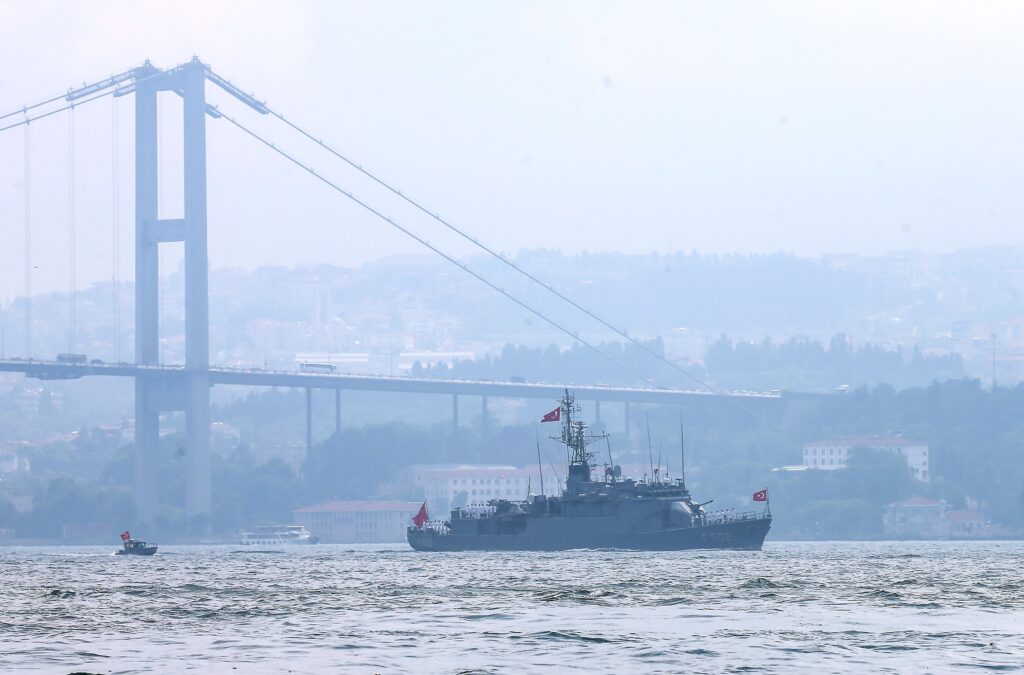
Turkish patrol ship TCG Bandirma passes through the Bosphorus on May 25, 2019. Source: Isa Terli/Anadolu via Getty Images.
Reset and Pragmatism: 2021 to Today
Mounting economic and diplomatic constraints prompted a reset: Turkey worked to ease tensions with most major regional actors to stabilize its economy and restore investor confidence. Unlike the integrative ambitions that underpinned “Zero Problems,” this normalization has been narrower and more transactional. Restoring trade, attracting Gulf investment, and regaining diplomatic access were prerequisites for sustaining a degree of autonomy from both regional and Western pressure, particularly sanctions and defense restrictions intended to constrain Turkey’s security and procurement choices. Within this recalibration, Ankara revived its bid for BRICS membership, partly as a signaling device to diversify partnerships, enhance bargaining leverage with Western allies, and reinforce Turkey’s claim to strategic autonomy.
Beginning in late 2021, Turkey reopened relations with the UAE and Saudi Arabia to attract investment. It likewise worked to depoliticize its rivalry with Egypt, with normalization accelerating in 2023 after a decade of estrangement. In the Eastern Mediterranean, Turkey sought to reduce risks through overtures to Israel (before October 7, 2023, and the war in Gaza) and Greece, drawing on leverage generated by the 2019 maritime boundary agreement with Libya’s Tripoli-based Government of National Accord (GNA), which exchanged Turkish security support for recognition of Ankara’s maritime claims aimed at disrupting emerging maritime arrangements made by Greece, Cyprus, Egypt, and Israel. Turkey even entered cautious talks with Assad, mediated by Russia, to assess whether it could align its security priorities with its goal of enabling Syrian refugee returns ahead of the 2023 general election.
Russia’s 2022 invasion of Ukraine provided a clear test case for Turkey’s recalibrated method. Ankara armed Kyiv and restricted warship transit through the Bosphorus and Dardanelles straits under the Montreux Convention yet refused to join Western sanctions regimes and expanded trade with Russia. The Black Sea Grain Initiative showcased Turkey as a crucial broker. Within NATO, the same balancing logic saw Erdoğan leverage Sweden’s 2024 accession to the organization to secure progress on acquiring F-16s and counterterrorism statutes while staying firmly within the Alliance’s protective framework. Turkey’s leverage over Europe has also rested on its role as a gatekeeper of migration since the 2015 EU-Turkey deal to restrict refugee flows, as well as on its growing appeal to European states seeking to bolster their defensive capabilities in the wake of Russia’s war in Ukraine.
The fall of Assad in Syria in December 2024 marked a major victory for Turkey. With an Ankara-friendly government in Damascus, Erdoğan saw a new opening to merge foreign and domestic agendas. Turkey-backed militias and reconstruction plans in northern Syria now serve a dual purpose: weakening the YPG to address security concerns along Turkey’s southern border, while promoting “voluntary” refugee returns to Turkish-controlled areas of northern Syria to ease nationalist resentment over security and refugee numbers at home. Separately, imprisoned PKK head Abdullah Öcalan’s March 2025 call for PKK disarmament strengthened Erdoğan’s hand in Iraq, where the group’s entrenched presence and its ties to Iran had complicated Turkey’s efforts to expand trade, energy cooperation, and regional connectivity.
“The fall of Assad in Syria in December 2024 marked a major victory for Turkey. With an Ankara-friendly government in Damascus, Erdoğan saw a new opening to merge foreign and domestic agendas.”
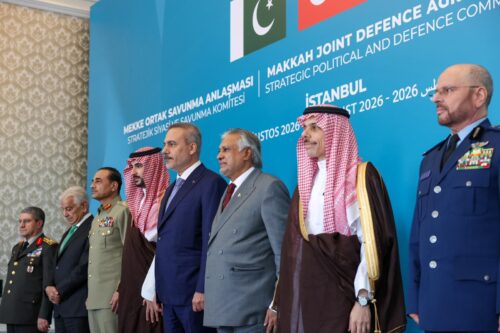
The war in Gaza tested Turkey’s recalibrated diplomacy by forcing Erdoğan, in the face of the AKP’s post-2024 local election setbacks and mounting criticism from Islamists, to pair uncompromising pro-Hamas rhetoric with the pragmatic engagement required to remain relevant in the October 2025 cease-fire negotiations. Turkey’s successful coordination with Qatar and the United States has granted it a role in Gaza’s reconstruction and post-war oversight, including a seat on President Donald Trump’s Board of Peace. Though subject to ongoing regional maneuvering, this achievement represents a symbolic and practical victory, reinserting Ankara into a diplomatic arena from which it had been largely marginalized since 2013 due to its break with Israel and overt support for Hamas and the Muslim Brotherhood. Turkey has also played a role in regional efforts, alongside Pakistan, Saudi Arabia, and Egypt, to negotiate a deal to end the war between the US and Iran.
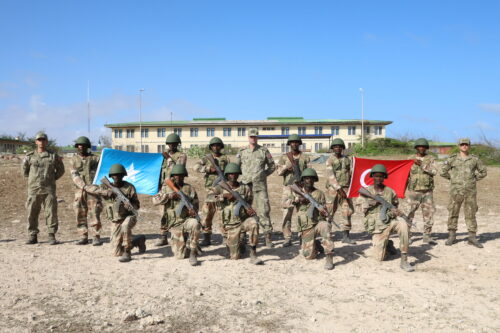
Defense-industrial diplomacy has become a cornerstone of Turkey’s realpolitik. From Central Europe (Poland, Hungary) to Africa (Ethiopia, Somalia, Niger) and the Caucasus and Central Asia (Azerbaijan, Turkmenistan), Baykar drones and armored vehicles have embedded Ankara within local militaries through training and maintenance contracts. These partnerships have reinforced Turkey’s reputation as a problem-solver among non-Western states and expanded its footprint, at times even finding it arming rival actors.
Energy diplomacy has reinforced Turkey’s transactional leverage. Revived pipeline talks with Iraq and Azerbaijan, as well as swap schemes with Iran and Turkmenistan and plans for Syrian and Eastern Mediterranean corridors, are meant to transform the country into a gas hub, enabling Ankara to sell interdependence to both Europe and Russia.
In this emerging system, Turkey’s tools of statecraft, including migration management, energy corridors, defense exports, mediation platforms, and Gulf financial inflows, serve as currencies in a marketplace of reciprocal concessions. Each transaction reinforces Ankara’s effort to project Turkey and its prevailing leader as an indispensable intermediary between East and West.
Takeaways
Over two decades of AKP rule, Turkey has shifted from the “Zero Problems” normalization strategy to the moralized activism of the early 2010s, the militarized unilateralism of the late 2010s, and, finally, the transactional pragmatism that has so far defined Erdoğan’s third decade in power. Rather than a coherent grand strategy, these shifts reflect repeated misjudgments about regional dynamics and foreign perceptions of Turkey, combined with Erdoğan’s shifting domestic political imperatives. Ankara’s pursuit of autonomy has thus unfolded through correction and constraint within the Western security architecture.
While Davutoğlu’s vision aimed to reduce geopolitical friction, Erdoğan’s approach since the Arab Spring has often treated such friction as geopolitical capital, sometimes extracting advantage, but frequently at high diplomatic and economic cost. The result is a foreign policy whose coherence lies not in ideology but in strategic non-alignment deployed for national (and increasingly personalistic) advantage. Whether this reflects a durable strategic pattern or merely Erdoğan’s latest adaptation to structural limits, Turkey’s multi-vectoral engagement continues to position it as a pivotal, though unpredictable, actor in the new Middle East.
This backgrounder was researched and written by MEI winter 2025 intern Jonathan Breibart, with input from Senior Fellow Gönül Tol.
Top photo by Nick Potts/PA Images via Getty Images.