
Each issue of The Middle East Journal includes book reviews that are among the most respected, comprehensive, and up-to-date in the field of Middle East studies. Here are 10 recommended titles selected by our Book Review Editor and Editor from reviews published in this year’s issues.
The full reviews have been set to free access for a limited time, so check out the list and, if not already, consider subscribing here to receive print copies of MEJ as well as electronic access to issues dating back almost 20 years.

The Hamas Intelligence War against Israel
by Netanel Flamer (Cambridge University Press)
“I argue this work could become a ‘quiet classic’ for former and current intelligence professionals … As a professor of intelligence studies, I appreciate Flamer’s approach. As a former US Marine Intelligence officer and Senior Executive US intelligence official, Iadmire his detail, and the lessons learned about an adversary of which I thought I had an honest understanding. Nevertheless, I realize even I underestimated to a degree Hamas’s complex intelligence gathering and use.”
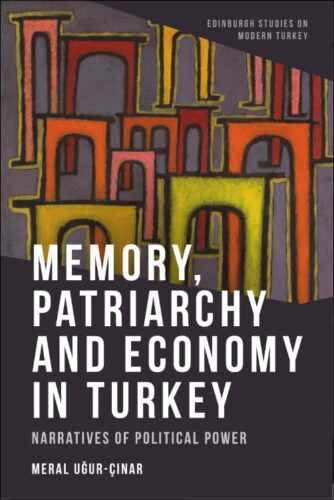
Memory, Patriarchy and Economy in Turkey: Narratives of Political Power
by Meral Uğur-Çınar (Edinburgh University Press)
“Memory, Patriarchy and Economy in Turkey is remarkable in many aspects, including the breadth of its cases (Turkey, Austria, Hungary, the US, and the EU), the careful use of interpretive methods, and its ambition to weave together so many sites and texts — ranging from political speeches to museum objects as well as graffiti and slogans from protests — in order to understand the role of narratives in contemporary politics, especially in relation to dynamics of populism and authoritarianism. The book will be of interest not only to scholars of Turkish or Middle Eastern politics but those interested in understanding the role of narratives globally.”
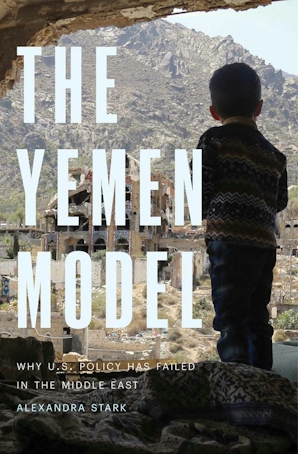
The Yemen Model: Why U.S. Policy has Failed in the Middle East
by Alexandra Stark (Yale University Press)
“The Yemen Model is a fascinating examination of Washington’s thinking behind policy toward Yemen during the rise of al-Qa‘ida in the Arabian Peninsula in 2009 and the Arab Spring, through the 2014 coup by Ansar Allah (the Zaydi Shi‘i Islamist group known as the Huthis) and the war of 2015–22 (but does not include the more recent Huthi attacks on shipping in the Red Sea). The detailed investigation of the problems behind Saudi targeting with Washington insiders responsible for helping mitigate the high rate of civilian casualties is an invaluable contribution. And the chapter on the activist campaign to get Congress to utilize the War Powers Act to stop American support for the Saudi campaign is a captivating insider account.”
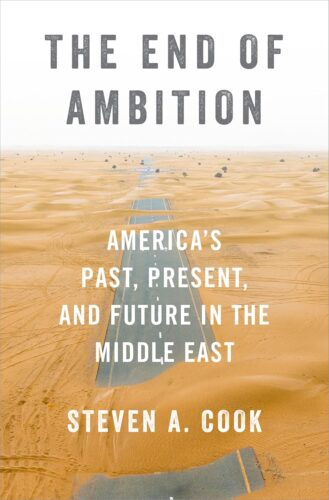
The End of Ambition: America’s Past, Present, and Future in the Middle East
by Steven A. Cook (Oxford University Press)
“The End of Ambition is an excellent corrective to the all too frequent assessments in recent years that the US either no longer has vital interests in the Middle East or that only US leadership can resolve the region’s conflicts. Cook acknowledges that the US cannot withdraw from the region but argues for a judicious focus on core interests and achieving them at an acceptable cost.”
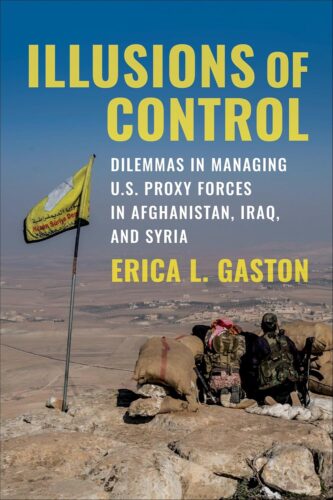
Illusions of Control: Dilemmas in Managing U.S. Proxy Forces in Afghanistan, Iraq, and Syria
by Erica L. Gaston (Columbia University Press)
“Illusions of Control is a book I wish had been out when writing my own, which focused more on the norms that should govern proxy relationships. Gaston’s insights into the interaction between principal-agent theory and bureaucratic policy analysis illuminate sources of moral hazard necessary for understanding how norms arise under these conditions and which ones will be effective. Moreover, her thorough research and well-developed cases move the discussion from the conceptual to the concrete, making her work valuable for both academics and practitioners. By challenging the ‘illusions of control’ that underpin many international interventions, Gaston encourages readers to rethink their assumptions and adopt more reflective and context-sensitive approaches.”
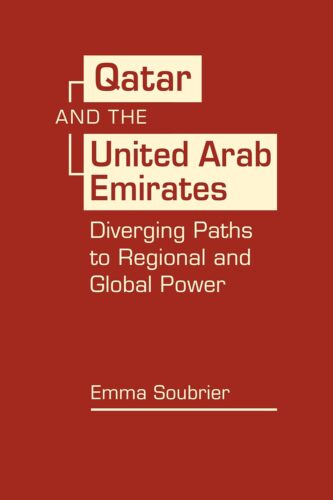
Qatar and the United Arab Emirates: Diverging Paths to Regional and Global Power
by Emma Soubrier (Lynne Rienner)
“This book is a welcome evolution from the accomplished single-state studies produced by scholars such as David Roberts and Kristian Coates Ulrichsen. It also has a multidisciplinary approach, which sets it apart from regional surveys of economies or politics … [It] is important, covers policy as well as various theories that explain and justify those policies, and could be applied with utility to other regions of the world.”
Reviewed by David B. Des Roches
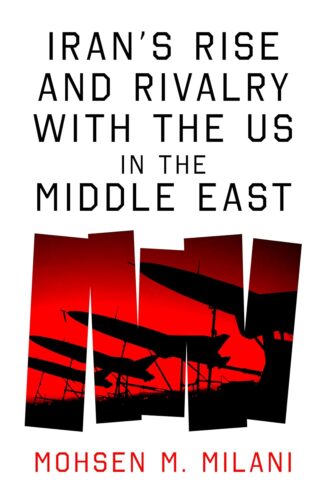
Iran’s Rise and Rivalry with the US in the Middle East
by Mohsen M. Milani (Oneworld Publications)
“Iran’s Rise and Rivalry with the US in the Middle East is a deeply informed and analytically rigorous account of one of the most complex bilateral relationships in global politics. Its realist framing provides a sturdy foundation for understanding the material stakes of the rivalry, while its empirical chapters gesture toward a broader explanatory palette that includes ideational, institutional, and domestic sources of
behavior. Rather than a limitation, this tension is what makes the book valuable: it opens space for interdisciplinary dialogue and invites readers to think beyond the boundaries of any one theoretical approach.”
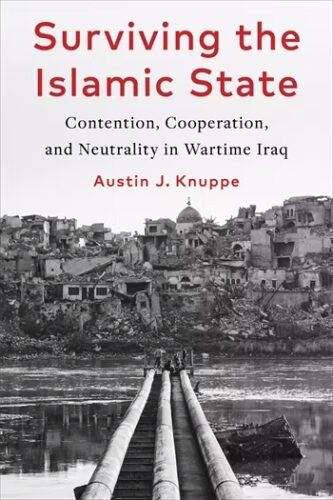
Surviving the Islamic State: Contention, Cooperation, and Neutrality in Wartime Iraq
by Austin J. Knuppe (Columbia University Press)
“Surviving the Islamic State: Contention, Cooperation, and Neutrality in Wartime Iraq, by Austin Knuppe, is an important and welcome addition to research on civilian populations in war, the rise and fall of the ISIS insurgency, and the politics of contemporary Iraq … The book shines for its careful mixed-methods analysis, its empirical richness, and its respect for Iraqis’ struggle under ISIS.
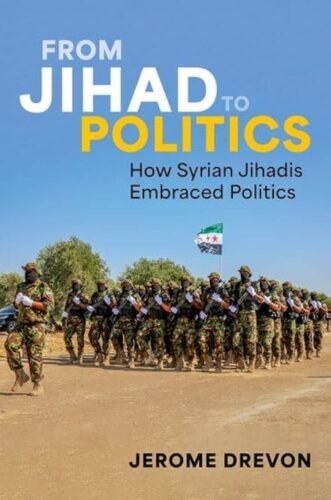
From Jihad to Politics: How Syrian Jihadis Embraced Politics
by Jérôme Drevon (Oxford University Press)
“From Jihad to Politics is a tour de force: it not only provides a timely investigation into the background and evolution of the new rulers of post-Assad Syria, but also makes substantial contributions to Syrian studies, research on jihadism, and the broader literature on civil wars.”
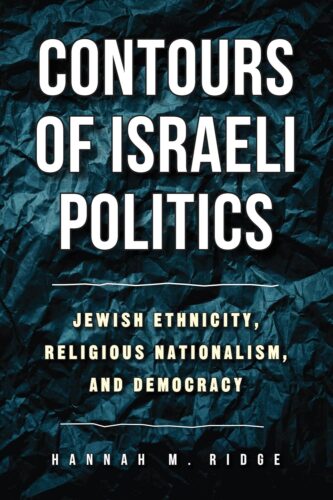
Contours of Israeli Politics: Jewish Ethnicity, Religious Nationalism, and Democracy
by Hannah M. Ridge (Temple University Press)
“Ridge’s analysis underscores a stark reality: twenty-first-century Israel, even before the October 7 attacks, falls short of liberal-democratic ideals. Most Jewish citizens do not prioritize liberal democracy … More pointedly, Ridge’s analysis makes it clear that those who tout Israel’s liberal democratic credentials ignore the views of its Jewish population. For those who support Israel based on an ideal of shared liberal values, this raises the question of what exactly that means, and who precisely supports those values within Israel today.”