







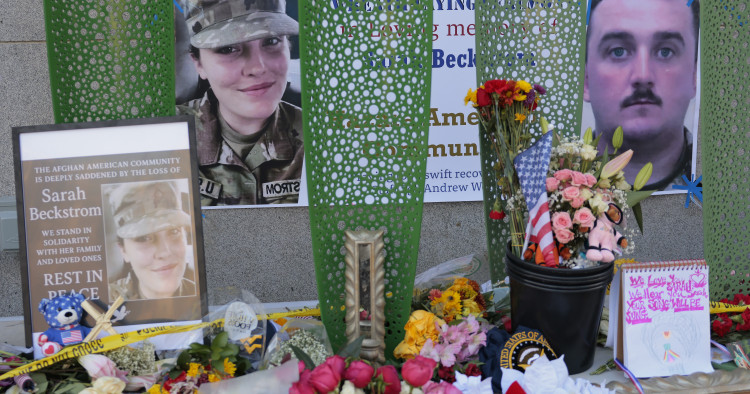
We heard with horror that two US service members were shot the day before Thanksgiving while performing their duties — on US soil, in the US capital.
We were further dismayed to learn that the suspect was an Afghan who had been paroled into the United States in 2021 following the fall of Kabul, after reportedly working with the US government in Afghanistan.
Without question, the accused should be prosecuted to the full extent of the law. No political resentment, if that was his motivation, justifies the use of violence, particularly against those people who have taken an oath to protect America.
As former members of the diplomatic corps, we have the highest respect for the US armed services. Throughout our respective careers, our military has protected us in dangerous situations overseas. We have witnessed their sacrifices on the battlefield in Afghanistan, Iraq, and elsewhere. It is a particular tragedy to see those serving our country struck down in our own streets.
We both served our country in Afghanistan, where our missions were attacked by Afghan terrorists, exactly two years apart — US Embassy Kabul on September 13, 2011, and US Consulate Herat on September 13, 2013.
The threat posed to us by Afghan terrorists did not deter us from supporting, in various capacities, the mission to assist a very different group of Afghans to gain admission to the US. These Afghans worked with the US, at great risk to themselves and their families.
We chose to support these efforts because of the totality of our experiences in Afghanistan, not just the worst ones. The vast majority of Afghans are not violent extremists; they are ordinary people who want a better life for their children and work hard to achieve this goal. Some, such as those eligible for Special Immigrant Visas (SIVs), risked their lives for us and were threatened by the same extremists who targeted us. We also take seriously the promises the US government made to these allies to bring them to safety.
In the aftermath of a horrific crime, we naturally search for ways to prevent any such future crimes. Out of fear, sometimes these efforts go too far, such as the social media frenzy now calling for the expulsion of all Afghans, or even all Muslims, from the US. If true that America provided shelter to this man and his family out of loyalty because he was once our ally, only for him to become our enemy, this would represent a terrible betrayal. But this should not damn the entire effort.
America is a country that values individualism — individual opportunity and individual responsibility. We should keep this principle in mind, even in the worst of times. Any person accused of crimes in the US should face judgment before a court and, if found guilty, be suitably punished. It would be a betrayal of American values, however, to blame a whole community for the actions of one person.
Ambassador Ryan Crocker has had a long association with Time of Remembrance, a Gold Star Family organization in the inland northwest. A six-time US ambassador, he was the 2020 recipient of West Point’s Thayer Award, presented to an outstanding citizen whose service and accomplishments in the national interest exemplify the military academy’s motto, “Duty, Honor, Country.” He retired from the Foreign Service in 2009, then came out of retirement to serve as US Ambassador to Afghanistan (2011-12). He currently serves as a Distinguished Diplomatic Fellow at MEI and as senior advisor to No One Left Behind, a US veteran-led non-governmental organization that assists Afghans eligible for resettlement in the United States.
Jillian Burns retired from the Foreign Service in 2014, after serving as Consul in Herat (2012-13). She returned to the State Department (2022-25) to work in the Office of the Coordinator for Afghan Relocation Efforts (CARE), the government organization that coordinated the multi-agency efforts involved in relocating eligible — and vetted — Afghans to the US.
Photo by Heather Diehl/Getty Images
The Middle East Institute (MEI) is an independent, non-partisan, non-for-profit, educational organization. It does not engage in advocacy and its scholars’ opinions are their own. MEI welcomes financial donations, but retains sole editorial control over its work and its publications reflect only the authors’ views. For a listing of MEI donors, please click here.