







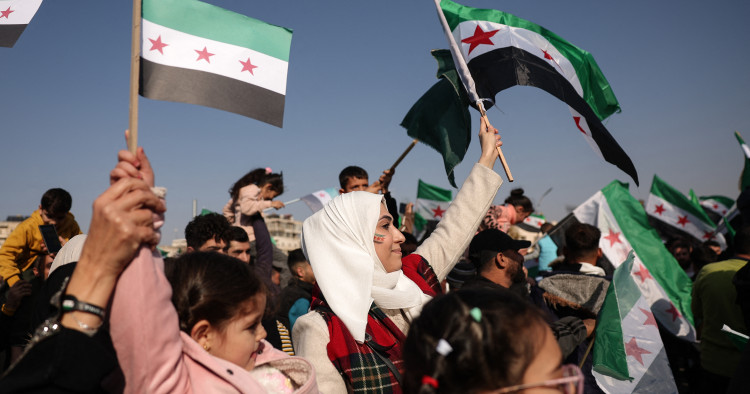
Few places display the cost of civil war as starkly as Syria. On my first visit back since serving as the American ambassador from 1998 to 2001, the country is barely recognizable. The large, Sunni suburbs of Damascus are devastated, as are the Sunni cities of Aleppo, Homs and Hama. In eastern Ghouta, where chemical bombs fell on Syrian families and children, I saw buildings leveled and heaps of rubble. Scenes like these are stark reminders of a war that has forcibly displaced half of the country, while millions more have fled to Turkey, Jordan and Lebanon.
One year after the fall of the Assad regime, Syria is still in very fragile phase of its transition to a new political order. The country faces monumental reconstruction challenges, estimated in the hundreds of billions of dollars, well beyond the capabilities of the new Syrian government. Without sustained American leadership and investment, Syria’s transition will be slow, fragile, and dangerously reversible.
The stability of the Middle East, and by extension, U.S. national security, depends on Washington’s commitment to seeing Syria’s transition through. Retreat cedes ground to instability and extremism, creating a vacuum that adversaries will fill. American leadership and support must focus on the basic building blocks of a durable order to create a Syria that is politically inclusive, protective of religious minorities, and a strong ally to the United States.
The Middle East Institute (MEI) is an independent, non-partisan, non-for-profit, educational organization. It does not engage in advocacy and its scholars’ opinions are their own. MEI welcomes financial donations, but retains sole editorial control over its work and its publications reflect only the authors’ views. For a listing of MEI donors, please click here.