This individual is a guest contributor. MEI is not able to assist with contact requests.
Daniel Wagner is the CEO of Country Risk Solutions and has more than three decades of experience assessing cross-border risk. He is an authority on political risk insurance and analysis and has worked for some of the world’s most respected and best-known companies, including AIG, GE, the African Development Bank, the Asian Development Bank, and the World Bank Group. Until the end of 2023 he was Adaptation Finance Lead and Technical Advisor on Private Capital Mobilization for COP28 in Abu Dhabi and Dubai. Prior to that he was Senior Investment Officer for Guarantees and Syndications at the Asian Infrastructure Investment Bank in Beijing and Abu Dhabi.
Daniel has published 10 books — Decision-Making in the Polycrisis Era, The Chinese Epiphany, The Chinese Vortex, The America-China Divide, China Vision, AI Supremacy, Virtual Terror, Global Risk Agility and Decision-Making, Managing Country Risk, and Political Risk Insurance Guide — as well as more than 700 articles on current affairs and risk management. He is a regular contributor to such publications as the South China Morning Post, Sunday Guardian, Diplomatic Courier, and Fair Observer, among many others. For a full listing of his publications and media interviews please see www.countryrisksolutions.com.
Daniel holds master’s degrees in international relations from the University of Chicago and in international management from the Thunderbird School of Global Management. He also has a bachelor’s degree in political science from Richmond University in London.
On September 15, President Trump presided over a ceremony on the South Lawn of the White House where Prime Minister Benjamin Netanyahu of Israel and the foreign ministers of the United Arab Emirates (UAE) and Bahrain, Abdullah bin Zayed Al Nahyan and Abdullatif Al Zayani, respectively, signed a general declaration of principles, called “The Abraham Accords.” Numerous analysts have focused on the regional impact of the normalization of relations between Israel and these two Gulf Arab countries. However, this development has worldwide geopolitical implications — including for China.
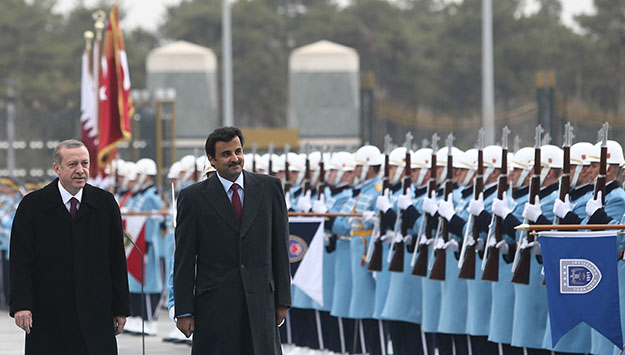
Qatar is Turkey’s closest ally in the Gulf Cooperation Council (G.C.C.) and, since 2011, Ankara has become Doha’s most important regional ally. From Syria to Libya, the Qataris and Turks have worked in tandem to pursue shared interests, chiefly via support for Islamist non-state actors. More than four months into the G.C.C. crisis, Ankara has played a pivotal role in assisting Qatar weather the blockade imposed by a quartet of Arab countries—Bahrain, Egypt, Saudi Arabia, and the United Arab Emirates (U.A.E.).
Between the rise to power of the Justice and Development Party (A.K.P.) in the early 2000s and the eruption of the Syrian crisis in 2011, Turkey’s “zero problems with neighbors” approach to foreign policy seemed commendable. Today, however, Ankara’s foreign policy is perhaps best described as “zero neighbors without problems.” In response to the Arab uprisings of 2011, Ankara’s projection of primarily soft power has evolved into the embrace of hard power—most notably in Iraq and Syria.