Fanar Haddad is a Senior Research Fellow at the Middle East Institute, National University of Singapore and a Non-Resident Senior Fellow at the Middle East Institute, Washington D.C. He has lectured in modern Middle Eastern politics at the University of Exeter, at Queen Mary, University of London and at the National University of Singapore. Prior to obtaining his PhD, Haddad was a Research Analyst at the British Foreign and Commonwealth Office where he worked on radicalization and on North Africa. He has since published widely on issues relating to historic and contemporary Iraq. His main research interests are identity, historical memory, nationalism, communal conflict and minority politics. He is the author of Sectarianism in Iraq: Antagonistic Visions of Unity (2011).
The Hashd: Redrawing the Military and Political Map of Iraq
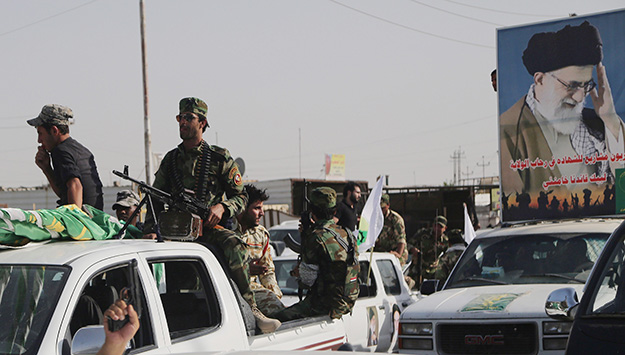
Al-Hashd al-Sha‘bi—also known as the Popular Mobilization Units, the Shi‘i militias, or simply “the Hashd”—has joined Iraqi security forces and the Kurdish peshmerga to spearhead Iraq’s ongoing offensive against ISIS. The coordinated assault has scored significant successes in various parts of Diyala, Babil, and Salah al-Din, including the recapture of Tikrit. With this string of recent triumphs, the Hashd has provided a potent rallying point for a reinvigorated sense of Iraqi nationalism, albeit one with distinctly Shi‘i overtones.
"Marked" for Exclusion: The Problem of Pluralism, State-building, and Communal Identities in Iraq and the Arab World
In this essay, the author argues that the dynamics of contemporary Sunni-Shi‘a relations in Iraq and elsewhere in the Arab world are not fundamentally different from those animating other societal cleavages. The modern Iraqi state’s awkwardness vis-à-vis its Shi‘a population, and indeed other outgroups and minorities, was most directly a product of exclusionary nation-building based on problematic conceptions of “unity” and “pluralism.” Rather than actually fostering unity or respecting and nurturing pluralism (politically or communally), these concepts have often been used to exclude dissenters whose non-conformity was deemed a threat to the body politic.
A common dichotomy that emerges in discussions of Sunni-Shi‘i “sectarianism” in the contemporary Middle East is that of secular versus sectarian. The logic underlining this false duality is obvious enough: a sect is, after all, a subgroup of a religious denomination that exists as a result of theological or jurisprudential peculiarity as shaped by history, politics, and geography. Therefore, logic would suggest that “secularism” is a plausible antonym for “sectarianism:” a temporal, civic approach to public space rooted in modern understandings of the nation-state and its master institutions and the need to separate church from state. As intuitive as this undoubtedly seems, it remains a false dichotomy that misrepresents sectarian identities and sectarian dynamics in the Arab world and overlooks the role played by class, politics, and power in what is ostensibly a religious issue.