This individual is a guest contributor. MEI is not able to assist with contact requests.
Ibrahim Jalal is a former non-resident scholar with the Middle East Institute’s (MEI) Arabian Peninsula Program, and a non-resident at the Malcolm H. Kerr Carnegie Middle East Center.
He has worked with donors and international organizations including the United Nations, the Overseas Development Institute (ODI), and Sussex University’s Institute of Development Studies in research and advisory capacities; occasionally briefs audiences, including think tanks, diplomatic corps, U.N. officials, the private sector, and humanitarian organizations; and takes part in Track II events related to Yemen and the MENA region.
His research examines third-party-led peace and dialogue processes in Yemen, the proliferation of armed non-state actors and implications on peace agreements’ implementation, post-war security orders and stabilization efforts, the politics of social assistance in fragile and conflict-affected states, violent extremism, and the foreign and defense policies of the Gulf and Western states in Yemen. Prior to joining MEI, Ibrahim was a Visiting Scholar at Macquarie University’s Department of Security Studies and Criminology in Australia.
The UAE may have withdrawn from Yemen, but its influence remains strong
On Feb. 9, 2020, after five years of involvement in Yemen’s civil war as part of the Saudi-led coalition, the UAE’s leadership celebrated the completion of its phased military withdrawal from the country in a ceremony at Zayed Military City. Although the UAE’s withdrawal has provided an exit strategy from the stalemate in Yemen, it neither suspends Abu Dhabi’s role in the coalition nor curtails Emirati influence on the ground.
From Stockholm to Riyadh: Breaking the Yemen peace process deadlock
Over the past 14 months, there have been moments when it seemed like progress was being made toward de-escalation in Yemen, but there have also been significant setbacks as well. Peace efforts thus far have been largely fragmented and frail, and two primary lessons from the past failures have become clear.
A fight for survival in a new landscape: Can Yemen’s GPC recover after Saleh?
Since the death of its founder Ali Abdullah Saleh on Dec. 4, 2017, the General People’s Congress (GPC) — Yemen’s dominant political party for the past four decades — has faced a test in attempting to reunify its divided wings in Riyadh, Cairo, Abu Dhabi, and Sanaa amid a shifting strategic landscape. The GPC’s factions have competed over the party leadership, failed to elect a transitional leader, and exchanged accusations following the Saudi-brokered meeting in Jeddah in July 2019. Nevertheless, Abu Dhabi and Riyadh’s attempts to revive Saleh’s damaged old political vehicle continue, both politically and militarily.
Yemen’s Stockholm Agreement one year on: Imaginary progress?
Just over a year ago, the international community rejoiced in the revival of the UN-led Yemen peace process with the conclusion of the Stockholm Agreement between the Yemeni government and the Houthi insurgency (Ansar Allah), brokered by UN Special Envoy Martin Griffiths. Although the deal marked the first political breakthrough in the peace process since the collapse of Geneva and Kuwait talks under Griffith’s predecessor, the ensuing hurdles in implementation meant that hopes for its success were short-lived. In evaluating the progress on the agreement’s three key components — covering prisoner exchange, Hodeida, and Taiz — it quickly becomes clear that the truism that implementing peace agreements is far more important, and difficult, than concluding them still rings true.
Despite the hurdles, an opportunity for de-escalation in Yemen
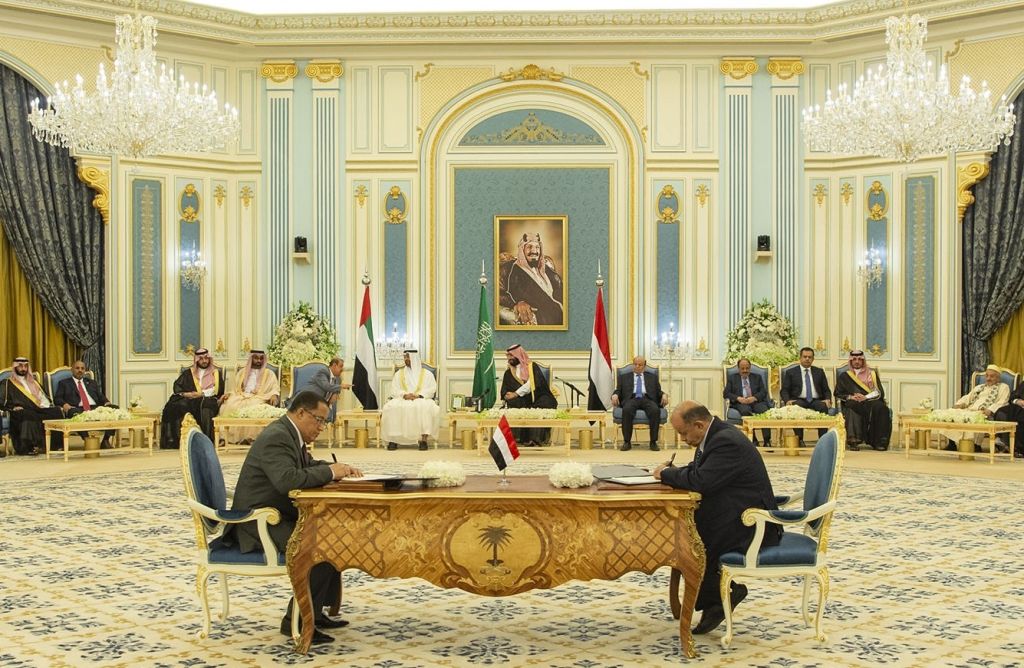
After more than two months of Saudi-mediated indirect talks between the Republic of Yemen Government (ROYG) and the UAE-backed Southern Transitional Council (STC), the two sides finally reached a deal on Nov. 5. The Saudi effort, which culminated in the signing of the Riyadh Agreement, is aimed at resolving the conflict within the Arab coalition-backed front and uniting the two parties in the fight against the Iranian-backed Houthi militias. The agreement, which spans political, economic, security, and military arrangements, involves restructuring the executive, military, and security branches of the ROYG, partial disarmament of STC-loyal forces, and the demilitarization of Aden — all of which will be phased in over the next three months.
After Aramco: Will halting Houthi attacks on Saudi Arabia end Yemen’s war?
After five years of indecisive war, there is a clear desire on the part of the international community to bring the conflict in Yemen to an end, and the recent UN-endorsed Houthi initiative seems predicated on the assumption that ending the fighting between Riyadh and the Houthis would achieve this. A closer look at the situation, however, suggests this assumption is flawed.
Yemen’s peace process: The Hodeida Agreement that never was?
In late July, Lt. Gen. Michael Anker Lollesgaard left Yemen after his six-month term as the second head of the UN Mission in support of the Hodeida Agreement (UNMHA) came to an end. Unlike his predecessor, Maj. Gen. Patrick Cammaert, who departed quietly, Lollesgaard was given a proper sendoff from Sana’a. A senior Houthi commander, Maj. Gen. Ali al-Musheki, even went so far as to describe Lollesgaard as “a conscientious military commander.”
Monday Briefing: A mixed record for PM Khan’s first year in office
This week’s briefing on recent news and upcoming events in the region featuring Arif Rafiq, Ibrahim Jalal, Michael Sexton and Eliza Campbell, and Alex Vatanka.
Monday Briefing: US and Turkey face S-400 confrontation
This week’s briefing on recent news and upcoming events in the region including Turkey’s confrontation with the U.S. over its S-400 defense system, the latest round of Afghan peace talks, the UAE’s drawdown in Yemen, Turkey’s media signaling on Syria, and the 21st consecutive week of protests in Algeria, featuring W. Robert Pearson, Marvin G. Weinbaum, Ibrahim Jalal, Guney Yildiz, and Robert S. Ford.