This individual is a guest contributor. MEI is not able to assist with contact requests.
Ragui Assaad is Professor at the Humphrey Institute of Public Affairs at the University of Minnesota. He has written extensively on labor market and youth issues in the Middle East and North Africa. The author acknowledges the able research assistance of Stefan Johansson in the preparation of this essay.
Earlier this month, Interim President Adli Mansour appointed Judge Mohamed Amin el-Mahdi as Egypt’s first-ever Minister of Transitional Justice and National Reconciliation. It’s an encouraging move for a country that has, for decades, endured an oppressive environment of fear due to successive regimes’ use of power and the security apparatus to suppress and torture dissidents. After Hosni Mubarak’s ouster in 2011, many Egyptians hoped that their long list of abused rights could find justice, but until now very little has been accomplished.
The Future of Democracy in Egypt: Notes from the Ground
The Middle East Institute is proud to host Sahar F. Aziz, associate professor of Law at Texas Wesleyan University, and Mirette F. Mabrouk, deputy director for Regional Programs at the Atlantic Council’s Rafik Hariri Center for the Middle East, for a discussion about the impact and implications of the ouster of President Mohamed Morsi. Mirette Mabrouk will provide a macro-perspective of the current situation and discuss some of the key turning points that precipitated the recent crisis.
The Future of Democracy in Egypt: Notes from the Ground
The Middle East Institute is proud to host Sahar F. Aziz, associate professor of Law at Texas Wesleyan University, and Mirette F. Mabrouk, deputy director for Regional Programs at the Atlantic Council’s Rafik Hariri Center for the Middle East, for a discussion about the impact and implications of the ouster of President Mohamed Morsi. Mirette Mabrouk will provide a macro-perspective of the current situation and discuss some of the key turning points that precipitated the recent crisis.
The Future of Democracy in Egypt: Notes from the Ground
The Middle East Institute is proud to host Sahar F. Aziz, associate professor of Law at Texas Wesleyan University, and Mirette F. Mabrouk, deputy director for Regional Programs at the Atlantic Council’s Rafik Hariri Center for the Middle East, for a discussion about the impact and implications of the ouster of President Mohamed Morsi. Mirette Mabrouk will provide a macro-perspective of the current situation and discuss some of the key turning points that precipitated the recent crisis.
The Future of Democracy in Egypt: Notes from the Ground
The Middle East Institute is proud to host Sahar F. Aziz, associate professor of Law at Texas Wesleyan University, and Mirette F. Mabrouk, deputy director for Regional Programs at the Atlantic Council’s Rafik Hariri Center for the Middle East, for a discussion about the impact and implications of the ouster of President Mohamed Morsi. Mirette Mabrouk will provide a macro-perspective of the current situation and discuss some of the key turning points that precipitated the recent crisis.
The Future of Democracy in Egypt: Notes from the Ground
The Middle East Institute is proud to host Sahar F. Aziz, associate professor of Law at Texas Wesleyan University, and Mirette F. Mabrouk, deputy director for Regional Programs at the Atlantic Council’s Rafik Hariri Center for the Middle East, for a discussion about the impact and implications of the ouster of President Mohamed Morsi. Mirette Mabrouk will provide a macro-perspective of the current situation and discuss some of the key turning points that precipitated the recent crisis.
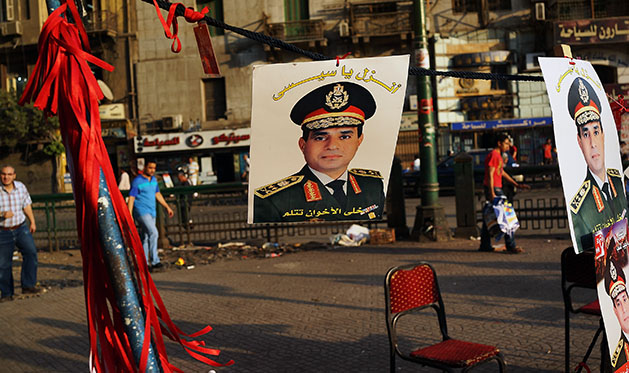
Yesterday, General Abdul Fattah el-Sisi, Egypt’s Minister of Defense and head of the military, called for Egyptians to take to the streets in protest on Friday to “confront terrorism.” Such a call amounts to a public relations one-upmanship vis-à-vis continued Islamist protests since Morsi’s ouster. Clearly, the Egyptian military is in no need of popular protests to confront credible national security threats or armed militias that threaten the security of citizens.
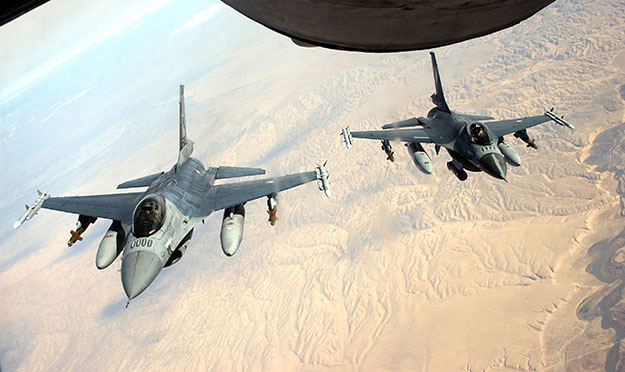
Yesterday, the United States announced that it would delay the delivery of four F-16 fighter jets to Egypt.[1] While such a move might appear to signal a block in U.S. military aid to the country, most Egyptians believe that the United States will, as it always does, provide Egypt with military funding.
Iranians in Malaysia: Batik Artist Pegah Jahangiri
Artist Pegah Jahangiri hails from Tehran, but is currently a doctoral student in visual arts at the University of Malaya, Malaysia. She recently spoke to MEI about her work with batik, strikingly dyed cloth found all over the world, but particularly popular and refined in Southeast Asia.
Mada Masr’s journalist Lina Attalah spoke to Gehad el-Haddad, spokesperson of the Muslim Brotherhood and senior advisor to its political arm, the Freedom and Justice Party, at the Rabaa el-Adaweya sit-in, where pro-deposed President Mohamed Morsi protesters have been camping to express their rejection of the military coup that ousted him.
What is the current plan? Keep mobilizing to exert pressure? Negotiate at some point?
The Iraqi Factor in the Syrian Crisis: Catalyst or Inhibitor?
Iraqis who cast their votes in postponed local elections in Anbar and Nineveh on 20 June had a lot on their plates. Beyond issues relating to the provision of services locally, the last weeks before the elections saw massive protests against the central government in Baghdad. The many angry slogans on display included calls for greater autonomy for the Sunni-majority areas of Iraq as well as expressions of solidarity with the mainly Sunni Syrian opposition movement.
When the young Shaykh Tamim bin Hamad al-Thani became ruler of Qatar last month after his father stepped aside in a seamless transition, one of his first official acts was to seal the generational shift by appointing a new prime minister.
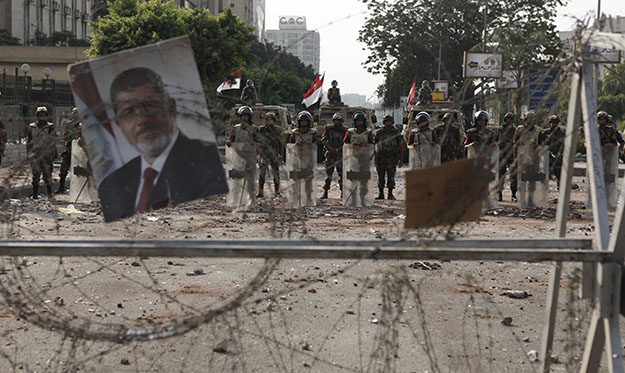
Before 3 July 2013 enters the annals of U.S.-backed anti-Islamist coups[1] it is worth noting that Mohamed Morsi’s ill-fated presidency differs from prior cases. Whereas the Islamic Salvation Front (FIS) and Hamas posed a threat (however chimeric) to Washington, Morsi quickly won plaudits from U.S. officials. Meanwhile, he menaced the domestic opposition with an autocratic panache. When Morsi exceeded his elected mandate and refused to share power, secularists and Salafists rose against him—while the U.S.