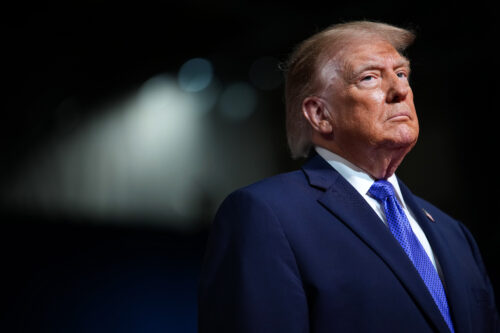
President Donald Trump’s next move on Iran should follow from what he actually wants, and with his legacy at stake, the choice matters. If the ultimate goal is regime change through internal collapse, the logic points to a long squeeze: tighter enforcement of the economic blockade and periodic military strikes to limit Iranian actions in the Strait of Hormuz, a campaign that might outlast his presidency. Whether by design or by drift, that is roughly the course Washington is on today.
Trump has never convincingly made the case for regime change, let alone organized a coherent campaign to achieve it. His actions and rhetoric since the US-Israeli war with Iran began at the end of February suggest a narrower focus: the immediate opening of the Strait of Hormuz and then greater Iranian concessions on the nuclear file. Vice President JD Vance’s recent letter to Tehran reportedly defined America’s central interest as ensuring that Iran never obtains a nuclear weapon. Tehran, meanwhile, gets a vote, and it has made clear that it will not be strangled quietly.
The Republican rout in the US midterm elections on November 3, which Vance blamed squarely on the war, may push Trump toward a settlement. So may the prospect of Prime Minister Benjamin Netanyahu’s possible departure following Israel’s October 27 election, which could reduce Israeli pressure for another round of fighting.
If Trump chooses diplomacy, he will have to navigate Tehran’s factional rivalries, and his administration appears to understand them. Vance addressed his letter to Mohsen Rezaei, the relatively hardline secretary of Iran’s Supreme National Security Council (SNSC), which has become the main forum where the regime’s rival power centers make decisions.
Washington’s bet on Rezaei rests on a sound premise: Iran’s leadership is divided, but it is not paralyzed, and powerful figures inside the regime now see compromise with Washington as necessary. Supreme Leader Mojtaba Khamenei has widened the government’s mandate to negotiate and called for ending the limbo of “no war, no peace.” The real test is whether a yes from Tehran can bind the whole system, and whether the unity that war imposed can survive the price of peace.
The Invisible Arbiter
Trump has called it his “biggest problem”: no one knows who runs Iran. His own administration’s outreach suggests it knows more than he lets on, but the confusion is understandable. Nearly nine months after Ali Khamenei was killed in the opening strikes of the war on February 28, his son and successor, Mojtaba, has not made a single public appearance. Iranian media have released old photos and undated footage of him, but nothing recent or verifiable. No new photographs, video, or audio. His instructions arrive as text, read out on state television or posted online, on subjects ranging from peace talks and the Strait of Hormuz to congratulations for Iranian sports teams.
A system built around a visible leader is now governed in the name of an invisible one, and every faction claims to speak for him. On November 2, President Masoud Pezeshkian announced that Mojtaba had authorized talks on subjects previously off-limits. Two days later, a message attributed to the leader called it “gravely mistaken” to expect change from America’s “partisan and factional shifts” or to think concessions could buy off Washington. A hawk and a dove in Tehran could each find support for their policy in the same week’s statements.
Yet a system without a visible arbiter is not the same as a system without the capacity to make decisions. The Islamic Republic has never been monolithic: Supreme Leader Ruhollah Khomeini and his successor Ali Khamenei spent decades refereeing among the Islamic Revolutionary Guards Corps (IRGC), the Majlis (parliament), the presidency, and the clergy. What is new is the absence of a referee, and the regime has improvised around it.
Stepping in to fill the gap is the SNSC, where 13 surviving senior figures represent the presidency, parliament, the IRGC, and the regular military (Artesh). Two members, Rezaei and hardline politician Saeed Jalili, represent the supreme leader, whose approval its decisions require. Within the SNSC, there is a smaller six-man committee that, according to Foreign Minister Abbas Araghchi, decides whether talks with the Americans should happen and sets the parameters for Iran’s negotiators.
This machinery has delivered. In June, 12 of the council’s 13 members approved the memorandum of understanding Vance negotiated in Islamabad: Iran would reopen the Strait of Hormuz in exchange for an end to the US naval blockade of Iranian ports and the release of some frozen assets, with the nuclear file deferred. A letter attributed to Mojtaba said he had “reservations” but deferred to the council. For a political class that spent decades arguing over whether talking to Washington was pragmatism or treason, that was no small feat.
The Islamabad deal broke down within weeks, and both sides still blame each other. Disagreements over its terms, particularly on the Strait of Hormuz, were compounded by Iranian attacks on commercial shipping in July whose authorization remains disputed. But the initial consensus in Tehran was real. There were later offers to reopen the strait, whose terms Washington found insufficient, but these too reflected support within Iran’s leadership for a negotiated way forward.
“We argue in our meetings,” Araghchi told Al Jazeera on November 1, “but when we reach a decision, all of us stand behind it and implement it.” That claim is self-serving, and the record complicates it. But it is closer to the truth than the picture of a regime too fractured to sign anything.
Washington’s Bet
The most telling rebuttal to “no one runs Iran” comes from the Trump administration itself. In late October, Vance wrote directly to Rezaei and offered to meet him. According to David Ignatius of The Washington Post, US officials concluded after Islamabad that Mohammad Bagher Qalibaf, the speaker of the Majlis who had negotiated the June memorandum, could not turn it into an enforceable settlement back in Tehran. US intelligence revised its map of Iranian power and identified Rezaei as a central decisionmaker, perhaps the one figure able to build consensus across Tehran’s power centers. It also assessed that Rezaei is in regular contact with Mojtaba, and that the two spoke after Vance’s letter arrived.
This is not a portrait of paralysis. The American intelligence community tracked the rise and fall of various figures in Tehran after Ali Khamenei’s death and judged that Rezaei was its best bet to bring competing factions behind a deal. No agreement has yet been reached, and Rezaei’s ability to deliver remains unproven. But the Trump administration’s outreach acknowledges the point its public rhetoric often obscures: there is an address in Tehran where a deal can be considered and decided upon.
Rezaei is an unlikely peacemaker. Still the subject of an Interpol Red Notice over his alleged involvement in the 1994 bombing of a Jewish community center in Buenos Aires, he is better known at home for repeated failed presidential bids and mocked populist economic proposals than for statesmanship. But he has outlasted almost everyone from the first generation of Islamist revolutionaries, and his surviving network built while commanding the IRGC from 1981 to 1997 gives the American bet on him a certain logic. A hardliner may be able to sell a deal with Washington that a moderate could not — only Nixon could go to China. But Rezaei cannot make that decision alone. He must secure the support of the SNSC and ultimately Mojtaba Khamenei. His value to Washington lies in his ability to build that consensus, not in any authority to impose a deal himself.
Rezaei criticized the Islamabad memorandum almost as soon as it was signed and has since declared it void. By mid-September, Tehran had set out seven conditions for resuming talks, which were subsequently conveyed to Washington during the United Nations General Assembly. They included lifting the blockade, releasing frozen assets, and ending attacks against Iran. Rezaei insisted that Iran would neither reopen the strait nor return to negotiations until its demands were met. Yet he greeted Vance’s letter by saying its tone had “changed completely” and called that a positive sign. That may be how a hardliner begins preparing skeptics at home for diplomacy without appearing to retreat.
The Fight over Credit
If Tehran can decide, why has it not? The divisions are still real, and they run along three lines at once: ideological preferences, institutional power, and personal ambitions. Iran’s factions genuinely disagree over whether to accept limits on enrichment, under what conditions to reopen the Strait of Hormuz, and whether any compromise with Trump would save the regime or invite more pressure. But the strand Americans often miss is the fight over who negotiates, and who gets the credit.
The Rezaei-Qalibaf rivalry is four decades old. During the Iran-Iraq war, the younger Qalibaf served as a division commander under Rezaei; in politics, the subordinate became a rival. After the Islamabad agreement collapsed, far-right critics accused Qalibaf, who had negotiated it, of surrendering Iran’s wartime gains. Yet some of the same voices welcomed Rezaei’s growing role in diplomacy once Vance’s letter landed on his desk.
This contradiction did not go unnoticed. “If negotiation is inherently bad,” the Tehran news site Nameh News asked, “how does it become good when the negotiator changes?” Its answer was that factions could not bear to see a project of national scale registered in a rival’s name. But the fight over who gets credit is not the whole story, and there is a point here for Washington. Some in Tehran are trying to contain the rivalry. Araghchi insists that Qalibaf remains chief negotiator and that Rezaei “fully supports” him. He also warned that if Vance’s letter to Rezaei was intended to sow division within Tehran, Washington would be making another mistake. But these public assurances contrast with the attacks on Qalibaf from hardline factions that have welcomed Rezaei’s growing influence.
Whether the arrangement Araghchi describes can survive the difficult choices required by a deal remains an open question. Vance’s outreach to Rezaei has already raised suspicions in Tehran that the US is picking favorites, and engagement that looks personal rather than institutional risks deepening the rivalry a deal would need to overcome. Rezaei’s value lies in his role as the SNSC’s point man. Any agreement will also need the backing of Qalibaf and Pezeshkian, and ultimately Mojtaba Khamenei, and will be durable only if no faction sees more advantage in undermining it than supporting it.
Wild Cards
For Iran, the harder problem might not be deciding but delivering. For Washington, the collapse of the Islamabad agreement in July, hastened by attacks on commercial vessels in Hormuz, raised precisely that concern. Iranian officials told The New York Times the attacks were carried out without the knowledge of Pezeshkian, IRGC commander Ahmad Vahidi, or the SNSC, and traced them to forces linked to Hossein Taeb, a former IRGC intelligence chief close to Mojtaba who reportedly opposed the deal. Taeb was subsequently appointed to lead the Basij, the regime’s powerful paramilitary force. The IRGC later insisted the operation was neither a rogue action nor without coordination with higher officials, without naming them.
That episode is the strongest evidence for the skeptics, and it cuts deeper than a story about a rogue official. If Taeb acted alone, a faction helped sink a decision taken at the top. If he acted with Mojtaba’s blessing, then the formal process does not reflect where power really lies, or the leader is deliberately keeping two tracks open: talks through the SNSC, pressure through his loyalists in the Revolutionary Guards. Taeb’s sudden return to a senior role suggests the second reading cannot be dismissed.
Yet even the darker reading is not an argument against negotiating. A leader who keeps two tracks open is hedging, and the terms of a possible settlement may determine which course he chooses. The same leader has also pushed to end the limbo and reportedly widened Pezeshkian’s mandate. The lesson is that a deal must be designed around the spoiler: phased, reciprocal steps that let each side measure compliance as it goes; agreed channels to investigate incidents at sea, so one provocation cannot sink the whole arrangement; and the broadest possible buy-in in Tehran, so that no faction, and no leader, can easily disown it.
Sequencing alone will not resolve the hardest issues: Iran’s stockpile of highly enriched uranium, which Tehran says it will not ship abroad, and its claimed right to enrich. But it can buy time and help narrow the divide, letting each side bank gains before confronting the concessions it fears most.
The Poison Chalice
Tehran should not misread the moment either. Trump has lost Congress, not his war powers, and a lame-duck president stung by defeat may be tempted to escalate. Surviving nine months of bombardment is a dangerously low definition of success; another round could leave the regime still standing while wrecking the economy it needs to govern going forward. Iran’s own officials admit that their limbo of “no war, no peace” cannot last.
The deeper question is whether anyone in Tehran can own a compromise. Abbas Maleki, who helped negotiate the end of the Iran-Iraq war in 1988, recently recalled that Khomeini took personal responsibility for the decisions of his negotiators, shielding them from accusations of betrayal. Khomeini famously likened accepting that ceasefire to drinking from a “poison chalice.” Mojtaba Khamenei, by contrast, gave the Islamabad memorandum only qualified backing, with “reservations.” Washington cannot give him the political standing Khomeini had.
Trump still has a choice. He can pursue a prolonged campaign aimed at regime change, though he has yet to explain such a strategy or its endpoint. If his objective is instead a nuclear agreement, Washington has a clearer idea of who must be brought on board in Tehran and what a durable deal would require: dealing with the SNSC as a body, securing support across rival factions, sequencing reciprocal steps so neither side bears all the risk upfront, and building in safeguards against spoilers.
The war has brought Iran’s rival factions together but agreeing on how to end it could pull them apart. If Trump wants a deal, he might want to act before that happens
Alex Vatanka is a Senior Fellow at the Middle East Institute.
Photo by Iranian Leader Press Office/Handout/Anadolu via Getty Images
The Middle East Institute (MEI) is an independent, non-partisan, not-for-profit, educational organization. It does not engage in advocacy and its scholars’ opinions are their own. MEI welcomes financial donations, but retains sole editorial control over its work and its publications reflect only the authors’ views. For a listing of MEI donors, please click here.