
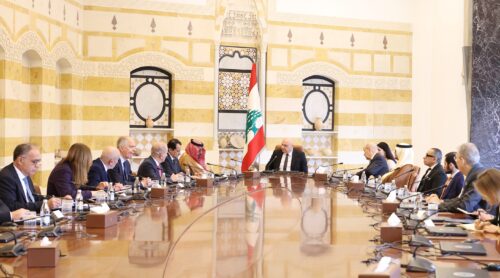
This article is part of a report outlining an actionable US roadmap to win in Lebanon, comprising eight chapters of specific policy interventions across the security, economic, and political dimensions needed to secure a sovereign Lebanon, lock in US gains against Iran, and permanently end the Israel-Lebanon conflict.
Key Takeaways
- Lebanon’s reconstruction failures have been political, not technical. Three Paris conferences mobilized billions against reform conditions both donors and recipients understood would not be implemented. Future engagement must treat this record as its baseline, not a footnote.
- State ownership is both a governance principle and an anti-capture mechanism. Channeling reconstruction through parallel structures — donor-managed agencies, non-governmental organization delivery networks, project enclaves — erodes the institutional capacity Lebanon needs to sustain recovery. But ownership without accountability is a license for leakage. Both must be enforced together.
- The comparative record — Iraq, Lebanon’s own 2006 experience, and Ukraine — points to specific instruments: a government-owned national recovery plan; a ring-fenced multi-donor trust fund with independent oversight; civil society embedded in accountability design, not decorating it; and conditionality tied to disbursement milestones rather than entry pledges.
- The current Lebanese government under President Joseph Aoun and Prime Minister Nawaf Salam, paired with the International Monetary Fund’s June 2026 Governance and Corruption Diagnostic, represents Lebanon’s most credible opportunity for reform in a generation. The key question is whether Washington and its Gulf partners will consistently use their leverage to secure implementation or revert to a familiar cycle of financing commitments that are unlikely to be fulfilled.
We Keep Asking the Wrong Question
For more than three decades, international engagement with Lebanon has revolved around the wrong question. Donor conferences and international financial institutions have focused chiefly on how much money the country needs. However, the more consequential question has always been how external financing can strengthen institutions rather than substitute for them — and how it can reinforce Lebanese ownership without reinforcing the patterns of elite capture that have repeatedly undermined reform.
The historical record complicates the conventional narrative. Lebanon’s central failure was not a shortage of resources: billions were pledged and, in many cases, disbursed. Nor was it an absence of reform conditions, which accompanied virtually every major donor initiative. The deeper problem was the international community’s attachment to two flawed paradigms — money before reform and reform before money — neither of which delivered sustainable change.
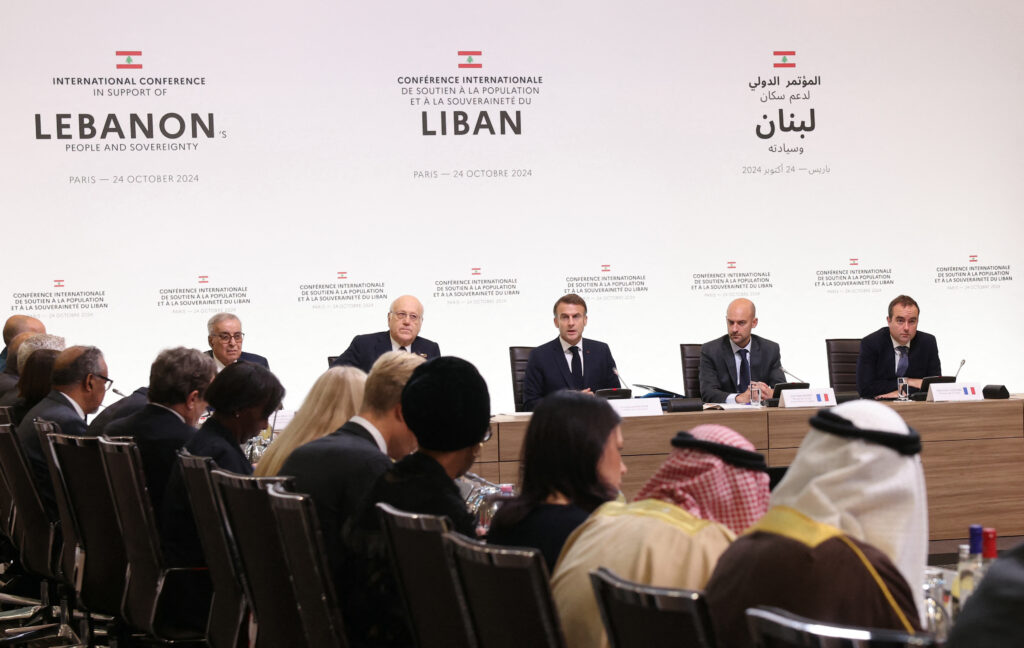
The Paris I, II, and III (2001-07) donor conferences disbursed financing first, on the expectation that fiscal and governance reforms would follow. Between them, the three conferences mobilized more than $12 billion — roughly $500 million under Paris I, $4.4 billion under Paris II at a moment of acute fiscal distress, and over $7.5 billion under Paris III after the 2006 war. They succeeded in stabilizing public finances, financing reconstruction, and postponing crises that might have otherwise arisen sooner. But by the time Paris III convened, it was already apparent that many reforms promised under Paris II had not materialized; nevertheless, new pledges were made and new reform matrices negotiated. Reform conditionality became less an instrument of accountability than a diplomatic ritual — politically useful because it justified continued support, but rarely capable of altering the incentives of the system it was meant to change. The 2018 Economic Conference for Development through Reforms and with the Private Sector (CEDRE, by its French acronym) inverted the model, conditioning the bulk of the $11 billion in pledges on governance, procurement, fiscal, and electricity-sector reforms enacted in advance. The logic was compelling: if disbursement before reform had failed, reform before disbursement might succeed. But political paralysis, the October 2019 uprising, the banking collapse, sovereign default, and the Beirut port explosion combined to destroy the conditions under which reforms could be implemented, and the pledged financing never flowed. CEDRE became the mirror image of Paris III: where Paris delivered money without reform, CEDRE delivered neither reform nor money.
The result is a paradox that defines Lebanon’s reconstruction challenge today: under one model, money arrived but reform did not; under the other, reform did not arrive, so neither did the money.
The task is not to choose between generosity and severity. It is to design an architecture that simultaneously strengthens Lebanese institutions, creates credible accountability, and resists capture by the structures that contributed to the country’s collapse in the first place.
This pattern was never a matter of donor naivety or Lebanese bad faith. It reflected a structural contradiction within the aid relationship itself. Donors, operating in a fragile regional environment, remained reluctant to suspend support when reforms stalled, fearing that withdrawal would accelerate the instability they were trying to prevent. Lebanese political elites, for their part, correctly read this reluctance: they understood that geopolitical considerations would ultimately outweigh conditionality and structured their own behavior accordingly. The tacit bargain that emerged — continued financing in exchange for continued promises — survived three donor conferences because it served the short-term interests of everyone party to it, even as it eroded the institutions on which long-term stability depended.
One of the most persistent misconceptions in post-conflict recovery is the belief that there exists a clean “day after” — a clear transition from war to peace, from crisis to stability, after which reconstruction can proceed in an orderly sequence. History suggests otherwise. Germany’s recovery after 1945 did not result from external financing alone; the Marshall Plan mattered enormously, but it succeeded because resources were deployed into an environment where courts functioned, administrations operated, and citizens gradually regained confidence in the state. Iraq, Afghanistan, and Bosnia each absorbed extraordinary volumes of international assistance in the decades since, and in each case physical reconstruction outpaced political and institutional reconstruction: roads were rebuilt and buildings restored, while governance remained contested or incomplete. The outcome in each case was not outright failure, but it also was not durable success. Lebanon’s recovery will face the same risk unless its architecture treats institutional consolidation as the primary objective rather than a byproduct of financing.
From Capacity Building to Capacity Substitution
One of reconstruction’s most persistent assumptions is that weak institutions can be safely bypassed until they grow stronger. Lebanon’s experience suggests the opposite: institutions that are bypassed do not strengthen — they atrophy. The Council for Development and Reconstruction (CDR), created in 1977, became Lebanon’s principal interface with international donors after the Taif Agreement, the accord that formally ended the bulk of the Lebanese Civil War (1975-90). As it accumulated procurement authority, donor relationships, and technical expertise, line ministries lost the same functions in parallel — project preparation, contracting, and donor liaison all migrated to the CDR rather than building capacity within permanent government structures. The model performed well in the short run: projects moved, financing flowed. However, it substituted for state capacity rather than building it. By the late 2000s the CDR itself had become entangled in the same political economy it was designed to circumvent with politicized appointments, contested contracting, and eroding donor confidence.
This is not unique to Lebanon. In the 1990s, the Palestinian Economic Council for Development and Reconstruction (PECDAR) efficiently managed donor funds but was criticized for weakening public institutions by operating in parallel.
Similar patterns appear in Afghanistan, Bosnia, and Iraq, where donor-created units speed up projects but often leave ministries weaker by drawing away talent and authority.
Lebanon’s own experience shows the same problem: donor-funded consultants and project units delivered results but created isolated pockets of expertise rather than strengthening institutions.
The result is a familiar paradox — heavily supported ministries that remain weak, fragmented expertise, and reforms that fail to last. The key distinction is between building capacity within institutions and substituting for them. Lebanon’s experience shows the cost of substitution: ministries that are both over-supported and ineffective. Parallel mechanisms can be necessary in crises, but they risk becoming permanent. Lebanon’s next reconstruction must focus on strengthening state institutions, ensuring that external support builds lasting capacity rather than replacing it.
Comparative Lessons: Iraq 2003, Lebanon 2006, and Ukraine 2022
- Iraq after 2003 demonstrates the cost of bypassing the state altogether. The US reconstruction program there was, by appropriation, the largest in American history — more than $60 billion channeled through a labyrinth of government agencies, private contractors, and international organizations. The Special Inspector General for Iraq Reconstruction (SIGIR), in its final assessment, attributed the program’s disappointing results to insufficient pre-war planning, interagency fragmentation, cost-plus contracting that rewarded expenditure over outcomes, and security conditions that made implementation and oversight persistently dangerous. But the structural cause, documented repeatedly across SIGIR’s audit record, was the systematic bypassing of Iraqi institutions: reconstruction was designed and implemented by Americans for Iraqis rather than with them. Infrastructure was built that Iraqi institutions had not been involved in planning and lacked the capacity to operate; healthcare facilities were equipped with technology that local staff were never trained to use; water treatment systems were handed to municipalities that could not manage them. The program generated physical assets without the institutional capacity to sustain them, and the assets degraded accordingly. In an environment with active elite-capture dynamics, the gap between asset and institution also created new opportunities for politically connected actors to extract value from the reconstruction process itself — weakening the very state institutions the program was meant to benefit.
- Lebanon’s 2006 post-war reconstruction is the most instructive cautionary case precisely because it is domestic. International support was mobilized rapidly: the Stockholm Conference in August 2006 generated pledges exceeding $900 million within weeks of the cease-fire, channeled mainly through the CDR, and physical reconstruction in the south proceeded with notable speed in some areas. But Hizballah’s Jihad al-Bina construction arm moved faster and more visibly, using reconstruction as an instrument of political consolidation and reinforcing the group’s standing as the de facto provider of public goods in areas where the Lebanese state — working through an institution with limited independence and credibility — was comparatively invisible. The lesson is not that speed is undesirable; it usually is. It is that reconstruction without a deliberate state-building strategy strengthens whichever actor controls delivery — and in Lebanon’s fragmented political landscape, that actor is rarely the state.
- Ukraine’s post-2022 architecture is the most sophisticated contemporary attempt to correct this pattern. Its central structural innovation is the insistence on Ukrainian government ownership of recovery planning and tracking. The Multi-Agency Donor Coordination Platform, established by G7 decision in late 2022, was explicitly designed to work with — not around — Ukrainian authorities, coordinating donor resources behind a Ukrainian-owned national recovery plan rather than a parallel donor-designed framework. Ukraine’s DREAM system, a digital reconstruction and project-management platform linked to donor systems, provides transparent, real-time tracking of projects, procurement, and expenditure. It is a government-owned accountability architecture rather than a donor-imposed oversight mechanism. The distinction matters: it positions the Ukrainian state as the accountable actor, builds domestic public financial management capacity, and creates the evidentiary basis for the parliamentary and civil-society oversight that is the ultimate check on elite capture. The model has limits — corruption risk in a wartime environment remains substantial, and a 2024 US Government Accountability Office (GAO) review found accountability systems under strain despite strong institutional effort — but its foundational architecture of government-owned planning, coordinated donors, transparent tracking, and milestone-based conditionality represents a clear advance over both the Iraq experience and Lebanon’s own Paris cycle.
Designing for State Ownership Without Capture
Lebanon is not Ukraine: its political economy is more fragmented, its institutions more comprehensively captured, and its security environment more complex. But the architectural principles are transferable, and the 2026 Governance and Corruption Diagnostic conducted by the International Monetary Fund (IMF) now gives them unusual specificity. Four design choices follow directly.
First, a single Lebanese-owned national recovery plan should serve as the reference document for all donor engagement, with the current Lebanese government under President Joseph Aoun and Prime Minister Nawaf Salam supported — and expected — to produce costed sectoral priorities and measurable milestones, with World Bank and United Nations technical assistance. Donor alignment behind this plan, rather than behind separate bilateral portfolios, should be an explicit condition of coordinated support.
Second, financing should flow through a purpose-built multi-donor trust fund with governance designed to resist capture: an independent board including Lebanese civil society alongside government and donor representatives, procurement rules exceeding Lebanese legal minimums, public disclosure of contracts above a defined threshold, and reporting obligations to the Lebanese Parliament, not only to donor capitals. Civil society’s role here is operational, not symbolic — organizations that have tracked elite capture for decades hold institutional knowledge of how leakage occurs that no external technical team can replicate.
Third, disbursement should be tied to demonstrated institutional milestones rather than front-loaded pledges. The Paris cycle’s defining flaw was rewarding commitment rather than performance. The IMF Diagnostic’s benchmarks — on rule of law, central bank governance, public financial management, and anti-money-laundering compliance — are specified precisely enough to serve as disbursement triggers. This is harder to sell at a donor conference than a headline pledge, and it demands more patience than political cycles naturally allow, but it is the only model with a demonstrated record of effectiveness.
Fourth, the CDR question must be confronted directly rather than deferred again. The choice is binary: reform the institution with genuine independence, transparent procurement, and parliamentary oversight, or replace it with a new body whose governance is designed from inception to resist the pressures that captured its predecessor. Either path requires sustained donor pressure. Donors should commission — and make public — an independent governance assessment of the CDR before deciding which path to take.
None of this displaces the IMF’s existing program with Lebanon itself, which remains the single most consequential near-term institutional process in the country. Washington, as the IMF’s largest shareholder, should use its influence to protect the integrity of loss-allocation negotiations against political pressure for a diluted financial gap law, and to ensure that progress against the Diagnostic’s benchmarks is tracked and reported publicly. Transparency about progress — or its absence — is itself an accountability mechanism.
Some observers have periodically proposed a currency board as part of Lebanon’s financial stabilization strategy. Under the right institutional circumstances, the idea deserves serious consideration, though not as a substitute for broader reform. Currency boards have historically been most effective where political authorities seek to make a highly credible commitment to monetary discipline and where supporting fiscal, banking, and governance institutions are sufficiently robust to sustain that commitment. Experiences in places as diverse as Hong Kong, Bulgaria, Estonia, and post-war Bosnia and Herzegovina demonstrate that a currency board can help restore confidence, stabilize expectations, and constrain politically motivated monetary financing when public trust in domestic institutions has been severely damaged. In Lebanon, however, any consideration of such an arrangement would need to follow — not precede — agreement on banking-sector loss allocation, recapitalization of the financial system, strengthened central bank governance, and a sustainable fiscal framework.
Without these foundations, a currency board risks becoming another technical mechanism burdened with solving fundamentally political problems. With them, however, it could provide a powerful credibility-enhancing commitment device, helping restore confidence in the monetary system while broader governance reforms take hold.
What Donors Must Avoid
Three recurring failure modes deserve explicit attention, because each has already undermined a previous Lebanese reconstruction cycle.
- Financing parallel delivery structures as a default response to governance weakness. Routing development assistance through non-governmental organizations or foreign-managed project teams produces short-term efficiency but signals to Lebanese citizens that the state is irrelevant to their welfare — reinforcing patronage over performance. Emergency humanitarian response is the appropriate exception; development reconstruction is not.
- Allowing bilateral visibility concerns to fragment donor coordination. Separate, nationally branded projects create duplication and gaps that politically connected actors exploit. Ukraine’s Donor Platform works because it subordinates visibility to programmatic coherence behind a single government-owned plan; Lebanon requires the same discipline.
- Conflating reform intention with reform performance. The Paris cycle collapsed because donors accepted promises as proof. The current government’s commitments are credible — they should be met with respect and patience, but held to demonstrated outcomes, not the benefit of the doubt that earlier governments exhausted.
The Strategic Stakes
Lebanon enters this moment with a government of uncommon credibility, an IMF Diagnostic that provides an unusually detailed accountability roadmap, and a donor community with more reason than ever — after decades of recycled pledges — to demand structural change as a condition of structural support. The Lebanese diaspora, several million strong and highly educated, is watching for the institutional signals that would justify return and reinvestment; that human capital, not physical infrastructure, is Lebanon’s most strategic asset.
What has been missing from every previous cycle is not goodwill, which has been abundant on all sides, but the architectural discipline to convert intentions into durable institutions. That discipline means aligning behind a Lebanese-owned plan rather than donor portfolios, disbursing against demonstrated milestones rather than stated commitments, treating civil society oversight as a requirement rather than a courtesy, and sustaining accountability pressure through political cycles that reward gesture over substance.
Underneath the financing question sits a more fundamental one: can Lebanon move from a system whose legitimacy rests on communal representation toward one whose legitimacy rests on performance? That transition, more than any single reconstruction tranche, will determine whether the country’s recovery proves durable or merely postpones its next collapse. Roads can be rebuilt within a single budget cycle. Institutional trust takes generations — which is precisely why the design of this recovery matters more than its size.
Recommendations
A. For US and Donor Governments
- Condition coordinated support on alignment behind a single Lebanese-owned national recovery plan; decline to support bilateral projects that operate outside it.
- Channel financing through a ring-fenced multi-donor trust fund with an independent board, civil society representation, and procurement rules that exceed Lebanese legal minimums.
- Structure all disbursement around post-implementation milestones drawn from the IMF’s June 2026 Diagnostic, not pre-implementation pledges.
- Leverage World Bank and IMF shareholder influence to protect the integrity of the banking sector loss-allocation framework against political dilution.
- Publicly commission and release an independent governance assessment of the CDR as a prerequisite for determining its future role.
B. For Multilateral Institutions and Gulf Partners
- Track and publicly report Lebanese reform progress against the Diagnostic’s specific benchmarks, making transparency itself an accountability tool.
- Reward demonstrated transparency and performance in future engagement, rather than reinforcing existing patterns of political patronage.
- Support the technical capacity of Lebanese ministries directly, resisting the reflex to default to parallel implementation units.
C. For the Government of Lebanon
- Produce a costed, milestone-based national recovery plan with World Bank and UN technical support and treat it as the binding reference for all external engagement.
- Embed civil society organizations in the design — not just the monitoring — of recovery governance structures from the outset.
- Decide and act on whether the CDR will be structurally reformed or superseded, rather than allowing the question to lapse again.
- Sustain implementation of World Bank- and IMF-defined governance benchmarks independent of the disbursement calendar, to rebuild credibility with both donors and citizens.
Ferid Belhaj is a Senior Fellow at the Policy Center for the New South and Adjunct Professor at Mohammed VI Polytechnic University. Previously, he was the Vice President for the Middle East and North Africa at the World Bank from July 2018 to March 2024. He held several positions during his 25-year career at the bank, including Chief of Staff to the President of the World Bank Group and Director for the Middle East (2012-17); Director for the Pacific Department (2009-12); Special Representative to the United Nations in New York; and Senior Counsel and Country Manager for Morocco. Before joining the bank, he served as a Tunisian diplomat, including as Legal Adviser at Tunisia’s Permanent Mission to the United Nations and as Deputy Chief of Mission at the Tunisian Embassy in Washington, DC.
Top photo by Lebanese Presidency/Handout/Anadolu via Getty Images.
The Middle East Institute (MEI) is an independent, non-partisan, not-for-profit, educational organization. It does not engage in advocacy and its scholars’ opinions are their own. MEI welcomes financial donations, but retains sole editorial control over its work and its publications reflect only the authors’ views. For a listing of MEI donors, please click here.
How Lebanon can be Trump’s first success in a troubled region