







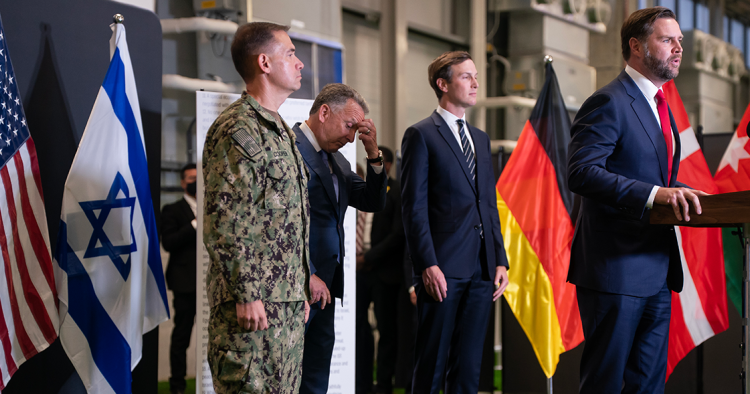
On October 9, the White House persuaded Israel and Hamas to agree to a cease-fire based on a 20-point peace plan initially unveiled on September 29. The plan specifically called for the formation of two multinational entities. A “Board of Peace,” chaired by President Donald Trump, would be composed of senior officials charged with setting an initial framework for the redevelopment of Gaza. Whereas an International Stabilization Force (ISF) would train and support newly formed Palestinian police forces, secure border areas, and enable the free flow of aid and other goods into the devastated coastal strip. While not specified in the plan, the United States established the Civil-Military Coordination Center (CMCC) in Kiryat Gat, Israel, on October 17, to support stabilization efforts. Vice President JD Vance attended the opening and explained the objectives of the new entity: “US military personnel will not deploy into Gaza but will instead help facilitate the flow of humanitarian, logistical, and security assistance from international counterparts into Gaza.” Since then, the ISF has struggled to gain traction, compelling a reexamination of whether or even the degree to which US forces may need to become involved. Washington should approach any such notions very carefully.
To understand ISF delays, the devil is in the (missing) details
Like many aspects of the 20-point plan, the specific mission of the ISF was left intentionally vague and has remained so despite some subsequent clarification. Following a few weeks of tepid responses from potential international partners, the US sought and obtained approval, on November 17, for a United Nations Security Council resolution (UNSCR 2803) endorsing the formation of both the ISF and Board of Peace. The resolution also authorized a host of activities in the pursuit of “demilitarizing the Gaza Strip.” Crucially, however, the resolution failed to account for the current cease-fire context whereby Gaza is bifurcated into two distinct areas. The “red zone,” where Hamas is still active, comprises roughly 48% of the territory’s landmass and more than 90% of its population. The “green zone,” currently under Israeli control, accounts for the remaining 52% of the strip and provides a sparsely populated buffer along the Israel border. Israel Defense Forces (IDF) units have pulled back to a “yellow line” delineating the boundary between the two zones to guard against any Hamas incursions into the green zone or beyond.
Per the UN resolution, the IDF will gradually retreat from Gaza as the ISF “establishes control and stability.” Further complicating matters, Hamas has asserted that it has not agreed to disarm and claims that international mediators failed to discuss the ISF with them directly. Some reports suggest that they would be willing to decommission some of their heavy weapons under the supervision of Egypt, but this would likely be insufficient to satisfy Israel’s perception of “demilitarization” and fail to assuage countries wary of contributing forces to a high-risk mission. Thus, early expectations for troop commitments from partner states acceptable to both Israel and Egypt and with credibility to engage the Palestinians have given way to skepticism about signing onto a mission that remains ill-defined and fraught with risk.
Stuck on “dormant”: Attempts to build the ISF on the fly falter
The reality is that the US and other regional interlocutors were eager for a cease-fire between Israel and Hamas, and the best way to facilitate this was an agreement that was both comprehensive and open-ended. This was sufficient to allow for the return of hostages and secure a general cessation of hostilities but has hindered subsequent implementing steps. To meet the initial goal of launching the second phase of the 20-point plan by the end of 2025, US officials have pressed to simultaneously form the Board of Peace and the ISF despite key questions remaining unanswered. In each case, the flurry of activity has thus far failed to overcome this critical constraint.
For the ISF, the past couple of months have seen the contours of its potential mission evolve. Conversations with US officials directly involved in this process in mid-November reflected an expectation that at least a portion of the ISF would be operational in the “red” part of Gaza to primarily oversee the reestablishment of a new governing entity that omits Hamas and, if threatened or engaged, would be willing to use force. As conveyed at the time, the bulk of the ISF would focus on policing Gaza and supporting a new Palestinian law enforcement entity (without distinction of zone). The remaining force, however, would concentrate on interdicting Hamas attacks and perhaps even conduct targeted operations against the group. At the time, the concern centered around convincing Israeli counterparts to accept an operation aimed at “demilitarizing” Gaza, in accordance with the UN resolution, rather than demanding the more ambitious “disarming” of all forces within the territory.
Discussions have subsequently evolved based on the outreach US officials have conducted with potential force-contributing countries. Initial reports that Azerbaijan and Indonesia were interested have subsided as the nature of the mission remains murky and neither seems willing to confront Hamas. More generally, it would be irrational to expect any Muslim nation to accept a mission that would place it in general conflict with Palestinians, regardless of its affiliation. Other reports suggest that Italy has been the first to make a firm offer, though the details have yet to be released. Fundamentally, no candidate for contributing forces wants to confront the choice of either killing a Hamas militiaman carrying out an attack on Israelis or, conversely, face being blamed for failing to prevent such an attack. Further complicating this politically disastrous scenario is Israel’s wariness of entrusting its security to non-Israeli troops in an environment where all sides have yet to endorse the ISF mission.
It stands to reason, then, that the estimates of the number of forces required for the ISF have fluctuated because of similarly vacillating levels of commitment interest. Approximations have remained broad, ranging from 6,000 to 20,000, with recent reporting suggesting that contributions will be at the bottom end of the range. Based on Gaza’s population of 2.2 million, this would result in a force ratio of 367:1. This would be completely inadequate to conduct a mission that could skew toward a counterinsurgency (which carries an admittedly inexact ideal ratio of roughly 25:1). Even if the ISF force size reaches the high end of the range, the ratio of 110:1 would not be sufficient to deal with any prolonged resistance.
Nevertheless, these estimates will remain arbitrary until some common understanding is reached on the ultimate nature of the mission as well as its goals and objectives. Thus far, the US has reached out to over 70 countries regarding contributions to the ISF without receiving a single firm commitment aside — maybe — from Italy. On December 16, US Central Command (CENTCOM) hosted a conference in Doha with representatives of more than 25 governments to discuss how to shape an ISF mandate to accommodate potential force providers, but once again no agreement was reached. Thus far, any expression of interest has come with the stipulation that their role be confined to the “green zone” currently controlled by the IDF. Such a mission would not facilitate the desired pullback of IDF units out of Gaza and as such would continue to stall implementation of the peace plan. Perhaps in an effort to break this logjam, the US has recently floated a risky proposition that it should consider only very carefully.
Proceed (very) cautiously: Inserting US leadership into the ISF
With a notionally uncooperative Hamas reasserting its control over the majority of Gaza’s population and the IDF still opportunistically targeting Hamas leadership, the 20-point peace plan for Gaza seemingly hangs in the balance. A December 11 report stated that the Trump administration plans to appoint a two-star general as commander of the ISF. The story cited two unnamed Israeli officials conveying what US Ambassador to the UN Michael Waltz briefed to Prime Minister Benjamin Netanyahu in Israel during a visit the week of December 8. Two anonymous US officials confirmed this intention, and Waltz even stated that he knows the senior officer personally. If accurate, such a decision invites new questions and enhances other existing uncertainties. While some are more pressing than others during the current force development phase, all will need to be answered prior to any ISF deployment.
The most immediate concern brought up by the announcement is the potentially awkward scenario whereby a forward commander is not authorized to set foot in their area of operation. The Trump administration has consistently maintained that no US forces would be deployed to Gaza, a position that a CENTCOM spokesperson reiterated bluntly last month: “To be clear, no US troops will be deployed into Gaza. Any reporting to the contrary is false.” On the one hand, changing the as-to-now inflexible directive would tarnish the initial conception of the ISF as a more neutral force and increase the likelihood of Hamas resistance. Maintaining this restriction, on the other hand, will place strong limitations on the operational effectiveness of the commander and any other assigned US personnel.
This then raises the related issue of rules of engagement and how these will drive materiel resource requirements for the ISF mission. Recent American experience leading a multinational operation in Afghanistan offers useful perspective. Assuming an eventual ISF mission incorporates all of Gaza, US leadership will need to remain mindful of caveats that will impose conditions and limitations on various forces regardless of the overarching rules of engagement in place. Relatedly, even if US forces remain outside of Gaza, partner expectations will be heightened with a US commander at the helm. Partners contributing forces will likely demand significant US support for their units. Depending on the broader rules of engagement, this will incorporate some combination of intelligence, surveillance, and reconnaissance (ISR), logistics, medical evacuation, and potentially fires (e.g. artillery) and air support. This level of assistance may indeed help attract partners but could come at a steeper cost to the US than expected.
Such a scenario also invites heightened US military manpower requirements, particularly if other force contributions remain minimal. From a personnel perspective, the CMCC was established with 200 assigned US forces, including Lieutenant General Patrick Frank, the commander of CENTCOM’s Army component (ARCENT), who serves as its co-lead along with a senior US civilian. The impending appointment of a two-star commander for the ISF, however, will introduce more substantial operational staffing requirements that will no doubt increase the US force posture regardless of the involvement of other contributors. In addition to US staffing requirements, there will likely also be an inclination to incorporate at least a training and mentoring element to engage with other contributing units (perhaps at their insistence). This would entail forces from either the US Army’s Security Force Assistance Brigade (SFAB) or the Special Forces. Combine this with the personnel required to provide the aforementioned support, and the US footprint could increase quickly and significantly.
In sum, the United States should be circumspect and deliberate before taking on an operational leadership role of the ISF. Satisfying the complexity of requirements that include optimal skillsets, respected professionalism, top-end capabilities, and general gravitas for an ISF acceptable to Egypt and especially Israel makes for a challenging Venn diagram that likely must include some US participation. Nevertheless, options that allow for a more limited involvement, such as a training and mentoring role that avoids a presence in Gaza, should be the starting point for deliberations. There must also be a realistic understanding that any useful mission is inevitably going to put forces in harm’s way, even if measures are taken to minimize such danger.
Accepting the leadership responsibility should come only as a last resort means of firming up a multinational commitment of forces aligned on a comprehensive mission that satisfies the goal of the 20-point plan to demilitarize Gaza. It should also come with clear guidelines pertaining to rules of engagement, US manpower, and types of support the US is willing to provide. Rushing into such a decision will not resolve the fundamental issue of a missing mandate for the ISF and runs the risk of creating a US-centric force that stumbles into an increasingly kinetic conflict. In such a scenario, one compromise can quickly lead to another and the prospect of losing sight of the strategic intent becomes elevated.
Jason H. Campbell is a Senior Fellow at the Middle East Institute, where he focuses on international security, geopolitics, and foreign policy.
Photo by Nathan Howard - Pool/Getty Images
The Middle East Institute (MEI) is an independent, non-partisan, non-for-profit, educational organization. It does not engage in advocacy and its scholars’ opinions are their own. MEI welcomes financial donations, but retains sole editorial control over its work and its publications reflect only the authors’ views. For a listing of MEI donors, please click here.