Trump’s Midterm Loss Opens a Window for Iran Diplomacy
Eight months after launching the war alongside Israel, Trump has yet to explain what an American victory would look like or how much longer the United States must keep fighting to achieve it. While Americans opted to vote for the Democratic Party, which is preparing to challenge the logic of the war, Trump retains much executive power to stay in the war. Going forward, this means the political risks for him and his party will be high.
Brian is joined by His Excellency Talal Al Rahbi, the ambassador of the Sultanate of Oman to the United States of America, to discuss what it means to represent the “Switzerland of the Middle East” and the role of Oman’s quiet diplomacy. He also reflects on growing up during Oman’s transformation, his time spent in the United States, and why the two nations’ long-standing partnership matters today.
After decades of political setbacks, Iran’s former Revolutionary Guards commander has returned to the center of power. Is he an incidental beneficiary of war, or have observers underestimated him all along?
Climate Change Threats, Opportunities, and the GCC Countries
Originally posted April 2008
Oil and gas revenues for GCC countries have enabled exceptional and accelerated development in all aspects of life. These countries have become a hub of intense activity in many spheres—geopolitical, military, economic, industrial, construction, and tourism, to name a few. However, the scale of oil and gas production and use has also led to severe environmental problems.
One of the strangest features of contemporary Iranian politics must surely be the reality that despite the concerted and successful effort to narrow the range of candidates allowed to run for various political offices, competition among individuals and groups has not only remained unabated, it has intensified. The elite jockeying that has taken place in the past few months, leading to the upcoming March 14 Majlis elections, is a good example of the competitive intensity that had come to characterize Iranian politics.
On January 3, 2008, Iran’s supreme leader, Ayatollah ‘Ali Khamene’i once again sought to remind domestic and foreign audiences about his stature in Tehran. Stating that “cutting off relations with the US” was one of the “principal policies” of the Iranian government, but that he would be the “first person to endorse these relations” if it benefited the Iranian people, Khamene’i secured news headlines.[1]
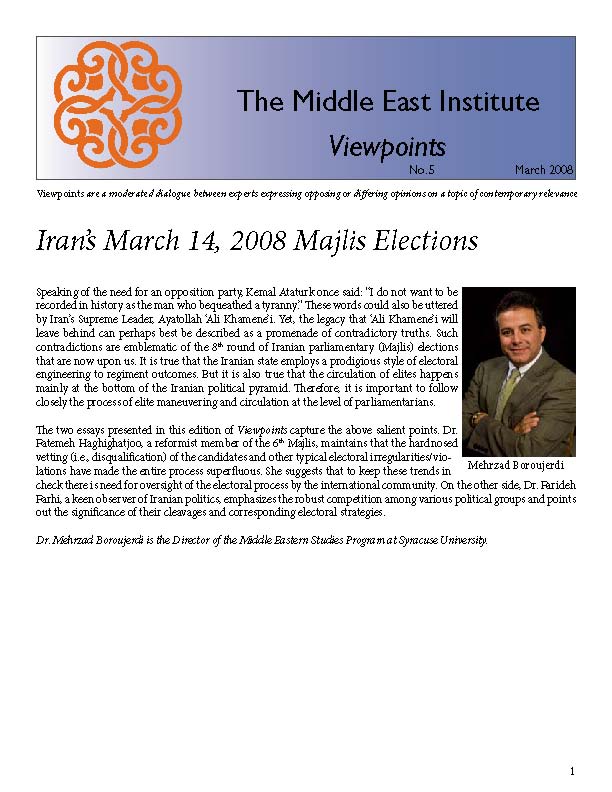
Introducation to Iran's March 14, 2008 Majlis Elections
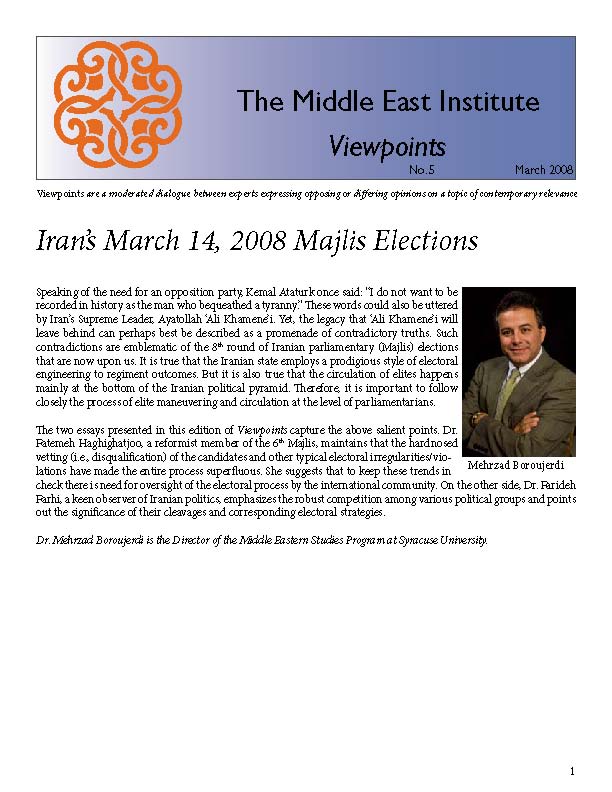
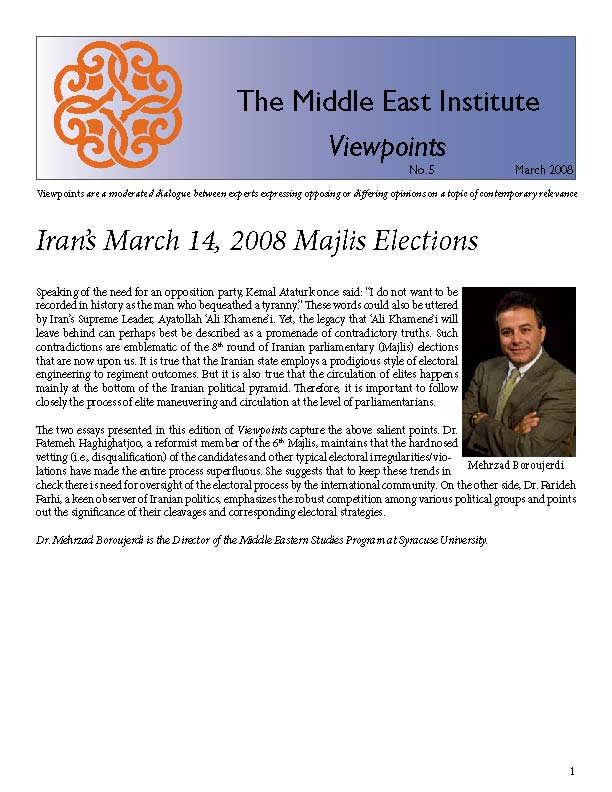
Speaking of the need for an opposition party, Kemal Ataturk once said: “I do not want to be recorded in history as the man who bequeathed a tyranny.” These words could also be uttered by Iran’s Supreme Leader, Ayatollah ‘Ali Khamene’i. Yet, the legacy that ‘Ali Khamene’i will leave behind can perhaps best be described as a promenade of contradictory truths. Such contradictions are emblematic of the 8th round of Iranian parliamentary (Majlis) elections that are now upon us. It is true that the Iranian state employs a prodigious style of electoral engineering to regiment outcomes.
“In the past week Iran’s president, Mahmud Ahmadinejad, has damned it as a ‘worthless piece of paper’ and China’s premier, Wen Jiabao, has moaned that it is causing his country ‘big pressure’. The dollar’s relentless decline—it hit a new low of $1.49 against the euro on November 21st—is prompting jibes from America’s critics, jangling investors’ nerves and giving policymakers headaches.”[1]
The oldest peer-reviewed publication dedicated to the study of the modern Middle East, MEI’s flagship journal covers politics, society, and culture in the region.