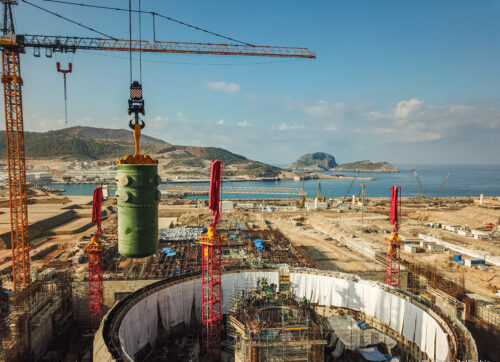
Turkey’s Nuclear Ambitions in the Post-Iran War Environment
Turkish ambitions to develop nuclear weapons are not new, but the changing security environment is strengthening Ankara’s motivations and rationale for moving away from its longstanding role as a champion of nonproliferation and toward a strategy of preserving the option to build nuclear weapons without actually pursuing them. The challenge for Washington is to manage the nuclear trajectory of regional powers such as Turkey and Saudi Arabia rather than preventing them from acquiring greater nuclear capabilities altogether.
Trump’s South Caucasus Peacemaking Is His Most Successful, but It Remains Unfinished
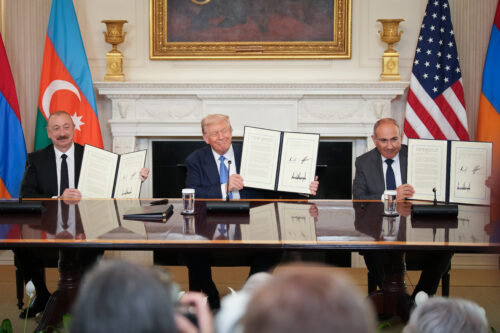
Of all the fronts in President Trump’s peacemaking agenda, the South Caucasus has delivered the most concrete results. The August 2025 Washington Declaration, signed between Armenia and Azerbaijan and witnessed by Trump, marked an important step toward peace in the region. The two sides initialed a peace agreement and advanced plans to unblock regional connectivity, including through the establishment of the Trump Route for International Peace and Prosperity (TRIPP), which would connect Azerbaijan to its Nakhijevan exclave through southern Armenia. Implementation of TRIPP has since made notable progress, but construction has yet to start. A breakthrough on those two tracks would, in turn, unlock Armenia–Türkiye normalization, transforming a long-fractured region into an area of trade and interdependence.
Wars don’t just end. They get interpreted, reinterpreted, and turned into strategic doctrine. That is what happened after the Iran-Iraq War of the 1980s, a conflict that saw the United States back Tehran’s Iraqi adversaries. The war taught Tehran three lessons it never unlearned: that Washington wants the Islamic Republic gone, that Iran stands essentially alone in the world, and that it cannot survive a direct, overt fight with the U.S. and Israel.
Iran has two independent naval forces: the Islamic Republic of Iran Navy (IRIN), whose existence predates Iran’s 1979 Revolution, and the Islamic Revolutionary Guard Corps Navy (IRGCN), which evolved separately in midst of the Iran-Iraq war (1985).
One of the most enduring epithets for Hamas, right up there with “terrorist,” is “proxy.” If you Google “Hamas Iran proxy,” you get 1,750,000 hits. The idea that the relationship between Sunni Hamas, the Gaza affiliate of the Muslim Brotherhood, and Shia Iran was merely a marriage of convenience and not a true love match is rejected by those who forget that most enduring maxim of Middle East politics: “The enemy of my enemy is my friend.” And implicit in that maxim are two more words: “for now.”
To truly appreciate the political standing of Iran’s regular armed forces in today’s Islamic Republic, the key is to take into account the impact of the ongoing and unparalleled internal feud in the top ranks of the regime. The feud, pitching the factions of Supreme Leader Ayatollah ‘Ali Khamenei and President Mahmud Ahmadinejad against one another in a bitter contest for power, has turned the Artesh into an inescapable entity that neither faction can afford to ignore.
This Opinion piece first appeared in Frontline’s Tehran Bureau on January 19, 2012.
After months of frosty relations, Iran and Turkey are talking again. The ostensible reason for Turkish Foreign Minister Ahmet Davutoglu’s visit to Tehran two weeks ago was to try to jump start stalled nuclear talks with the so-called P5+1 group of nations. Davutoglu conveyed to Iranian chief nuclear negotiator Saeed Jalili the European Union’s invitation to resume the talks in Turkey that were suspended a year ago for lack of progress.
More than three decades after the Revolution of 1979, the Islamic Republic of Iran Army [Artesh-e Jomhouri-ye Eslami-ye Iran] and the Islamic Revolutionary Guard Corps [Sepah-e Pasdaran-e Enqelab-e Eslami] (IRGC), remain entangled in a state of fierce rivalry.
Much attention has been given to the IRGC’s asymmetric defense capabilities, its role in Iraq’s post-2003 insurgency, and its alleged hold over the Strait of Hormuz, but there is little scrutiny in open source literature on the significance of the Iranian Army (Artesh) to Iran’s national security.
Since its inception in 1979, the Islamic Republic of Iran (IRI) has duplicated almost all state institutions. It retained the institutions that existed under the old regime while creating new Islamic agencies to perform the same tasks. The Iranian armed forces did not escape this process. Under the monarchy, the armed forces were called the Artesh Shahanshahi or Imperial Army. Although called the “Army,” or Artesh, the force consisted of the three main services (army, navy, and air force) plus the Imperial Guard Divisions (Gard-e Javidan) and the Army Aviation Command (Hawa Nirouz).
In an official gathering in December 2010, Major General Attollah Salehi, Commander-in-Chief of the Iranian Army said that during his visits to Army barracks, he would see the pictures of the leaders of the “sedition” (The Islamic Republic’s present hard-line leadership refers to opposition leaders and 2009 presidential candidates Mir Hossein Moussavi and Mehdi Karrubi as leaders of sedition) hanging on the walls.
Along with Egypt and Turkey, Iran is one of the most populous countries in the Middle East. Aware of its strategic significance and millennium-long civilization, Iranian leaders have always aspired to assume a leadership role on regional and international issues and pursued an assertive policy to reach their country’s potential. This ambitious strategy requires, among other things, strong military forces.
The Artesh: Iran’s Marginalized and Under-Armed Conventional Military
Originally posted November, 2011
Ravaged, intimidated, and gutted to the core in a series of purges after the 1979 Revolution, the remnant of the Shah’s military, renamed the Army of the Islamic Republic of Iran, known generally in Persian as the Artesh, put itself together as best as it could to face invading Iraqi forces at the beginning of the Iran-Iraq war.
Iran’s conventional military forces — ground, air, and naval — once stood tall as the best armed military forces in the Middle East aside from those of Israel. The United States lavished the most sophisticated military hardware on the Shah, who was willing and able to tap his financial resources from Iran’s oil wealth to buy modern conventional arms. The Shah had the ambition, the financial means, and the political-military backing of the United States to turn Iran into the Persian Gulf’s most formidable military power.
A United States Marine's View of the Artesh and IRGC
United States military forces use standard procedures for planning operations against other militaries. These procedures differentiate between different branches, or units, of an opposing force depending on their capabilities and limitations. This article presents one such analysis of the Iranian Military, where there are vast differences between the Islamic Revolutionary Guard Corps (IRGC)and the Artesh, or the regular Iranian armed forces. The article then draws parallels to the planning for Operation Iraqi Freedom that led to the defeat of the Iraqi Republican Guard and regular Iraqi
The oldest peer-reviewed publication dedicated to the study of the modern Middle East, MEI’s flagship journal covers politics, society, and culture in the region.