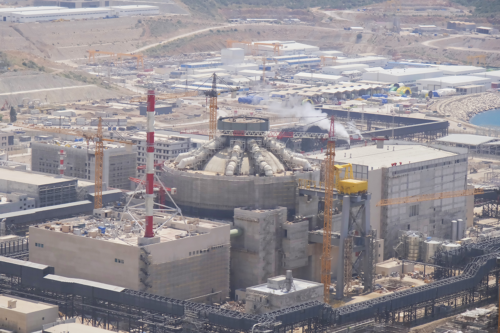
As a result of the Iran war, Turkish thinking about nuclear weapons appears to be shifting. Iran’s emergent ability to threaten regional states (and possible determination to acquire a nuclear weapon itself), growing concern about Israeli aggressiveness, doubts about US security guarantees, and greater Saudi nuclear autonomy are all pushing Ankara to consider a future nuclear option.
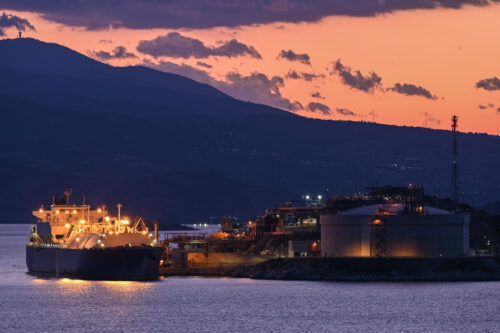
In less than two decades, a string of offshore discoveries has turned the Eastern Mediterranean into a significant gas-producing region, making Israel an exporter, twice lifting Egypt into the ranks of liquefied natural gas (LNG) exporters, and giving Cyprus finds it has yet to bring to market. This backgrounder explores the potential and challenges of exploiting and managing LNG resources in the region.
The Mecca Joint Défense Agreement: A New Geometry of Middle Eastern Power?
On August 7, 2026, Saudi Arabia, Turkey, and Pakistan signed the Mecca Joint Défense Agreement, a collective-defense pact widely compared to NATO’s Article 5. This essay argues that the comparison is misleading. Mecca borrows NATO’s language of solidarity without yet possessing NATO’s institutional machinery, and the Houthi offensive against Saudi Arabia in September 2026 provided an early and revealing test of what the agreement actually means in practice. Neither Pakistan nor Turkey automatically entered the fight on Saudi Arabia’s behalf, and Washington, despite an initial reluctance to strike directly, remained indispensable through intelligence support and a major proposed F-35 sale. Drawing on realist alliance theory — Hans Morgenthau, Kenneth Waltz, Stephen Walt, Glenn Snyder, and Steven David — and on the precedent of the Central Treaty Organization (CENTO), the essay contends that the Middle East is not dividing into rival blocs but moving from hierarchy toward a looser, overlapping geometry of hedged partnerships, in which American exclusivity is eroding considerably faster than American primacy.
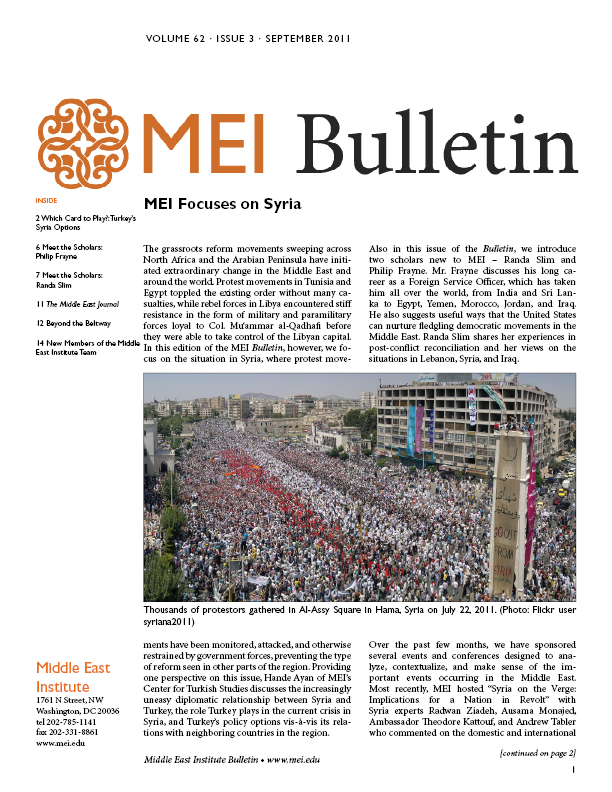
Amidst ongoing violence against protestors in Syria, Hande Ayan of the Center for Turkish Studies discusses the uneasy diplomatic relationship between Turkey and Syria and Turkey’s role in the political situation there. The September 2011 Bulletin also introduces MEI scholars Philip Frayne, who speaks on his Foreign Service career and offers his insights on how the US can support democratic transitions in the Middle East, and Randa Slim, who is interviewed on her experience in post-conflict reconciliation.
When President Obama met with Turkish Prime Minister Recep Tayyip Erdogan on Tuesday, the two discussed cooperation on Syria, counter-terrorism and supporting the Arab spring. But a central theme of the talks, and what most concerns the U.S. at the moment, is a sharply deteriorating Turkish relationship with Israel that the U.S. hopes to reverse. Conversely, this deterioration was the source of much acclaim when Erdogan visited Arab spring countries last week.
The release of last week’s UN Palmer Report, assessing Israel’s attack on the Mavi Marmara and five other ships carrying aid to Gaza, sparked outrage in Turkey. Many criticized the report’s alleged bias, and claimed it failed to provide a credible legal analysis of the Mavi Marmara incident in which nine Turkish citizens were shot to death by Israeli commandos, some at close range and from behind.
F. Stephen Larrabee, Distinguished Chair in European Security at the RAND Corporation, and Gonul Tol, Executive Director of the Middle East Institute’s Center for Turkish Studies, highlight the importance of drafting a new civilian constitution to solve Turkey’s Kurdish issue.
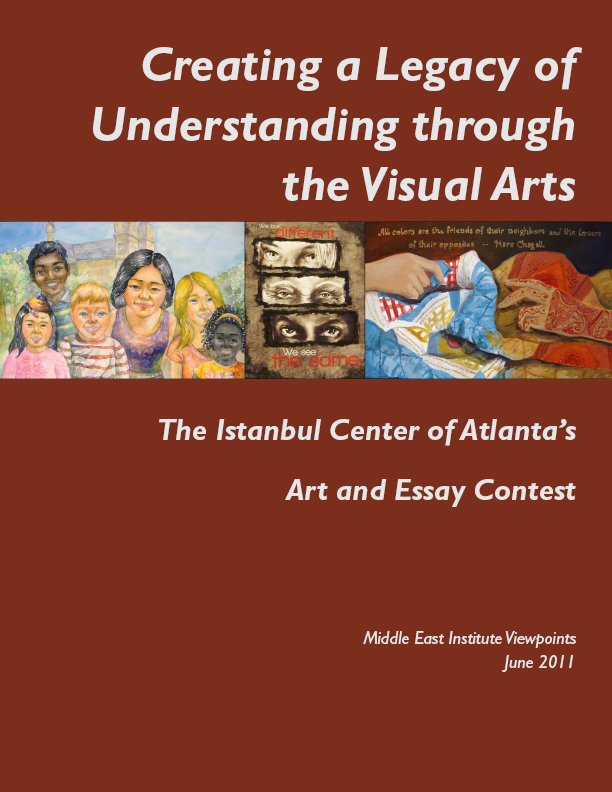
Creating a Legacy of Understanding through the Visual Arts: The Istanbul Center of Atlanta's Art and Essay Contest
This volume has been prepared for the Middle East Institute’s Viewpoints collection. Several stakeholders in the Istanbul Center of Atlanta’s Annual Art and Essay Contest have been involved in the composition of this text. Our goal is to provide a history of this successful program, as well as to define a model for the recreation of such an outreach project for other regions.
In the early 1970s, I taught art classes in three elementary schools in Phoenix, New York. After enduring long snowy and cold winters for ten years, I moved to the Atlanta, Georgia area where the sun shines almost every day. There, I re-entered the field of education, teaching art for Cobb County Schools for 17. During this time, I shared original programs and curriculum in workshops and lectures held at international, national, and state conferences.
The oldest peer-reviewed publication dedicated to the study of the modern Middle East, MEI’s flagship journal covers politics, society, and culture in the region.