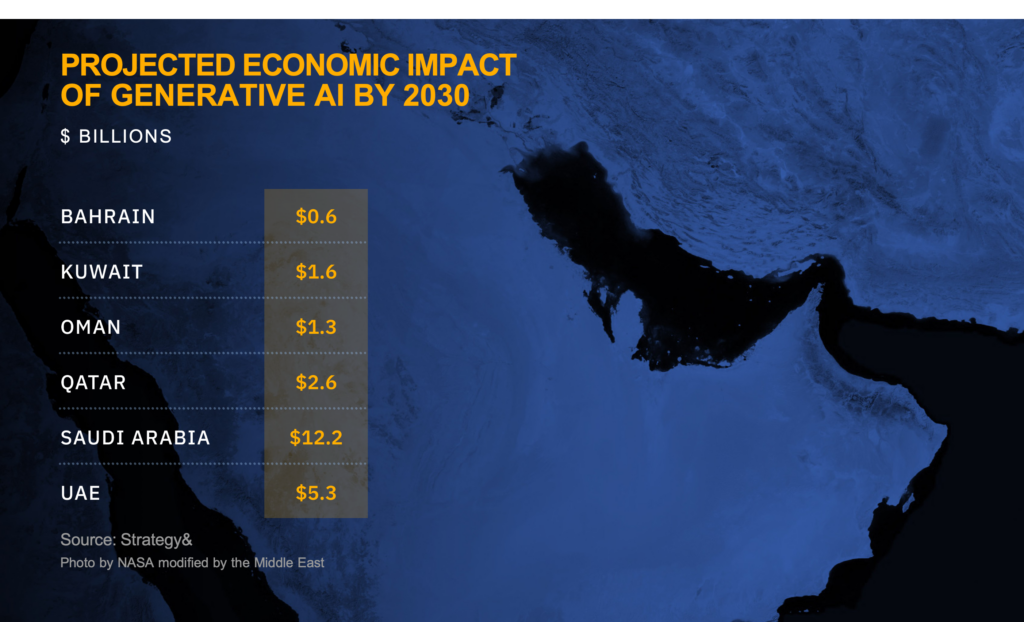
The Gulf states are betting big on artificial intelligence. Their motive is simple: While hydrocarbons will remain part of the energy mix for the foreseeable future, the revenue and influence tied to crude are already beginning to diminish. AI is not just about technology; it is a hedge, and potentially a new foundation for sustaining and even increasing their power in the rapidly shifting world order.
This report explores the current strategies and next steps for the Gulf Cooperation Council states as they diversify their economies in pursuit of a high-tech, AI-driven future.
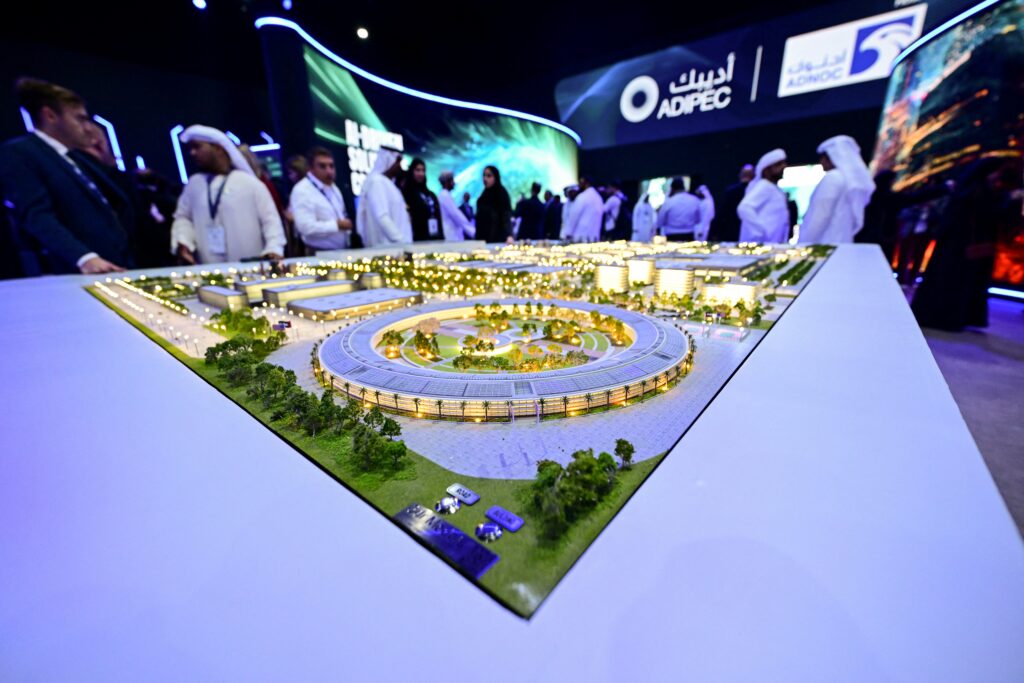
Guests look at a model of the largest data center in the UAE under construction in Abu Dhabi as the Stargate initiative, a joint venture between G42, Microsoft, and OpenAI, during the Abu Dhabi International Petroleum Exhibition & Conference (ADIPEC) on November 3, 2025. Photo by Giuseppe CACACE / AFP via Getty Images.
Introduction
The Gulf states are betting big on artificial intelligence (AI). Their motive is simple: While hydrocarbons will remain part of the energy mix for the foreseeable future, the revenue and influence tied to crude are already beginning to diminish. Oil has made the Gulf one of the world’s wealthiest regions, but it is unlikely to carry the same weight in the decades ahead. That is why the Gulf states are channeling today’s hydrocarbon revenues into funding efforts to develop a high-tech, AI-driven future.[1] For them, AI is not just about technology; it is a hedge, and potentially a new foundation for sustaining and even increasing their power in the rapidly shifting world order.
Economic diversification is at the heart of this strategy. For decades, the Gulf states have relied on petroleum and natural gas exports as the backbone of their GDP. Saudi Arabia alone still produces about 9% of all crude oil globally.[2] Yet they recognize that this status quo is not permanent. By investing oil revenues into AI research, startups, and infrastructure now, the Gulf states aim to future-proof their economies and maintain their status as key global players in a post-oil era.
Beyond economics, national power and geopolitical leverage are critical motivators for Gulf leaders. They see AI as a force multiplier that can enhance everything from defense and intelligence to finance and healthcare. Full-scale adoption of AI applications confers strategic advantages — more capable militaries, more efficient industries, and new engines of growth.[3] In national security, for example, AI systems can sift through vast amounts of data for real-time intelligence, a capability already being harnessed by the United States, other members of the G7 (Canada, France, Germany, Italy, Japan, and the United Kingdom), Israel, and other major powers. Possessing cutting-edge AI elevates a country’s influence. The Gulf states want to be developers and deployers of advanced technology — not just investors or consumers — so they can move beyond raw resource extraction or lower-level processing in the global economy and become part of the broader transition toward techno-industrialism.[4]
“At a moment when capital spending on AI infrastructure is climbing into the hundreds of billions of dollars, the Gulf’s appetite for scale and speed gives Washington something rare: an external accelerator.”
AI is thus seen as a pathway to sustain their leadership and bargaining power on the global stage. Indeed, Gulf governments understand that playing a major role in both energy supplies and AI infrastructure dedicated to computational power (compute) could grant them new geo-economic leverage in the coming decades. If they can offer partners cheap oil and competitively priced, large-scale computing, their importance in the world order will only grow. By pushing into AI, the Gulf also seeks an edge in regional and great-power relations. All six Gulf Cooperation Council (GCC) countries — Bahrain, Kuwait, Oman, Qatar, Saudi Arabia, and the United Arab Emirates — have published national AI strategies, signaling a top-level political commitment to this transition. In sum, the Gulf is betting on AI as the next source of national wealth and influence: a chance to diversify away from oil while securing a prime seat at the table in the emerging AI-driven world order. It is a bold gamble, but one aligned with their broader visions of economic renaissance and sustained geopolitical clout.
Graphic by amtitus/ DigitalVision Vectors via Getty Images modified by the Middle East Institute.
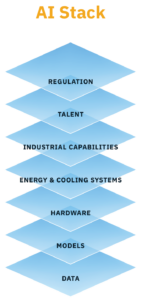
For the United States, the Gulf’s AI push is strategically consequential. Done right, AI deals struck between Washington and Gulf capitals can reinforce American technological leadership. On the one hand, they anchor the Gulf states more firmly in the US tech sphere. On the other, they channel Gulf capital toward the broader American AI ecosystem of associated standards, legislation, human capital, technological assets, software, and techno-industrial know-how, together referred to as an “AI stack.” At a moment when capital spending on AI infrastructure is climbing into the hundreds of billions of dollars, the Gulf’s appetite for scale and speed gives Washington something rare: an external accelerator. If the US can shape the rules, supply the microchip processors, and secure the firmware and cloud environments these systems run on, it will gain partners that expand the reach of the American AI ecosystem rather than constrain it. That matters, especially now, as China’s rival AI stack gains ground through sheer chip volume, increasing compute, and aggressive global deployment.[5] Gulf alignment with the US ecosystem is commercially valuable for American companies, expanding the US compute footprint globally while accelerating the Gulf’s integration and upward movement within the global AI value chain. Nevertheless, even without Washington — and even along a longer, more complex pathway involving Beijing — the Gulf states retain viable routes to advance their AI ambitions
There are also broader geo-economic implications. The world is entering a phase where compute is becoming a form of geopolitical leverage. Bringing the Gulf into a structured, American-aligned AI architecture strengthens US influence across three continents. Gulf-operated AI hubs — powered by US chips, cloud platforms, and security protocols — would anchor American standards across the Middle East, South Asia, and parts of Africa. That boosts US geo-technological power. It gives American firms privileged market access. It creates an alternative to a Chinese digital footprint. In sum, it is becoming an essential pillar of 21st-century strategy, where the fusion of capital, energy, and compute will define national power.
Text Box: What Is Artificial Intelligence?
AI is a field of computer science focused on creating machines and software capable of performing tasks that normally require human intelligence. These tasks include recognizing speech, interpreting language, identifying images, solving problems, and making decisions. Most modern AI systems are based on statistical and machine-learning techniques, rather than fixed rule-based programming. In recent years, many of the most capable AI systems have been built using Transformer architecture, which enables models to process and relate large amounts of data in parallel and to capture long-range relationships in text, images, and other inputs. Rather than being explicitly programmed for every step, AI systems learn from data, detect patterns, and improve performance over time, often under human-defined objectives and constraints.
Today, AI enhances human activity by making tools, machines, and systems more capable than ever before. Large language models (LLMs), such as ChatGPT, Claude, or Gemini, can generate human-like text, summarize vast amounts of information, and answer complex questions with remarkable speed and scale, even as they remain prone to errors, hallucinations, and inconsistencies, particularly outside well-defined domains or when operating without human oversight.[6] Other forms of AI include computer vision (used in medical diagnostics and autonomous vehicles), reinforcement learning (which powers robotics and logistics optimization), and recommendation engines (which drive online commerce and media platforms).[7] Together, these systems are not only improving existing processes, they are opening entirely new frontiers.
Some researchers argue that the technology is more than a tool of efficiency; it could accelerate exponential technological progress across the scientific spectrum. From unlocking protein folding, revolutionizing drug discovery, or designing new materials and energy systems to managing complex systems like global supply chains and power grids with precision beyond human capacity, AI could enable breakthroughs that humans alone could not achieve, or indeed even ones that they have not yet imagined.[8]
Other researchers, however, are less optimistic, raising concerns about AI and pointing to a host of potential negative effects. These include impacts in areas ranging from the social and economic to the security and environmental fronts.[9] For now, there are more questions than answers about the trajectory of this potentially revolutionary technology.
Photo by gorodenkoff/Stock/Getty Images Plus via Getty Images.
The Role of Compute in the 21st Century
AI compute, much like oil, is a foundational resource — a potentially critical input into virtually every tool, weapon, or system to make it far faster, more comprehensive, and more integrated than it could otherwise be. Thus, AI compute can be built, acquired, and deployed by states and individuals alike in the pursuit of efficiency and innovation, from commercial applications to military operations.
Perhaps the most visible aspect of its physical infrastructure for the general population has been the accelerating growth of massive data centers in various parts of the world. One of their key constraints, which plays a central role in dictating where they are being built, is access to large amounts of low-cost electricity. Powering the surge in the world’s data centers alone is expected to require over three times more energy by the end of this decade than it did in 2023. These data centers are the physical hubs that, in turn, house the vast array of hardware required for AI. The specialized AI chips — such as graphics processing units (GPUs), logic chips originally designed for digital image processing, which now also serve as the computational engines for training and running large-scale AI models — perform the complex calculations and data processing that power modern AI systems. This entire infrastructure collectively processes data to generate an output. In the context of large language models, this output is often broken down into tokens, which are then reassembled to achieve the final response to a user’s request.[10] Just as control over oil was a source of geopolitical power, control over this compute infrastructure is rapidly becoming a decisive factor in global influence and strategic competition between states.
“Only a handful of firms and countries possess the supply chains, capital, technical expertise, and industrial depth to manufacture leading-edge semiconductors, design and operate exascale data centers, and sustain the power needed to keep them running.”
Why does compute matter so much for global power? Unlike other critical inputs such as electricity, which every modern state needs but which does not on its own confer strategic advantage, compute is both hierarchical and scarce. In terms of hierarchy, not all compute is created equal: The ability to train state-of-the-art AI models requires the most advanced chips, tightly coupled with hyperscale data centers and steady, large-scale energy flows.[11] These resources are extraordinarily difficult to build and coordinate. Thus, compute capacity remains scarce. Only a handful of firms and countries possess the supply chains, capital, technical expertise, and industrial depth to manufacture leading-edge semiconductors, design and operate exascale data centers, and sustain the power needed to keep them running.
As a result of its specific dual nature, compute is a force multiplier — for those able to harness it. It enables the development of ever more capable and sophisticated AI models, which can in turn transform military planning, economic productivity, intelligence gathering, and even the ability to design new technologies. Countries that control compute are not just powering their economies; they are also building the engines of discovery and dominance for the next century — assuming AI ultimately delivers to a meaningful extent on its promised capabilities, which remains likely but is by no means guaranteed. The difficulty of securing compute reflects its strategic importance; access is likely to carry disproportionate weight, and some actors — most notably the United States and possibly China — are already pulling ahead of the rest.
Liquid cooled servers in an installation at the Global Switch Docklands data center campus in London, United Kingdom, on June 16, 2025. Photo by Jason Alden/Bloomberg via Getty Images.
AI Development in the Gulf
As states work to procure the resources needed to have the most compute, the Gulf region is in an advantageous position to join the top players. This is due to the Gulf’s unique combination of vast capital on hand, easy access to massive energy supplies, and a central geographic location — at the crossroads of Europe, Asia, and Africa — that enjoys reduced latency (the delay caused by the physical distance data must travel) for global data flows.[12] The GCC member states, which also have a strong desire to diversify their economies beyond oil and gas, are now rapidly positioning themselves to take up this global AI leadership mantle, primarily by establishing the necessary data center infrastructure, incentivizing chip design inside the Gulf, and leveraging their energy advantage.
Building the AI Stack Backbone
The GCC’s focus on AI and broader technological transformation began in the 2010s, when the Gulf states — each to a different degree and at varying scales and speeds — began investing heavily in digital infrastructure. The UAE, Qatar, and Saudi Arabia were some of the first in the region to install 5G networks, raising questions in the US over their use of Chinese technology to build them and creating a dilemma for the Gulf states amid a growing tech cold war between Washington and Beijing.[13] Yet ultimately, the Gulf’s 5G buildout was a critical step for AI development that helped set the stage for a new kind of conversation between Washington and these capitals around advanced technology. In the past, the relationship was primarily focused on the region as a source of investment — such as Emirati state-owned Mubadala Investment Company’s seminal, capital-intensive investment in GlobalFoundries in the 2000s, which established the UAE as a major shareholder in the US-based semiconductor producer. The new dialogue, in turn, is centered on technological deployment and the strategic alignment of national priorities, repositioning the GCC countries as players within the global technological ecosystem.[14]
The Gulf states made AI more than simply a private-sector experiment; they raised it to a national priority, directing billions of dollars toward developing and embedding it into government strategies, education programs, and industrial policy. This shift was made possible in large part by the earlier buildout of 5G networks, which provided the high-speed, low-latency digital infrastructure needed to support large-scale data flows, cloud services, and AI applications. The countries have made this emphasis clear through the development of programs and leadership positions within the government dedicated to AI. In order to achieve these goals, Gulf sovereign wealth funds began to invest in AI firms, both in the region and beyond, building a foundation from which to access the latest AI technologies and then model their own programs after them. One leading example is Saudi Arabia’s Public Investment Fund (PIF), which has invested in companies such as Luma AI.[15] Another is the Qatar Investment Authority and MGX’s investments in xAI.[16] These relationships give the Gulf states insight into up-and-coming technologies and open doors for collaboration and technology transfer.
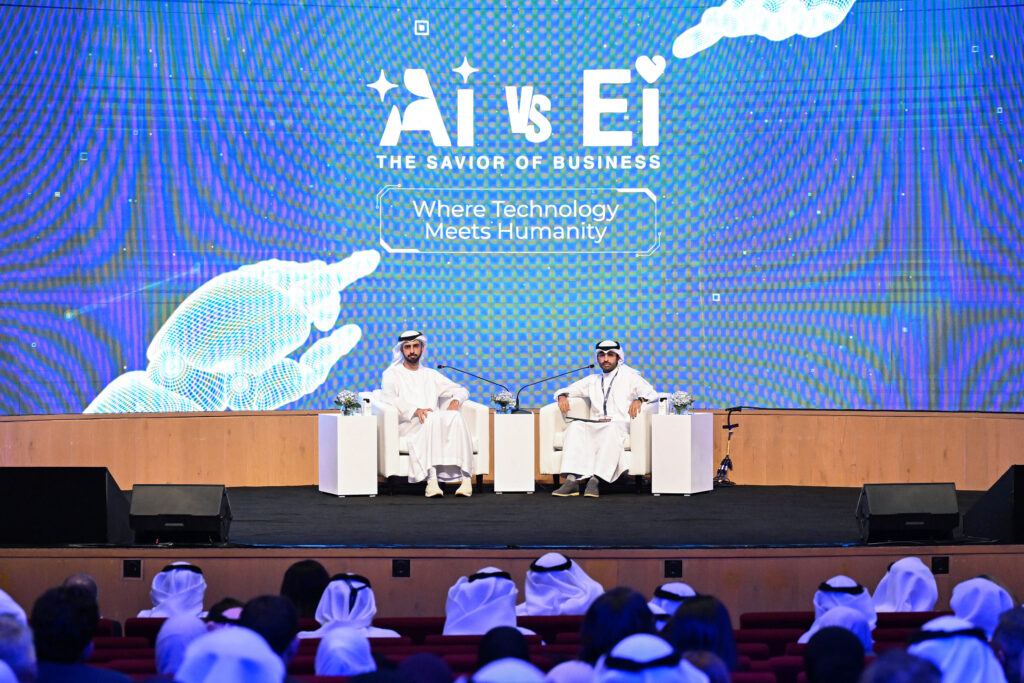
Photo above: The UAE’s Minister of State for Artificial Intelligence, Digital Economy, and Remote Work Omar al-Olama (L) and Kuwait Times managing director Abdullah Boftain speak at the Breaking Barriers 3: AI vs. EI — The Savior of Business conference, in Kuwait City, on November 16, 2025. Photo by YASSER AL-ZAYYAT/AFP via Getty Images.
Role of the Gulf’s Sovereign Wealth Funds
Gulf sovereign wealth funds make conscious choices to not only finance foreign AI firms but also support the development of their own local companies and infrastructure. In the UAE, the sovereign AI champion G42 focused on bringing AI and cloud computing to a wide variety of sectors, ranging from healthcare to government. In Saudi Arabia, PIF funded HUMAIN to develop an Arabic LLM. Qatar has created a new AI-focused company, Qai, backed by the Qatar Investment Authority, to invest in infrastructure at home and abroad.[17] These firms are proof that the Gulf wants to be more than just a consumer of this technology; the regional countries are actively positioning themselves as producers.
The Gulf states are also investing heavily in students and research. Academic institutions like King Abdullah University of Science and Technology (KAUST) in Saudi Arabia and the Mohamed bin Zayed University of Artificial Intelligence (MBZUAI) in the UAE are just two examples of Arab Gulf countries taking an interest in preparing the next generation of computer scientists. GCC member states are focusing on domestic research and development (R&D) and creating robust educational initiatives to build a self-sufficient, knowledge-based economy. This includes significant investment in talent development and the creation of dedicated research institutions that go beyond simply acquiring foreign technology.
Major Milestones for AI in the Gulf
Although all six GCC states have shown a growing interest in AI, each has pursued subtly different goals by somewhat different means. A Boston Consulting Group (BCG) report measuring AI readiness across Gulf countries identified Saudi Arabia and the UAE as “AI Contenders” — the second highest of four categories in terms of industry maturity. Bahrain, Kuwait, Oman, and Qatar were labeled “AI Practitioners” — one rank down and indicating countries with developing infrastructure and initiatives, but still in the early stages.[18] BCG looked at more than 30 indicators in areas ranging from AI ambitions and skills to policies, investment, and ecosystem to gauge how ready the countries were to scale AI and achieve their goals. Overall, the report found high levels of ambition throughout the GCC; every country has articulated a national AI strategy or roadmap. But tangible AI development in the region remains unequal.
Image by GarryKillian / iStock / Getty Images Plus via Getty Images.
Leaders in AI Buildout in the Gulf
Saudi Arabia
The kingdom’s technological push began in 2016 with Vision 2030, a national blueprint for long-term economic development and diversification.[19] This commitment was formalized in 2019 with the establishment of the Saudi Data and Artificial Intelligence Authority (SDAIA).[20] Saudi Arabia’s ambitions expanded in 2024, when Google partnered with PIF to build an advanced AI hub.[21] And in May 2025, Crown Prince Mohammed bin Salman established HUMAIN, a state-owned AI holding company supported by PIF, which then developed its own Arabic LLM, ALLaM.[22]
Next Steps: Saudi Arabia is moving toward building one of the world’s largest compute capacities, scaling HUMAIN’s data centers to the gigawatt (GW) level in terms of their power consumption. In parallel, it is developing a national chip design ecosystem with dozens of firms.[23] These efforts aim to transform Saudi Arabia into a regional hub for AI capacity that serves emerging markets.
United Arab Emirates
Similarly, the UAE’s strategic focus on AI was demonstrated in 2017 with the establishment of the Ministry of Artificial Intelligence.[24] This was followed in 2018 by the founding of the Emirati tech holding company G42 and the inauguration of the MBZUAI in 2019.[25] The UAE’s financial commitment was solidified in 2024, when Mubadala and G42 launched MGX, a $100 billion AI infrastructure investment firm.[26] This move positioned the UAE among an elite group of countries working on the question of AI infrastructure on a global scale and providing the capital for such a buildup. In 2025, the Emirates rolled out two new AI models: Falcon Arabic and its higher-performing version, Falcon-H1.[27]
Next Steps: The UAE is consolidating its position as a global AI hub by expanding projects like Stargate, a large-scale data infrastructure campus, and scaling its investments across Europe, Africa, and Asia. The goal is to export compute capacity, embedding the UAE deeply into global AI supply chains while anchoring AI capabilities at home.
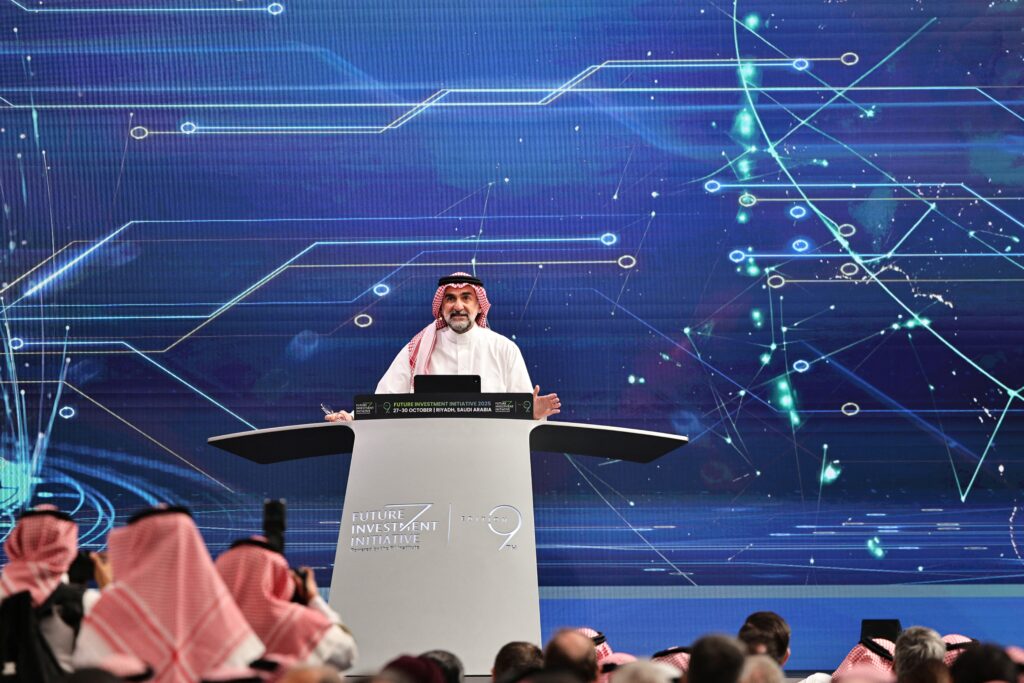
Photo above: Yasir Al-Rumayyan, head of the Public Investment Fund, Saudi Arabia’s influential sovereign wealth fund, addresses the opening ceremony of the Future Investment Initiative, in Riyadh on October 28, 2025. Photo by FAYEZ NURELDINE/AFP via Getty Images.
Emerging AI Players in the Gulf
Qatar
Qatar’s foundation for AI research was laid in 2010 with the establishment of the Qatar Computing Research Institute (QCRI).[28] In 2019, the Ministry of Transport and Communications adopted the National Artificial Intelligence Strategy for Qatar. The country then saw a major infrastructure development in 2023, when Google Cloud opened a new “cloud region,” or geographical area hosting data centers to support cloud services, in Doha.[29] Expanding on its partnerships, Qatar entered into a five-year agreement with Scale AI in February 2025 to develop AI tools for its public systems.[30] Qatar is also positioning itself as a leading investor in frontier technologies, channeling capital into AI startups and infrastructure abroad with projects. This has included projects such as Fanar, an LLM developed by QCRI, and investment in quantum computing firm Psiquantum.[31] Paired with bets on advanced materials and energy technologies, these efforts aim to give Qatar both domestic capability and a global role as a technology investor and convener.
In late 2025, Qatar launched Qai, a national AI company backed by the Qatar Investment Authority, and entered into a $20 billion joint venture with Brookfield to develop AI infrastructure in Qatar and select international markets.[32] At its core, the move is about positioning Qatar as a serious AI and compute player, backed by capital and energy that can actually support the infrastructure.
Next Steps: The creation of Qai signals a shift toward bringing significant AI compute capacity online in Qatar, alongside the development of an enterprise layer that can support government, industry, and international partners operating from the Gulf country.
Kuwait
Kuwait’s political system tends to move more cautiously on major technological bets, but the underlying drivers of compute capacity across the Gulf — capital, energy, land availability, and proximity to global data routes — still position the country as a credible contender for AI infrastructure and deployment. The Kuwaiti foray into AI infrastructure began with the private sector, as companies like Omniva focused on building AI-based GPU data centers using advanced cooling technologies. In March 2025, Microsoft announced its intent to establish an AI-powered Azure Region in the country, referring to a geographic area including one or more data centers alongside networking infrastructure, to accelerate digital transformation.[33] In June 2025, MGX, BlackRock, Global Infrastructure Partners, and Microsoft welcomed the Kuwait Investment Authority (KIA) into the AI Infrastructure Partnership (AIP), an initiative designed to mobilize capital for next-generation AI infrastructure development.[34] This move is also an indication that the UAE’s big bet on AI infrastructure is creating a gravitational pole — one that is drawing other Gulf sovereign wealth funds to join forces and pursue similarly ambitious, moonshot-scale objectives.
Next Steps: If Kuwait launches a national AI infrastructure company, similar to the UAE’s G42, Saudi Arabia’s HUMAIN, or Qatar’s Qai, to coordinate capital, energy, and compute at scale, it could move from participant to shaper in the Gulf’s AI buildout.
Oman
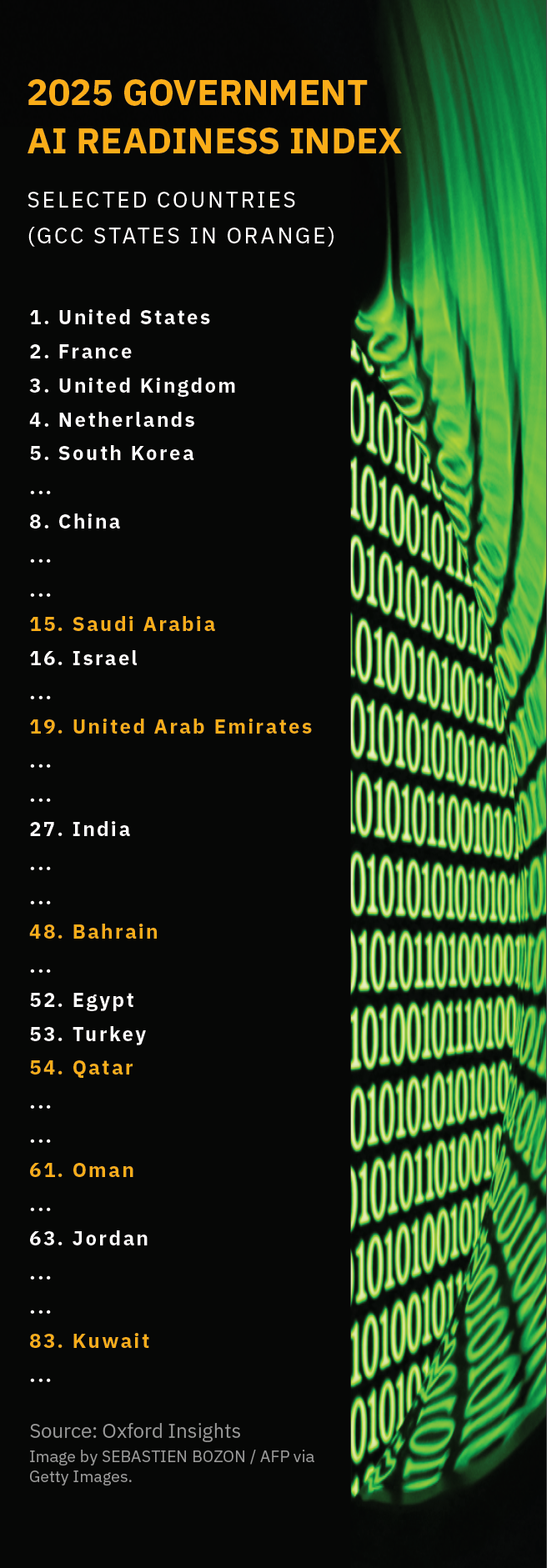
Following significant investment in AI development between 2021 and 2024, Oman’s early progress was recognized in May 2025, when it climbed five spots to rank 45th in the 2024 Government AI Readiness Index, produced by the UK-based consultancy Oxford Insights.[35] Oman has since fallen back to 61st place in the 2025 index, following a reconceptualization of the methodology behind calculating these rankings.[36] Its early progress is nevertheless notable, particularly given the GDP gap between Oman ($105.2 billion in 2025) and larger Gulf economies such as Saudi Arabia ($1.269 trillion; ranked 22nd in the 2024 AI readiness index; 15th in 2025) and the UAE ($569.1 billion; ranked 13th in 2024; 19th in 2025).[37]
Recognizing the need to accelerate its technological trajectory, Oman has begun allocating millions of rials to develop AI-powered applications, support research, and enhance public-sector efficiency. The sultanate is also connected to major international fiber-optic cables like 2Africa, landing in Barka and Salalah, and the 9,800‑kilometer Oman-Australia Cable (OAC), linking Muscat with Perth and beyond — critical arteries for data flows across continents.[38] In parallel, data center operators are investing in sustainability: Oman Data Park has launched a 1.4-megawatt (MW) solar plant to power its Knowledge Oasis Muscat facility, aligning infrastructure expansion with the country’s net zero ambition.[39]
Oman is taking a different path from its Gulf peers. Rather than prioritizing large-scale AI compute, it is positioning itself as a serious entrant into the global semiconductor ecosystem, with investment opportunities announced across the chip value chain at the International Semiconductor Executive Summit in Muscat.[40] The strategy spans a $30 million integrated circuit design company targeting international markets, the Middle East’s first outsourced semiconductor assembly and test (OSAT) facility with $130-140 million in investment, and a flagship semiconductor-grade silicon manufacturing plant aimed at supplying global raw-material demand. Backed by incentives including free land, customs exemptions, long-term tax benefits, and full foreign ownership in free zones, Oman is deliberately lowering barriers for investors while building domestic capability. With more than $130 million already committed, over 250 nationals trained, its first chip design firm launched, and the successful design of the Oman 1 and Oman 2 chips, the sultanate is carving out a role as a strategic player in the AI ecosystem.
Next Steps: Oman is forging a distinct path, prioritizing its role as a specialized player in the semiconductor supply chain rather than racing to achieve massive compute capacity. Unlike its neighbors in Riyadh or Abu Dhabi, Muscat has refrained from launching a centralized national AI “champion.” Omani leadership is making a deliberate bet: focusing on the hardware foundations of the AI stack rather than the high-stakes, capital-intensive bet of gigawatt-scale data centers. Whether the sultanate eventually pivots toward the “compute-first” model seen elsewhere in the GCC remains to be seen, likely contingent on the commercial performance of its initial semiconductor investments.
Bahrain
Bahrain’s AI journey has a strong foundation in cloud computing and data centers. In July 2019, Amazon Web Services (AWS) launched its first Middle East Region cloud zone in the country.[41] Bahrain’s commitment to digital governance was highlighted in July 2025 with the announcement of a National Policy for the Use of AI by the Information and eGovernment Authority (iGA).[42] In a major move, the US and Bahrain signed an agreement on civil nuclear cooperation in July 2025, with a key focus on developing small modular reactors (SMRs) to power energy-intensive AI infrastructure and support the Gulf island state’s digital transformation.[43]
Next Steps: With SMRs providing clean, steady power, the kingdom is well positioned to expand AI-ready infrastructure and embed AI into its financial services and e-government systems. These steps will ensure Bahrain remains competitive while aligning with the Gulf’s wider push to link energy abundance with AI development.
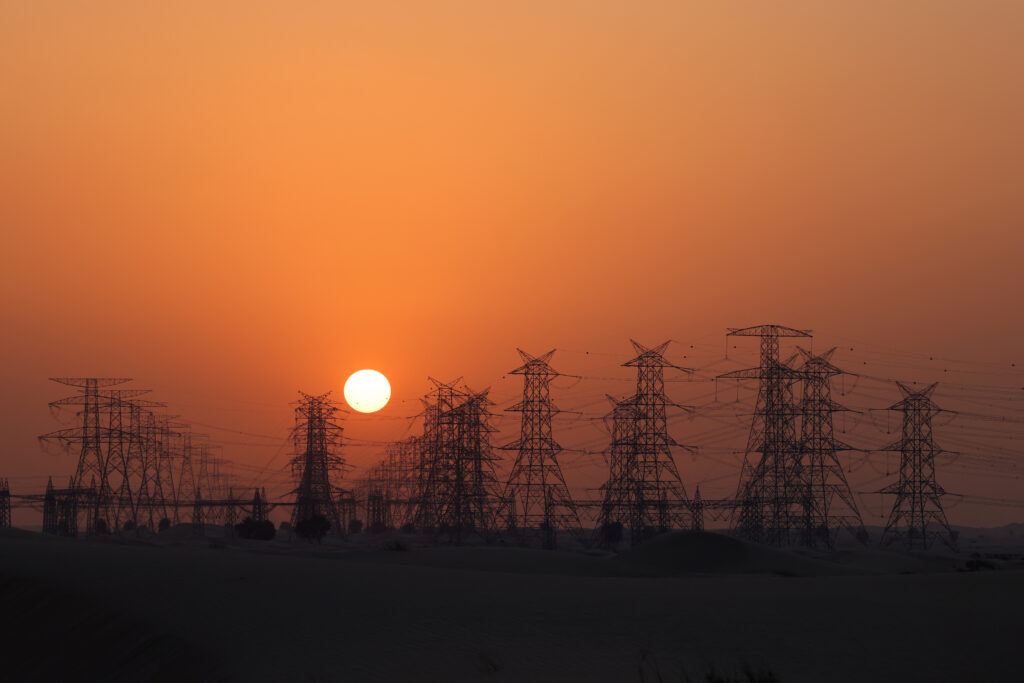
High-voltage pylons in the emirate of Dubai, United Arab Emirates, on October 30, 2021. Photo by GIUSEPPE CACACE/AFP via Getty Images.
Energy Surplus as a Strategic Resource
AI is a voracious consumer of power. Training LLMs and running inference — the process of using a trained AI model to generate outputs such as predictions, text, or decisions in real time — at scale requires immense amounts of electricity. In the United States, for example, a December 2024 estimate showed that 4.4% of all energy is now consumed by data centers, with projections indicating this will grow to 12% of all US electricity usage by 2028.[44] As this demand escalates, the true constraint on AI will not be chips — it will be energy.
This is where the Gulf holds a decisive, immediate advantage. Over the next five years, as the world races to bring 200-300 GW of AI compute capacity online, the Gulf’s energy surplus positions it as the most viable region to rapidly convert chips into actual compute infrastructure.[45] With abundant oil, natural gas, and increasingly large-scale investments in solar, hydrogen, and nuclear, the Gulf states can power AI clusters at scale — reliably, cheaply, and quickly. Unlike European grids, which are already stretched thin, the Gulf offers stability, redundancy, and regional energy integration through frameworks like the Gulf Cooperation Council Interconnection Authority (GCCIA).[46]
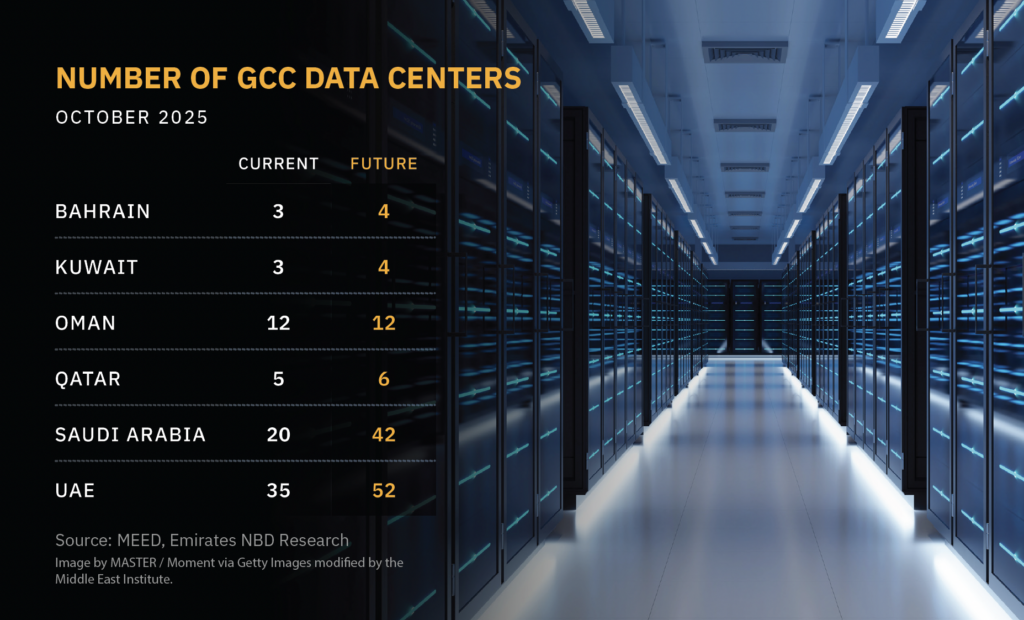
Another, related issue is the vast amount of water that must be used to dissipate the heat created as a byproduct by data center chip racks. With the rapid proliferation of data center construction across the GCC — with capacity expected to triple to 3.3 GW by 2030 — there is a growing concern about strains this may place on scarce water resources in the hot and dry Gulf region. In Saudi Arabia alone, data centers consumed 15 billion liters of water last year. However, engineers and policymakers are racing to find solutions before this problem becomes a crisis with socio-political consequences. Proposed remedies include closed-loop water recycling mandates for data center operators, synthetic coolants piped directly to microchips, as well as increased use of desalination plants to produce more water. But all involve high up-front costs, and the time horizon for implementation is tight given aggressive data center and AI infrastructure buildout schedules. Nonetheless, industry insiders remain optimistic.[47]
Even as the Gulf states lay the groundwork for broader economic transformation — moving toward digital infrastructure, industrial diversification, and knowledge economies — their core competitive edge in the AI race remains energy. In fact, it is this surplus energy capacity that serves as a key driver of economic diversification by enabling the construction of energy-intensive AI infrastructure. This infrastructure, including frontier data centers and chip deployments, lays the groundwork for long-term diversification goals and positions the region as a launchpad for broader AI ecosystems.
The Gulf’s ability to rapidly mobilize energy toward AI has the potential to make it the nucleus of a broader techno-industrial transformation. Once the AI infrastructure is in place, this strategic realignment should allow the GCC to pivot from oil to a diversified energy mix to power the AI infrastructure, which will include sources such as SMRs, traditional nuclear, and renewables.[48] In short, the Gulf countries see their energy surplus as the foundation for their rise as a global AI power. And as the world shifts from an age of fossil fuels to an age of compute, energy abundance may once again define who rises and who falls in terms of wealth and prosperity.
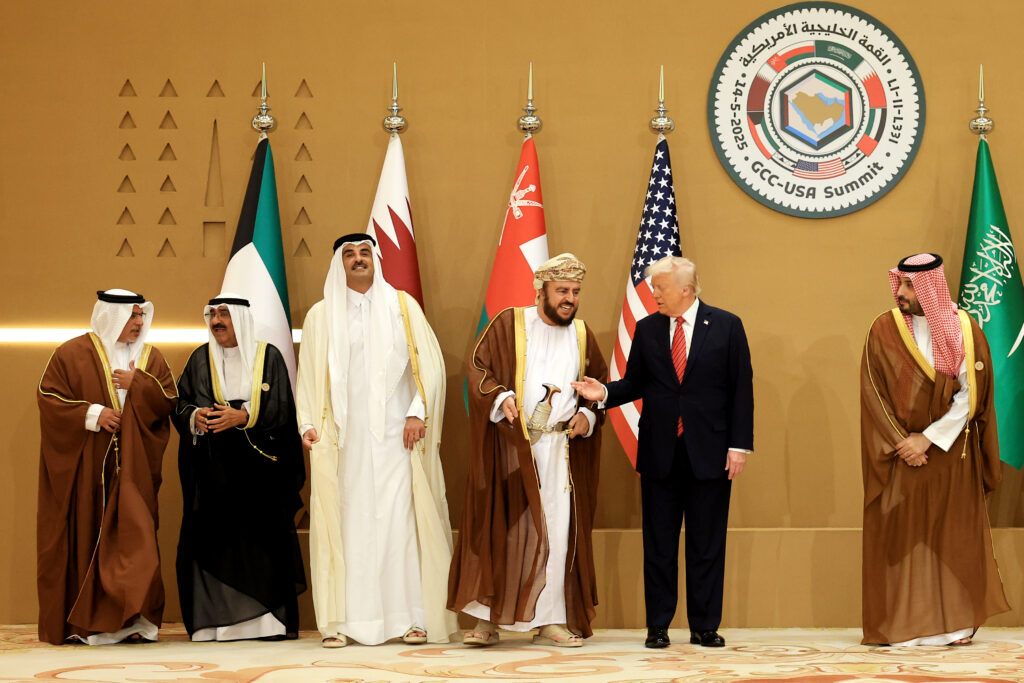
US President Donald Trump (2R) and Saudi Crown Prince Mohammed bin Salman (R) prepare to pose for photos with Gulf Cooperation Council leaders during the GCC Leaders’ Summit at The Ritz-Carlton on May 14, 2025, in Riyadh, Saudi Arabia. Photo by Win McNamee/Getty Images.
A Pivot in US-Gulf Relations
President Donald Trump’s trip to the Gulf early into his second term, in May 2025, marked a real pivot in US-Gulf relations. The role of both energy and defense is getting subsumed into technology and AI. The agreements announced during the visit spanned chip sales, large-scale infrastructure projects, cloud arrangements, and new data center construction. A central element was the prospective easing of US export controls on advanced chips. Under the administration of President Joe Biden, The Framework for Artificial Intelligence Diffusion restricted such exports as part of a broader effort to limit China’s access to high-end semiconductors needed to train frontier AI models.[49]
The old foundation of US-Gulf relations — oil-for-security — is being joined by something new but no less significant: a compute partnership in the making.[50] It may take years to come to fruition, but what has been achieved so far shows real promise, as evidenced by a series of recent, high-profile collaborations.[51] These include the HUMAIN partnership with AWS, Nvidia, and Qualcomm, as well as the US-UAE AI joint venture to build a 5 GW AI cluster.[52] In addition, the US-Bahrain agreement on civil nuclear cooperation, signed in July 2025, is likely tied to developing SMRs to power energy-intensive AI infrastructure.
Crucially, this emerging compute partnership is fundamentally different from the old oil-for-security model. Compute is not a transactional commodity; it is an ecosystem. What the US and the Gulf are now constructing is built on shared technical standards, coordinated safeguards, and co-developed infrastructure — not a simple exchange of resources. In this sense, the relationship is shifting from a narrow quid-pro-quo to a deeper form of technological alignment, one that embeds both sides in a shared architecture of AI development and deployment. The region now aims to position itself — individually and later collectively — to power the AI layer of the global economy outside the United States and China. As this shift unfolds, it will transform the strategic relationship with the United States as well.
There are other key differences too. Compute is built, not extracted like hydrocarbons; it is modular, distributed, and globally networked. However, its global nature does not entirely eliminate geography. Even though AI systems operate through globally interoperable software layers, the physical foundations — chips, energy supply, fiber optic cable landing points, and legal jurisdiction — remain geographically rooted. This is why countries are pursuing distinct “stacks” (US and China): They seek control over the physical and regulatory layers even within a networked system.
Moreover, compute is not a scarce, singular asset in the way oil infrastructure once was. It is increasingly redundant, scalable, and replicable. Even in high-risk scenarios, the Gulf states are not betting on a handful of vulnerable facilities. Saudi Arabia, the UAE, and Qatar are collectively planning 8-10 GW of AI-related compute capacity, spread across a number of different sites, grids, and operators. That scale and distribution fundamentally change the risk calculus. Destroying or disrupting individual data centers would certainly impose costs, but it would not remove these states from the AI business in any lasting way, nor would it resemble a sudden oil-style supply shock.
“Moreover, compute is not a scarce, singular asset in the way oil infrastructure once was. It is increasingly redundant, scalable, and replicable.”
This is not to say that AI infrastructure is invulnerable. Data centers and power sources can still be physically targeted, and recent conflicts — from the destruction of hardened nuclear facilities in Iran to attacks on energy infrastructure in Ukraine — demonstrate that no site on earth is entirely beyond reach. Nevertheless, the key distinction between AI and a more “traditional” sector like hydrocarbons is that AI systems are more recoverable and redistributable than oil infrastructure, with the ability to shift workloads or replicate capacity elsewhere.
The United States, thus, benefits from Gulf compute capacity without needing to defend it the way it once defended energy infrastructure. Modern AI infrastructure can be duplicated, mirrored, or rerouted across jurisdictions. Data centers can be hardened, workloads can shift, and redundancy is built into the architecture. In short, compute creates shared interests, not binding security liabilities.
This distinction applies primarily to AI assets. For the foreseeable future, hydrocarbon infrastructure will still exist alongside AI infrastructure, and with it the continuation — though gradually diminished — of US “oil-for-security” interests. The Gulf is not flipping a switch from oil to compute overnight; there will be a period of overlap in which legacy energy security concerns persist even as new AI-driven alignments take shape. That overlap matters. It means US security exposure in the Gulf does not disappear, but it grows more diversified rather than more concentrated, and less singularly tied to hydrocarbons than in previous decades.
This is why the emerging relationship looks less like “compute-for-security” and more like “compute-for-alignment” — a partnership in which technological alignment does not automatically translate into military entanglement but instead reflects a deliberate strategic choice by Gulf partners to align with the American stack. If anything, the rise of AI infrastructure gives the US more flexibility, not less. Rather than eliminating risk, it changes its character — shifting from single-point vulnerabilities to distributed, recoverable ones. In this sense, the Gulf’s growing importance in AI strengthens political alignment with the United States without recreating the structural vulnerabilities of the oil era. Instead of inherited obligations, it creates optionality, interoperability, and strategic incentive — anchoring the relationship in an AI ecosystem that is dynamic, resilient, and mutually advantageous rather than wholly hostage to physical infrastructure or geography.
Artificial Intelligence (AI)
The field of computer science focused on building machines and software capable of tasks that heretofore have required human intelligence, such as language processing, pattern recognition, and decision-making.
AI Stack The full, interdependent system that makes advanced AI possible, spanning hardware, models, data, energy systems, cooling, talent, regulation, and industrial capabilities, rather than any single technology or company.
Compute
Compute means computational power. It is the combined ability to run advanced software and AI systems at scale, made possible by three things working together: advanced semiconductors, hyperscale data centers (facilities providing extreme scaling capabilities), and large-scale energy flows that together make possible the training and deployment of frontier AI models. Compute is hierarchical and scarce — only a handful of nations and firms can marshal it at scale. In this sense, compute functions as the strategic substrate of the AI age.
Data Centers Facilities that house the hardware — servers, GPUs, storage systems — are used to process and store the massive volumes of data that AI depends on. Hyperscale data centers can consume as much power as small cities.
Digital Transit Hub
A nation that serves as a routing point for global data flows, thanks to undersea cables and connectivity infrastructure. Oman, for example, leverages its geography to connect Asia, Africa, and Europe.
Energy Surplus The excess capacity of a country to generate electricity beyond domestic demand. For the Gulf, abundant oil, gas, renewables, and nuclear resources make energy a strategic advantage in powering AI infrastructure.
Frontier Models
The most advanced, large-scale AI systems operating at the cutting edge of current capability — typically trained with massive compute, vast datasets, and novel architectures to push the limits of reasoning, generation, and autonomous task performance.
Graphics Processing Units (GPUs) Specialized chips designed to perform many calculations in parallel. Originally built for rendering graphics, GPUs are now the workhorses of AI because they can process the large volumes of mathematical operations required to train and run machine-learning models quickly and efficiently.
Hyperscaler A large cloud service provider — such as Amazon Web Services (AWS), Microsoft Azure, or Google Cloud — that operates massive, globally distributed data center networks designed to scale compute, storage, and networking capacity instantly and on demand.
Large Language Models (LLMs)
A type of AI trained on massive amounts of text to generate human-like responses, summarize information, and answer questions. Examples include OpenAI’s GPT series, the UAE’s Falcon models, and Saudi Arabia’s ALLaM model developed by HUMAIN.
Latency The delay between sending data and receiving a response, caused in part by the physical distance data must travel through cables and network infrastructure.
Quantum Computing
A frontier technology that uses principles of quantum mechanics to solve problems too complex for classical computers.
Semiconductor Chips
Semiconductors are the foundational logic devices of the digital age, converting physical phenomena into computable signals and enabling every layer of modern technology. Within this hierarchy, advanced processors such as graphics processing units (GPUs) and specialized chips like Google’s tensor processing units (TPUs) are indispensable for artificial intelligence. They perform the massive parallel mathematical operations required to train and deploy frontier AI models.
Small Modular Reactors (SMRs)
Next-generation nuclear reactors that produce power at a smaller scale than traditional plants, typically under 300 megawatts per unit. Their modular design allows faster construction, safer operation, and integration into diverse grids. SMRs provide steady, carbon-free electricity — an attractive complement to intermittent renewables. For energy-intensive sectors like AI, they offer baseload power that can sustain hyperscale data centers and national compute clusters.
Techno-Industrialism
A fusion development model that anchors national power in the co-evolution of AI, advanced industry, and technology. It prioritizes dense manufacturing bases, frontier R&D, and scaled deployment (chips, compute, energy systems, robotics, bio/quantum) as mutually reinforcing pillars of competitiveness and security.
ABOUT THE MIDDLE EAST INSTITUTE
The Middle East Institute is a center of knowledge dedicated to narrowing divides between the peoples of the Middle East and the United States. With over 70 years’ experience, MEI has established itself as a credible, non-partisan source of insight and policy analysis on all matters concerning the Middle East. MEI is distinguished by its holistic approach to the region and its deep understanding of the Middle East’s political, economic and cultural contexts. Through the collaborative work of its three centers — Policy & Research, Arts & Culture, and Education — MEI provides current and future leaders with the resources necessary to build a future of mutual understanding.
INTELLECTUAL INDEPENDENCE
The Middle East Institute maintains strict intellectual independence in all of its projects and publications. This report represents solely the opinions and views of the author. We gratefully acknowledge the generosity of General Catalyst Institute in supporting this work
ABOUT THE AUTHOR
Mohammed Soliman is a senior fellow at the Middle East Institute (MEI), where he focuses on the intersection of technology, geopolitics, and business in the Middle East and other emerging markets. A trained engineer, he is a director at McLarty Associates, a global advisory firm, where he advises on strategic and policy matters at the intersection of technology, AI, finance, and energy. He is the author of the book West Asia: A New American Grand Strategy in the Middle East, published by Polity Press in February 2026. You may follow him on X @ThisIsSoliman.
Additional Photos
Top image by DKosig/ iStock / Getty Images Plus via Getty Images and modified by the Middle East Institute.
Contents image by Yuichiro Chino/ Moment via Getty Images.



 Kuwait
 Following significant investment in AI development between 2021 and 2024, Oman’s early progress was recognized in May 2025, when it climbed five spots to rank 45th in the 2024 Government AI Readiness Index, produced by the UK-based consultancy Oxford Insights.[35] Oman has since fallen back to 61st place in the 2025 index, following a reconceptualization of the methodology behind calculating these rankings.[36] Its early progress is nevertheless notable, particularly given the GDP gap between Oman ($105.2 billion in 2025) and larger Gulf economies such as Saudi Arabia ($1.269 trillion; ranked 22nd in the 2024 AI readiness index; 15th in 2025) and the UAE ($569.1 billion; ranked 13th in 2024; 19th in 2025).[37]