Summary
This report considers the lack of Palestinian political agency as a driver of regional insecurity that must be resolved before wider conflicts can be settled. The author analyses the conditions that contributed to the destruction of Palestinian political capacity, including Israeli policies, Palestinian shortcomings, and exploitation by Iran, and makes recommendations for an Arab strategic initiative.
Contents
Introduction: Palestine as a Regional Security Problem
The Architecture of Palestinian Political Erasure
An Unnatural Environment Cannot Produce Natural Leadership
Palestinian Leadership Failure
Iran’s Exploitation of the Vacuum
The Chain of Consequences: October 7 and Its Aftermath
Why Current Policy Frameworks Are Failing
The Case for an Arab Strategic Initiative
Palestinian Political Renewal: Preconditions, Not Prescriptions
Executive Summary
The prolonged destruction of Palestinian political capacity, engineered by Israeli policy, deepened by Palestinian leadership failure, and exploited by Iran, has not only cost Palestinians and Israelis dearly, but it has also contributed to a regional security crisis that now directly threatens Gulf stability, US strategic interests, and the global economy. This paper argues that Palestinian powerlessness is not an issue of secondary significance to Middle East geopolitics, but an active and escalating driver of instability. Failing to treat it as such all but guarantees recurring conflict between Palestinians and Israelis, stalled regional integration, and further violent escalation. Conversely, restoring Palestinian political agency could break the cycle that has fueled radicalization, Iranian exploitation, and the regional wars that have devastated Arab economies.
For decades, Israeli policy has systematically fragmented Palestinian political life: dividing territory, destroying representative institutions, severing Gaza from the West Bank, and foreclosing any credible path to self-determination. Palestinian leaders have compounded the crisis through their own failures. Hamas subordinated Gaza’s population to a strategy of perpetual armed confrontation. The Palestinian Authority (PA) calcified into an unelected bureaucracy whose primary institutional function became security coordination with the occupying power. The resulting vacuum invited Iranian exploitation, with Tehran invoking Palestinian self-determination as a vehicle to enhance its regional influence.
The consequences have been catastrophic. Hamas’s October 7, 2023, attack was the deadliest single assault on Israel in its history. Israel’s military response has devastated Gaza on a generational scale. Annexationist momentum in the West Bank has accelerated. The 2026 war between the US-Israel coalition and Iran brought the crisis directly to Arab sovereign territory, with Iranian missiles and drones striking Riyadh, Abu Dhabi, Kuwait, Doha, Dubai, and Manama. The unresolved Palestinian question, its genuine resonance with regional publics, and Iran’s weaponization of it thus helped fuel a direct military assault on Arab states and a global economic crisis estimated to have cost Arab economies well over $120 billion.
Current policy frameworks are failing. The Biden administration’s “revitalized PA” concept, the Saudi normalization track, “Board of Peace”-style administered governance models, and the Abraham Accords framework all share a structural deficiency: they treat Palestinian political agency as an afterthought rather than a foundation.
This paper proposes an Arab strategic initiative grounded in the following recommendations:
- Establish a standing Arab diplomatic mechanism for Palestinian political reconstruction, with dedicated staffing, budget, and senior political representation.
- Condition the deepening of further Arab normalization and economic engagement with Israel on measurable Palestinian political benchmarks, including a timeline for elections, a verified settlement freeze, and restored PA fiscal autonomy.
- Fund Palestinian institutional capacity-building directly, bypassing existing patronage networks and investing in an independent judiciary, electoral infrastructure, reformed security services, and independent media.
- Re-engage Palestinian factions diplomatically, including Hamas, on terms requiring concrete movement toward reconciliation, elections, and acknowledgment that October 7 was a catastrophic mistake, to deny Iran the monopoly on engagement.
- Engage Washington collectively on the urgency of preventing annexation, leveraging the upcoming renewal of the US-Israel memorandum of understanding to attach material consequences to actions that foreclose diplomatic options.
The alternative to this initiative is not managed stasis but continued deterioration: deepening Iranian influence, accelerating Israeli annexation, and recurring security crises the region has demonstrated it cannot effectively manage.
Introduction: Palestine as a Regional Security Problem
The prevailing frameworks through which Arab capitals and Washington have approached the Palestinian question are no longer analytically adequate. For decades, Palestine has been viewed through one of three lenses: a humanitarian crisis to be managed through aid and relief operations; a bilateral Israeli-Palestinian dispute to be mediated when conditions permit; or a symbolic cause to be acknowledged in summit communiqués but ignored in practice. Each of these framings has failed on its own terms. Taken together, they have permitted a slow-moving political collapse, the consequences of which are felt well beyond the Palestinian people.
The central question confronting Arab states and their international partners is whether the region, including Israel, can sustain the security consequences of continued Palestinian political erasure. The destruction of Gaza, the annexationist acceleration in the West Bank, Iran’s expansionist footprint through proxies and partners, and the regional escalation that followed October 7 are not disconnected crises. Nature abhors a vacuum, and the prolonged erosion of Palestinian political capacity, encouraged by Israel, deepened by Palestinian leadership, and exploited by Iran, has yielded a Palestinian state-sized hole filled by regionally proliferating violence.
This paper makes a single, sustained argument: that reversing the destruction of Palestinian political capacity is a strategic necessity for the security of the Arab states, the United States, and Israel itself. It maps the architecture of Palestinian political erasure, examines the failures of Palestinian leadership within that structure, analyzes Iran’s exploitation of the resulting vacuum, and traces the chain of consequences from political collapse to the current catastrophe. It then evaluates the specific policy frameworks that have been proposed and explains why each is structurally inadequate. It concludes with a concrete set of recommendations for an Arab strategic initiative that treats Palestinian political agency not as a bargaining chip but as a linchpin of regional security.
The Architecture of Palestinian Political Erasure
The weakening of Palestinian politics was not the inevitable byproduct of conflict. It was the cumulative result of decades of Israeli policy designed, with increasing deliberation, to prevent the emergence of a coherent Palestinian political actor capable of exercising sovereignty.
Territorial Fragmentation as Political Strategy
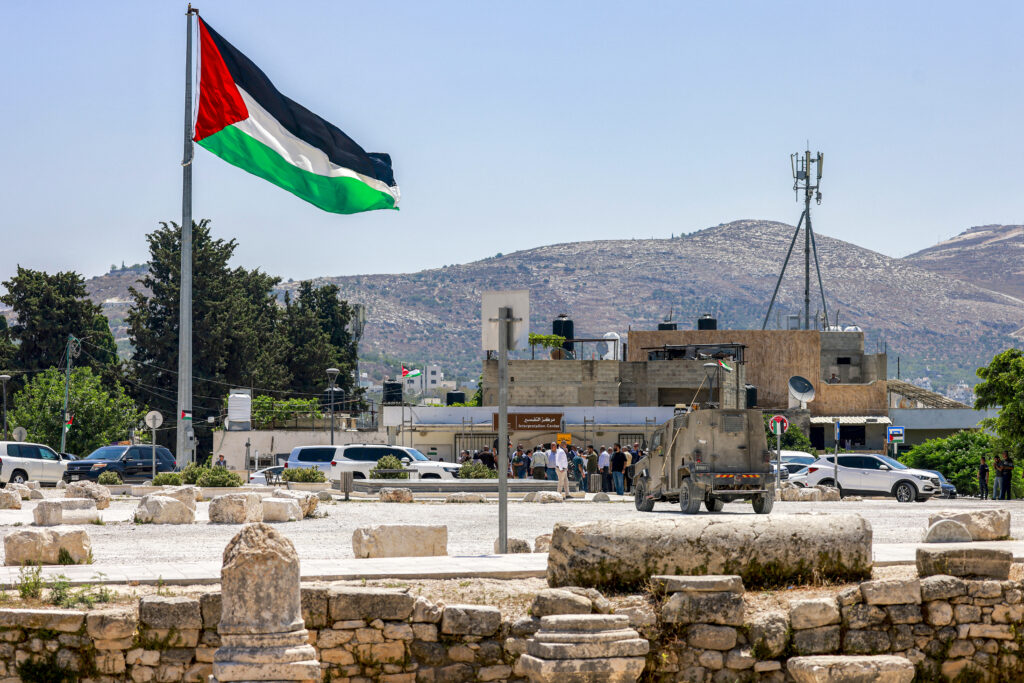
The most visible instrument of Palestinian political erasure is territorial. This begins with the split between the West Bank and Gaza, separated by the geography of Israel. Within the West Bank, that fragmentation deepens: the territory today is not a contiguous political unit but a patchwork of disconnected enclaves. Under the Oslo II Interim Agreement of 1995, it was divided into three administrative zones: Area A, under full Palestinian civil and security control; Area B, under Palestinian civil control but Israeli security authority; and Area C, under full Israeli control. Designed as a five-year transitional framework leading to a permanent status agreement, the arrangement instead became permanent infrastructure for Israeli control. Area C, which encompasses over 60 percent of the West Bank, remains under full Israeli military and administrative authority.[1] It contains the Jordan Valley, the major aquifers, and the land on which any viable Palestinian state would depend. Palestinian construction there is virtually prohibited; Israeli settlement construction is ongoing and accelerating.
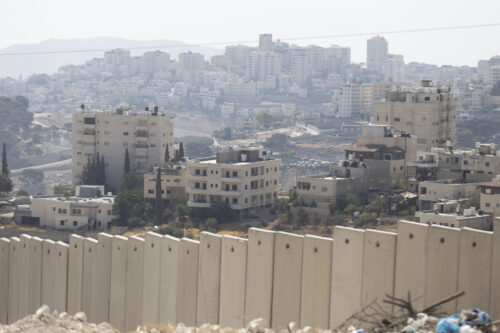
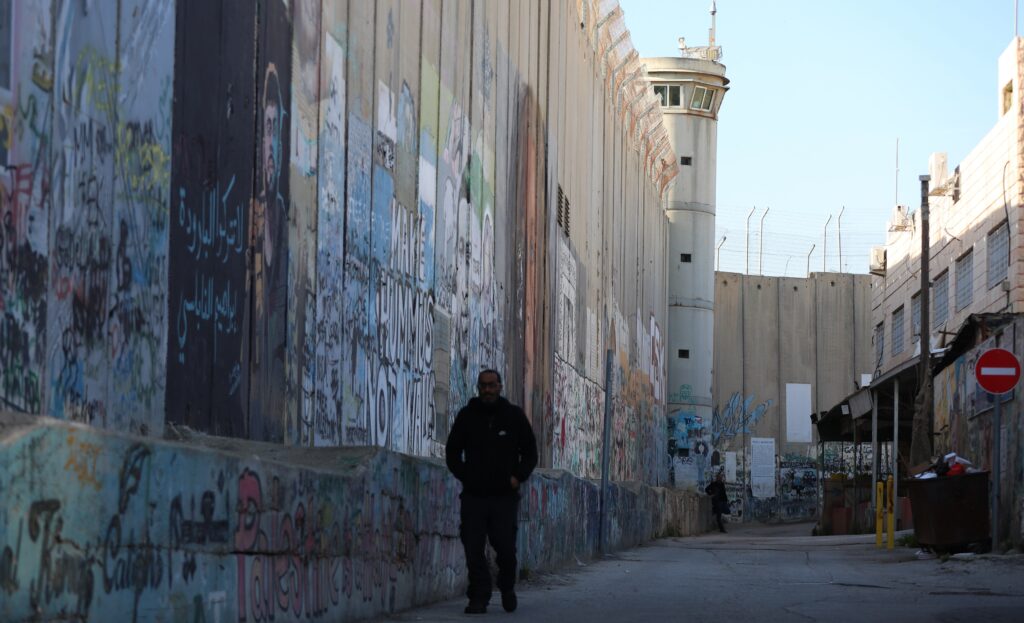
The settlement enterprise functions as a political and security architecture. Over 700,000 Israeli settlers now live in the West Bank and East Jerusalem.[2] Their security and quality of life are protected by a network of bypass roads and military checkpoints that has compromised the same security and quality of life for the Palestinians around them. Further, the barrier Israel constructed beginning in 2002, during the Second Intifada — the Palestinian uprising that erupted in 2000 and brought a wave of suicide bombings inside Israel — was justified as a security mechanism. However, rather than following the 1967 armistice line (the internationally recognized boundary between Israel and the occupied West Bank), it was built well beyond it, deep into Palestinian territory. With its route determined around pre-existing settlements and cutting deep into the West Bank, it became not just a security measure but a tool for efforts to predetermine final borders with a maximalist lens and, in the process, sever Palestinian communities from one another. The practical effect is that Palestinians in Ramallah, Hebron, and the Jordan Valley inhabit different political realities, subject to different permit regimes, with no continuous territorial connection between them.
Gaza’s separation from the West Bank followed a different and more deliberate path. By 2005, approximately 8,000 Israeli settlers lived in 21 settlements across Gaza, protected by a significant Israeli military presence, amid a Palestinian population of some 1.4 million. Prime Minister Ariel Sharon’s motivations for the unilateral disengagement that year, involving the removal of all settlements and Israeli security forces from the strip, have been variably interpreted. Whether driven by a desire to safeguard Israeli security in the wake of the Second Intifada; to test whether the Palestinians could become, in Israeli eyes, a “partner for peace” to mitigate international pressure to move toward a negotiated two-state solution; or to consolidate control over the West Bank, the net result of Sharon’s move was to further disconnect the two occupied territories. After Hamas violently seized control of the strip from the Fatah-led PA in June 2007, Israel imposed a comprehensive land, sea, and air blockade, severely restricting the movement of people and goods. Egypt simultaneously closed the Rafah border crossing, Gaza’s only non-Israeli-controlled exit.
Together, the blockade and border closure hardened Gaza’s separation from the West Bank into a durable political and territorial fact. Movement of people between Gaza and the West Bank became nearly impossible. The Palestinian polity was split into two administrative zones with no shared governance, no shared elections, and no mechanism for political reunification. The enduring divide was not merely a natural outcome of the Hamas-Fatah rivalry. It was a condition that Israel and the international community actively maintained or enabled through economic and diplomatic policy, even as it ran directly counter to the articulated support for two-state “peace process” diplomacy these actors maintained. Managing a divided Palestinian leadership became the default design rather than facilitating the emergence of a unified leadership better equipped to enter into and sustain the kind of agreements being nominally pursued.
The Erosion of Representative Institutions
Political fragmentation was reinforced by the systematic erosion of Palestinian representative institutions. The Palestinian Legislative Council (PLC), elected in 2006 in what international observers recognized as a credible election, has not convened in a meaningful session since 2007. Its Hamas members were arrested en masse by Israel in the weeks following the election, with over 40 legislators and ministers detained, and many held for years without trial.[3] The PA’s legislature was effectively destroyed by a combination of Palestinian dysfunction, an Israeli decision to decapitate an elected government whose composition it found unacceptable, and an international community response to bypass the new government and deal only with and through the office of President Mahmoud Abbas.
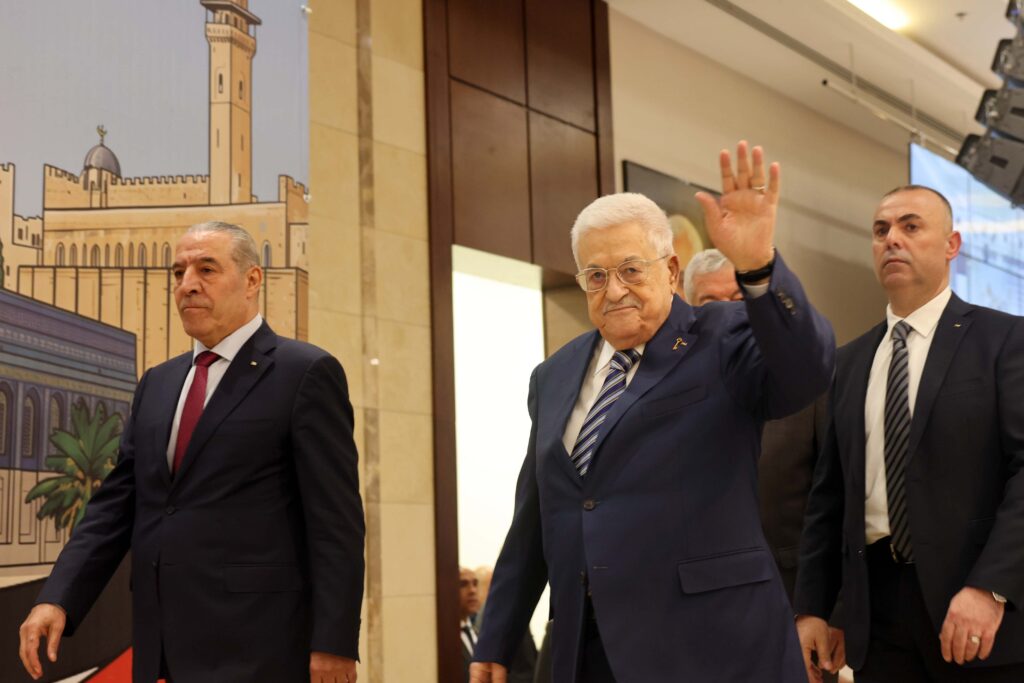
Presidential and legislative elections have not been held since 2005 and 2006, respectively. President Abbas is now two decades beyond his elected term. The electoral and governance system ushered in via the Oslo Accords, which was supposed to give Palestinians a democratic stake in their own governance, has been suspended indefinitely. This reflects the Palestinian leadership’s own reluctance to face voters as much as Israel’s refusal to accept any electoral outcome it cannot control. The 2006 precedent taught every Palestinian faction a durable lesson: elections that produce the “wrong” result will be punished, not respected.
Beyond formal institutions, the broader ecosystem of Palestinian political life has been degraded. Hamas, the PA, and Israel have all served each other’s interests in their respective approaches to repressing Palestinian political life in the Occupied Territories. Restrictions on freedom of assembly, association, and movement, enforced by the Israeli military in the West Bank and by the blockade in Gaza, have constricted the space in which normal politics can occur. Political organizers are subject to administrative detention. Student councils, professional unions, and civic organizations operate under surveillance and periodic suppression.[4] The Israeli permit regime — the system of military-issued permissions Palestinians must obtain to move between towns, cross checkpoints, enter East Jerusalem, reach farmland beyond the separation barrier, or work inside Israel — fragments daily life to a degree that makes sustained collective political action extraordinarily difficult. In Gaza and in the West Bank, Hamas and the PA, respectively, have arrested and harassed political opponents and civil society activists, prevented protests, and cracked down on press freedoms.[5]
The Oslo Architecture as Containment
The Oslo Accords were conceived as a transitional framework leading to a final-status agreement. They became, instead, a permanent structure of managed occupation. The PA was established to administer Palestinian daily life, health, education, municipal services, and policing, but all under the ultimate umbrella of Israeli security supremacy. Palestinian leadership never had control over its borders, airspace, electromagnetic spectrum, water resources, or territorial continuity. It was permitted to govern but not to exercise sovereignty.
The PA’s fiscal architecture reinforced this dependency. A significant share of its budget comes from clearance revenues, taxes, and customs duties collected by Israel on the PA’s behalf and transferred monthly.[6] This mechanism has given Israel a financial chokehold: transfers can be reduced or withheld as a tool of political pressure, as has happened repeatedly. In 2024 and 2025, Israeli Finance Minister Bezalel Smotrich used this mechanism to withhold the entirety of PA tax revenues on ideological grounds, pushing the Authority to the brink of fiscal collapse.[7] The remainder of the PA’s budget depends on international donor funding, which comes with its own conditions, most notably the expectation of continued security coordination with Israel.
Security coordination became, over time, the PA’s most consequential institutional function. The US-sponsored security sector reform under Gen. Keith Dayton in the late 2000s produced a Palestinian security force whose primary operational relationship was not with the Palestinian public but with Israeli security services.[8] Joint patrols, intelligence sharing, and the suppression of armed Palestinian activity in Area A of the West Bank, in which the PA was supposed to have full administrative and security control, became the PA’s main institutional output. Viewed largely as a success by the Israeli security establishment and the international community for the growing professionalization of the Palestinian Security Forces (PSF), this arrangement became the driving impetus for sustaining support for the PA.
Lost, or ignored, was the extent to which any improvements that accrued to the Palestinian public from increased law and order were subsumed by an overwhelming sense and experience that their security forces were there to serve Israel’s security needs more than their own. The pride that many Palestinians initially felt toward the emergence of a security force that would serve the Palestinian state-in-waiting did not survive the realities of a state that never emerged.
The Denial of a Political Horizon
None of this would have been nearly as corrosive if a credible political horizon had remained in view. Palestinians were never blind to the asymmetries of the Oslo process, but many tolerated them to the extent that the trajectory was seen as a path to statehood. That path has been blocked for over a decade now.
One round of final-status negotiations collapsed at Camp David in 2000 and gasped its last breath in Taba in 2001. The Annapolis process in 2007-08 produced no agreement. The final-status negotiations revived by US Secretary of State John Kerry in 2013 ended in failure by mid-2014. Since then, there has been no serious diplomatic effort.
The question of responsibility for these failures is itself contested, and the disagreement matters. In the prevailing Israeli and American account, Israel made genuine and far-reaching offers, at Camp David and Taba, in the Clinton Parameters, and in Prime Minister Ehud Olmert’s 2008 proposal, that would have established a Palestinian state on terms close to the international consensus, only to see Palestinian leaders decline: Yasser Arafat because he sought more than any Israeli government was prepared to concede, and Mahmoud Abbas because he could not survive the domestic cost of accepting less than his predecessor had demanded. In the Palestinian account, those offers were less complete than they appeared; foundered on the core issues related to the essential nature of the future state; and were in any case overtaken by relentless settlement expansion that was steadily consuming the very territory on which a state was to be built.[9]
The “Peace to Prosperity” plan, released by President Donald Trump’s administration in January 2020, was written with heavy Israeli input and zero Palestinian engagement. Unsurprisingly, the result was a vision that no Palestinian leader of any faction could have accepted. Adopting Israeli positions on all core issues of security, borders, settlements, and the status of Jerusalem, the plan ran roughshod over progress made in previous rounds of negotiations between the two parties and produced a map of a fragmented Palestinian entity with no sovereignty over its borders, airspace, or security.[10] Six years on, the current Israeli governing coalition includes senior ministers who openly reject any nod to Palestinian statehood, advocate wholesale annexation, and describe the West Bank settler project as the fulfillment of a divine mandate.[11]
Defenders of Israeli policy argue that the steady deterioration in what has been offered to Palestinians is the price they pay for having rejected more generous proposals in the past, and that Israel now acts unilaterally only because no better alternative was accepted when one was available. Whatever the historical merits of that claim, as a matter of policy it is self-defeating. A framework advanced in the knowledge that it cannot be accepted is not a genuine attempt at resolution but a rationalization for imposing outcomes by force, and the predictable results — entrenchment, radicalization, and recurring violence — are precisely the costs the region can no longer afford to absorb.
Palestinians believe that the cumulative message conveyed to them has been unambiguous: there is no viable political path to self-determination. Successive diplomatic frameworks have either collapsed or been structured in ways that foreclosed even the constrained sovereignty that earlier negotiations had once held out as a destination — self-government already qualified by limits on borders, airspace, and armed forces that Palestinian negotiators had largely accepted, and that had foundered instead on the core questions of Jerusalem, final borders, and refugees. Elections have been suspended, or their outcomes rejected. Institutions have been eroded or dismantled. The political horizon has not simply dimmed through neglect; it has been foreclosed through sustained policy choices.
This paper does not attempt to adjudicate the history of the failed attempts to achieve an acceptable resolution. But the allocation of blame, however it is finally apportioned, does not remove the strategic problem. Even on the least charitable reading — that Palestinians bear primary responsibility for the absence of a state — the fact remains that Palestinians today experience the political horizon as foreclosed, and it is that experience, not its ultimate causation, that drives radicalization, invites Iranian exploitation, and destabilizes the region. A grievance does not become strategically inert because one judges it self-inflicted. The argument advanced here is that the Arab states and the international community have a compelling interest in addressing that grievance regardless of how they assign responsibility for its origins.
An Unnatural Environment Cannot Produce Natural Leadership
The preceding analysis leads to a structural observation that is essential to grasp in order to develop a more constructive policy response.
The political environment that Palestinians currently inhabit is not a natural one and cannot be expected to generate legitimate, accountable, or representative political leadership.
A population divided across disconnected territories, denied freedom of movement and association, unable to hold elections, barred from controlling its own fiscal resources, and subject to administrative detention for political activity lacks the basic preconditions for organic political development. The political space available to Palestinians has been so constrained by external control that the leadership it produces tends toward a narrow range: authoritarian entrenchment, factional militancy, dependency on external patrons, or bureaucratic survival. These outcomes are not reflections of inherent Palestinian political culture. They are predictable consequences of a political environment structured to prevent self-governance.
This is not a justification for the specific failures of Palestinian leaders, which are substantial, consequential, and addressed in the following section. The choices made by Hamas and by the PA have caused significant harm to the Palestinian people and contributed directly to the current crisis. However, a critique of Palestinian leadership that does not acknowledge the structural environment shaping it risks misidentifying the source of the problem and, consequently, misidentifying a solution.
The policy implication is significant: any framework that seeks to address Palestinian governance without dealing with the underlying conditions that deform Palestinian political life, installing alternative leaders, reforming the PA, and replacing Hamas with a more acceptable administration is unlikely to succeed. Such approaches treat the symptom, not the cause.
Palestinian Leadership Failure
The structural conditions described above explain the environment in which Palestinian leadership operates. They do not excuse the decisions made within it. Palestinian leadership has failed its people in ways that warrant specific examination.
Hamas: Resistance Without Strategy
Hamas won a democratic election in 2006, riding a wave of popular dissatisfaction with the corruption of Fatah, but its subsequent governance diverged significantly from the hopes of many of the voters who brought it to power. In Gaza, it subordinated the population’s welfare to its own ideological and military priorities. It pursued armed resistance as a self-sustaining objective, without articulating a viable political strategy for achieving Palestinian self-determination and without establishing meaningful accountability to the population under its control.
This is what distinguishes Hamas from a stateless liberation movement for which armed resistance may be the only instrument available. After Israel’s 2005 disengagement and Hamas’s 2007 seizure of the strip, Hamas was not an insurgency confronting an occupying army inside its territory; it was the government of Gaza, responsible for the welfare of more than 2 million people and in control of their internal affairs, even as Israel continued to control the territory’s borders, airspace, and coastline. Resistance, whatever its legitimacy as a posture toward occupation, could not substitute for governance. Hamas nonetheless subordinated the practical work of governing — economic development, public services, institutional accountability — to the maintenance of an armed confrontation that served its organizational survival, while corruption and coercion hollowed out what governance it did provide.
The Israeli blockade of Gaza, imposed in 2007 following Hamas’s military takeover of the strip and expulsion of Fatah and PA officials, was devastating and collectively punitive. But Hamas made no serious effort to break the deadlock through diplomacy, national reconciliation, or institutional reform. Multiple unity agreements, including Mecca in 2007, Cairo in 2011, the Beach Camp agreement in 2014, the 2017 reconciliation attempt, the Algiers Declaration of 2022, and the largely performative Beijing Declaration of 2024, collapsed in part because Hamas was unwilling to accept arrangements that would dilute its military autonomy or subject its governance to democratic oversight.[12] It tied Gaza’s fate to perpetual armed confrontation, a posture that served its organizational survival far more than it served Palestinian self-determination.
The attacks of October 7, 2023, represented the most consequential expression of this approach: a large-scale operation launched without a plausible strategy to a viable end state, without coordination with other Palestinian factions or other members of Iran’s Axis of Resistance, and in reckless disregard of the retaliation it would provoke against the civilian population Hamas governed. It was carried out with premeditated intent to target Israeli civilians. Nor was it launched in ignorance of the likely consequences for Palestinians: the available evidence indicates that Hamas’s leadership anticipated a devastating Israeli response and either discounted the cost to Gaza’s civilians or calculated that their suffering would generate decisive international pressure to halt Israel’s campaign.[13] That calculation proved catastrophically wrong. Hamas failed to foresee that the scale and cruelty of its own assault would license an Israeli response equally indifferent to civilian life — one that no measure of international outcry would be permitted to constrain.
The operation constituted a strategic catastrophe for the Palestinian people, one that Hamas’s leadership undertook without consulting the population it claimed to represent and who would bear the consequences. Hamas prioritized its own interests over the national interest and has accepted no responsibility for the catastrophe that followed.
The Palestinian Authority: Governance Without Legitimacy
The PA’s failure is different in character but comparable in consequence. Where Hamas pursued a strategy of militancy without political viability, the PA followed a trajectory of institutional atrophy. It ossified into an aging, unelected bureaucracy that preserved its institutional existence at the expense of its political relevance.
No presidential or legislative elections have been held since 2005 and 2006, respectively. President Abbas is now two decades beyond his elected term, governing by decree over a population that did not choose him and cannot remove him. The PA’s legitimacy, once rooted in its claim to represent the Palestinian national project and deliver statehood, has evaporated as it has become clear that it can achieve neither. Palestinian Center for Policy and Survey Research (PCPSR) polling, conducted routinely for over two decades, has tracked a steady decline in Palestinian public confidence in the PA as an institution, and in Abbas as a leader. This trend accelerated significantly in the past five years, with more than 80 percent wanting the president to resign.[14]
Corruption has compounded the crisis. Patronage networks pervade the PA’s administrative structures. Transparency International’s assessments and reporting by the AMAN Coalition (Transparency Palestine) have documented systemic misallocation of resources, nepotism in appointments, and the concentration of economic privilege among a political elite whose material interests are now tied to the perpetuation of the status quo rather than its transformation.[15]
Security coordination with Israel remains the PA’s most visible institutional output. The PSF, trained and funded through the United States Security Coordinator body (USSC), maintains a primary operational relationship with Israeli security services.[16] For many Palestinians, especially in the northern West Bank cities where Israeli military raids and large-scale settler attacks have intensified since October 7, the PA’s security apparatus appears less as a protector of the Palestinian people than as an auxiliary of the occupation’s enforcement infrastructure. This perception, whether fair or not, has destroyed the PA’s credibility in the communities that most need effective governance. The “freedom of action” that Israel has maintained across the West Bank, including in those areas that are designated as under full PA control according to the Oslo Accords, has reinforced one of two reputations for the PSF: one, it is weak and subservient to Israeli authority, or two, when acting to root out terror networks operating in its jurisdiction, it is doing so on the backs of Israeli tanks and for Israel’s interests only.
The Compounding Effect
The result is a Palestinian national movement split between two failing authorities, one governing through coercion and ideology in Gaza, the other through inertia and patronage in the West Bank, with no unified political strategy, no credible national institutions, and no mechanism for internal renewal. Palestinian civil society, which could serve as a corrective force, has been constrained by both the occupation and the two governing factions, each wary of independent political organizing.
An entire generation of Palestinians has grown up with no experience of representative governance, free elections, or accountable institutions. The political structures that were supposed to carry the national project forward have instead become obstacles to it. This outcome is not a reflection of Palestinian capacity for self-governance. It is the result of a combination of external suppression and internal decay that has rendered self-governance effectively impossible under present conditions.
Iran’s Exploitation of the Vacuum
As Palestinian institutions lost their capacity to represent their population and Arab states reduced their engagement to rhetorical solidarity and humanitarian assistance, the space was increasingly occupied by external actors with their own strategic agendas. No actor has filled this space more consequentially than Iran.
How Iran Operates in the Palestinian Space
Tehran did not create the Palestinian problem. It has, however, exploited a condition that Israeli policy and Palestinian leadership failure produced, and it has done so with considerable skill, consistency, and strategic purpose.
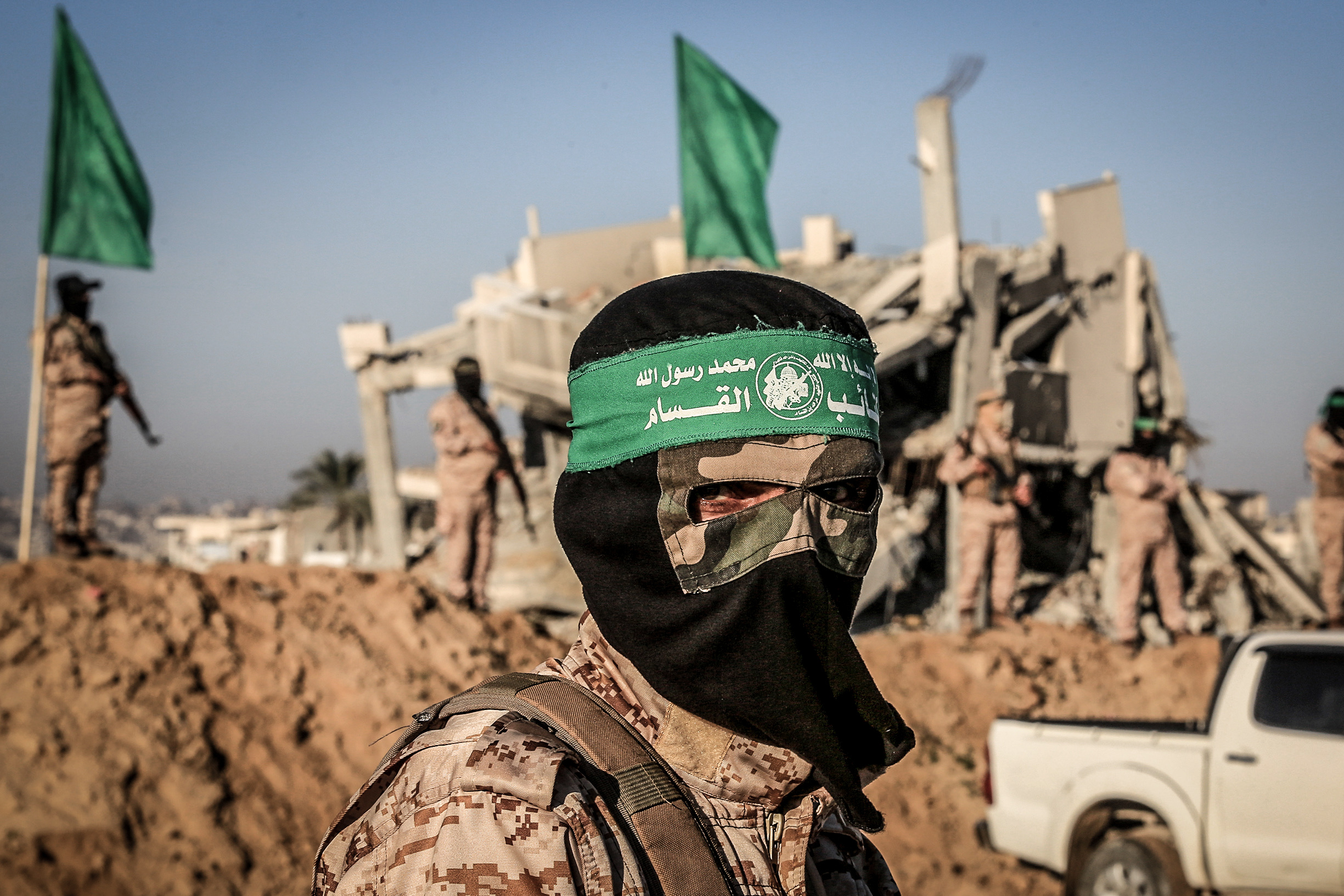
Iran’s investment in Hamas and Palestinian Islamic Jihad (PIJ) has been sustained over decades. Estimates of annual Iranian financial support to Hamas have ranged from $70 million to over $100 million in peak years, supplemented by weapons transfers, technical assistance in rocket and tunnel construction, and strategic guidance channeled through the Islamic Revolutionary Guard Corps’ Quds Force (IRGC-QF).[17] PIJ has been even more directly dependent on Iranian support, functioning in practice as an extension of Iran’s regional military network.
The “Axis of Resistance” framework integrates Palestinian factions into a regional architecture whose strategic priorities are set in Tehran. Hizballah in Lebanon, the Houthis in Yemen, Shi’a militias in Iraq, and Palestinian armed groups in Gaza are positioned as a unified front, with Palestine as the ideological centerpiece and Iranian expansionism, as well as deterrence, as the operational logic. Within this framework, Palestine has functioned primarily as a legitimizing symbol. Tehran champions the cause because it resonates deeply with Arab and Muslim publics, lending ideological credibility to what is fundamentally a Persian-Shi’a power projection strategy in a predominantly Arab-Sunni region. The cause is indispensable to Tehran’s regional narrative, but expendable as an actual policy priority when Iranian strategic interests require flexibility.
What Iranian Instrumentalization Costs Palestinians
Iranian support came with strategic strings that Palestinians have paid for disproportionately. Alignment with Tehran’s posture meant integration into a regional confrontation that Palestinians did not choose and cannot control. The timing and nature of military operations, including, by many assessments, the strategic context surrounding October 7, were influenced by calculations that extended well beyond the Palestinian national interest.[18]
The costs to Palestinians and the rest of the region are significant. Iran’s exploitation of the Palestinian cause has linked a legitimate national struggle to a broader pattern of regional militarization, proxy warfare, and state fragmentation in pursuit of Iranian regional hegemony. Lebanon, Syria, Iraq, Yemen, and now Gaza have each been drawn into cycles of armed confrontation that serve Tehran’s grand strategy while imposing severe costs on the societies involved. The Palestinian cause has been instrumentalized to provide ideological justification for Hizballah’s entrenchment in Lebanese governance, Houthi attacks on international shipping, and Iraqi paramilitary operations outside state authority. The resulting association has caused great damage to Palestinian interests.
The dynamic is self-reinforcing. A shared threat calculus vis-à-vis Iran helped forge the Abraham Accords, which formally upended a degree of Arab consensus (in word, if not in deed) around refraining from normalizing with Israel before Palestinian self-determination was achieved. With the Accords’ Arab signatories still affirming a two-state outcome while accepting a rearrangement of the “order of operations,” the agreements retained the potential to be used in support of Palestinian statehood. In practice, however, they increasingly manifested as a detour around rather than an access road to such a resolution. As Arab political engagement on the issue waned, Iranian influence expanded by default. Hamas and PIJ did not turn to Tehran out of ideological preference for Iranian patronage over Arab political support. They did so because Iran remained the primary regional actor willing to provide material backing without an expectation of political capitulation. The outcome has not been Palestinian liberation but deepening structural dependency, and a Palestinian cause whose parameters are increasingly shaped by strategic calculations made in Tehran rather than in Ramallah or Gaza.
The diplomatic cost has been equally damaging. Association with the Iranian axis narrowed the political space for Palestinian diplomacy, particularly with the Gulf states and Western governments. Palestinian factions found themselves categorized as Iranian proxies, which, while an oversimplification, contained enough truth to limit their ability to engage the very actors whose support they needed most.
Once again, Palestinian leadership is not blameless for the growing deprioritization of its cause among some Arab-state allies. While the Abraham Accords were most frequently viewed through the lens of what could bring Arab states and Israel closer, less attention was paid to the factors that drove Arab states and the Palestinian leadership further apart. Many Gulf actors still vividly recall the Palestine Liberation Organization’s support for Saddam Hussein during his 1990 invasion of Kuwait. The Gulf states saw this as a betrayal, and it has not been forgotten. Decades on, as many of these states seek greater stability and regional integration in the pursuit of longer-term security and economic growth, the destabilizing violence and rejectionism of Hamas and the corruption and perceived political and diplomatic passivity of the PA increasingly tried the patience of the Palestinians’ Arab allies. The Palestinian cause still resonated with Arab publics, more so in states that had fought wars with Israel, and more so after October 7, but Arab leaders grew unwilling to hold their own interests hostage to a Palestinian leadership they had lost faith in.
Distinguishing the Palestinian Cause from the Iranian Strategy
An analytical distinction is necessary here that is frequently elided in public discourse but that has significant policy implications.
The Palestinian cause is a struggle for national liberation rooted in statelessness, the denial of fundamental rights, and ongoing occupation and dispossession. Iran’s Axis of Resistance is a regional power projection strategy. Tehran has supported Hamas, PIJ, Hizballah, and the Houthis, as well as Iraqi, Syrian, Pakistani, and Afghan militias, as components of a network that allows Iran to subvert Arab governments and pressure Israel, the United States, and the Gulf states while distributing the costs of confrontation across proxy theaters rather than absorbing them directly. Palestine serves as a key element of the network’s unifying moral framework, not because Tehran is committed to Palestinian self-determination, but because an unresolved, legitimate cause provides ideological cover and popular resonance for an architecture of proxy warfare whose logic is, at its base, Iranian.
A meaningful and sustainable Palestinian political agreement, one yielding a state with functioning institutions, legitimate governance, and stable relations with Arab neighbors, would eliminate one of Tehran’s most valuable regional instruments. Tehran’s interests are therefore antithetical to such an outcome and the Iranians have repeatedly acted — alone or through their proxies — to preclude Israeli-Palestinian peace.
Countering this influence in the Palestinian arena, therefore, cannot be achieved primarily through sanctions or containment, but requires addressing the underlying political vacuum that makes Iranian influence possible. A credible political pathway for Palestinians, supported by Arab states, would erode the structural basis for Iranian leverage. The continued absence of such a pathway guarantees that Iranian influence will persist and deepen, because Tehran will remain, by default, the most consequential external actor willing to champion the cause.
The Chain of Consequences: October 7 and Its Aftermath
Israeli suppression, Palestinian institutional failure, and Iranian exploitation converged over decades to produce the conditions for catastrophe. On October 7, 2023, those conditions erupted from Gaza with devastating and wide-ranging consequences. This is not a justification for the violence of the attack. The killing of civilians, the taking of hostages, and the scale of the assault represent grave violations of decency, let alone international law, that no political context can excuse. Yet a refusal to examine the structural conditions that produced October 7 suggests a lack of analytical and moral seriousness. If left unaddressed, the underlying drivers of the conflict will only produce more violence.
The eruption had deep roots: years of political suffocation in Gaza, an Israeli-led divide-and-conquer approach to Palestinian politics, the collapse of diplomacy, the failure of Palestinian institutions to offer an alternative path, and the conviction, cultivated by Hamas and exploited and reinforced with Iranian backing, that armed escalation was the only path left. Together these produced a catastrophe that has set back the prospects for peace by a generation.
Gaza’s Destruction
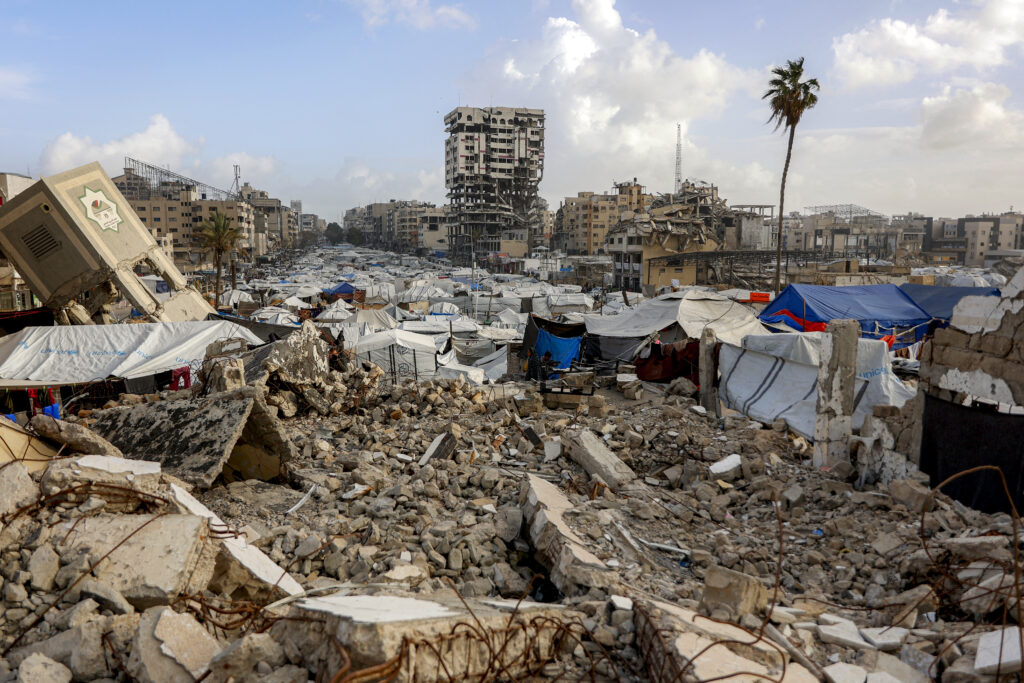
Israel’s military response has exceeded any precedent in the Israeli-Palestinian conflict. Tens of thousands of Palestinians have been killed, the majority of them civilians — by some estimates, more than five times the number killed during the 1948 war.[19] Nearly the entire population of Gaza, over 2 million people, has been displaced, many of them multiple times.[20] Hospitals, schools, universities, water treatment facilities, power infrastructure, and residential neighborhoods have been destroyed on a scale that the United Nations, the International Committee of the Red Cross, and virtually every humanitarian organization operating in the territory have described as catastrophic.[21] The UN estimated that 81 percent of structures in Gaza had sustained damage or were destroyed as of October 2025.[22]
What “postwar Gaza” now means is a territory without functioning governance, basic services, habitable infrastructure, or any political framework for reconstruction. The physical destruction has been accompanied by what amounts to the erasure of Gaza as a functioning society, a condition that, absent radical intervention, will generate instability for a generation.
An assessment divorced from historical context has led Israel and the US to treat the root cause of October 7 as inherent Palestinian radicalism, hence the “deradicalization” agenda that is front and center in the Trump administration’s 20-Point Plan for Gaza.[23] To the extent radicalization is an issue to be addressed, it is a symptom, not a cause. An entire generation has been deprived of education from the youngest of ages, and has witnessed or endured loss, death, suffering, and destruction over the past three years. Policy that fails to acknowledge and address this reality will produce a self-fulfilling prophecy, locking the parties into an endless cycle of violence.
West Bank Annexationist Acceleration
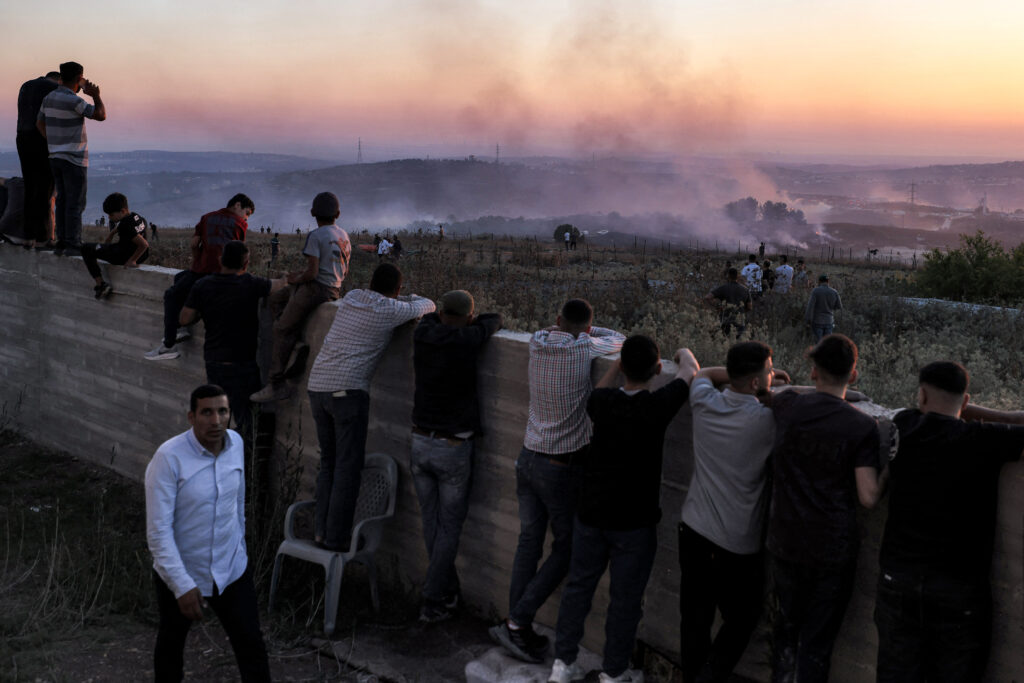
Prior to October 7, many observers and many of those living the realities on the ground were convinced the conditions were ripe for an explosion but assumed that its epicenter would be the West Bank, not Gaza. In 2022, the West Bank had experienced its deadliest violence in 20 years. Since October 7, 2023, there has been an unprecedented acceleration of violence and territorial encroachment in the West Bank. UN Office for the Coordination of Humanitarian Affairs (OCHA) data documents a dramatic surge in settler violence since October 2023, including armed attacks on Palestinian villages, destruction of property, and forced displacement of communities.[24] Israeli military operations in Jenin, Tulkarm, and Nablus have reached a scale and intensity not seen since the Second Intifada.
The Israeli government has moved openly toward de facto annexation. Finance Minister Bezalel Smotrich’s “decisive plan” for the West Bank envisions the extension of Israeli sovereignty over the territory.[25] Outposts previously considered illegal under Israeli law have been retroactively legalized. Settlement construction has accelerated. The Knesset’s vote on February 21, 2024, rejecting any unilateral declaration of Palestinian statehood by a margin of 99 to 9, was a political signal that the Israeli political establishment, as currently constituted, has no intention of permitting Palestinian self-determination in any meaningful form.[26]
The intent behind this trajectory has been stated plainly by the officials driving it. Smotrich, who as finance minister also holds authority over the civil administration of the West Bank, unveiled in 2025 a plan to extend Israeli sovereignty over some 82 percent of the territory under the explicit guideline of securing “maximum land, minimum Arabs,” and in 2026 proclaimed a “revolution” in settlement expansion.[27] National Security Minister Itamar Ben Gvir has used his authority over the police to shield settlers and has openly called for the emigration of Palestinians from Gaza.[28] Their rhetoric has been matched on the ground: settlement construction has reached record levels, with dozens of new outposts established in a single year, several of them retroactively legalized by the state.[29]
The human cost has fallen on Palestinian communities. According to UN OCHA, settlers and Israeli forces killed at least 616 Palestinians in the West Bank, including 115 children, between January 2024 and April 2025, in the course of nearly 2,000 recorded incidents of settler violence, while more than 41,000 Palestinians were driven from their homes and land.[30] Entire Bedouin and herding communities have been forced off land they had inhabited for generations, a pattern that human rights organizations have characterized as de facto ethnic cleansing — and one grave enough to prompt the United Kingdom, Canada, Australia, New Zealand, and Norway to impose sanctions on Smotrich and Ben Gvir for incitement to violence.[31] What is unfolding in the West Bank is not a series of isolated security incidents but a coordinated effort, advanced through official policy and tolerated vigilante violence alike, to render Palestinian territorial contiguity and self-determination impossible.
Regional Spillover
Following the attacks of October 7, these dynamics rippled far beyond Israel and Palestine with striking speed.
The Houthi campaign against Red Sea shipping, launched in late 2023 and framed as solidarity with Gaza, disrupted one of the world’s most critical trade corridors. Container traffic through the Suez Canal dropped precipitously, rerouting added weeks and billions in costs to global supply chains, and insurance premiums for Red Sea passage spiked.[32] Suez Canal revenues fell by nearly half in the first six months of the disruption, and global shipping costs more than tripled on affected routes. The economic impact has been felt from European importers to Gulf port operators to Egyptian state revenues.[33]
At Iran’s insistence, Hizballah intervened in the war on Hamas’s behalf beginning on October 8, provoking a full-scale Israeli military campaign in southern Lebanon the following year. This campaign has displaced over 1 million Lebanese civilians and threatened to destabilize a country already teetering on the brink of economic collapse.[34] The direct exchange of strikes between Iran and Israel in April and October 2024, the first of their kind, revealed escalation dynamics that neither side fully controls and that the region’s security architecture was not designed to manage.[35]
The escalation crossed a further threshold in June 2025. In a 12-day war, Israel launched a surprise campaign — Operation Rising Lion — against Iran’s nuclear and military infrastructure, striking facilities at Natanz, Fordow, and Isfahan and killing senior commanders and nuclear scientists, while Iran answered with hundreds of ballistic missiles and drones aimed at Israeli cities. On June 22, the United States joined the war directly, striking Iran’s fortified nuclear sites with bunker-busting munitions before a cease-fire was declared two days later.[36] The operation settled nothing. It demonstrated that a direct Israeli-American war against Iran was no longer a hypothetical but something that had already been fought once — and it set the stage for the far larger campaign that followed eight months later.
The February 2026 War: When the Spillover Became Direct
The events of February and March 2026 marked the next turn in an ever-tightening spiral of escalation. On February 28, 2026, the United States and Israel launched a coordinated military campaign against Iran, targeting its military infrastructure, nuclear and ballistic missile facilities, and senior leadership, including the assassination of Supreme Leader Ali Khamenei.[37] Iran’s retaliation was directed not only at Israel but also, significantly, at Arab states hosting US military assets. To be sure, the history of Arab-Iranian conflict and grievances is long, well predating October 7 and even the origins of the Israeli-Palestinian conflict. Yet in its latest incarnation, the Gulf was drawn directly into a war whose immediate spark was the nuclear impasse but whose deeper fuel was the regional proxy conflict built on the foundation of the unresolved Palestinian question.
The scale of Iranian strikes against Arab capitals was unprecedented. Kuwait City, Doha, Riyadh, Dubai, Abu Dhabi, and Manama were all targeted with ballistic missiles, cruise missiles, and drone attacks.[38] Iran’s retaliation focused not just on military bases hosting US forces, but on a wide range of civilian targets: ports, airports, factories, data centers, power plants, hydrocarbon production and export facilities, hotels, monuments, and even tourist attractions.[39] Saudi Arabia’s eastern region and Riyadh were struck, with the Saudi Foreign Ministry confirming attacks were repelled but not without damage. In Bahrain, fuel infrastructure was hit. Between February 28 and March 27, 378 ballistic missiles, 15 cruise missiles, and approximately 1,835 drones were launched at the United Arab Emirates, killing 13 people, injuring over 224 from 31 nationalities, and causing severe damage to critical infrastructure, including the Emirates Global Aluminium plant at Al Taweelah, Abu Dhabi, whose operations were shut down, with repairs estimated to take as long as one year.[40]
Qatar’s experience was particularly illustrative. Iran launched 203 missiles and 87 drones at the country between February 28 and March 18, targeting Al Udeid Air Base, Doha’s airport, and, most consequentially, Qatar’s liquefied natural gas (LNG) infrastructure at Ras Laffan Industrial City and Mesaieed Industrial Area.[41] The damage from strikes on Qatar’s energy facilities was estimated to require up to five years to fully repair, with annual losses projected at $20 billion, approximately 37 percent of total government revenue.[42] Qatar was also targeted by Israeli strikes against Hamas figures based in Doha, making the country a target of both belligerents in a conflict it did not initiate. Qatari forces intercepted multiple missile salvos and shot down two Iranian Su-24 bombers, the first time in the conflict that an Arab state engaged Iranian military aircraft directly.[43]
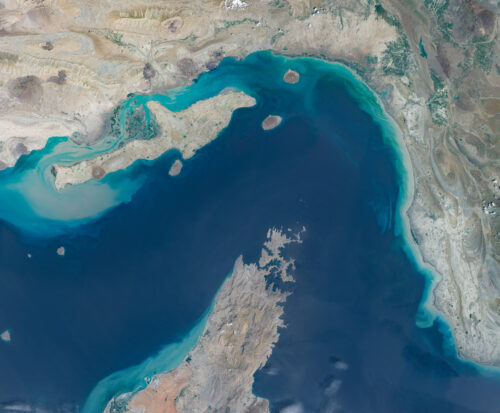
Iran simultaneously closed the Strait of Hormuz beginning March 4, blocking roughly 20 percent of globally traded seaborne oil from transit.[44] Brent crude surged over 55 percent, exceeding $120 per barrel at peak. Oil production across Kuwait, Iraq, Saudi Arabia, and the UAE collectively dropped by at least 10 million barrels per day by mid-March.[45] The International Energy Agency characterized the disruption as the largest supply shock in the history of the global oil market.[46] Gulf Cooperation Council states, which depend on the strait for over 80 percent of food imports, faced a concurrent food security emergency, with consumer prices spiking 40 to 120 percent and emergency airlifts required to maintain basic supply chains.[47] By the end of March, early estimates placed the cumulative cost to Arab states at over $120 billion, though the full toll, including longer-term reconstruction costs, lost foreign investment, and disrupted trade relationships, is expected to be far higher.[48]
The strategic implications for Arab states are stark. Iran, the actor that had for decades invoked the Palestinian cause to legitimize its regional posture and justify its proxy network, directed much of its retaliatory fire not at Israel but at Arab countries.
The failure to resolve the Palestinian question, to restore Palestinian political agency, and to deny Iran the ability to weaponize the Palestinian cause have helped produce a military assault on Arab sovereign territory, a global economic crisis, and a devastating demonstration that the Palestinian question is not a contained bilateral dispute but a direct threat to Arab national security — paid for in Arab lives and Arab infrastructure.
None of this reduces Iran’s conduct to the Palestinian question alone. Tehran’s pursuit of regional primacy, its nuclear ambitions, and its rivalry with the Gulf states and the United States follow their own logic and would persist even if the Israeli-Palestinian conflict were resolved tomorrow. But the Palestinian cause has served as the connective tissue of Iran’s regional strategy — the legitimizing narrative that binds its proxies together and lends its confrontation with Israel and the Gulf its popular resonance. Resolving it would not end Iran’s ambitions, but it would strip them of their single most potent ideological instrument.
Tehran has consistently framed Gulf-US military cooperation as a betrayal of Palestine, leveraging Palestinian suffering to delegitimize Gulf security partnerships and justify military escalation. The 2026 war has provided Gulf governments with a definitive counterargument: Iran-backed militancy and Iranian direct action have not advanced Palestinian liberation in any respect. They have widened wars into Arab territory, devastated Arab economies, killed Arab civilians, and provided the very pretext, an Iranian threat requiring military response, that produced the catastrophe the Gulf states have now experienced firsthand.
The trajectory of the war since then has underscored how combustible the confrontation remains. A two-week cease-fire brokered by Pakistan in April 2026 was extended in June and formalized on June 17 in a US-Iran memorandum of understanding intended to end the war. That understanding collapsed within weeks. On July 8, 2026, President Trump declared the memorandum “over,” citing renewed Iranian attacks on shipping in the Strait of Hormuz, and the two sides resumed exchanges of fire.[49] Mediation by Qatar and Pakistan continues, but the negotiations are moribund, and the Strait of Hormuz — where Iran has persisted in asserting control and firing on commercial vessels — remains an unresolved flashpoint capable of reigniting both the war and the economic shock that accompanies it.
The figures cited in this section reflect estimates compiled during and immediately after the most intense phase of hostilities; because the conflict has not durably ended, final assessments of casualties, infrastructure damage, and economic losses remain provisional and are likely to be revised upward. What is already clear, however, is the strategic lesson: the chain of escalation that began with the unresolved Palestinian question — through October 7, the destruction of Gaza, the expansion of proxy warfare, and the US-Israeli campaign against Iran — has delivered its most devastating consequences to Arab states that were neither parties to the conflict nor authors of the policies that produced it.
That lesson does not, by itself, dictate the response — and it would be a mistake to assume the region has drawn a single conclusion from it. For some Arab governments, the events of 2026 have been an argument not for re-engaging the Palestinian question but for insulating themselves from it. The UAE has continued to deepen its ties with Israel and to treat the Palestinian file as a liability best held at arm’s length. Saudi Arabia maintains that it will not normalize relations with Israel absent an irreversible path to Palestinian statehood yet has invested little political capital in bringing such a path about and is not pressing Washington to do so. Kuwait, Oman, Bahrain, and Jordan, though wary of the Israeli far right’s trajectory, have likewise kept the Palestinian issue at the margins of their strategic planning. The prevailing instinct across much of the region is disengagement: to hedge, to diversify security partnerships, and to wait out a conflict that appears immune to resolution.
This paper argues that disengagement is the wrong lesson, and a dangerous one. The 2026 war demonstrated precisely that the Palestinian question cannot be quarantined: its unresolved condition supplied the ideological fuel and the political opening that carried a regional war onto Arab soil. A strategy of insulation presumes a firebreak that does not exist. The Gulf states cannot buy their way out of the consequences of Palestinian statelessness through normalization, missile defense, or economic diversification alone, because the instability those consequences generate does not respect the boundaries of the bilateral dispute. The remainder of this paper explains why restoring Palestinian political agency is the only durable response, and how the Arab states might begin to pursue it.
Why Current Policy Frameworks Are Failing
The crisis described above has generated numerous policy proposals, yet the frameworks currently on offer, from Washington, from European capitals, and from various international actors, share a structural deficiency: they attempt to manage the consequences of Palestinian political erasure without reversing the erasure itself.
The Biden Administration’s Approach
President Joe Biden’s postwar concept centered on a “revitalized Palestinian Authority” that would extend governance from the West Bank to Gaza, supported by international backing and an eventual pathway to statehood linked to Saudi normalization with Israel. The concept was sound in its recognition that Palestinian governance was necessary. It failed in execution because it rested on two premises not supported by reality: that the PA possesses the legitimacy and capacity to govern Gaza, and that the Israeli government would permit it to do so. The PA has no mandate in Gaza, no institutional presence, and no public support. Prime Minister Benjamin Netanyahu’s government rejected the proposal before it was formally made.[50] The “revitalized PA” remained a Washington talking point with no pathway to implementation.
The Saudi normalization track represented a more ambitious framework. Riyadh signaled a willingness to normalize relations with Israel, an enormous strategic prize, in exchange for a credible, irreversible pathway to Palestinian statehood, a security agreement with the United States, and access to civilian nuclear technology. The logic was sound: use the leverage of normalization to extract meaningful Israeli concessions on Palestinian rights. But the framework exposed a structural limitation of incentive-based diplomacy: it cannot work when one party has no interest in the outcome being offered. The Netanyahu coalition, dependent on far-right partners who view annexation as a governing mandate, was never going to deliver Palestinian statehood in exchange for normalization it believed it could eventually obtain on cheaper terms. Israel’s response to October 7 effectively shelved the track, and its revival faces the same structural obstacles.
“Board of Peace” and Administered Governance Models
A separate category of proposals envisions international or multinational administration of Gaza that bypasses Palestinian political representation in favor of technocratic governance, security management, and externally directed reconstruction. Variants of this concept, as laid out in the Trump administration’s “Board of Peace” proposal and other similar frameworks, imagine a coalition of Arab and international actors managing Gaza’s affairs while deferring questions of Palestinian sovereignty and political rights to an indefinite future.[51]
These proposals do not constitute viable peace frameworks. Their structural design focuses on the administration of a post-conflict outcome rather than the resolution of the underlying political question. A framework that begins with disarmament and ends with administration, without restoring Palestinian political rights, representation, or self-governance, does not resolve the conflict. It freezes it at the point of maximum Palestinian dispossession. Historical precedent reinforces the point: externally administered governance without local political legitimacy, from the Coalition Provisional Authority in Iraq to the UN Interim Administration Mission in Kosovo (UNMIK), has consistently failed to produce durable stability.[52] There is no reason to believe Palestine would be the exception. The obstacle is not the competence of external administrators but the impossibility of conferring local political legitimacy from the outside — the same difficulty that defeated earlier trusteeship concepts, including Martin Indyk’s 2003 proposal for an international trusteeship over the Palestinian territories.[53] Legitimacy cannot be administered into being; it must be generated through representation, which is precisely what these models defer.
The Trump-Era Model and its Legacy
The Trump administration’s “Peace to Prosperity” plan, released in January 2020, offered Palestinians a fragmented, demilitarized entity with no sovereignty over borders, airspace, or security, a proposal so far from Palestinian minimum requirements that it was rejected before negotiations began. Its lasting significance lies not in its specific provisions but in the precedent it set: that the United States could propose a framework for the conflict that excluded Palestinian political agency entirely and face no meaningful diplomatic cost.
The Abraham Accords, in practice, extended this logic. Normalization between Israel and the UAE, Bahrain, Morocco (and, to an incomplete extent, Sudan) proceeded without conditioning it on progress toward Palestinian statehood, the central lever of Arab diplomatic strategy toward the Israeli-Palestinian conflict, as laid out in the Arab Peace Initiative framework of 2002.[54] Arguably, with that approach having yielded no progress over decades, creative and determined diplomacy could have used these new agreements to forge a better outcome. As it turned out, the Accords delivered real benefits to their signatories, and some near-term security advantages to the region, but have so far only reduced Israeli incentives to confront the longer-term consequences of rejecting Palestinian statehood. The net effect is a setback for regional security in the long run.
The Common Deficiency
Each of these frameworks treats Palestinian political agency as either an afterthought or an obstacle. The Biden approach assumed the PA could be revitalized from the outside. The Saudi track assumed Israeli concessions could be purchased with normalization. The Board of Peace model assumes governance can be administered without politics. The Trump-era Peace to Prosperity plan assumed Palestinians could be bypassed altogether.
All of them fail for the same reason: they attempt to build stability on the ruins of Palestinian political capacity. Until a framework begins with the restoration of that capacity, not as a reward for good behavior but as the foundation for any durable arrangement, it will produce, at best, a temporary pause before the next eruption.
The Case for an Arab Strategic Initiative
The argument of this paper has been cumulative: Israeli policy destroyed Palestinian political capacity; Palestinian leaders deepened the destruction through their own failures; Iran exploited the resulting vacuum; and the consequences now radiate outward as a regional security crisis that affects Gulf capitals, global trade, and the international economy. The question is what to do about it.
Why Arab States, and Why Now
No external actor, not the United States, the European Union, or the United Nations, will prioritize the restoration of Palestinian political agency unless Arab states make it a strategic demand. Washington’s domestic politics make conditioning aid to Israel extraordinarily difficult. European influence in the region is marginal. The UN is structurally incapable of enforcement. Arab states are the only actors with both the strategic interest and the potential leverage to change the trajectory, but only if they act collectively, concretely, and with strategic seriousness rather than rhetorical solidarity.
The timing is not optional. Every month that passes without intervention deepens the entrenchment of the current dynamics: further destruction in Gaza, further annexation in the West Bank, further Iranian consolidation, and further erosion of the space for any future settlement. The window for reversing these trends is narrowing, and it will not reopen on its own.
Recommendations for Arab Regional Actors
- Establish a standing Arab diplomatic mechanism for Palestinian political reconstruction. This would not be another ad hoc committee or summit communiqué but a permanent diplomatic body with a mandate, a dedicated budget, and senior political representation from Saudi Arabia, the UAE, Egypt, Jordan, and Qatar. Its function would be to coordinate Arab policy on Palestine, engage directly with Palestinian political factions, interface with Washington and European capitals, and prevent the Palestinian file from being parceled out to competing bilateral tracks or deferred indefinitely. The model is not the Arab League’s existing structures, which lack authority and urgency. It is closer in ambition to the sustained, high-level political investment — quiet back-channel diplomacy, direct engagement among leaders, and concentrated American brokerage — that culminated in the Abraham Accords, but directed at the Palestinian question with equivalent seriousness.
- Condition deepening and additional normalization and economic engagement with Israel on Palestinian political benchmarks. Arab states should explicitly link any future normalization steps, including the deepening of existing Abraham Accords relationships and the pursuit of Saudi-Israeli normalization, to measurable progress on Palestinian political rights. These should not take the form of vague aspirations toward statehood but rather concrete, verifiable benchmarks: a timeline for Palestinian elections under international monitoring, a verified freeze on settlement expansion, and the restoration of PA fiscal autonomy from Israeli-controlled clearance revenues. This is not a reversal of normalization. It is the assertion that normalization without regional stability is a depreciating asset, that regional stability requires Palestinian political agency, and that a durable peace must also deliver the measure of justice for Palestinians that Arab publics continue to expect their governments to pursue — absent which any normalization will remain shallow and politically brittle.
- Fund Palestinian institutional reconstruction directly. Arab states should redirect a portion of their Palestine-related expenditure from humanitarian maintenance to political capacity-building. This means not relegating that file to the responsibility of European or other actors outside of the region but investing in the infrastructure of Palestinian self-governance: an independent judiciary, a credible electoral commission, a reformed security sector accountable to Palestinian civilian authority, and independent media. Funding should be channeled through mechanisms that bypass both the PA’s patronage networks and Hamas’s governance structures, including direct support to Palestinian civil society organizations, municipal governments, universities, and professional associations that retain public trust. A Palestinian Economic Sovereignty Fund, backed by Gulf capital, should be established to reduce the PA’s structural dependency on Israeli-controlled revenues and donor conditionality.
- Re-engage Palestinian factions diplomatically to deny Iran the monopoly. The current posture of many Arab states, maintaining formal relations with the PA while refusing engagement with Hamas, has achieved nothing except to cede the field to Tehran. Arab states should re-engage Palestinian factions, including Hamas, on terms that require concrete movement toward national reconciliation and elections; adoption of a political, not solely military, strategy; the disarmament of factional militias, or, at a minimum, a verifiable cessation of violence, in favor of a unified security authority accountable to a legitimate Palestinian government; and acknowledgment that October 7 was a catastrophic mistake whose consequences were borne overwhelmingly by the Palestinian people. The alternative to Iranian influence is not pretending Hamas does not exist. It is offering Palestinian factions a credible political pathway that Iran cannot and will not provide. This does not require endorsing Hamas’s ideology or methods. It requires recognizing that diplomatic isolation has empowered Tehran, not weakened it.
- Engage Washington now on the urgency of preventing annexation. President Trump has previously described annexation by Israel as a redline. However, his administration has ignored or looked the other way as the Israeli government pursues it in a piecemeal and de facto as opposed to de jure fashion. It is time to ring the alarm bell. Arab states individually lack the leverage to shift Israeli behavior. Collectively, and in coordination with European partners, they can make a credible case to Washington that Israeli territorial maximalism that ignores Trump’s publicly stated preferences, and that forecloses future diplomatic options, fuels further violence against and dispossession of Palestinians, and foments instability that threatens American interests, American allies, the safety and security of Israel itself, and the broader American-led regional order. With talks beginning on the renewal of the US-Israel memorandum of understanding (MoU) and the future of the bilateral aid relationship, now is an opportune time for Arab allies to engage the administration. A renewed US-Israel MoU provides options for creative leverage, conditioning types of support on adherence to policy redlines such as annexation.
What This Is Not
This initiative should not be understood as a call for confrontation with Israel. It is a call for strategic clarity: a recognition that Arab interests require Palestinian political agency, and that policies which erode it impose direct costs on Arab security. Nor is it a rescue of the current PA or an endorsement of Hamas. It is an investment in the conditions under which Palestinians can develop legitimate political leadership, conditions that, as this paper has argued, do not currently exist. The initiative is grounded not in charitable obligation but in strategic self-interest.
Palestinian Political Renewal: Preconditions, Not Prescriptions
This paper does not prescribe internal Palestinian political arrangements because neither the United States nor the Arab states should be telling the Palestinians how to govern themselves. As a Palestinian, I believe that the specific form of Palestinian governance, the composition of future leadership, and the structure of national institutions should be left to ourselves to sort out, once credible leaders, organizations, and civil society groups have reemerged. External prescription, whether by Arab states, the United States, or international bodies, would reproduce the very dynamic this paper argues against, denying Palestinian political agency in the name of managing Palestinian affairs.
That said, some preconditions for legitimate renewal are nonetheless clear, even where the outcomes are not, and Arab states have a role in helping to secure them.
Elections, presidential and legislative, must be held on a timeline agreed by Palestinian factions, with international monitoring and Arab political backing that includes pressure on Israel to permit voting in East Jerusalem and to respect electoral outcomes regardless of which factions prevail. A reconciliation framework must end the Gaza-West Bank split as a political and administrative reality, even if full political unity requires time. This does not mean forcing Hamas and Fatah into a false unity government. It means creating the conditions, security guarantees, political space, and external support under which Palestinian factions can negotiate a genuine national compact. Institutional reform must separate security functions from political control and build accountability mechanisms that prevent the reconcentration of power. And the protection of civic space is essential: Palestinian civil society, media, universities, and professional organizations must be able to operate without suppression by occupation authorities, the PA, or Hamas.
The appropriate Arab role is not to dictate political outcomes but to protect the conditions under which Palestinian self-determination can function, and to defend them against actors with an interest in their absence.
Risks and Trade-Offs
A credible policy proposal requires an honest assessment of the risks and constraints associated with its implementation.
The current Israeli government will oppose any framework that restores Palestinian political agency. Senior coalition members have staked their careers on the proposition that Palestinian statehood must be permanently prevented. Arab states must be prepared for sustained diplomatic friction and calibrate their initiative to survive changes in Israeli government composition, building institutional mechanisms that outlast any single election cycle in Jerusalem or Washington.
There is no guarantee that Palestinian elections or reconciliation will produce unified, competent, or moderate leadership. The political environment has been so degraded that early results may be messy, contested, and imperfect. But the current alternative, indefinite political paralysis under occupation, is producing catastrophically worse outcomes. The absence of guaranteed outcomes should not preclude action when the alternative is producing demonstrably worse results.
Iran will resist any framework that reduces its influence over Palestinian factions. Tehran has invested decades in building relationships that serve its regional strategy, and it will use every instrument at its disposal to undermine an Arab initiative that threatens to displace it. This is an argument for urgency, not caution. Delay merely deepens Iranian entrenchment and narrows the space for Arab alternatives.
US domestic politics make conditioning military aid to Israel extraordinarily difficult. The recommendation to press Washington on this point is a long-term strategic objective, not a short-term expectation. Arab states must build the case patiently, in coordination with European allies, and frame it in terms of American self-interest rather than as an ultimatum. Wading into a conversation on other allies’ bilateral aid agreements comes with sensitivities, particularly at a time when the conversation around US-Israel aid has become a political football within both the right and left wings of American domestic politics. A collective approach by Arab and European allies risks being framed as gratuitous “ganging up” on Israel. However, this should be neither approached nor treated as an anti-Israel position. The argument is that the current trajectory is unsustainable, that it is generating costs that American allies are absorbing, and that a course correction is in everyone’s interest, including Israel’s.
Conclusion
The destruction of Palestinian political capacity is no longer a challenge confined to the Palestinian people. It has become a regional security problem with global ramifications, and it requires a strategic response commensurate with its implications.
For decades, the Palestinian question has been deferred, by Arab states that found rhetorical solidarity more manageable than strategic engagement, by an international community that framed the conflict as a bilateral negotiation between structurally unequal parties, and by the United States, which consistently subordinated Palestinian political rights to other regional priorities. The accumulated costs of that deferral are now evident: a devastated Gaza, an annexation-bound West Bank, an empowered Iran, an internationally isolated Israel, a destabilized region, and a global economy hard hit by a foreseeable crisis.
The Palestinian people have been failed at multiple levels, by an occupation that systematically dismantled their political institutions, by leaders who prioritized organizational survival over national purpose, and by external actors that invoked their cause while subordinating it to other strategic objectives. The political environment they inhabit is not an organic condition. It was constructed through deliberate policy choices, and its dysfunctions are not byproducts but the intended result.
For the Arab states, restoring Palestinian political agency will require sustained effort, significant political investment, and a willingness to absorb diplomatic costs in pursuit of long-term strategic returns.
The restoration of Palestinian political agency is not a humanitarian gesture and should not be framed as one. It is a strategic necessity rooted in the recognition that no durable regional order can be constructed on the basis of permanent Palestinian political exclusion. There are no actions that guarantee near-term success. But the costs of continued inaction are certain, substantial, and growing, for all concerned.
Endnotes
[1] World Bank, “Area C and the Future of the Palestinian Economy,” October 2, 2013; B’Tselem, “Area C,” accessed July 6, 2026.
[2] B’Tselem, “Statistics on Settlements and Settler Population,” updated January 16, 2019; Peace Now, “Settlement Watch,” accessed July 6, 2026.
[3] “Arrest of Legislative Council Members,” Addameer Prisoner Support and Human Rights Association, November 2018; International Crisis Group, “Ruling Palestine II: The West Bank Model?” ICG Middle East Report No. 79, July 17, 2008.
[4] Ihsan Adel, “Israel’s Arrest Policy against Palestinian University Students in the West Bank and Israel: A Tool for Eroding Palestinian National Identity and Consolidating Israeli Colonialism,” Law for Palestine, April 2023.
[5] “Restrictions on Movement,” B’Tselem, November 11, 2017; Omar Shakir, “Two Authorities, One Way, Zero Dissent: Arbitrary Arrest and Torture under the Palestinian Authority and Hamas,” Human Rights Watch, October 23, 2018.
[6] “Economic Monitoring Report to the Ad Hoc Liaison Committee,” World Bank, updated September 18, 2023. Clearance revenues constitute approximately 60-65% of total PA revenues.
[7] Neomi Neumann, “West Bank Economics Are Key to Stabilizing the Palestinian Authority — or Forcing Its Collapse,” The Washington Institute for Near East Policy, May 31, 2024.
[8] Lt. Gen. Keith Dayton, “Peace through Security: America’s Role in the Development of the Palestinian Authority Security Services,” address to the Washington Institute for Near East Policy, May 7, 2009; Alaa Tartir, “The Evolution and Reform of Palestinian Security Forces 1993–2013,” Stability: International Journal of Security and Development, Vol. 4, No. 1, 2015; International Crisis Group, “Squaring the Circle: Palestinian Security Reform under Occupation,” ICG Middle East Report No. 98, September 2010.
[9] Paul Adams, “The unseen map that promised to bring peace to the Middle East,” BBC, February 23, 2025; Economic Cooperation Foundation, “Clinton Parameters (2000),” Embassy of Denmark in Tel Aviv, December 23, 2000.
[10] The White House, “Peace to Prosperity: A Vision to Improve the Lives of the Palestinian and Israeli People,” January 28, 2020.
[11] “Israel’s Smotrich Launches Settlement Plan to ‘Bury’ Idea of Palestinian State,” Reuters, August 14, 2025; Zizette Darkazally, “Israel’s accelerating de facto annexation of the West Bank has dangerous implications,” Chatham House, April 17, 2026; Elise Baker, “All West Bank annexation proposals are illegal—and put core international principles at risk,” Atlantic Council, December 3, 2025.
[12] On the Mecca Agreement: brokered by Saudi Arabia, signed February 8, 2007; collapsed June 2007. On the Cairo Agreement: signed May 4, 2011, mediated by Egypt; never fully implemented. On the Beach Camp Agreement: signed April 23, 2014; a consensus government formed under PM Rami Hamdallah in June 2014, but Hamas retained de facto control of Gaza. On the 2017 reconciliation: signed October 12, 2017, in Cairo; implementation stalled on security sector integration. Nathan J. Brown, “Palestinian Politics After the Oslo Accords: Resuming Arab Palestine,” Carnegie Endowment for International Peace, 2003; International Crisis Group, “Israel/Palestine,” accessed July 2026.
[13] Summer Said and Rory Jones, “Gaza Chief’s Brutal Calculation: Civilian Bloodshed Will Help Hamas,” Wall Street Journal, June 10, 2024.
[14] Palestinian Center for Policy and Survey Research (PCPSR), “Public Opinion Poll No. 92,” PCPSR, May 26 – June 1, 2024. See also PCPSR quarterly polls.
[15] Transparency International, “Corruption Perceptions Index,” AMAN Coalition (Coalition for Accountability and Integrity, Transparency Palestine); Palestine has scored in the range of 24-28 out of 100 in recent years.
[16] Dayton, “Peace through Security,” 2009.
[17] Estimates of Iranian financial support to Hamas vary by source and period. The US Department of State and Department of the Treasury have cited figures in the range of $100 million annually. Jason D. Greenblatt and Brian H. Hook, “Israeli-Palestinian Peace Would Be Iran’s Worst Nightmare,” US Department of State, July 31, 2019; Matthew Levitt, Hamas: Politics, Charity, and Terrorism in the Service of Jihad, Yale University Press, 2006; IISS, “Iran’s Networks of Influence in the Middle East,” International Institute for Strategic Studies, November 2019.
[18] Staff, “Hamas Documents Show Oct. 7 Attack Aimed at Thwarting Israel-Saudi Normalization,” Times of Israel, May 18, 2025.
[19] Wafaa Shurafa, Samy Magdy, and Julia Frankel, “Israeli Strike Kills World Cup Screening Organizer in Gaza Just Before Kickoff,” Associated Press, July 8, 2026; Jason Burke, “Gaza Death Toll for First 16 Months of War Far Higher Than Reported, Says Peer-Reviewed Study,” The Guardian, February 19, 2026.
[20] United Nations Relief and Works Agency for Palestine Refugees (UNRWA), Situation Reports, accessed July 2026. See also UN OCHA, “Hostilities in the Gaza Strip and Israel, Flash Updates.”
[21] United Nations, European Union, and World Bank, “Final Gaza Rapid Damage and Needs Assessment,” United Nations, April 20, 2026; UNRWA, “Verification of Damages to Schools Based on Proximity to Damaged Sites — Gaza, Occupied Palestinian Territory, Update #10, July 2025,” UNRWA, August 21, 2025.
[22] UNOSAT, “UNOSAT Gaza Strip Comprehensive Damage Assessment,” United Nations, October 31, 2025.
[23] “Trump’s 20-point Gaza peace plan in full,” BBC, October 9, 2025.
[24] United Nations Office for the Coordination of Humanitarian Affairs (OCHA), “Data on Casualties,” accessed July 2026. OCHA documented a significant escalation in settler violence incidents following October 7, 2023. See also B’Tselem, “Settler Violence = State Violence,” updated regularly.
[25] Bezalel Smotrich, “Israel’s Decisive Plan,” Interactive Encyclopedia of the Palestine Question, September 7, 2017.
[26] See Knesset official records; Ari Rabinovitch, “Israeli Parliament Backs Netanyahu’s Rejection of ‘Unilateral’ Recognition of Palestinian State,” Reuters, February 21, 2024.
[27] Staff, “Israel’s Smotrich Declares ‘Revolution’ in West Bank Settlement Expansion,” Al Jazeera, July 6, 2026; International Crisis Group, “Sovereignty in All but Name: Israel’s Quickening Annexation of the West Bank,” ICG Middle East Report No. 252, October 9, 2025.
[28] Jeremy Sharon, “Ben Gvir calls to ‘encourage emigration,’ resettle Gaza at ultra-nationalist rally,” Times of Israel, May 14, 2024.
[29] Emma Graham-Harrison, “Israeli ministers seek three ‘Nahal’ outposts in Gaza as top commander says Israel now controls 65% of the strip, violating Trump ceasefire deal,” The Guardian, July 18, 2026; Office of the High Commissioner for Human Rights, “A/HRC/61/70: Israeli settlements in the Occupied Palestinian Territory, including East Jerusalem, and in the occupied Syrian Golan,” United Nations, March 17, 2026; UN Global Perspectives, “Israeli settlement activity accelerates in the West Bank, Security Council told,” UN News, September 29, 2025.
[30] UN Office for the Coordination of Humanitarian Affairs (OCHA), “Data on Casualties” and West Bank protection updates, accessed July 2026.
[31] “Erasing Anything Palestinian: Israel’s Ethnic Cleansing of West Bank Bedouin and Herding Communities,” Amnesty International, June 10, 2026; “UK, Canada and 3 Other Nations Sanction Ben Gvir and Smotrich over Settler Violence,” Times of Israel, June 10, 2025.
[32] Yusri Mohamed, Farah Saafan, Aidan Lewis, and David Evans, “Suez Canal head says Egypt studying further expansion of waterway,” Reuters, March 4, 2024; United Nations Conference on Trade and Development (UNCTAD), “Navigating Troubled Waters: Impact to Global Trade of Disruption of Shipping Routes in the Red Sea, Black Sea, and Panama Canal,” UN Office for Disaster Risk Reduction, February 23, 2024.
[33] Michele Labrut, “Suez Canal revenue drops by almost half due to Red Sea crisis,” Seatrade Maritime News, June 18, 2024.
[34] UNHCR, Lebanon Situation Reports, accessed July 2026; “Lebanon Crisis Response Plan,” International Organization for Migration (IOM), March 5, 2025.
[35] Iran launched approximately 300 drones, cruise missiles, and ballistic missiles at Israel on April 13-14, 2024, (“Operation True Promise”) in retaliation for the Israeli strike on the Iranian consulate in Damascus on April 1, 2024. Shaan Shaikh, “The Iran-Israel Air Conflict, One Week In,” Center for Strategic and International Studies, April 19, 2024.
[36] Adam Zeidan, “Twelve-Day War,” Encyclopaedia Britannica, accessed July 2026; David Gormezano, “Looking Back at Israel and Iran’s ’12-Day War,’” France24, December 26, 2025.
[37] Britannica Editors, “2026 Iran War,” Encyclopaedia Britannica, July 2, 2026; Philip Loft, “Israel/US-Iran Conflict 2026: Background and UK Response,” Research Briefing CBP-10521, House of Commons Library, April 24, 2026. Nearly 900 strikes were conducted in the initial 12-hour campaign targeting military infrastructure, nuclear facilities, and senior Iranian leadership.
[38] Al Jazeera Staff, AP, and Reuters, “Multiple Arab States That Host US Assets Targeted in Iran Retaliation,” Al Jazeera, February 28, 2026. See also Urooba Jamal, “After Iran’s Salvo Hit Their Skylines, Will Gulf States Enter the War?” Al Jazeera, March 2, 2026.
[39] AFP, “Kuwait says intercepted missiles targeting base housing US personnel,” Al-Arabiya English, February 28, 2026. Ali al-Salem Air Base attack confirmed by Kuwaiti authorities. Casualties: four soldiers and six civilians killed, 77 soldiers and 38 civilians injured. See “Casualties of the 2026 Iran War,” Wikipedia, accessed July 2026, compiled from official ministry statements.
[40] Luca Nevola, “Luca Nevola on Iranian strikes targeting the United Arab Emirates and the Gulf,” ACLED, March 16, 2026; Press Release, “EGA Al Taweelah site at KEZAD sustains significant damage,” Emirates Global Aluminium, March 28, 2026; Balaram Menon, “UAE air defences thwart 6 ballistic missiles and 9 UAVs on March 27,” Gulf News, March 27, 2026.
[41] See “2026 Iranian Strikes on Qatar,” Wikipedia, accessed July 2026, compiled from Qatari Ministry of Defense statements.
[42] Maha El Dahan, Andrew Mills, and Yousef Saba, “Iran Attacks Wipe Out 17% of Qatar’s LNG Capacity for up to Five Years, QatarEnergy CEO Says,” Reuters, March 19, 2026; Eli Leon, “Qatar Facing ‘Strategic Shock’ in Energy, Influence Crisis in Wake of Iran War,” Jerusalem Post, April 20, 2026.
[43] Enas Abuomer, “Missile Debris Injures 16 in Qatar After Iran Launches Barrage,” Al Jazeera, February 28, 2026.
[44] Brian Osgood et al., “Iran updates: US bases, embassies attacked as Tehran steps up Gulf strikes,” Al Jazeera, March 3, 2026; Lutz Kilian, Michael Plante, and Alexander W. Richter, “What the Closure of the Strait of Hormuz Means for the Global Economy,” Federal Reserve Bank of Dallas, March 20, 2026.
[45] Bloomberg News, “The Strait of Hormuz Oil Shock Is Now Heading West,” Bloomberg, March 30, 2026.
[46] International Energy Agency characterization cited in “Economic Impact of the 2026 Iran War,” Wikipedia, accessed July 2026. Brent crude surged over 55 percent, exceeding $120 per barrel at peak. See also John Power, “Oil Rises Above $106 Per Barrel as US, Iran Deadlocked in Strait of Hormuz,” Al Jazeera, April 24, 2026.
[47] See “Economic Impact of the 2026 Iran War,” Wikipedia, accessed July 2026.
[48] Estimated cumulative cost to Arab states exceeding $194 billion by end of March 2026. See Al Jazeera Staff and AFP, “One month of war on Iran cost Arab countries up to $194bn: UNDP,” Al Jazeera, March 31, 2026; Luca Nevola, Muaz Al Abdullah, Nasser Khdour, and Timothy Lay, “Middle East Special Issue: March 2026,” ACLED, March 4, 2026.
[49] Vaughn Cockayne and Tom Howell Jr., “U.S.-Iran Ceasefire Collapses amid New Strikes as Trump Mulls Restarting War,” The Washington Times, July 8, 2026.
[50] Julia Frankel and Samy Magdy, “Rebuffing Biden, Netanyahu rejects idea of Palestinian sovereignty in post-war Gaza,” PBS, January 20, 2024.
[51] Charles W. Dunne, “Trump’s Board of Peace: Rebuilding Gaza, or Remaking the World?” Arab Center Washington DC, February 18, 2026.
[52] On the Coalition Provisional Authority in Iraq (2003-2004), see Special Inspector General for Iraq Reconstruction (SIGIR), “Hard Lessons: The Iraq Reconstruction Experience,” SIGIR, 2009; Simon Chesterman, You, The People: The United Nations, Transitional Administration, and State-Building, Oxford University Press, 2004.
[53] Martin Indyk, “A Trusteeship for Palestine?” Foreign Affairs, May 1, 2003.
[54] The Arab Peace Initiative, reproduced by the European Union, proposed by Saudi Arabia and adopted at the Arab League Summit in Beirut, March 28, 2002. The initiative offered full Arab normalization with Israel in exchange for complete Israeli withdrawal from territories occupied in 1967, a just resolution to the Palestinian refugee question, and the establishment of an independent Palestinian state with East Jerusalem as its capital.
About the Author
Jaser AbuMousa is a Senior Fellow at the Middle East Institute. A Palestinian program manager and political analyst with over 20 years of experience leading governance, reconstruction, and conflict-sensitive development in Gaza, Jaser blends rigorous analysis with practitioner pragmatism to safeguard civilians and strengthen institutions. From 2015 to 2024, Jaser managed a multi-year Swiss Development Cooperation portfolio, forged cross-sector partnerships, and delivered political, socio-economic, and security analyses to inform strategy and policy. Previously, he supported United Nations operations in high-risk contexts and built accountability systems for major reconstruction programs funded by the European Union. In 2025, Jaser was selected as a Yale Peace Fellow at the Jackson School of Global Affairs.
Additional Photos
Cover photo: Graffiti on the Israeli barrier wall between Jerusalem and Bethlehem in the West Bank, Palestine, on March 31, 2026. Source: Wisham Hashlamoun/Anadolu via Getty Images.
Contents photo: A Palestinian flag at an archaeological site north of Nablus in the West Bank, Palestine, on June 29, 2026. Source: Jaafar Ashtiyeh/AFP via Getty Images.