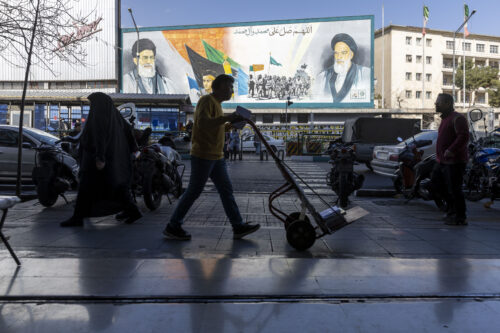
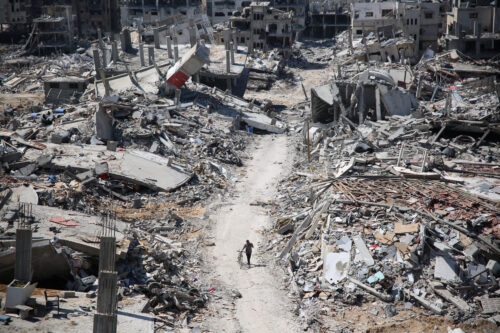
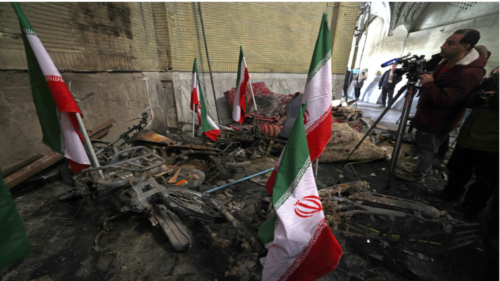
MEI Senior Fellow Jaser AbuMousa joins hosts Alistair Taylor and Matthew Czekaj to unpack how Hamas is navigating the US-Israel conflict with Iran and its impact on Gaza. Nearly two and a half years after the start of the Gaza war, international attention has shifted away from the humanitarian crisis in the devastated coastal strip. Meanwhile, Hamas’ primary state sponsor, Iran, has been severely weakened by US-Israeli military strikes and the death of former Supreme Leader Ayatollah Ali Khamenei. AbuMousa examines how this could affect Hamas’ trajectory moving forward and its place within the Axis of Resistance, as well as what it all means for the Palestinian people.
Nearly two weeks into the US and Israel’s war with Iran, MEI Senior Fellow Gönül Tol joins hosts Alistair Taylor and Matthew Czekaj to explore the impact of the widening regional conflict on Turkey. On March 9, Ankara announced that NATO air defenses shot down a second Iranian ballistic missile that had entered Turkish airspace since the start of the war and stated it would take all necessary defensive measures. Turkey is now caught in the middle of an escalating conflict that could pose risks to the country’s security, economy, and foreign policy. Tol, Taylor, and Czekaj discuss what a prolonged regional conflict could mean for Turkish President Recep Tayyip Erdoğan, his regional political objectives, and Turkey’s relationship with key Middle Eastern neighbors.
China in the crossfire: Calculated moves amid the US-Iran showdown
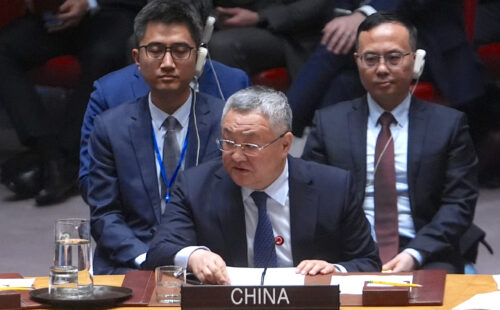
The launch of large-scale US and Israeli strikes against Iran places Beijing in a strategically uncomfortable position. This campaign is the most significant US military operation since the Iraq War, unfolding across a region central to China’s energy security and commercial ambitions.
Is Turkey the New Iran — Or Is that the Wrong Question?
The balance of power in the Middle East is shifting. Iran is on the defensive — its military capabilities were badly degraded by last year’s 12 days of Israeli and US strikes, and growing protests at home have made the regime look more vulnerable than it has in years.
Tehran Has Discovered Moscow Is a Fair-Weather Friend
The latest cycle of U.S.-Iran escalation has followed a familiar script: sharpened rhetoric from the United States, calibrated military signaling by Iran in the Persian Gulf, indirect diplomacy through Oman, and Israeli warnings that remain deliberately ambiguous but unmistakably real. Yet beneath this choreography lies a more consequential development inside Tehran. The current crisis is forcing Iran’s political class to reassess its central foreign-policy wager of the past decade: that deepening alignment with Russia and China would provide strategic insulation against Western coercion.
Brian sits down with Holly Dagres, Libitzky Family Senior Fellow at the Washington Institute for Near East Policy, to discuss Iranian public opinion and protest movements. Dagres, who was born in Los Angeles and moved to Iran at age thirteen, offers a rare insider perspective on the views and aspirations of the Iranian people. The conversation explores the formative experiences of her teenage years in Iran, the roots of the country’s powerful women’s movements, the power of youth voices, and US policy toward Iran.
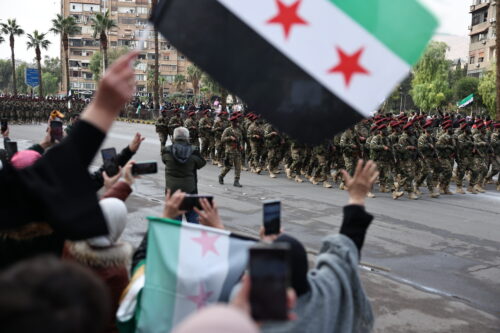
Dramatic developments in Syria have delivered a major blow to Kurdish ambitions for self-rule. In a rapid offensive, Damascus moved into northeast Syria, forcing the Kurdish-led Syrian Democratic Forces (SDF) out and effectively dismantling the autonomous region the Kurds had built during the civil war.
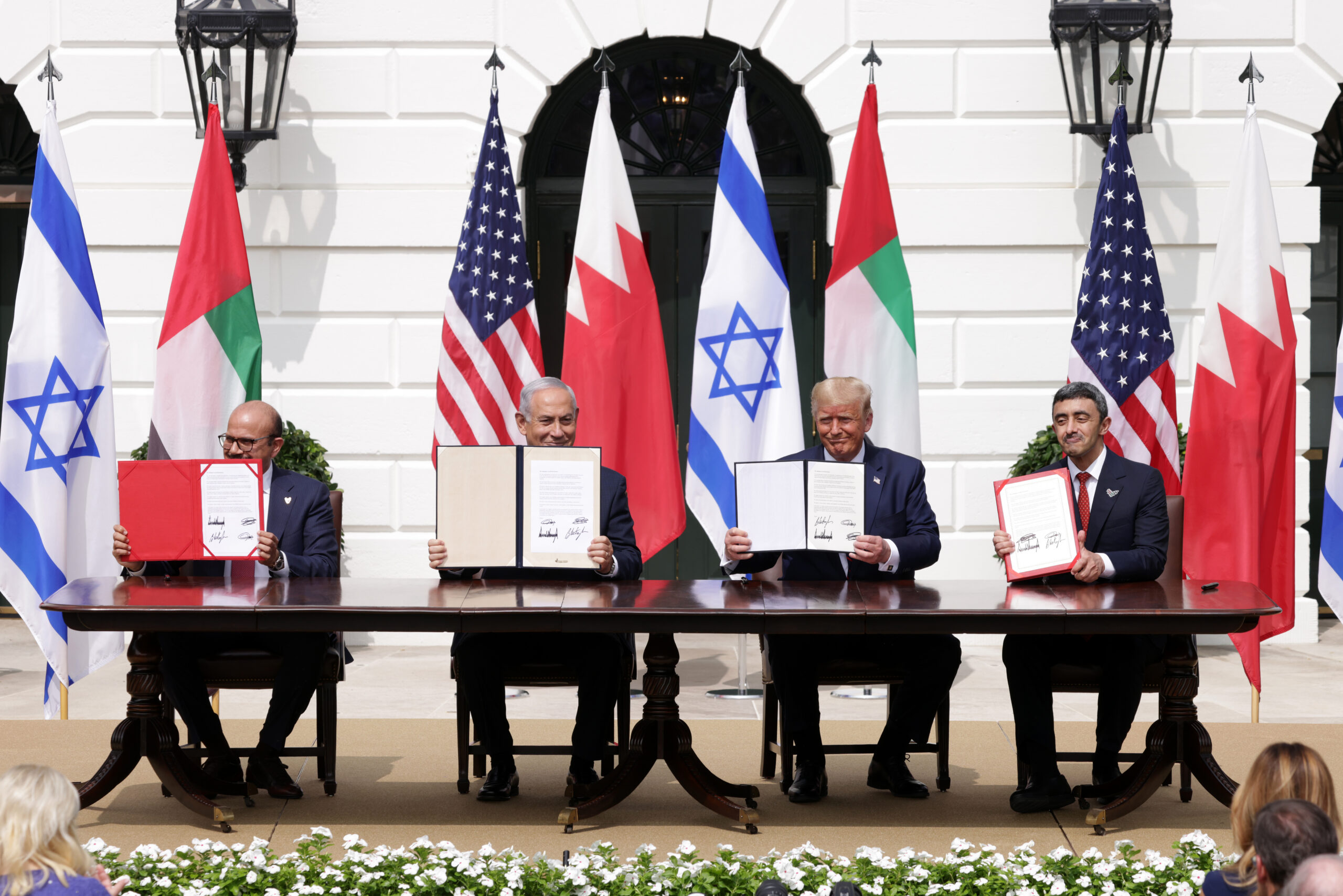
The Abraham Accords have represented a remarkable shift in U.S. Middle East policy. They reframed Arab-Israeli normalization as a result of shared interests – within the Middle East and directly with the US, rather than as a byproduct of Israeli-Palestinian peace. Signed in September 2020, on the last leg of the first Trump administration, the Accords brokered by Washington normalized relations between Israel and the United Arab Emirates (UAE) and Bahrain, followed by framework agreements with Morocco and Sudan. From the American perspective, the Accords were intended to break decades of diplomatic stagnation in the Middle East in order to establish a regional framework aligned with American strategic objectives.
Syria’s transition still faces a formidable array of challenges — from the implementation of the deal to integrate the SDF into state structures and the military, to the economy, reconstruction, transitional justice and accountability, refugee returns, and geopolitical tensions with Israel. However, a steady and significant decline in violence offers perhaps the most encouraging and consequential metric.
Whenever Iran is shaken by nationwide protests, as it was just last month, analysts and activists are consumed by the same two questions: will the country’s regime finally fall, and what will come next if it does? Answers abound.
New Questions on the International Stabilization Force for Gaza
In November 2025, the United States sought and obtained approval for a United Nations Security Council Resolution (UNSCR 2803) endorsing the formation of a Board of Peace (BoP) and International Stabilization Force (ISF) to support the implementation of the 20-point peace plan agreed to by Israel and Hamas the previous month. The ISF’s stated role is to help secure and demilitarize the Gaza Strip, primarily by facilitating the decommissioning of weapons, protecting civilians, and training and advising burgeoning Palestinian police forces. In the intervening months, however, progress on standing up the ISF has stalled, and conflicting messaging from US officials provides more questions than answers.
America’s New Defense Strategy — and What It Means for Iran
Hosts Alistair Taylor and Matthew Czekaj are joined by MEI Distinguished Military Fellow Mick Mulroy to discuss the Trump administration’s new National Defense Strategy (NDS) and its implications for the Middle East. While serving as the Deputy Assistant Secretary of Defense (DASD) for the Middle East from 2017 to 2019, Mulroy helped prepare the 2018 NDS, giving him an insider perspective on US defense planning. Together, Taylor, Czekaj, and Mulroy unpack what the new strategy means for US priorities globally and for the Middle East in particular, including how it could be reflected in a potentially looming military strike on Iran.
Long before the Gaza war erupted in 2023, a broad consensus had already taken hold across policymakers, activists, and foreign-policy circles: the Israeli-Palestinian conflict was at a political dead end. The Oslo framework—and the promise of a two-state solution—had steadily lost credibility as a realistic path forward. Since Hamas’s October 7 attacks, the devastation in Gaza and the accelerating realities on the ground have made a two-state outcome even harder to imagine. And yet, it remains the default language of Middle East diplomacy. Most recently, UN Secretary-General António Guterres reaffirmed his determination to oppose Israeli actions undermining the two-state solution and called for renewed momentum toward Palestinian statehood.
Against the backdrop of the Iranian government’s brutal crackdown on protestors, Brian is joined by Emad Shargi, an Iranian-American businessman who was unjustly detained by the regime in 2018 until his release in 2023. Shargi recounts his firsthand experience in the notorious Evin Prison and offers rare insights into the mentality and tactics of the Islamic Republic. He and Brian also discuss his recommendations for US engagement in Iran and his hopes for the country’s future.