Findings and Recommendations of the Conference on “Arab-U.S. Relations in Perspective” hosted jointly by the School of Global Affairs at AUC and the Middle East Institute, on January, 29-30, 2017, in Cairo, Egypt.
Monday Briefing: Trump’s Executive Orders Don’t Reveal a Coherent Strategy
In this week’s Monday Briefing, MEI experts Paul Salem, Paul Scham, Randa Slim, W. Robert Pearson, and Marvin G. Weinbaum provide analysis on recent and upcoming events including the Trump administration’s apparent lack of a coherent strategy in the implementation of executive orders, the possibility of an improved relationship between Israel and the UK in the wake of Brexit, the Astana meeting to discuss the Syrian cease-fire deal, bilateral efforts to improve Turkish-Israel relations, and the uncertainty surrounding U.S.-Pakistani relations under the Trump administration.
Monday Briefing: Trump Scores a Ruinous ‘Own Goal’ in the Middle East
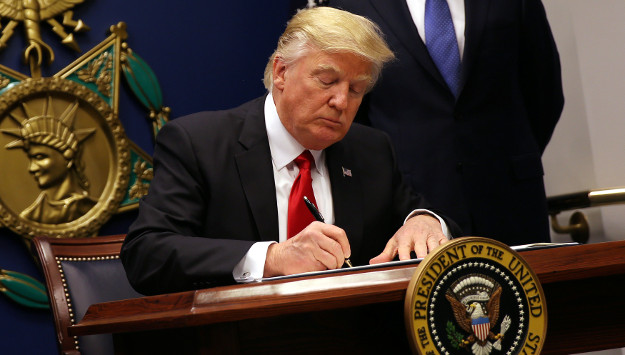
In this week’s Monday Briefing, MEI experts Paul Salem, Robert S. Ford, and W. Robert Pearson provide analysis on recent and upcoming events including the Trump administration’s controversial travel ban, the Syrian regime’s dismissal of calls for a cease-fire, and the upcoming meeting between German Chancellor Angela Merkel and Turkish President Recep Tayyip Erdogan.
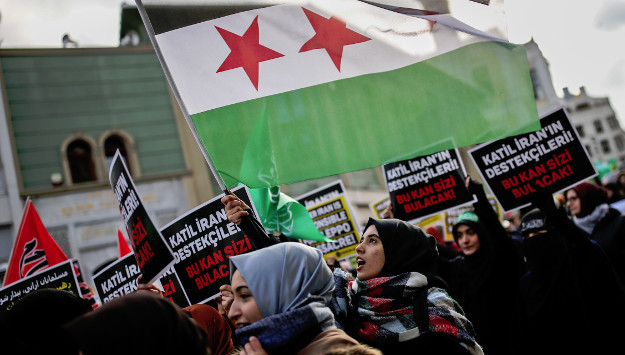
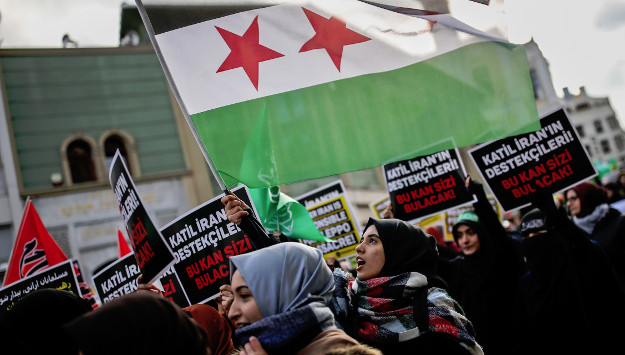
Kayhan, a leading newspaper that represents the most hardline of voices inside the Iranian regime, has been raising doubts about Turkish intentions in the Syrian conflict. The reservations the paper expressed come shortly after the late December 2016 Turkish-Russian-Iranian ceasefire deal aimed to kick-start the political process to find a solution to the six-year Syrian war.
Burden or Boon? Turkey’s Tactical Treatment of the Syrian Refugee Crisis
Turkey’s ruling Justice and Development Party (AKP) approaches the question of refugees much differently than its European counterparts. The latter’s pushing back against burden-sharing measures has led to what can be described as burden-shifting. In contrast, the AKP’s view of Syrian refugees in Turkey is that they are more of a boon than a burden. This essay explores the thinking and the tactics behind Turkey’s approach to dealing with the Syrian refugees challenge.
Saudi Interest in the Red Sea Islands of Tiran and Sanafir Grows as Its Security Interests Expand
Notwithstanding Egypt’s political and judicial contretemps, the Egyptian parliament is expected to vote soon in favor of the return of Tiran and Sanafir islands to Saudi Arabia. The decision, after months of controversy in Egypt, will fulfill the April 2016 agreement reached between Egyptian president Abdel Fattah al Sisi and Saudi King Salman bin Abdul Aziz Al Saud that formally acknowledged Saudi sovereignty over the two small islands and provided for their return to Riyadh’s control.
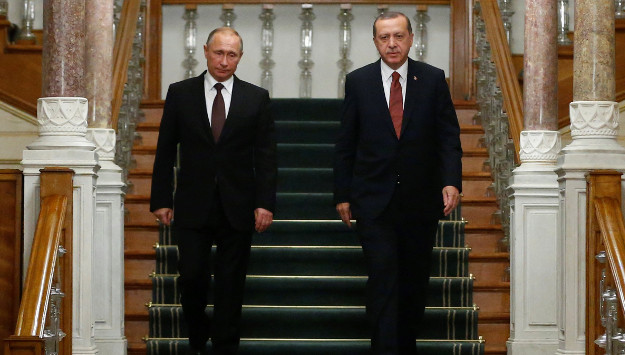
The current Syrian ceasefire effort of Russia and Turkey is a Russian attempt to impose a final political defeat on the rebels and a Turkish attempt to focus on eliminating the Kurds in Syria militarily and politically. Turkey is also intensely lobbying the new U.S. administration for help. The ceasefire deal rests on the barbarism of Russia and the Assad regime and the feckless response of the West. This is the peace Rome imposed on the prostrate Carthage. The unanimous UNSC vote endorsing the Russian/Turkish proposal enshrines one side’s brutality and the other’s moral vacuum.
January 5, 2017 – Eric Trager, Esther K. Wagner Fellow at the Washington Institute for Near East Policy, joins host Paul Salem to discuss his new book, “Arab Fall: How the Muslim Brotherhood Won and Lost Egypt in 891 Days.”
Turkey Warns Iran against Breach of Syria Cease-Fire
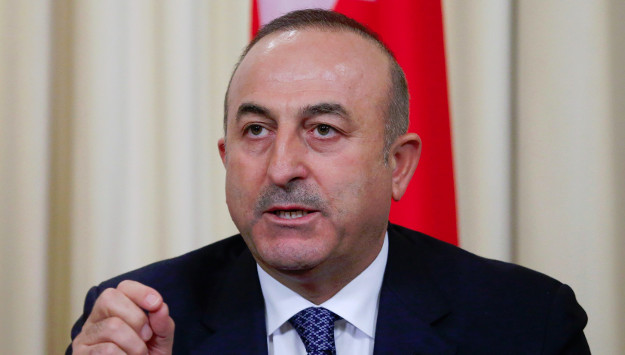
The Turkish foreign minister has openly urged Iran to “play its role as an underwriter of the ceasefire in Syria.” Mevlut Cavusoglu specifically demanded that Tehran rein in Shiite militiamen and the Lebanese Hezbollah and make them “stop violating” the ceasefire in Syria that was agreed on December28.
Tehran’s unwavering support for the regime of Bashar al-Assad continues to irk the Turks, according to press reports. On December 16, the Turkish prime minister, Binali Yildirim, and Iran’s vice president, Eshaq Jahangiri, spoke on the phone. The discussion was ostensibly about Jahangiri’s upcoming visit to Turkey, but also focused on the Syrian civil war.
Egypt’s Supreme Constitutional Court (S.C.C.) recently ruled that a central element of the country’s controversial Protest Law relating to police power to ban public demonstrations is unconstitutional.
New to the Oman Library’s shelves is a distinct collection, donated by Sallie Lewis on behalf of her late husband, Ambassador Samuel Lewis. This new addition brings a unique set of stories to the library, with many works containing signatures and personal notes from well known figures who worked closely with the ambassador during his career in the foreign service.