The Israel-Palestine Conflict: Views of a Palestinian-Israeli member of the Israeli Knesset
Dr. Ahmad Tibi is a member of the Arab Movement for Change and was first elected to the Israeli Knesset in 1999. He currently serves as Deputy Speaker of the Knesset and head of the parliamentary committee of inquiry, which seeks to accommodate Palestinians through integration into jobs in the public sector. He has played a key role in the politics of the Palestinian-Israeli community, which constitutes approximately one fifth of Israel's population. He has also played a key role in relations between Palestinian-Israelis and Palestinians in the occupied territories and Dr.
Transnational Networks and Local Challenges: Iraqis in Cairo
Originally posted March 2010
It is estimated that over four million Iraqi refugees have fled to neighboring countries in the region since the 2003 war began. While migration continued after the war, the peak of this influx was witnessed particularly in and after 2006 due to the acceleration of violence in central and southern Iraq. More particularly, the majority of these refugees fled due to direct threats to their lives and their immediate families.
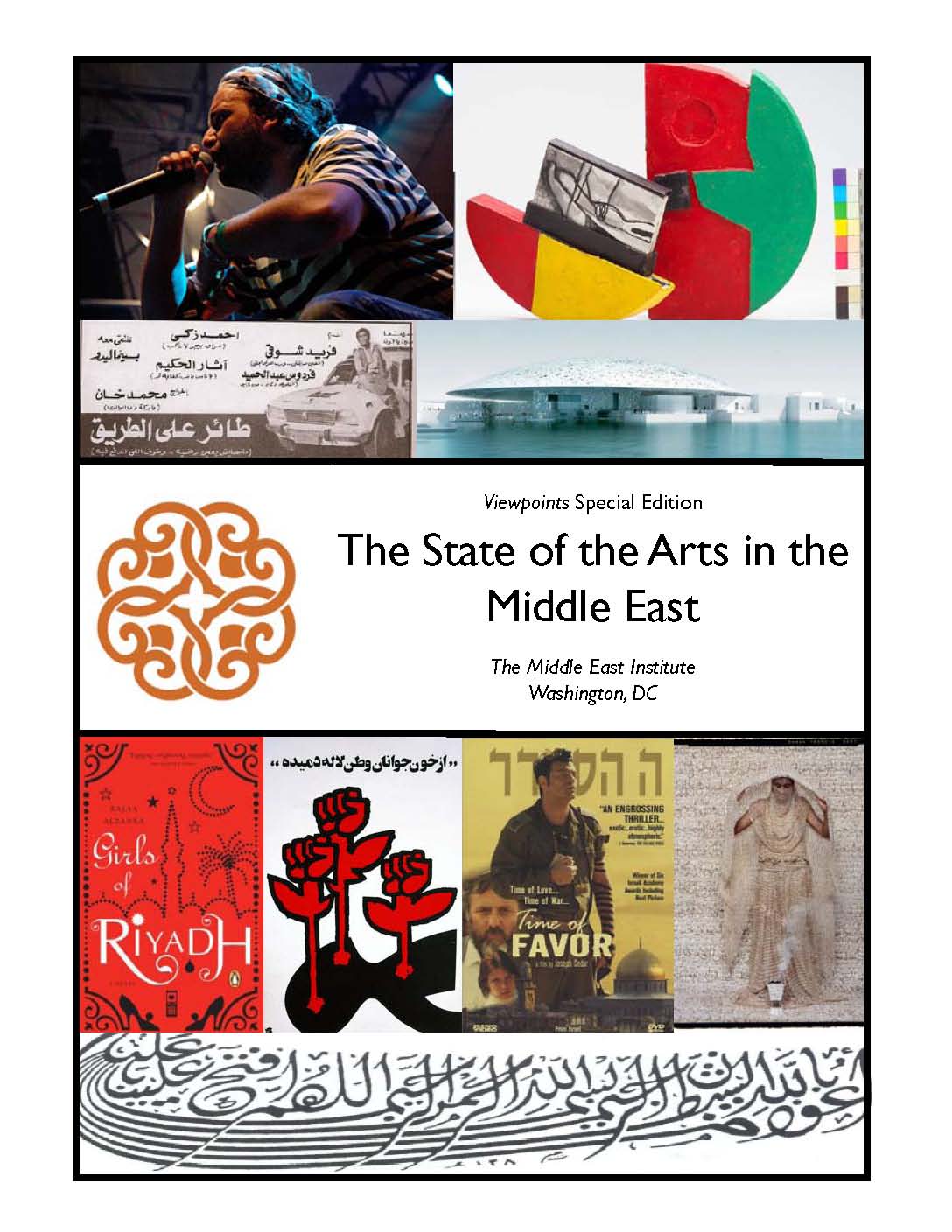
Introduction to The State of the Arts in the Middle East: Volume IV
Literature, visual art, and photography not only serve an aesthetic purpose, but often act as mediums through which their creators explore deeply personal experiences and their broader social implications. In this, the fourth volume of MEI’s “The State of the Arts in the Middle East,” Najat Rahman considers the works of the Palestinian artists Emily Jacir and Eman Haram, and W. Scott Chahanovich (with Pauline Pannier) discusses the memoirs of the Moroccan-born writer Abdellah Taïa.
Turkey and Israel: What Lies Behind the Recent Volte Face
In recent months, the Israeli-Turkish relationship, strong and stable during the 1990s, has been placed under severe pressure. Tensions began in January 2009 when Israel launched military operations in Gaza, later prompting Turkish Prime Minister Recep Tayyip Erdogan to walk out of a televised debate with Israeli President Shimon Peres following a heated exchange over the issue.
Economic Peace in the West Bank and the Fayyad Plan: Are They Working?
There can be a democratic, de facto Palestinian state by 2011, according to Salam Fayyad, the Prime Minister of the Palestinian Authority (PA). The goal was outlined in an eloquent two-year plan entitled “Ending the Occupation, Establishing the State,”[1] published in August 2009, which called for the formation of the institutional foundations of statehood prior to, and independent of, an agreement with Israel.
This Commentary first appeared as an op-ed on BitterLemons-International.org, October 22, 2009
Syria could not be more ecstatic at the row that has recently developed between Turkey and Israel. Turkey, once among Israel's staunchest allies, now sees eye-to-eye with Syria regarding the difficulties in dealing with Israel and Israel's abusive treatment of Palestinians.
Introduction to The Legacy of Camp David: 1979-2009
Since the “Six Day War” in June 1967, countless American and other diplomats have sought almost continuously to broker peace between Israel and its surrounding Arab enemies. From that tangled history, one achievement stands tallest in a forest of scrub: the Egypt-Israel Treaty signed on March 26, 1979 on the White House front lawn by President Anwar Sadat, Prime Minister Menachem Begin, and President Jimmy Carter.
How the New Arab Media Challenges the Arab Militaries: The Case of the War between Israel and Hizbullah in 2006
One, Two / the Arab army where are you?/ The Arab army where are you?/The Egyptian Arab Army/ resides in an-Nasr [victory] compound/ Wakes up in the afternoon/ to drink its tea/ The Gulf Arab army/ can do absolutely nothing/ “Strategic silence” indeed/ “cut us some slack, man!”/ The Tunisian Arab army/ is green like parsley/ But ‘Aziza loves Yunis/ the wars can wait/ The Sudanese Arab army/ I can hear its clamor in my ears/ “Damn it!
The Jordan Valley is a lush, wetland ecosystem that is the biological heart of the Middle East region at large. As the meeting point of the Asian, African, and European continents, the valley is at the crossroads of biodiversity. In addition to the unique flora and fauna, the valley is one of the world’s most important migratory pathways for birds. Over 500 million birds migrate from Europe to Africa twice a year, dependent on the Jordan Valley as a stopping ground on their long journey.
Within a mere few years after World War II the Middle East was remade. The creation of the State of Israel in 1948 and its consequences helped propel that part of the world to what seems to be a permanent and unenviable spot on any list of world crises.