Skip to Content

Research & Commentary

Read in-depth research, analysis, and commentary from MEI’s fellows and experts on the Middle East. 

Washington’s War, Tehran’s Waiting Game
  • Analysis
  • Washington’s War, Tehran’s Waiting Game

    In an August 9 interview with Axios, when asked about the endless swings of the Iran standoff, he shrugged it off as familiar territory. “It’ll work out in the end. It always does. It’s like a chess game.”

    Behind the rhetoric sat a harder fact.

    A Credit Strategy for Syria’s Reconstruction
  • Analysis
  • A Credit Strategy for Syria’s Reconstruction

    With sanctions repealed, Syrian policymakers must ensure that growing volumes of credit reach beyond the narrow political and commercial networks that have generally dominated Syrian finance. That will require a credit strategy aimed at sectors and regions historically excluded from formal finance. Syria’s specialized state banks offer an imperfect but ready-made mechanism to do so.

    August 13, 2026

    The “Anti-Strategic President” Needs to Revive a Policy Process to Resolve Iran
  • Analysis
  • The “Anti-Strategic President” Needs to Revive a Policy Process to Resolve Iran

    President Donald Trump’s disdain for strategy extends to process: mass National Security Council firings and reliance on a tiny circle of advisors have left the interagency policy process dormant amid the Iran war. The result is improvised, damaging moves like the Strait of Hormuz toll scheme. Reviving a professional, deliberative policy process is essential.

    Additional Research & Commentary

    Backgrounders

    Israeli Settlements in the West Bank
  • Backgrounder
  • Israeli Settlements in the West Bank

    Since 1967, Israeli settlements in the West Bank have been a contested feature of the Israeli-Palestinian conflict. The ultimate disposition of the settlements and ongoing activity related to their growth have repeatedly defied agreement in negotiations over a resolution to the conflict.

    June 9, 2026

    The Houthis
  • Backgrounder
  • The Houthis

    The Houthis are a political-military faction and Zaydi religious movement founded in northwestern Yemen in the 1980s. A key member of Iran’s Axis of Resistance with links to other militant organizations in the Arabian Peninsula and the Horn of Africa, the group has continued to pose a threat to Western interests on a global scale.

    May 15, 2026

    The India-Middle East-Europe Economic Corridor
  • Backgrounder
  • The India-Middle East-Europe Economic Corridor

    The India-Middle East-Europe Economic Corridor (IMEC) is a proposed multinational infrastructure initiative aimed at upgrading connectivity between the three regions through integrated trade, energy, and digital networks. Announced at the G20 summit in New Delhi in September 2023, IMEC is envisioned partially as a counterweight to China’s international infrastructure project, the Belt and Road Initiative.

    June 3, 2026

    Turkish Foreign Policy
  • Backgrounder
  • Turkish Foreign Policy

    After a decade of post-Arab Spring isolation, Turkey’s leaders have recognized that their ambition to position the country as an agenda-setter on the world stage requires active engagement in all directions. President Recep Tayyip Erdoğan’s consolidation of executive authority has centralized foreign policy decision-making and tied it to his domestic political priorities, transforming the country’s revisionist approach to one shaped primarily by personal and pragmatic interests.

    April 23, 2026

    Podcasts

    Middle East Focus

    MEI’s flagship weekly podcast on US foreign policy and contemporary political and social issues in the Middle East.

    Taking the Edge Off the Middle East

    MEI Senior Fellow Brian Katulis engages friends, colleagues, and policy experts in casual conversations on the most important happenings in the Middle East. 

    Rethinking Democracy

    MEI Senior Fellow Gonul Tol hosts leading scholars and thought leaders on global democracy trends and the state of the liberal international order. 

    Filter by
    8779 Results
    A new general and a fragile peace in Deir ez-Zor
    Maj. Gen. Khader (center) tours regime positions near Shoula alongside Feras Jeham (pointing) commander of the Deir ez-Zor NDF and Republican Guard officers.
  • Analysis
  • A new general and a fragile peace in Deir ez-Zor

    Five months into his job as commander of regime forces in Deir ez-Zor, Maj. Gen. Nizar Khader appears to have skillfully gained control over the diverse tapestry of loyalist forces in the region. Khader’s return to power in the east quickly put an end to the deadly disputes that had plagued the governorate’s security forces for years. He then launched a nearly three-month campaign, coordinated between Syrian, Iranian, and Russian forces, to push ISIS cells back into the province’s hinterlands, securing the crucial highway connecting Deir ez-Zor with Palmyra and Damascus to the west. His success, while impressive, will face its second major test soon as ISIS prepares for a potential Ramadan offensive.

    April 19, 2021

    Iran’s game plan for Iraq’s militias
    Photo credit should read AHMAD AL-RUBAYE/AFP via Getty Images
  • Analysis
  • Iran’s game plan for Iraq’s militias

    Historically, Iran has used Iraqi militias to implement both its short-term plans and long-term strategies. At this stage Iran seems to have included its Iraqi proxies in plans to lift U.S. sanctions. Going forward, the Islamic Republic may use escalation against the United States in Iraq to exercise leverage in its dealings with Washington on the JCPOA.

    April 19, 2021

    Bulgaria in the Black Sea: Defending against Russian hybrid warfare
  • Analysis
  • Bulgaria in the Black Sea: Defending against Russian hybrid warfare

    As a NATO and EU member, Bulgaria has consistently been a target of the Kremlin’s hybrid warfare. Moscow is pursuing a calculated and well-planned policy aimed at influencing domestic politics in Bulgaria, with a view of preventing the country from becoming a robust NATO regional security provider. This is especially important for the build-up of the Alliance’s presence in the Black Sea.

    April 19, 2021

    The road ahead for Libya
    Middle East Institute
  • Podcast
  • The road ahead for Libya

    Jonathan Winer and Mirette Mabrouk join host Alistair Taylor to discuss Libya’s new interim government, the complex regional and international dynamics at play, and what Libya’s future might look like.

    April 16, 2021

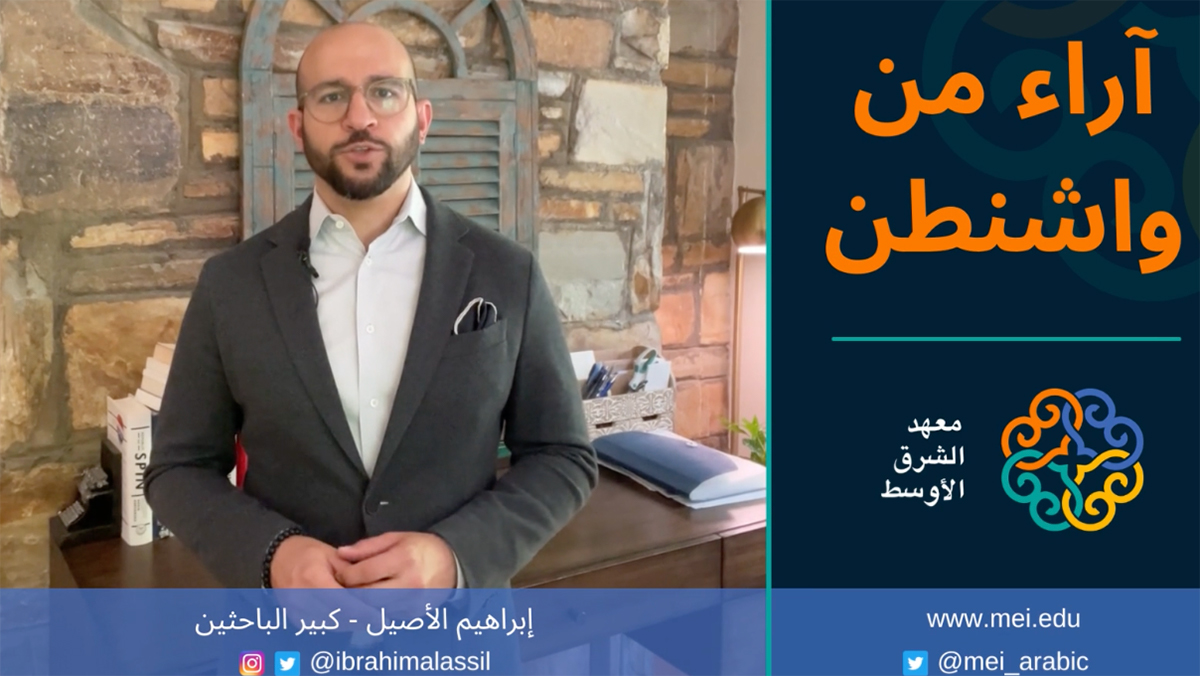
    حلقة 13: آراء من واشنطن – إيديولوجيا النظام الإيراني تجاه الولايات المتحدة
  • Video
  • حلقة 13: آراء من واشنطن – إيديولوجيا النظام الإيراني تجاه الولايات المتحدة

    في هذه الحلقة من ‘آراء من واشنطن’، يستعرض إبراهيم الأصيل رأي لنازي موينيان حول الموقف الإيديولوجي للنظام الإيراني من الولايات المتحدة وأثره على المفاوضات

    April 16, 2021

    The role of algorithms in the persistent US-Iranian impasse
    Costfoto/Barcroft Media via Getty Images
  • Analysis
  • The role of algorithms in the persistent US-Iranian impasse

    Even if we assume that there is goodwill between the U.S. and Iran to improve relations, the power of algorithms will place major stumbling blocks in the way of efforts toward future normalization. A priori programming of foreign policy options and lines of argument have led to immutable algorithms causing the relationship between the two countries to calcify. On both sides, the key personalities who define national security, interpret events, and shape policies toward one another have had virtually no direct contact or experiences with each other’s country. They interpret events, extract meanings, react to one another, and delineate policies through prisms, images, metaphors, binaries, groupthink, and in the lexicon of artificial intelligence, algorithms.

    April 16, 2021

    Following a royal rift King Abdullah faces daunting choices
    Photo by Jordanian Royal Council/Handout/Anadolu Agency via Getty Images
  • Analysis
  • Following a royal rift King Abdullah faces daunting choices

    April 11, 2021 was to be a day of celebration and national pride marking the kingdom of Jordan’s centenary as a state — a geopolitical feat in itself few thought was possible a century ago. But instead of pomp and ceremony the festivities were overshadowed by stark events that took place a week before when the government unveiled a “plot” to destabilize the country involving a senior member of the royal family, a close former palace aide, and “outside entities.” This was an unprecedented development in the history of the kingdom and ruling monarchy. The implication of Prince Hamzah, the former crown prince and half-brother of King Abdullah, in a fuzzy conspiracy that is tantamount to a coup has shocked Jordanians from all walks of life. 

    April 16, 2021

    Repairing regional and global relationships through cyber diplomacy
    Photo by Chip Somodevilla/Getty Images
  • Analysis
  • Repairing regional and global relationships through cyber diplomacy

    Under mounting pressure to define and execute its foreign policy to “restore U.S credibility,” the Biden administration needs to carefully consider its focal points in the Middle East, especially in light of the region’s recent realignment following the signing of the Abraham Accords. Luckily, through cyber diplomacy and norm setting, the administration can restore its credibility without abandoning its core ideals, while also nurturing relationships in the Middle East and beyond. Such cyber diplomacy could involve both engaging with partners to strengthen rules-based frameworks around acceptable state behavior in cyberspace and using cyber to leverage wider diplomatic aims.

    April 15, 2021

    As tensions grow, a strong Georgia-Ukraine partnership is essential for Black Sea security
  • Analysis
  • As tensions grow, a strong Georgia-Ukraine partnership is essential for Black Sea security

    New strategic alliances are being forged across the Black Sea in an attempt to counterbalance Russian influence in the region. The Georgia-Ukraine strategic partnership is complex and multifaceted. Despite diplomatic obstacles and how relatively new it is, the relationship is already making a difference to Black Sea security. On trade, security, or Euro-Atlantic integration, Georgia and Ukraine have realized they are louder when they speak with one voice. However, Russia’s military buildup on Ukraine’s border and in the Black Sea demonstrates that regional peace cannot be achieved without the support of the United States. Greater support is needed as Ukraine and Georgia continue to fight Russian hybrid warfare across the spectrum.

    Vaccine diplomacy in the MENA region
  • Analysis
  • Vaccine diplomacy in the MENA region

    Vaccine diplomacy, or the use of vaccine supplies as a tool of soft power projection, has entered the political dictionary. In a world where COVID-19 has been taking a terrifying human and financial toll, vaccine supplies promise relief and interact with pre-existing politics and foreign policy priorities. China and Russia have sought to enhance their influence in the Middle East and North Africa (MENA) region with a number of high-profile vaccine deals. This has drawn the ire of a beleaguered European Union, whose self-professed goal is to become a more geopolitical union even while its domestic vaccination effort lags behind the U.S. and the U.K.

    April 14, 2021

    العراق والتحول العسكري الأمريكي
  • Commentary
  • العراق والتحول العسكري الأمريكي

    “الكاظمي يحاول تدريجيًا احتواء المليشيات بينما يتعهد بتجنب حرب أهلية جديدة داخل العراق، وهو موقف يرحب به العراقيون المنهكون”.

    حلقة 12: آراء من واشنطن – العراق والانتقال الأمريكي العسكري
  • Video
  • حلقة 12: آراء من واشنطن – العراق والانتقال الأمريكي العسكري

    في ‘آراء من واشنطن’ هذا الأسبوع، يستعرض إبراهيم الأصيل رأي للسفير روبرت فورد حول الحوار الاستراتيجي بين العراق والولايات المتحدة ومسألة القوات الأمريكية في العراق

    April 14, 2021

    The China-Iran deal and the reinvention of the Iranian revolution
    Photo by THOMAS PETER/AFP via Getty Images
  • Analysis
  • The China-Iran deal and the reinvention of the Iranian revolution

    The announcement of the Comprehensive Strategic Partnership (CSP), a 25 year-long economic and development agreement between China and Iran, has immediately added to the intensifying discourse concerning US-China Geostrategic Competition. Nonetheless, a closer look at its implications suggests that it may be useful in achieving some U.S. goals with Iran: particularly regime modernization.

    April 13, 2021

    Read the Middle East Journal

    The oldest peer-reviewed publication dedicated to the study of the modern Middle East, MEI’s flagship journal covers politics, society, and culture in the region.