Skip to Content

Research & Commentary

Read in-depth research, analysis, and commentary from MEI’s fellows and experts on the Middle East. 

Trump’s Family Business Deals Risk Further Undermining the Credibility of US Middle East Policy
  • Analysis
  • Trump’s Family Business Deals Risk Further Undermining the Credibility of US Middle East Policy

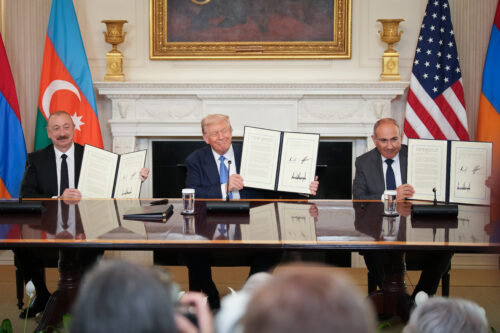
    President Trump’s family businesses are once again in the spotlight as a new financial disclosure showed they earned $2 billion in income in 2025 — a dramatic increase on the year before, with much of it coming from Gulf entities, raising emoluments concerns. Mounting perceptions of corruption, combined with unresolved crises in Iran and Israel-Palestine, are eroding trust among key partners in the Middle East. With the 2026 midterms approaching, these entanglements could represent a major political vulnerability and further undermine America’s already-strained standing in the region.

    Do the Gulf States Need a New Playbook?
  • Podcast
  • Do the Gulf States Need a New Playbook?

    After the US-Israel-Iran war — and the strikes that followed the cease-fire — the Gulf states find themselves dangerously exposed. Host Alistair Taylor is joined by MEI Associate Fellow Gregory Gause to discuss the war’s impact on the Gulf, their partnership with the United States, and whether the turmoil of recent months will push Gulf leaders to reassess their alliances and international engagement.

    July 2, 2026

    Additional Research & Commentary

    Backgrounders

    The Houthis
  • Backgrounder
  • The Houthis

    The Houthis are a political-military faction and Zaydi religious movement founded in northwestern Yemen in the 1980s. A key member of Iran’s Axis of Resistance with links to other militant organizations in the Arabian Peninsula and the Horn of Africa, the group has continued to pose a threat to Western interests on a global scale.

    May 15, 2026

    The Abraham Accords
    Photo by Alex Wong/Getty Images
  • Backgrounder
  • The Abraham Accords

    This backgrounder provides an overview of how the Abraham Accords came about, the US interests involved, their economic and strategic consequences, and the prospects for further enlargement going forward.

    November 17, 2025

    Turkish Foreign Policy
  • Backgrounder
  • Turkish Foreign Policy

    After a decade of post-Arab Spring isolation, Turkey’s leaders have recognized that their ambition to position the country as an agenda-setter on the world stage requires active engagement in all directions. President Recep Tayyip Erdoğan’s consolidation of executive authority has centralized foreign policy decision-making and tied it to his domestic political priorities, transforming the country’s revisionist approach to one shaped primarily by personal and pragmatic interests.

    April 23, 2026

    Western Sahara: Why the conflict still matters
  • Video
  • Western Sahara: Why the conflict still matters

    As the Western Sahara conflict reaches its fifth decade, the territorial dispute remains unresolved and largely unknown. MEI’s Intissar Fakir unpacks the Western Sahara’s complex history and the rival claims by Morocco and the Sahrawi Arab Democratic Republic. She examines recent developments, such as President Trump’s recognition of Moroccan sovereignty over the territory and the collapse of a 30-year cease-fire, as well as the core questions that remain unanswered after half a century.

    August 7, 2025

    Podcasts

    Middle East Focus

    MEI’s flagship weekly podcast on US foreign policy and contemporary political and social issues in the Middle East.

    Taking the Edge Off the Middle East

    MEI Senior Fellow Brian Katulis engages friends, colleagues, and policy experts in casual conversations on the most important happenings in the Middle East. 

    Rethinking Democracy

    MEI Senior Fellow Gonul Tol hosts leading scholars and thought leaders on global democracy trends and the state of the liberal international order. 

    Filter by
    8748 Results
    Transitional Justice in Tunisia
    Middle East Institute
  • Analysis
  • Transitional Justice in Tunisia

    Since the “Arab Spring,” international actors have considered Tunisia an exemplar of democratic transition in the Arab world. But this optimism is increasingly being replaced by fear and frustration, especially within Tunisia itself. Transitional justice—dealing with the crimes committed by previous regimes—is one of the subjects of debate.

    February 27, 2014

    Transitional Economics in Egypt
  • Analysis
  • Transitional Economics in Egypt

    In December 2012, the Central Bank of Egypt announced that the country’s foreign reserves had reached an alarming low of $15 billion, less than 50 percent of its holdings following Hosni Mubarak’s ouster in February 2011. At that point, the Bank was no longer capable of providing the treasury with the monthly dollar transfers necessary for the purchase of basic food and energy imports, and thus had to rely on foreign borrowing to cover these imports and debt service as well as to support local currency.

    February 27, 2014

    Lebanon at the Crossroads
  • Analysis
  • Lebanon at the Crossroads

    Testimony by MEI’s Paul Salem before the U.S. Senate Committee on Foreign Relations, Subcommittee on Near Eastern and South and Central Asian Affairs, delivered February 25, 2014.  Find more information here about the hearing, including full video (Salem’s testimony begins at 1:22:40).

    February 26, 2014

    The Arab Awakening: Determinants and Economic Consequences
  • Analysis
  • The Arab Awakening: Determinants and Economic Consequences

    Economist Zubair Iqbal explains the daunting economic challenges facing Arab countries in transition following the Arab Awakening and the different trajectories stemming from those nations’ policy responses. Tunisia and Egypt provide an instructive case study: the former made hard fiscal decisions and has embraced sound economic principles and achieved broad support for a reform plan, while the latter, suffering from more difficult political conditions, has been faced with limited policy options that increase the risk for long-term challenges.

    February 25, 2014

    Al Qaeda's Expansion in Egypt: Implications for U.S. Homeland Security
  • Analysis
  • Al Qaeda's Expansion in Egypt: Implications for U.S. Homeland Security

    Testimony of MEI Resident Scholar Mohamed Elmenshawy before the House Committee on Homeland Security Subcommittee on Counterterrorism and Intelligence, delivered February 11, 2014.  Click here for video clips and additional testimony from this hearing.

    February 25, 2014

    Church-State Relations in Egypt
  • Analysis
  • Church-State Relations in Egypt

    The Christmas visit of Egypt’s interim president Adly Mansour to the Coptic Cathedral in Cairo occasioned much commentary in the Egyptian press about a new era in church-state relations. Indeed, newspaper headlines heralded the visit as the first undertaken by an Egyptian president to a Coptic patriarch to offer congratulations on a Coptic holiday. The interim president’s magnanimity in making the visit was set in stark contrast to the parsimonious attitude of Hosni Mubarak, who would typically leave such obligatory greetings to a lesser figure in the Egyptian government.

    February 24, 2014

    Yemen’s Contentious Transitional Justice and Fragile Peace
    Middle East Institute
  • Analysis
  • Yemen’s Contentious Transitional Justice and Fragile Peace

    Yemen was not immune to the wave of popular uprisings that swept some countries of the Middle East and North Africa region. However, because of the Yemeni state’s fragility, concurrent zones of conflict, and a power struggle that divided the core military and tribal elites, the international community was afraid that the youth uprising that started in January 2011 might lead to a collapse of the state. Given the consequences of such a collapse on the security of the Gulf states, oil production, and the international war on terror, the Gulf Cooperation Council brokered a deal in November 2011—the Gulf initiative—which laid the foundation for a transitional government. The main aim of the initiative was to secure a peace deal that halted Yemen’s slide into chaos. Peace was sought through the brokering of an inclusive National Dialogue Conference (NDC), but peace did not entail changing the regime or its pattern of politics. While transitional justice has been a part of this process of peaceful reconciliation, it raises questions about the sustainability of this peace and provides a showcase of the precarious state of Yemeni affairs.

    February 24, 2014

    Kerry’s Proposed “Framework” Offers Way Forward for Israel/Palestine
  • Analysis
  • Kerry’s Proposed “Framework” Offers Way Forward for Israel/Palestine

    John Kerry’s extraordinary efforts to make peace between Israel and Palestine through six months of bilateral talks have produced no significant results. Kerry, determined to succeed, is turning to a “framework” that would create a new basis for continued negotiations. The framework has not yet been released. But if it is a clear outline of an American plan for peace, not just a collection of ideas that avoids laying out U.S. positions, it could be a game changer.

    February 21, 2014

    The Afghan Bridge in U.S.-Iranian Ties
  • Analysis
  • The Afghan Bridge in U.S.-Iranian Ties

    Fatemeh Aman co-authored this article.

    As President Obama met his top Afghanistan commanders in the Oval Office on February 4 to discuss his decision to reduce the U.S. military presence in Afghanistan, he received a compliment from an unlikely source. Ali Akbar Velayati, the top foreign policy aid to Iran’s Supreme Leader, Ayatollah Khamenei, called Obama’s Afghan withdrawal policy “wise.”

    Security & the Tunisian Constitution
  • Analysis
  • Security & the Tunisian Constitution

    January 27, 2014 will likely be engraved in the collective memory of the Tunisian people as the day they witnessed the adoption of their first post-authoritarian constitution—a charter that will hopefully pave the way for the country’s democratization. This legal framework was ratified by members of the Tunisian National Constituent Assembly (NCA) in a celebratory atmosphere.

    February 18, 2014

    The Resurgence of Militant Islamists in Egypt
  • Analysis
  • The Resurgence of Militant Islamists in Egypt

    The recent attacks against Egypt’s police and military have raised concerns over the return of the militant insurgency that plagued Egypt during the 1980s and 1990s. Ansar Bayt al-Maqdis (ABM), a Sinai-based militant group, has repeatedly and publicly claimed responsibility for the cascade of bombings.

    February 14, 2014

    Saudi Arabia, Syria, and Bin Laden's Ghost
  • Analysis
  • Saudi Arabia, Syria, and Bin Laden's Ghost

    Osama bin Laden may be dead, but his ghost was in Riyadh the other day, hovering over Saudi Arabia’s King Abdullah as he issued a decree making it a crime for any Saudi citizen to take part in a war outside the kingdom.

    The obvious motivator was the civil war in Syria, where hundreds of young Saudis have been spotted in the ranks of the most radical jihadi groups battling both the government and other less extreme rebels. But the roots of the king’s action, and the problem it was designed to address, can be traced to the 1980s war against the Soviet occupation of Afghanistan.

    February 14, 2014

    The Rise and Fall of Transitional Justice in Taiwan
  • Analysis
  • The Rise and Fall of Transitional Justice in Taiwan

    Authoritarian rule in Taiwan ended peacefully in the late 1980s. Since then, state institutions and private organizations have repeatedly attempted to address the atrocities committed during authoritarianism (1945-1987). This essay explores the various factors that have determined transitional justice in Taiwan over the last two decades. It demonstrates that post-authoritarian Taiwan has experienced three distinct periods: first, limited apology and compensation (1988-2000); second, attempts at transitional justice that ended in failure (2000-2008); and third, a reversal of all transitional justice mechanisms and a relapse to the past (2008-present). These changes are due in significant part to indigenous conflicts in Taiwan that have not been resolved, but also to global economic and political events that have drastically reduced the focus on democratic governance and accountability.

    February 14, 2014

    Read the Middle East Journal

    The oldest peer-reviewed publication dedicated to the study of the modern Middle East, MEI’s flagship journal covers politics, society, and culture in the region.