Skip to Content

Research & Commentary

Read in-depth research, analysis, and commentary from MEI’s fellows and experts on the Middle East. 

Trump’s Family Business Deals Risk Further Undermining the Credibility of US Middle East Policy
  • Analysis
  • Trump’s Family Business Deals Risk Further Undermining the Credibility of US Middle East Policy

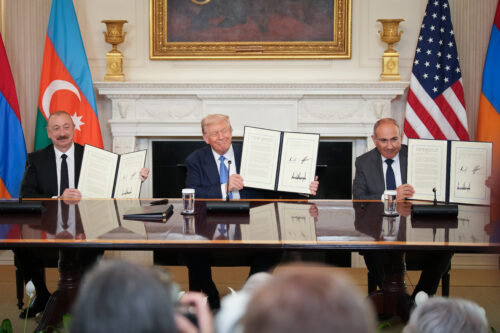
    President Trump’s family businesses are once again in the spotlight as a new financial disclosure showed they earned $2 billion in income in 2025 — a dramatic increase on the year before, with much of it coming from Gulf entities, raising emoluments concerns. Mounting perceptions of corruption, combined with unresolved crises in Iran and Israel-Palestine, are eroding trust among key partners in the Middle East. With the 2026 midterms approaching, these entanglements could represent a major political vulnerability and further undermine America’s already-strained standing in the region.

    Do the Gulf States Need a New Playbook?
  • Podcast
  • Do the Gulf States Need a New Playbook?

    After the US-Israel-Iran war — and the strikes that followed the cease-fire — the Gulf states find themselves dangerously exposed. Host Alistair Taylor is joined by MEI Associate Fellow Gregory Gause to discuss the war’s impact on the Gulf, their partnership with the United States, and whether the turmoil of recent months will push Gulf leaders to reassess their alliances and international engagement.

    July 2, 2026

    Additional Research & Commentary

    Backgrounders

    The Houthis
  • Backgrounder
  • The Houthis

    The Houthis are a political-military faction and Zaydi religious movement founded in northwestern Yemen in the 1980s. A key member of Iran’s Axis of Resistance with links to other militant organizations in the Arabian Peninsula and the Horn of Africa, the group has continued to pose a threat to Western interests on a global scale.

    May 15, 2026

    The Abraham Accords
    Photo by Alex Wong/Getty Images
  • Backgrounder
  • The Abraham Accords

    This backgrounder provides an overview of how the Abraham Accords came about, the US interests involved, their economic and strategic consequences, and the prospects for further enlargement going forward.

    November 17, 2025

    Turkish Foreign Policy
  • Backgrounder
  • Turkish Foreign Policy

    After a decade of post-Arab Spring isolation, Turkey’s leaders have recognized that their ambition to position the country as an agenda-setter on the world stage requires active engagement in all directions. President Recep Tayyip Erdoğan’s consolidation of executive authority has centralized foreign policy decision-making and tied it to his domestic political priorities, transforming the country’s revisionist approach to one shaped primarily by personal and pragmatic interests.

    April 23, 2026

    Western Sahara: Why the conflict still matters
  • Video
  • Western Sahara: Why the conflict still matters

    As the Western Sahara conflict reaches its fifth decade, the territorial dispute remains unresolved and largely unknown. MEI’s Intissar Fakir unpacks the Western Sahara’s complex history and the rival claims by Morocco and the Sahrawi Arab Democratic Republic. She examines recent developments, such as President Trump’s recognition of Moroccan sovereignty over the territory and the collapse of a 30-year cease-fire, as well as the core questions that remain unanswered after half a century.

    August 7, 2025

    Podcasts

    Middle East Focus

    MEI’s flagship weekly podcast on US foreign policy and contemporary political and social issues in the Middle East.

    Taking the Edge Off the Middle East

    MEI Senior Fellow Brian Katulis engages friends, colleagues, and policy experts in casual conversations on the most important happenings in the Middle East. 

    Rethinking Democracy

    MEI Senior Fellow Gonul Tol hosts leading scholars and thought leaders on global democracy trends and the state of the liberal international order. 

    Filter by
    8748 Results
    Egypt's Draft NGO Law: Impact and Implications
    Middle East Institute
  • Podcast
  • Egypt's Draft NGO Law: Impact and Implications

    The Middle East Institute is pleased to welcome Sarah Margon of Human Rights Watch and Nancy Okail of Freedom House for a timely discussion about the implications of Egypt’s controversial draft NGO law submitted for vote to the Shura Council last week. The law, which seeks to restrict the funding and operation of non-governmental organizations, is being slammed by human rights groups both inside Egypt and around the world as a blow to the free and full expression of Egyptian civil society.

    June 7, 2013

    Egypt's Draft NGO Law: Impact and Implications
    Middle East Institute
  • Podcast
  • Egypt's Draft NGO Law: Impact and Implications

    The Middle East Institute is pleased to welcome Sarah Margon of Human Rights Watch and Nancy Okail of Freedom House for a timely discussion about the implications of Egypt’s controversial draft NGO law submitted for vote to the Shura Council last week. The law, which seeks to restrict the funding and operation of non-governmental organizations, is being slammed by human rights groups both inside Egypt and around the world as a blow to the free and full expression of Egyptian civil society.

    June 7, 2013

    Egypt's Draft NGO Law: Impact and Implications
    Middle East Institute
  • Podcast
  • Egypt's Draft NGO Law: Impact and Implications

    The Middle East Institute is pleased to welcome Sarah Margon of Human Rights Watch and Nancy Okail of Freedom House for a timely discussion about the implications of Egypt’s controversial draft NGO law submitted for vote to the Shura Council last week. The law, which seeks to restrict the funding and operation of non-governmental organizations, is being slammed by human rights groups both inside Egypt and around the world as a blow to the free and full expression of Egyptian civil society.

    June 7, 2013

    Egypt's Draft NGO Law: Impact and Implications
    Middle East Institute
  • Podcast
  • Egypt's Draft NGO Law: Impact and Implications

    The Middle East Institute is pleased to welcome Sarah Margon of Human Rights Watch and Nancy Okail of Freedom House for a timely discussion about the implications of Egypt’s controversial draft NGO law submitted for vote to the Shura Council last week. The law, which seeks to restrict the funding and operation of non-governmental organizations, is being slammed by human rights groups both inside Egypt and around the world as a blow to the free and full expression of Egyptian civil society.

    June 7, 2013

    Malaysia: A Base for the Growing Asia-Middle East Market?
    Middle East Institute
  • Analysis
  • Malaysia: A Base for the Growing Asia-Middle East Market?

    With the shift in the direction of Gulf Cooperation Council (GCC) countries’ trade from the West to Asia and the emphasis on the “Islamic connection” by Malaysia and many of its Middle Eastern counterparts, Malaysia-GCC economic cooperation appears to be gaining momentum. Malaysia’s strategic location at the center of Southeast Asia and the need for as well as the apparent determination of Malaysia and the GCC countries to diversify their export markets could provide the impetus for this partnership to flourish.

    June 6, 2013

    NGOs Under Fire in Egypt
    Middle East Institute
  • Analysis
  • NGOs Under Fire in Egypt

    It was with customary gusto that Egyptian President Mohamed Morsi proudly announced that he had submitted his first draft law to the Shura Council under the new constitution that came into effect in December of 2012.

    June 5, 2013

    Security Challenges in a Two-State Solution: Is an International Role the Key?
  • Analysis
  • Security Challenges in a Two-State Solution: Is an International Role the Key?

    …in any peace agreement, the Palestinian area must be demilitarized. No army, no control of air space. Real effective measures to prevent arms coming in, not what’s going on now in Gaza. Israel must govern its own fate and security. (Prime Minister Benjamin Netanyahu, June 14, 2009)[1]

    June 4, 2013

    Interview with Indian Ambassador (ret.) Ranjit Gupta: Jeddah, Saudi Arabia ― The Second Posting (1976-1978)
    Middle East Institute
  • Analysis
  • Interview with Indian Ambassador (ret.) Ranjit Gupta: Jeddah, Saudi Arabia ― The Second Posting (1976-1978)

    Soon after arriving, I was surprised to find out from long-serving local staff at the Embassy and a few Indians who had resided in Saudi Arabia for more than three decades that I was the first non-Muslim Foreign Service Officer to serve in the Indian Embassy in Saudi Arabia.

    June 3, 2013

    What if al-Assad Prevails?
  • Analysis
  • What if al-Assad Prevails?

    This article was originally published on CNN’s Global Public Square blog on May 30, 2013.

    Let’s imagine a world in which Bashar al-Assad wins a military victory, remains in power, and defies the world to deal with him. Because, unfortunately, it appears to be an all too plausible scenario.

    May 30, 2013

    Gulf Research Council April 2013 Gulf-Asia Bulletin
    Middle East Institute
  • Analysis
  • Gulf Research Council April 2013 Gulf-Asia Bulletin


    The GRC’s April 2013 Gulf-Asia Bulletin, edited by Noriko Suzuki, contains the following short pieces:

    • On OSIPP-GRC Academic Cooperation by Toshiya Hoshino |04
    • Japan-Gulf Relations in the Wider Gulf-Asia Context by Makio Yamada |06
    • Japan and the Gulf: Balanced Business Relationship, and Thereafter by Yoshio Minagi |10
    • A General History of Kuwait-Japan Economic Relations from the 1950s to the 1970s by Takumi Sato |14

    May 30, 2013

    The Grand Sheikh and the President
  • Analysis
  • The Grand Sheikh and the President

    From Muhammad Ali to Mohamed Morsi, modern Egyptian leaders have understood that any attempt to control the state without the endorsement, if not blatant co-option, of key institutions such as al-Azhar is an ill-fated pursuit. The headache for President Morsi is that these institutions are trying to assert their independence and are presenting a range of direct and indirect challenges to his authority and, more broadly, to the Muslim Brotherhood and its political arm, the Freedom and Justice Party (FJP).

    May 29, 2013

    A Conversation with the FJP's Amr Darrag
  • Analysis
  • A Conversation with the FJP's Amr Darrag

    Amr Darrag is a senior member of the Muslim Brotherhood and a professor of engineering at Cairo University. He served as the head of the foreign relations committee of the Freedom and Justice Party and as secretary general of the constituent assembly that drafted Egypt’s new constitution in 2012. He was recently appointed Minister of Planning and International Cooperation.

    May 28, 2013

    Interview with Professor Selçuk Esenbel, Director of the Asian Studies Center, Boğaziçi University, Istanbul, Turkey
    Middle East Institute
  • Analysis
  • Interview with Professor Selçuk Esenbel, Director of the Asian Studies Center, Boğaziçi University, Istanbul, Turkey

    Although Turkey has a long history of continuing interaction with European intelligentsia, politicians and opinion makers, and also with the United States, there is very little experience and background with which to communicate with Asian countries. The Asian Studies Center is now recognized as the institution that can form viable academic connections and develop projects accordingly which will “bring the world to Turkey.”

    May 27, 2013

    Read the Middle East Journal

    The oldest peer-reviewed publication dedicated to the study of the modern Middle East, MEI’s flagship journal covers politics, society, and culture in the region.