Skip to Content

Research & Commentary

Read in-depth research, analysis, and commentary from MEI’s fellows and experts on the Middle East. 

Trump’s Family Business Deals Risk Further Undermining the Credibility of US Middle East Policy
  • Analysis
  • Trump’s Family Business Deals Risk Further Undermining the Credibility of US Middle East Policy

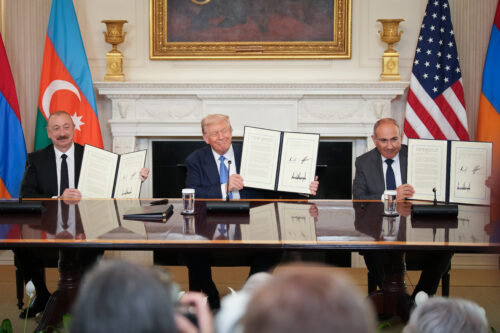
    President Trump’s family businesses are once again in the spotlight as a new financial disclosure showed they earned $2 billion in income in 2025 — a dramatic increase on the year before, with much of it coming from Gulf entities, raising emoluments concerns. Mounting perceptions of corruption, combined with unresolved crises in Iran and Israel-Palestine, are eroding trust among key partners in the Middle East. With the 2026 midterms approaching, these entanglements could represent a major political vulnerability and further undermine America’s already-strained standing in the region.

    Do the Gulf States Need a New Playbook?
  • Podcast
  • Do the Gulf States Need a New Playbook?

    After the US-Israel-Iran war — and the strikes that followed the cease-fire — the Gulf states find themselves dangerously exposed. Host Alistair Taylor is joined by MEI Associate Fellow Gregory Gause to discuss the war’s impact on the Gulf, their partnership with the United States, and whether the turmoil of recent months will push Gulf leaders to reassess their alliances and international engagement.

    July 2, 2026

    Additional Research & Commentary

    Backgrounders

    The Houthis
  • Backgrounder
  • The Houthis

    The Houthis are a political-military faction and Zaydi religious movement founded in northwestern Yemen in the 1980s. A key member of Iran’s Axis of Resistance with links to other militant organizations in the Arabian Peninsula and the Horn of Africa, the group has continued to pose a threat to Western interests on a global scale.

    May 15, 2026

    The Abraham Accords
    Photo by Alex Wong/Getty Images
  • Backgrounder
  • The Abraham Accords

    This backgrounder provides an overview of how the Abraham Accords came about, the US interests involved, their economic and strategic consequences, and the prospects for further enlargement going forward.

    November 17, 2025

    Turkish Foreign Policy
  • Backgrounder
  • Turkish Foreign Policy

    After a decade of post-Arab Spring isolation, Turkey’s leaders have recognized that their ambition to position the country as an agenda-setter on the world stage requires active engagement in all directions. President Recep Tayyip Erdoğan’s consolidation of executive authority has centralized foreign policy decision-making and tied it to his domestic political priorities, transforming the country’s revisionist approach to one shaped primarily by personal and pragmatic interests.

    April 23, 2026

    Western Sahara: Why the conflict still matters
  • Video
  • Western Sahara: Why the conflict still matters

    As the Western Sahara conflict reaches its fifth decade, the territorial dispute remains unresolved and largely unknown. MEI’s Intissar Fakir unpacks the Western Sahara’s complex history and the rival claims by Morocco and the Sahrawi Arab Democratic Republic. She examines recent developments, such as President Trump’s recognition of Moroccan sovereignty over the territory and the collapse of a 30-year cease-fire, as well as the core questions that remain unanswered after half a century.

    August 7, 2025

    Podcasts

    Middle East Focus

    MEI’s flagship weekly podcast on US foreign policy and contemporary political and social issues in the Middle East.

    Taking the Edge Off the Middle East

    MEI Senior Fellow Brian Katulis engages friends, colleagues, and policy experts in casual conversations on the most important happenings in the Middle East. 

    Rethinking Democracy

    MEI Senior Fellow Gonul Tol hosts leading scholars and thought leaders on global democracy trends and the state of the liberal international order. 

    Filter by
    8748 Results
    Women, Shari‘a, and Personal Status Law Reform in Egypt after the Revolution
    Middle East Institute
  • Analysis
  • Women, Shari‘a, and Personal Status Law Reform in Egypt after the Revolution

    Like almost everything else during the uncertain period of the transitional government, the future of personal status law reform is at a crossroads in Egypt. The new constitution (assuming one will exist)[1] may technically have little direct impact on how the country’s laws affect women’s lives, but the legislative process that emerges thereafter most certainly will.

    October 1, 2011

    Morocco’s “Arab” Spring
    Middle East Institute
  • Analysis
  • Morocco’s “Arab” Spring

    As elsewhere in North Africa and the Middle East, the youth-driven revolts in Tunisia and Egypt produced a tsunami in Morocco’s political landscape. On February 20, a movement took shape that publicly demanded a constitutional monarchy in which an elected and accountable government would have control over the country’s social, economic, and security policies. All across the country, it organized rallies in which tens of thousands of Moroccans participated.

    October 1, 2011

    “The Beginning of Arabia’s Spring:” The Khalid Revolution
    Middle East Institute
  • Analysis
  • “The Beginning of Arabia’s Spring:” The Khalid Revolution

    “Knowledge and freedom carry no national identity…. There is no nation that has known light and preferred receding back.”

    Ameen Rihani (The Rihani Essays, 421)

    October 1, 2011

    Tunisia Tests the Waters of Democracy
    Middle East Institute
  • Analysis
  • Tunisia Tests the Waters of Democracy

    Ten months after a young fruit seller set himself alight in a small, marginalized town in central Tunisia, his compatriots will be voting in what many are hoping will be the country’s first free and fair elections. In the poll set for October 23, Tunisians will be electing a national constituent assembly that will be charged with writing the rules of the new political era. That assembly will spend up to a year writing a new constitution and deciding which form of government the country will have.

    October 1, 2011

    Arab Countries: Dynamics of Change
    Middle East Institute
  • Podcast
  • Arab Countries: Dynamics of Change

    Join us for a discussion with Adel Abdellatif who, in his capacity as Chief of the UNDP's Regional Programme Division of the Regional Bureau for Arab States, oversees its flagship Arab Human Development Reports. Mr. Abdellatif will be discussing the dynamics of change in an Arab world undergoing seismic political transformations.

    September 30, 2011

    Yemen's Unhappy Ending
    Middle East Institute
  • Analysis
  • Yemen's Unhappy Ending

    This Commentary was first published as an op-ed in Foreign Policy’s “Middle East Channel” on September 27, 2011

    September 27, 2011

    Erdogan's Arab Spring Tour
    Middle East Institute
  • Analysis
  • Erdogan's Arab Spring Tour

    When President Obama met with Turkish Prime Minister Recep Tayyip Erdogan on Tuesday, the two discussed cooperation on Syria, counter-terrorism and supporting the Arab spring. But a central theme of the talks, and what most concerns the U.S. at the moment, is a sharply deteriorating Turkish relationship with Israel that the U.S. hopes to reverse. Conversely, this deterioration was the source of much acclaim when Erdogan visited Arab spring countries last week.

    U.N. Palestine Vote: Time to Exhale
    Middle East Institute
  • Analysis
  • U.N. Palestine Vote: Time to Exhale

    This article first appeared as an Op-Ed on Politico.com on September 19, 2011

    Palestinian President Mahmoud Abbas early this week will likely fulfill his longstanding vow to introduce in the U.N. Security Council a resolution to recognize Palestine as the 194th member state. No one should be the least bit surprised.

    September 19, 2011

    A View From the Gulf: A Discussion of Gulf Politics and Security
    Middle East Institute
  • Podcast
  • A View From the Gulf: A Discussion of Gulf Politics and Security

    The Middle East Institute is proud to host Gulf Research Center experts Abdulaziz Sager, Mustafa Alani, and Christian Koch for an examination of recent developments in the Gulf in the wake of the Arab Spring. The speakers will address the crises in Yemen and Bahrain, US-Gulf relations and the question of reform in the region.

    Speakers: Dr. Abdulaziz Sager, Dr. Mustafa Alani, Dr. Christian Koch, Amb. David Mack

    September 16, 2011

    Assessing Turkey's Moralpolitik
    Middle East Institute
  • Analysis
  • Assessing Turkey's Moralpolitik

    The release of last week’s UN Palmer Report, assessing Israel’s attack on the Mavi Marmara and five other ships carrying aid to Gaza, sparked outrage in Turkey. Many criticized the report’s alleged bias, and claimed it failed to provide a credible legal analysis of the Mavi Marmara incident in which nine Turkish citizens were shot to death by Israeli commandos, some at close range and from behind.

    Rebuilding Libya: A Status Report on the Humanitarian Situation on the Ground
    Middle East Institute
  • Podcast
  • Rebuilding Libya: A Status Report on the Humanitarian Situation on the Ground

    The Middle East Institute (MEI) and International Relief and Development will jointly host a discussion on the reconstruction of Libya following the fall of the Qaddhafi regime and the humanitarian dimensions of the rebuilding efforts. As the rebels root out the last of Qaddhafi royalists and regime strongholds, the question of Libya's future looms large.

    September 7, 2011

    Read the Middle East Journal

    The oldest peer-reviewed publication dedicated to the study of the modern Middle East, MEI’s flagship journal covers politics, society, and culture in the region.