This article is part of a collection of short essays written by the Fellows of the Middle East Institute to explore aspects of the ongoing war with Iran. The intent of the collection is to help readers see new and unexpected elements of the dynamics and impact of the ongoing hostilities and to think harder, deeper, and broader about the implications of the conflict. To read the other essays from this collection, as well as download the full report, please click here.
North African governments have sought to remain outside the US-Iran conflict, regardless of their differing alignments and preferences. Geography insulates them from the fighting, but not from the consequences. The region’s energy networks, maritime routes, and food supply chains, which generate opportunities in calmer times, are the same channels transmitting the war’s shockwaves now. That duality is the region’s predicament: what makes North Africa useful to others is what leaves it exposed. The region has become better connected faster than it has become economically resilient, leaving governments to absorb price, supply, and financial shocks generated elsewhere.
The war is not sorting the region into clear winners and losers. In Egypt, its impact has cut in opposing directions: Suez Canal revenue climbed as Gulf oil exports shifted toward Red Sea routes after the disruption of the Strait of Hormuz, even as foreign investors pulled billions from Egyptian treasury bills and bonds, weakening the pound and raising the cost of government debt. Algeria and Libya saw upsides they were not fully able to realize, as Europeans cut off from Gulf supplies turned to North African oil and gas. Algerian crude traded above $120 a barrel in April, giving Algiers leverage to renegotiate gas prices under long-term contracts. But higher prices also imposed costs on an economy and population exposed to imported inflation. Libya was able to capture the windfall from higher energy prices, but broader economic gains depend on greater political stability and export capacity the country has yet to achieve. Morocco’s OCP, the world’s largest phosphate exporter, illustrates the cleanest version of this duality. The United States suspended import duties to draw on Moroccan fertilizer as a substitute for disrupted Gulf supplies, even as OCP’s own production was squeezed by the loss of Gulf sulfur feedstock. The winners and losers were therefore delineated less by country than by supply chain. The gains and losses alike reveal dependencies transmitted through the very connections that North Africa has spent years building.
How the War Heightened North Africa’s Salience
The more important question is less which North African countries gained or lost from the war than what it revealed about the region’s strategic position, and which of those effects may outlast the conflict. The disruption of the Strait of Hormuz did not simply reroute more global trade through North Africa. It changed the relative value of alternative suppliers, routes, and infrastructure already in place. European states could turn more heavily to Algerian gas and Libyan crude; energy could move through alternative pipeline and maritime connections. The Suez Canal and SUMED pipeline, which carries crude across Egypt from the Red Sea to the Mediterranean, gained value as flows redirected; so did Moroccan fertilizer when Gulf supplies were cut off. North Africa cannot replace every route the war disrupted, but it can replace enough to count when buyers need a backup.
The Iran war has revealed how deeply North Africa is embedded in a wider system that stretches from the Gulf through the Red Sea and the Mediterranean to Europe and the Atlantic, encompassing trade, energy, physical infrastructure, and digital networks. As governments and companies search for alternatives to disrupted suppliers and routes, the assets the region already possesses become more valuable, and its exposure to external shocks becomes clearer. Both of these make it more consequential.
Bystanders?
North African governments approached the Iran war largely as outsiders. Some had little affinity for the Iranian regime; others worried about what they saw as Israel’s growing dominance. But what they shared was less a preferred outcome than an interest in staying clear of a conflict they could not influence but were economically exposed to. Their different relationships with the US, Israel, Iran, and the Gulf produced different diplomatic responses, but the basic calculus was the same.
The same pattern was visible during the 12-day war in June 2025. Algeria condemned the attack as a violation of Iranian sovereignty, in line with its longstanding policy of non-interventionism rather than support for Tehran. Libya condemned both sides, a balance that perhaps owed more to its fractured government than to principle. Morocco, Tunisia, and Egypt focused instead on condemning Iran’s retaliation against Qatar, reflecting which capitals were most invested in their Gulf relationships. That pattern has continued in the current war, as Iranian retaliation widened to other Gulf states.
North African governments have spent years trying to expand their room for maneuver by cultivating multiple partnerships. Morocco’s and Algeria’s relationships span the European Union (EU), the US, China, Russia, and the Gulf states. Egypt is similarly diversified; Tunisia and Libya have fewer resources to do so but still resist fixed alignment.
Nevertheless, cultivating more partners does not mean treating them all as equally important. Morocco’s diversification has not displaced the strategic value it attaches to the US or its substantial relationship with Israel. Algeria has built a different hierarchy while resisting dependence on any single partner. The value of diversification is primarily bilateral: it offers better bargaining positions with individual partners and reduces some political dependence. What it cannot do is shield these governments from shocks like the Iran war, to which they are economically exposed, even though none was a party to it.
North African economies depend on international markets and networks for food, energy inputs, transportation, finance, and technology. Europe is their largest economic partner, the Gulf states are important investors and sources of financial support, and their growing Asian trade depends in part on maritime routes through the Red Sea and, for some flows, through the Gulf.
The same tension increasingly applies to digital infrastructure. North Africa’s growing role as a landing and transit point for subsea cables linking Europe, Africa, and Asia increases the region’s strategic value but also exposes it to disruptions along the maritime corridor through which these connections run. This tension is particularly notable for Egypt, whose cable infrastructure forms a major transit point in the Red Sea and the Mediterranean, where conflict can threaten cable infrastructure and complicate access to repair vessels.
This creates a specific tension for North Africa. Governments increasingly seek strategic autonomy in their foreign relations while what they have to offer is connectivity — but that connectivity is also what leaves them exposed. It is a strength and a vulnerability they have not yet fully reconciled. They have heavily invested in improving their connections to regional and global markets without developing equivalent capacity to absorb the price volatility, the supply disruptions, and the financial shocks transmitted through stronger global market connections.
Connectivity Cuts Both Ways
North Africa’s strategic importance has traditionally been understood in terms of geography: its position between Europe and sub-Saharan Africa, its Mediterranean coastline, and its energy resources. Those still matter. But the region’s value increasingly derives from what governments have built. Similar geographical advantages can produce different degrees of influence depending on whether they were developed into networks and hubs or left as unrealized potential.
Egypt shows this gap most clearly. It collects tolls on traffic transiting the Suez Canal, and the closure of the Strait of Hormuz sent that revenue sharply higher, reaching $419 million in April 2026, the highest monthly level since early 2024. The value of Egypt’s infrastructure itself became clearer. Once the Strait of Hormuz was blocked, Saudi Arabia began moving oil through its East-West Pipeline to the port of Yanbu on the Red Sea to restore exports. In July 2026, after the Houthis announced their blockade of Saudi traffic through the Bab el-Mandeb, these exports were rerouted north to Suez and the SUMED pipeline at Ain Sukhna, further bolstering Egypt’s importance and revenues.
At the same time, the Egyptian economy struggled with rising fuel and food costs. Further limiting the government’s margin for maneuver, foreign investors sold Egyptian-pound treasury bills and bonds, withdrawing an estimated $5-8 billion from local financial markets. The episode exposed the vulnerability created by Egypt’s reliance on short-term foreign investment in pound-denominated debt. When geopolitical uncertainty prompted investors to exit, it put additional pressure on the pound and raised borrowing costs.
Benefiting from its pipelines to Europe, Algeria offered a quick supply source for EU partners when Gulf hydrocarbons became less accessible. Higher oil and gas prices increased export revenues and strengthened Algeria’s position with European buyers. But those same price increases also manifested in higher prices for goods, adding to inflation and fiscal pressures at home. The benefits for Algeria provided some cushion against the shock but did not entirely insulate the country from its impact.
Libya presents a different problem. It has comparable hydrocarbon reserves and proximity to Europe, but political fragmentation limits its ability to capitalize on increased European demand. The country’s vulnerability is less in its exposure through connectivity and more in its institutional weakness and the lack of adequate domestic development required to translate its resources into reliable economic gains.
The TransMed pipeline, which carries Algerian gas to Italy, runs through Tunisia, placing it within one of the energy corridors between North Africa and Europe. But that position has provided limited benefits during the war, as the terms governing the transit of Algerian gas are set through longer-term agreements. Meanwhile, higher energy and commodity costs have compounded Tunisia’s prolonged economic crisis. With even less fiscal space to absorb the costs of the war, Tunisia is more exposed to its downstream effects, without the benefits seen in other North African markets.
Morocco benefits from significant connectivity through its electricity grid and pipeline infrastructure. The kingdom is linked to Spain via two subsea electrical cables with a combined capacity of 1,400 megawatts (MW), which allows electricity to flow in both directions between the Spanish and Moroccan grids. The two countries agreed to a third connection in 2019 to expand that capacity. The value of these links became clear in April 2025, when Morocco sent nearly 900 MW north across the strait — close to the available transfer capacity at the time — to help stabilize Spain during a major country-wide blackout. The Maghreb-Europe Gas Pipeline, which once carried Algerian gas across the Mediterranean, now runs the other way, providing a flow of regasified liquefied natural gas to Morocco. But the conflict has not been a net gain for the kingdom. It remains heavily dependent on imported energy and food, which means disruptions are transmitted into higher domestic prices and costs, raising questions about the country’s overall resilience to repeated shocks.
Further, North Africa’s connections run outward toward Europe and global markets more than across the region itself. Political tensions and weak intra-regional links limit the extent to which national assets provide regional resilience. Individual states can still derive leverage from their infrastructure and geographic positions. But without stronger intra-regional connections those advantages cannot be maximized.
The Future of Chokepoints?
The lack of regional integration, however, does not diminish the strategic value of individual chokepoints and critical connections across North Africa. Alongside the Strait of Hormuz and the Bab el-Mandeb, the Suez Canal and the Strait of Gibraltar form an interconnected system linking global trade, but they are governed differently. The Suez Canal is a man-made waterway, and passage is guaranteed under a treaty, but Egypt owns and operates it and collects transit tolls. Cairo maintains and invests in the canal as a source of national revenue. The straits of Hormuz and Gibraltar, along with the Bab el-Mandeb, are natural waterways, where the generally applicable international legal regime protects transit and does not permit littoral states to simply impose transit tolls for passage. The Iran war has, of course, challenged this status.
Whatever the ultimate outcome of the war and its impact on the administration of the Strait of Hormuz, Iran has already demonstrated that disruption can create bargaining power over maritime chokepoints that did not exist before. While international legal standards have not changed, this experience creates the possibility that sufficient political pressure can force negotiations over arrangements once considered settled, a precedent that North African states have certainly noticed.
Morocco sits on the southern shore of one of the world’s busiest shipping lanes. Nothing suggests Rabat is preparing to toll or restrict transit in the Strait of Gibraltar, and international law forbids it. But the value of holding a sovereign position over a natural chokepoint looks different than it did before the Iran war, and the idea has already entered the Moroccan strategic discourse. In June, Professor Hamid Bouchikh, a former member of the commission on Morocco’s New Development Model, argued that if the international community tolerated fees at Hormuz, it would become harder to dismiss similar charges at Gibraltar. He proposed a carbon tax rather than a conventional toll. This does not represent Moroccan policy, but a concept that remains legally impermissible has nonetheless entered the strategic discourse because of a potential Hormuz precedent.
Leverage, Position, and Strategic Autonomy
The Iran war has given North African governments another demonstration of a broader shift already underway: as the international system becomes more transactional and fragmented, geography, connectivity, political alignment, and unresolved grievances become sources of leverage. North African states exposed to disruptions they cannot control have reason to look for every available means of protecting their interests and expanding their room to maneuver. The challenging part is to do so without creating additional vulnerabilities.
Morocco’s renewed emphasis on asserting sovereignty over the Spanish exclaves of Ceuta and Melilla on the North African coast offers a different example of this logic. The claims date to independence and the nationalist fervor around it; Rabat later pushed them into the background as other territorial priorities, particularly the Western Sahara, took precedence. Morocco would periodically revive the claims during crises with Spain. In 2026, that rhetoric intensified. Madrid’s wartime rupture with Washington, after Spain denied the US use of its bases and criticized the strikes on Iran, created an unusually favorable opening for Rabat. A mix of conservative US policy figures, an Israeli official, and nationalist Moroccan commentators began challenging Spain’s long-standing position that Ceuta and Melilla are integral parts of Spain. For some of them, the issue also offered a way to punish Madrid for its positions on Iran and Palestine. Morocco has historically raised the issue intermittently, more as a source of pressure on Spain than as a basis for a sustained diplomatic campaign, but the current tensions have created an opportunity to push the claim more forcefully.
None of this amounts to a change in US policy toward, or the legal status of, the exclaves. Morocco’s claims have gained no formal international recognition, but what is perhaps changing is the political receptivity to them abroad. All of this has created a convergence of circumstances in which Morocco can press for greater concessions, exert influence, and test how far external support can be pushed on issues important to Rabat. The kingdom has long understood the tools at its disposal: the value of its geography, cooperation on migration, security partnerships, and strategic relationships with the US and Europe. But this new crisis demonstrated that disruption, dependence, and political fragmentation can create bargaining opportunities — a lesson that is resonating beyond the Gulf.
Governments across North Africa are already seeking greater autonomy in their partnerships and favoring relationships that deliver tangible gains, and a more contested international environment may strengthen those tendencies. But leverage should not be confused with strength. A country can have strategically valuable infrastructure while remaining acutely exposed elsewhere, gain bargaining power while becoming more dependent on external investment, or diversify energy routes while creating new digital vulnerabilities. This will be one of the central challenges facing North Africa. The region is becoming more valuable to outside powers, but it remains to be seen whether that growing importance makes it more resilient as it expands its strategic autonomy, builds on the connectivity that makes it attractive, and learns to employ new sources of leverage.
Intissar Fakir is a Senior Fellow at the Middle East Institute, where she researches the politics and geopolitics of North Africa and the Sahel.
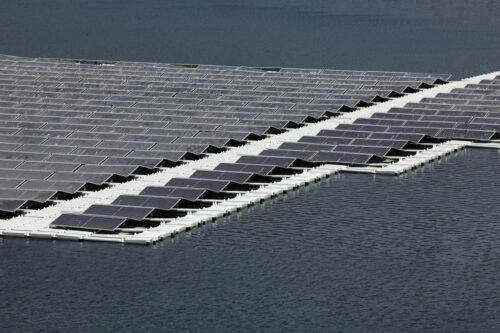
Top image: A floating photovoltaic solar installation in the reservoir at the Oued Rmel dam near the Tanger Med port in Morocco, on August 7, 2025. Photo by Abdel Majid Bziouat/AFP via Getty Images.
The Middle East Institute (MEI) is an independent, non-partisan, not-for-profit, educational organization. It does not engage in advocacy and its scholars’ opinions are their own. MEI welcomes financial donations, but retains sole editorial control over its work and its publications reflect only the authors’ views. For a listing of MEI donors, please click here.