This article is part of a collection of short essays written by the Fellows of the Middle East Institute to explore aspects of the ongoing war with Iran. The intent of the collection is to help readers see new and unexpected elements of the dynamics and impact of the ongoing hostilities and to think harder, deeper, and broader about the implications of the conflict. To read the other essays from this collection, as well as download the full report, please click here.
As the summer draws to a close, the storyline for the 2026 Iran war remains incomplete and the United States’ broader Middle East policy direction highly uncertain. None of the major issues that have long headlined Washington’s Iran portfolio — the Islamic Republic’s nuclear program, ballistic missiles, and support for international terrorism — appear any closer to resolution since the US and Israel started the war in February. New problems have emerged that did not exist before, like disrupted freedom of navigation in the Strait of Hormuz and renewed threats to shipping in the Red Sea from the Houthis in Yemen.
The US-Israeli campaign eliminated top leaders of the Islamic Republic and did considerable damage to its conventional military arsenal and nuclear program. But the same regime that has ruled Iran since the 1979 Islamic revolution remains in power — although with less predictable leaders at the very top. The broader regional security landscape, meanwhile, is more fractured than ever before, and there are increasing doubts about America’s reliability in the Middle East.
Widen the scope to the global landscape, and the opportunity costs of the 2026 Iran war for US foreign policy are even more apparent. Washington has expended considerable military resources and shifted time and attention away from other national security priorities, negatively impacting its global military readiness. In Europe, the Russia-Ukraine war rages on with no end in sight, and the link between the two conflicts continues to harden. Over the summer, Ukraine struck Russia-bound Iranian ships in the Caspian Sea, while Tehran has reportedly threatened US military bases in Europe if the war in the Gulf ramps back up.
At the same time, China, America’s greatest global strategic competitor, continues to expand its engagement around the world, all the while taking steps to limit the damage the Iran war is causing to its own economy. The US, in contrast, has had to divert military resources away from the Asia-Pacific region to prosecute the Iran war. Such sudden drawdowns and canceled or downgraded military exercises have raised new questions about long-standing security partnerships — not only among allies in Asia, like South Korea, but in Europe as well. And such questions have been exacerbated further by President Donald Trump’s repeated complaints that those countries did not help America deal with the Iran war’s fallout.
Add to this ledger the fact that the war in the Gulf has worsened economic pain in America and around the world, especially through spiking gasoline and food prices, which further degrade President Trump’s public support and complicate international political dynamics. For the moment, the Trump administration has opted to increase economic pressure on Iran, but it remains to be seen how this test of wills will play out and which side will prove it can absorb more economic pain without buckling.
Given all the uncertainty surrounding Trump’s Iran policy, it is difficult to draw definitive conclusions on the full implications of the war at this time; a wide variety of scenarios could yet emerge. The current trajectory is clearly unfavorable. In the Middle East, countries and non-state actors continue to test the limits of their power. Iran and its axis are weaker but less predictable. US partners continue to subtly hedge against America’s unpredictability, creating new arrangements like the recent Mecca Joint Defense Agreement among Saudi Arabia, Turkey, and Pakistan. The lack of resolution to the Palestinian-Israeli conflict remains a weak point in the stability of the region’s state system.
One already apparent impact of the 2026 Iran war on American foreign policy has been an increased risk that the US might accelerate its retrenchment from theaters across the world, for two main reasons: first, shifts in the global geopolitical landscape and how countries are responding to America; second, changes in America’s domestic political landscape heading into midterm elections. In some ways, the conflict and its aftermath could end up having a much greater long-term strategic effect on overall US foreign policy than the 2003 Iraq war did because of how much the world and America have changed since the early 2000s. In the more than two decades since that war, new centers of global power and influence have emerged to challenge the international system — namely, China’s steady rise on the global scene and Russia’s increasingly assertive efforts to undercut America and its North Atlantic Treaty Organization (NATO) allies in Europe.
But developments could also shift in the opposite direction, toward more optimistic outcomes. The Iranian regime is severely damaged and weakened, and the current economic blockade could force it to make concessions before the closure of the Strait of Hormuz does even greater damage to the global — and thus, also the American — economy. Such circumstances might even prompt the new Iranian leadership to agree to significant concessions on its nuclear program.
In another potential scenario, the Iranian people’s long-standing anger and frustration at the regime could boil over once again in the face of renewed economic pressure. The Islamic Republic has been waging war against its own people for decades, and Iranians have risen up in protest repeatedly, most recently at the start of this year. This could lead to a positive scenario where the Iranian people topple the regime, or it could lead to another brutal crackdown akin to January 2026. Wars are inherently unpredictable, and there is too much we do not know about what is going on inside Iran. If a regime-toppling uprising does happen, however, it would constitute a qualified win for the US, albeit less than was originally intended or promised. That said, the current trajectory should make us cautious about the likelihood of such a scenario.
One major unforced error the Trump administration has made in the 2026 Iran war is its ever-shifting rationales for military action and its spasmodic diplomatic efforts. These objectives have vacillated between changing the regime, empowering the Iranian people, achieving a new and better nuclear deal, degrading Iran’s conventional military capacities, and even, according to President Trump, complete civilizational destruction. The lack of a consistent end goal in the US policy approach on Iran has incentivized a debate that trends toward the operational and tactical, rather than the strategic, and likely confused the US administration and its regional partners over time.
No Major Strategic Gains for America in 2025-26
Since returning to office in January 2025, President Trump has rewritten the playbook of US foreign policy, implementing an unpredictable and unprecedented set of actions on the world stage. But more than a year and a half into Trump’s second term, his administration has had relatively little to show for it. The US president has succeeded in further pushing NATO allies to pledge higher levels of defense spending, and his harsh immigration policies at home and abroad have largely stemmed the flow of illegal immigrants into the country. America’s economy continues to grow despite being weighed down by Trump’s tariffs and the war’s inflationary impact. The president has not moved much closer to achieving most of his other major foreign policy goals, however, including ending the Russia-Ukraine war, fundamentally rewriting trade policies to benefit America’s economy, or achieving a lasting and comprehensive peace in the Middle East.
During the first 18 months of his second term, President Trump dedicated considerable time and attention to the Middle East, more than any US president has since Barack Obama came into office in 2009. There were some early gains from this involvement: he helped secure a cease-fire and the release of the last hostages in Gaza in October 2025, and his engagement in supporting Syria’s transition and Lebanon-Israel talks is a noteworthy bright spot in his Middle East policy.
Yet overall, the region is hardly more stable since Trump’s return to office. Furthermore, his erratic actions and statements on Iran have reinforced a long-standing crisis of efficacy in US foreign policy — successive American presidents have declared maximalist goals and repeatedly fallen short of achieving them. In the span of just a few short months during the 2026 Iran war, Trump and his team made statements that were not aligned with reality, variously claiming that America was implementing its own tolls in the Strait of Hormuz, that the strait was open and safe when it was not, and that the Iranian regime had accepted a deal when that was clearly not true. The president, top officials, and agency statements repeatedly contradicted one another on outlining a pathway to end the war. This volatility unsettled some of America’s closest partners, as did certain impulsive moves by Trump. For example, in mid-May, he posted on social media that he was “mandatorily requesting” that more countries join the Abraham Accords as a way to end the Iran war. None of those presumptive signatories, however, considered the timing or proposed formula right for proceeding with normalization with Israel, particularly as the Iran war had increased overall regional security threats and caused considerable economic damage to countries like Saudi Arabia.
The Trump administration’s inconsistent approach has instead incentivized some US Middle East partners to develop their own defense capabilities as part of a trend toward greater strategic autonomy and to diversify relations with other global and regional actors. This summer’s Saudi-Turkish-Pakistani Mecca Pact is the latest sign that countries are starting to move away from dependence on America’s security umbrella.
The US government’s inability to achieve the objectives it set for itself on Iran has also undercut regional and global perceptions about American effectiveness more generally. This is not a new dynamic: in the 2000s and 2010s, the US repeatedly fell short of achieving its stated goals in places like North Korea, Iraq, Afghanistan, and Syria. But what is different today is that the entire international system has fundamentally changed in large part due to the rise of countries like China and India, as well as the still mostly unmet challenges posed to the international order by Russia and Iran, among others. In the first quarter of this century, America had much more success in degrading terrorist adversaries like al-Qaeda and the Islamic State than it did in meeting challenges from state adversaries and competitors.
Today’s multipolar global system is complicated by the emergence of new power centers and characterized by the use of asymmetric force by weaker state actors like Iran to undercut leading powers like the US. All of this makes the margin for error in US foreign policy smaller than it was two decades ago, when China, Russia, India, and other growing regional powers were not the factors that they are today. President Trump is less capable of bending the will of the world toward his agenda than Presidents George W. Bush and Barack Obama were — moreover, Trump’s “America First” unilateralism and use of “troll power” incentivize countries to go their own way rather than cooperate with America’s policies.
In essence, these geopolitical shifts, combined with Trump’s unique style of statecraft, make it more difficult for Washington to produce lasting outcomes in the world — particularly in places like the Middle East already facing long-standing conflicts. As President Trump grows increasingly frustrated with the lack of tangible results in the region, he is likely to pull back and spend less time and energy on solving problems his own policies created or exacerbated — one of the reasons why Trump signaled earlier this summer that he was going to try a more “low key” approach on Iran.
This path toward US retrenchment from the Middle East was prefigured by national security and defense strategy documents the Trump administration released on the eve of the 2026 war. The inclination to move away from the Middle East was also a feature in certain episodes of the Obama and Biden administrations, when they tried to prioritize other regions like Asia or problems closer to home. Because the 2026 Iran war did not go the way President Trump had hoped, extending well past the four to six weeks he initially predicted, the Pentagon is now examining ways to cut its losses and reduce the risks associated with US troop deployments in the Middle East — including evaluating a smaller American military presence. Iran’s use of asymmetric force and the damage it has done to US military bases and diplomatic sites have already prompted some voices to call for a rethink of America’s positioning in the region.
Events in the Middle East will shape how Washington proceeds on all of these questions. But the broader point is that the incomplete results of the Iran war, coupled with how the broader world has reacted to Trump 2.0’s foreign policy, increase the chances that the incentives for America to pull back from the Middle East and key parts of the world will multiply.
The American Public Is Divided, Confused, and Disengaged From Foreign Policy
Just weeks before the 2026 midterm elections, voters remain mostly disengaged from foreign policy, including on issues in the Middle East like Iran. Their main concerns are closer to home — and in instances where higher gas and food prices are understood to be linked to the war, voters are strongly negative and critical of how the Trump administration began and has handled the conflict.
Despite this broad discontent, the political and policy environment has not produced a clear strategic alternative for US policy on Iran or the broader Middle East in America’s discourse in the same way that the discontent with the Iraq war 23 years ago produced a political alternative that was easily understood by most voters. This is largely due to the way that President Trump made his case to the American public about the conflict — he offered a mix of confusing and contradictory rationales that were often not connected to facts and reality. The Iran war was as unpopular at its start as the Iraq and Vietnam wars were at their conclusion, and the haphazard way Trump conducted the military campaign and diplomacy has soured Americans on the Middle East overall. Adding to this confusing mix have been divisions within the Trump administration: namely, between Vice President JD Vance, who favors less military action and more diplomatic accommodations with Iran, and Secretary of State Marco Rubio and others, who reportedly favor a more hardline approach.
The main political opposition, the Democratic Party, has failed to provide much in the way of a clear alternative vision or theory of victory beyond tactical and operational criticisms related to the Trump administration’s conduct of the war. Even at the height of voters’ concerns about gas and food price hikes caused by hostilities in the Gulf, Democrats in Congress and candidates in primary election battles mostly ignored the Iran war. Instead, they shifted the focus to the US-Israel relationship and the Israel-Hamas war in Gaza. Within the party and among voices who served in recent Democratic administrations, recycled arguments from two decades ago counsel that the US should simply throw up its hands and abandon the Middle East; however, none of these proposals seem to be taking root or gaining wider resonance — nor are any of them responsible or feasible given the persistence of American vital interests in the region.
The overarching factor is that the American public is not deeply engaged with the Middle East and lacks the appetite for a larger commitment to resolve many of the problems there, even if those problems directly impact their lives through higher energy and food costs. This attitude owes much to domestic political and ideological divisions exacerbated by leaders who fail to build a national consensus or stakeholder coalitions around clear foreign policy initiatives toward strategically important places like the Middle East. This makes America’s policy and political debates ripe for even greater discord and division, which are in turn stoked by foreign actors using sharp power, a method of influence employed by authoritarian governments to manipulate the political and information environments of democratic nations. No matter which party wins the 2026 midterm election, neither is likely to achieve decisive control over the full apparatus of government, let alone influence over public opinion, meaning persistent divisions within America’s political system and a lack of consensus on its foreign policy direction will continue for at least the next two years.
A Viable Alternative to the Current Course
This present course — one that increases the risks that the US pulls back from the Middle East and the world because of changes in the international system and American domestic politics — is unlikely to produce greater stability, peace, and prosperity. An alternative pathway can be constructed for US policy in the Middle East — one that builds on the long-standing military and diplomatic partnerships Washington has continued to foster in the region.
This proposed track has three main components:
1. Build stronger and more cohesive regional military, diplomatic, and economic coalitions. One of the longer-term US investments in the region over the past decade was to promote greater military and security integration between and among America’s close partners. These investments in interoperability and coordination remain incomplete, but the benefits came into focus when several US partners supported each other against Iranian aggression amid exchanges of fire between Iran and Israel in 2024 and the wars of 2025 and 2026.
The US should extend this operational model from the military arena to the diplomatic and economic realms — seeking to promote regional economic and energy cooperation that advances resilience in the face of varied threats as well as supports greater connectivity with the global economy. This requires a major shift away from the militarization of US foreign policy in the Middle East that occurred over the past quarter century, instead prioritizing diplomatic engagement with key partners to develop shared strategies. Above all, America should stop reflexively resorting to “strikes without strategy,” which have become all too common across several US administrations. The key to stronger regional coalitions that support US interests is greater diplomatic and economic coordination with partners who can serve as force multipliers.
2. Support efforts to strengthen weak states and promote economic prosperity. Another centerpiece of the struggle for stability in the Middle East is found in countries like Syria and Lebanon that are in the middle of historic yet still uncertain transitions aimed at rooting out extremism and corruption to give more voice to their people. US support for these nascent transitions will be crucial to success — as will working in close coordination with regional partners, as outlined above. Progress in Palestine is a key component of this effort to help strengthen the regional state system; the current US policy requires a major course correction that lifts up the voices of the Palestinian people and helps improve their lives through better governance and a stronger emphasis on basic freedoms.
3. Build coalitions on the domestic front in America. For American policy in the Middle East to become more consistent, US leaders on both sides of the aisle should stop treating the region as a partisan wedge issue. They must instead look for ways to build a stronger foundation for US engagement across ideological lines. One of the key lessons for US foreign policy from the last quarter century is that the harsh partisan and ideological divisions within the US on issues like Israel, Palestine, and Iran end up being a strategic vulnerability because America’s global adversaries and competitors exploit them to gain advantage.
Each of the above elements of this new policy course will require a steadier, more strategic diplomatic approach than the one the second Trump administration has embarked on. But working together to build a common agenda with like-minded partners in the region is more likely to produce long-term results that reduce the burden on the United States while increasing the chances for a more stable and prosperous Middle East.
Brian Katulis is a Senior Fellow at the Middle East Institute.
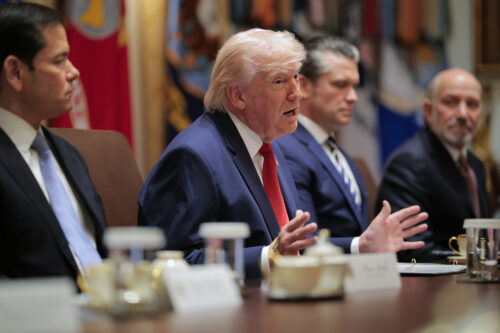
Top image: President Donald Trump speaks during a Cabinet meeting at the White House on March 26, 2026, in Washington, DC. Photo by Chip Somodevilla/Getty Images.
The Middle East Institute (MEI) is an independent, non-partisan, not-for-profit, educational organization. It does not engage in advocacy and its scholars’ opinions are their own. MEI welcomes financial donations, but retains sole editorial control over its work and its publications reflect only the authors’ views. For a listing of MEI donors, please click here.
Yemen: The Houthis’ Role in the Next Evolution of the Axis of Resistance
US Regional Defense Policy: Strategic Prioritization and the Promotion of Collective Defense