Turkey’s Nuclear Ambitions in the Post-Iran War Environment
September 10, 2026
Share
In early February 2026, Turkish Foreign Minister Hakan Fidan suggested that shifting international dynamics could push Turkey to acquire nuclear weapons, reigniting a decades-old debate in the West over Ankara’s nuclear ambitions.
American worries about Turkish ambitions to develop nuclear weapons are not new. As early as 1966, a secret memorandum by Clarence Wendel, the US minerals attaché at the US Embassy in Ankara, raised the possibility that Turkey was positioning itself to pursue nuclear weapons. Wendel pointed to several developments, including: “‘repeated Turkish assertions that a 200 mega-watt nuclear reactor is planned for Istanbul’; the stockpiling of reserves of 300 to 600 tons of uranium in low-grade ore deposits; and the ‘delaying and haggling tactics of the Turkish negotiators’ during negotiations over a bilateral peaceful nuclear cooperation agreement, which primarily concerned the transfer of safeguards responsibility from the USA to the International Atomic Energy Agency [IAEA].’”
The US ambassador at the time did not believe Turkey was bent on going nuclear, but he considered the possibility that Ankara was preparing a contingency plan in case a nuclear arms race gained momentum in the region. In the decades that followed, however, Turkey emerged as a strong advocate of nonproliferation. It joined the international legal framework for nuclear security through the Nuclear Non-Proliferation Treaty (NPT) and, later, the Additional Protocol; beyond these formal commitments, Turkish policymakers defended nonproliferation norms across international platforms, promoted a nuclear-weapons-free region, and called for global nuclear disarmament.
That is changing. Foreign Minister Fidan’s recent remarks are only the latest in a series of public statements in which President Recep Tayyip Erdoğan and other Turkish officials have increasingly challenged nonproliferation norms and even hinted at an interest in acquiring nuclear weapons. That rhetoric, combined with Turkey’s civilian nuclear energy and research programs and its indigenous surface-to-surface missile development projects, has fueled concerns that these capabilities could eventually form the backbone of a Turkish nuclear weapons program.
Although Turkey remains far from possessing the technical capabilities needed for a nuclear weapons program and its national interests continue to favor nuclear restraint, the shift in policymakers’ rhetoric suggests a broader change in Ankara’s thinking. This shift has been particularly pronounced since the failed coup attempt against Erdoğan in 2016. But the changing regional and global security environment is further strengthening both the motivations and the rationale for Ankara to move away from its longstanding role as a champion of nonproliferation and toward a strategy of nuclear hedging — one that preserves the option to build nuclear weapons without actually pursuing them — by laying the technological and institutional groundwork that would make weaponization easier and faster should circumstances change.
Turkey’s Changing Stance on Proliferation
For decades after Turkey first articulated its nuclear weapons policy in 1959, Ankara showed little interest in developing nuclear weapons of its own. Turkey’s reluctance to pursue the bomb can be explained by three factors: its desire to maintain strong ties with the West and cultivate its image as a “good international citizen”; its belief that the North Atlantic Treaty Organization’s (NATO’s) nuclear umbrella provided the most effective deterrent against both adversaries and regional proliferation; and its faith in the international nonproliferation regime as a means of preventing the spread of nuclear weapons.
Despite periodic tensions and repeated ups and downs in its relationship with the United States, Turkey continued to value its NATO membership and hosted US nuclear weapons deployed under NATO auspices. As Ankara’s relationship with the West acquired an additional dimension through its pursuit of European Union membership, its commitment to the international nonproliferation regime grew stronger. Even as Iran’s nuclear program emerged as a major concern for the US and countries across the region, Ankara continued to believe that diplomacy offered the best means of addressing the Iranian nuclear challenge.
These preferences were reflected in Turkey’s formal commitments to the international nonproliferation regime. Turkey ratified the NPT in 1980, formally committing itself to remain a non-nuclear-weapon state. The following year, it brought into force a Comprehensive Safeguards Agreement with the IAEA, placing its nuclear material and activities under international verification. Ankara further strengthened those commitments by signing the IAEA Additional Protocol in 2000, which gave the agency broader authority to verify the absence of undeclared nuclear material and activities. Turkey has also joined other pillars of the international nuclear regime, including the Comprehensive Nuclear-Test-Ban Treaty and the Convention on the Physical Protection of Nuclear Material, firmly embedding itself in the international nonproliferation and safeguards architecture.
Beyond its formal commitments to the international nonproliferation regime, Ankara played an active role in defending nonproliferation norms. Turkey often criticized what it saw as the West’s double standards — tolerating the nuclear programs of India, Pakistan, and Israel while taking a much harder line toward Libya, Iraq, Iran, and North Korea. Ankara also defended NPT members’ right to enrich uranium and suggested that Turkey could pursue enrichment if needed for its civilian nuclear program.
Yet until 2016, Turkish policymakers consistently advocated a nuclear-weapons-free Middle East and, later, broader global nuclear disarmament. When pressed, they categorically denied that Turkey had either the intention or the capability to develop nuclear weapons. While serving as prime minister, Erdoğan captured Ankara’s position in a 2009 speech, as Western pressure over Iran’s nuclear program was mounting. Turkey, he said, was “completely against nuclear weapons in the Middle East,” while criticizing what Ankara saw as a double standard: “There are countries with nuclear weapons in the Middle East, for example Israel. There is a difference: Israel is not a member of the IAEA; Iran is a member.” In 2013, Foreign Minister Ahmet Davutoğlu struck a similar note at an international conference in Istanbul attended by Iranian Foreign Minister Javad Zarif, saying, “WMD [weapons of mass destruction] are a crime against humanity, wherever [they are], by whomever they are owned, for whichever cause they are used.” Davutoğlu called on the international community to adopt a unified stance against nuclear weapons, reiterated Turkey’s commitment to a nuclear-weapons-free Middle East, and stressed that Ankara would never embrace rhetoric that ran counter to the principle of nonproliferation.
In 2014, Turkish officials categorically rejected allegations that Ankara was pursuing nuclear weapons. Responding to a controversial September 21 Die Welt article claiming that Erdoğan was overseeing a secret weapons program and had already obtained uranium-enrichment centrifuges from Pakistan, Turkey’s energy minister insisted that the country had neither the intention nor the capability to build a nuclear weapon. A year later, Foreign Minister Mevlüt Çavuşoğlu reiterated that Turkey had never sought nuclear weapons and opposed their acquisition by Iran — or by any other regional state, implicitly including Saudi Arabia, Egypt, and Israel.
The 2016 coup attempt marked a turning point in the Turkish government’s public rhetoric on nuclear nonproliferation. It came against the backdrop of a deteriorating security environment in Turkey’s immediate neighborhood and growing tensions with its NATO allies, particularly the United States. The war in Syria had sharply heightened Ankara’s sense of vulnerability. Washington’s partnership with the Kurdistan Workers’ Party (PKK)-linked Syrian Kurdish militia against the Islamic State (ISIS) had strained US-Turkish ties, while Russia’s retaliation after Turkey shot down a Russian jet in late November 2015 intensified Ankara’s security concerns. NATO had deployed Patriot batteries to Turkey in early 2013, at Ankara’s request, as the Syrian civil war intensified. But in August 2015, the US and Germany announced they would pull their batteries out, leaving only the Spanish battery that had replaced a Dutch one earlier that year. Berlin’s reasoning was that the main regional threat was now ISIS, which had no missiles. Erdoğan, fearing Russian retaliation after Moscow deployed advanced air-defense systems to Syria, urged them to stay. In the end, although the Spanish battery remained, the US and Germany went ahead with the withdrawal, reinforcing doubts in Ankara about whether it could count on NATO in a crisis.
The failed coup deepened those doubts. Erdoğan complained that the Obama administration had been slow to condemn the coup attempt and repeatedly criticized Washington for hosting religious leader Fethullah Gülen, whom he accused of masterminding it. Erdoğan’s rhetoric on nuclear weapons began to shift. In 2017, he acknowledged that nuclear weapons were contrary to Islam but added that “unfortunately the power war in the world requires [you] to have such weapons, even if you don’t want to.” By 2019, his language had become more explicit: At a Justice and Development Party meeting in Sivas where Erdoğan praised advances in Turkey’s indigenous defense industry and the country’s decreasing dependence on Western security, he said, “Some countries have missiles with nuclear warheads, not one or two. But [they tell us] we cannot have them. This, I cannot accept.” He went on to say, “There is no developed nation in the world that does not have them. All of them have it,” later adding, “We are working on this.”
A Changing World Fuels Turkey’s Nuclear Rethink
The dynamics of the Iran war appear to have reinforced the rationale for Turkey’s changing stance on nuclear weapons. Turkish officials interviewed by the author believe that the new Iranian leadership that emerged after the US and Israeli attacks on February 28, 2026, is more likely to pursue nuclear weapons than its predecessors, whom Ankara regarded as more risk-averse and restrained when it came to weaponization. Although Turkey’s relationship with Iran has historically been less conflict-ridden than those of the Gulf states, Ankara still sees a nuclear-armed Tehran as a serious security threat — and one that could trigger a regional nuclear arms race.
In interviews, Turkish diplomats have pointed to the missiles Iran fired toward Turkey during the war as evidence of this new danger. NATO intercepted the missiles, and although Iran denied firing them, officials repeatedly suggested that Tehran was behind the attacks. Many in Ankara had assumed that Iran would never take such a risk against a NATO member. The attacks challenged that assumption, reinforcing the view that an Iranian regime fighting for its survival might take risks previously considered unthinkable.
A second development heightening Turkey’s concerns is the rise of an increasingly aggressive — and, in Ankara’s view, reckless — Israel. Israel has long maintained a policy of deliberate ambiguity about its nuclear arsenal, an approach successive US administrations have effectively supported. For Turkey’s ruling elite, threats by an Israeli minister to use nuclear weapons in Gaza not only amounted to a rare public acknowledgment of Israel’s nuclear capability but also underscored the risks of preserving a regional nuclear imbalance. In Ankara’s view, such rhetoric could give other states greater incentive to seek their own deterrent. And by continuing to support Israel even when its officials invoked the potential use of a nuclear weapon, the US reinforced a grievance Turkey has voiced for decades: that the global nonproliferation regime applies one standard to Israel and another to its regional rivals.
Another recent development that, in the eyes of Turkey’s ruling elite, lends weight to Ankara’s shifting rhetoric is the US-Saudi nuclear deal, which the administration sent to Congress in late August. The deal would open the door to uranium enrichment on Saudi soil without giving it an unequivocal green light, pending the conclusions of a joint US-Saudi study on the economic viability of such a program. The agreement marks a departure from the “gold standard” of US civilian nuclear cooperation — a legally binding commitment under a Section 123 agreement to forgo domestic uranium enrichment and spent-fuel reprocessing, as the United Arab Emirates agreed to do in its 2009 nuclear cooperation agreement with the US.
Ankara sees the agreement as another indication that regional states are becoming more serious about keeping a nuclear weapons option open. Just as importantly, the fact that Washington is facilitating the program suggests to Turkish officials that the US itself is relaxing its stance on nonproliferation.
This shift comes as Ankara, like many US allies, increasingly questions Washington’s reliability. The Iran war has reinforced a perception in Turkey that the US is becoming more willing to take major military risks in the region without sufficient regard for the security interests of its allies. Similar anxieties are increasingly visible beyond the Middle East, strengthening Ankara’s sense that the nuclear landscape itself is changing. Fears that Washington could retreat from longstanding security commitments have fueled nuclear debates among several US allies. Polish President Karol Nawrocki, for instance, has argued that Poland should pursue a strategy “based on nuclear potential,” while prominent South Korean politicians have advocated developing “nuclear latency” with an eye toward preserving the option of eventually acquiring nuclear weapons. Finland’s parliament, meanwhile, recently amended the country’s nuclear-energy legislation to remove a categorical prohibition on nuclear weapons. From Ankara’s perspective, these developments reinforce a broader conclusion: as confidence in US security guarantees erodes and nuclear hedging becomes increasingly normalized, Turkey has more reason to reconsider its own longstanding restraint.
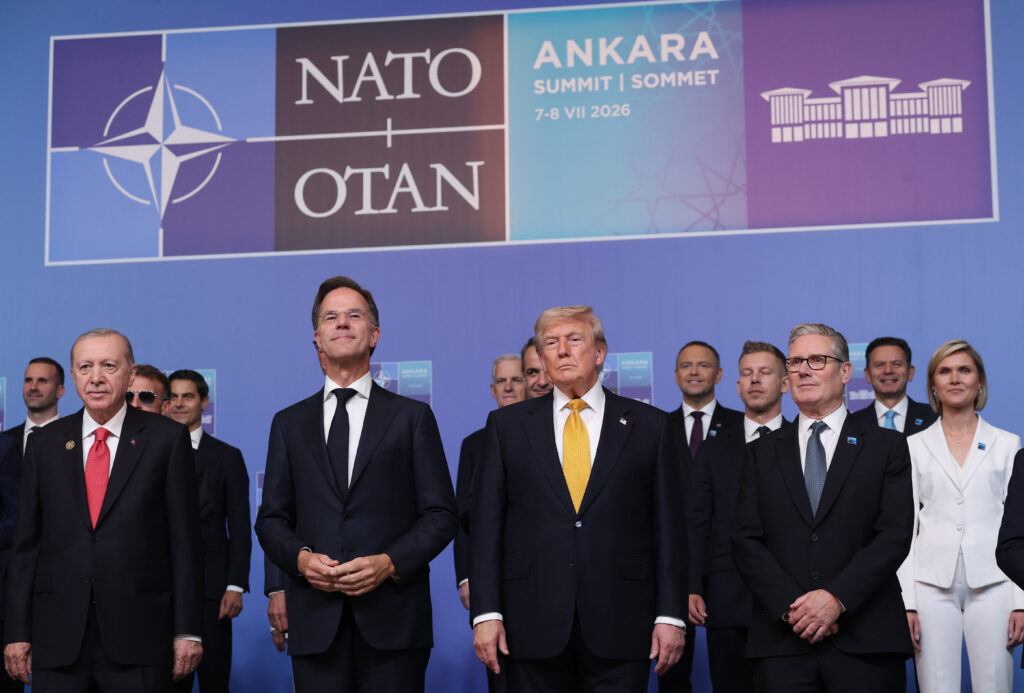
President Recep Tayyip Erdoğan of Turkey, NATO Secretary General Mark Rutte, President Donald Trump, and UK Prime Minister Keir Starmer, pictured during a welcome ceremony for the NATO Summit on July 8, 2026, in Ankara, Turkey. Photo by Win McNamee/Getty Images.
Three Scenarios for Turkey’s Nuclear Future
1. Relying on NATO Alone
Since joining NATO in 1952, Turkey has relied on the alliance, and particularly the United States, for extended nuclear deterrence. It is also one of five NATO countries that host US tactical nuclear weapons, with B61 bombers stationed at Incirlik Air Base. These nuclear weapons remain under strict American custody and control, including the codes required to arm them. The storage facilities at the base have been repeatedly upgraded and modernized, but tensions between Ankara and Washington and periodic regional instability have fueled recurring speculation that the weapons could eventually be moved out of Turkey.
For Ankara, NATO membership and the US nuclear umbrella have long been pillars of Turkish security policy. During the Cold War, Turkey particularly valued the deterrence provided by US nuclear weapons against the Soviet Union. Yet its experience with NATO has also generated persistent doubts about the reliability of allied security guarantees. The 1974 US arms embargo following Turkey’s intervention in Cyprus and NATO’s reluctance to meet Ankara’s requests for alliance-backed missile defenses during the first Gulf War raised questions about how unconditional the treaty’s Article 5 protection really was. More recently, the Iran war and America’s cancellation of the F-35 sale to Turkey, combined with President Donald Trump’s threats to withdraw from NATO and his broader unpredictability regarding US commitments, have reinforced Ankara’s concerns. Turkish officials worry they cannot always assume Turkey’s security priorities will be shared, or defended, by its allies.
Ankara’s exclusion from the F-35 program has not only widened this trust gap but added an operational dimension to those doubts. Turkey had planned to acquire at least 100 F-35As, which are certified to carry the modernized B61-12 nuclear bomb — and could have been expected to do so in a nuclear war under NATO’s nuclear-sharing strategy. After Washington expelled Turkey from the program over its purchase of the Russian S-400 missile defense system, Ankara was left without the fifth-generation aircraft it had expected to assume this role, making Turkey the only nuclear-sharing NATO member that is not transitioning to the F35s. Unless Turkey acquires another nuclear-certified aircraft, a lengthy and politically complicated process, it risks being reduced from an active participant in the nuclear-sharing mission to merely a host for US nuclear weapons. In that case, Turkey would have to rely on US aircraft based elsewhere in Europe to deliver the nuclear weapons stationed on its territory, since no US aircraft capable of doing so are permanently deployed at Incirlik Air Base. All these factors make relying solely on NATO for nuclear deterrence increasingly less appealing to Ankara.
2. Making a Run for the Bomb
Although the expansion of nuclear energy, increased access to nuclear-capable delivery systems, advances in enabling technologies, and greater availability and production of fissile material have made it easier and cheaper for states to reach nuclear-threshold status — and ultimately develop nuclear weapons if they choose to do so — going nuclear remains a risky undertaking. Most states that have considered acquiring nuclear weapons ultimately stopped short or reversed course. A small number, including India, South Africa, Pakistan, North Korea, and Israel, chose to cross the threshold. For Turkey, particularly at this juncture in its relations with NATO and its neighbors, the risks of following that path may be especially high.
After years of tensions with NATO allies and regional powers, Turkey has taken significant steps to repair those relationships. The shift reflected a growing recognition in Ankara that it cannot afford isolation in the Middle East or prolonged estrangement from its Western allies.
Following the Arab uprisings in the early 2010s, Turkey departed from its longstanding preference for preserving the regional status quo and avoiding intervention in its neighbors’ domestic affairs. Ankara instead backed forces seeking to overturn authoritarian regimes, providing diplomatic and, in some cases, military support to Islamist actors. The policy triggered a strong backlash from regional governments and contributed to Turkey’s growing isolation. Turkish officials initially portrayed that isolation as “precious loneliness,” but the economic and strategic costs eventually became difficult to sustain. As Turkey’s economy increasingly needed foreign investment — particularly from the wealthy Gulf states — Ankara shifted away from a militarized regional policy toward one emphasizing diplomacy, economic ties, and regional infrastructure integration. The rapid growth of Turkey’s defense industry provided another incentive to deepen cooperation with regional partners.
Similar pressures encouraged Ankara to repair relations with its NATO allies. Turkey’s acquisition of the Russian S-400 air-defense system triggered US sanctions on its defense sector and its removal from the F-35 program, underscoring the costs of estrangement from the West. Ankara’s need for Western investment, technology, and defense-industrial partnerships gave it strong incentives to rebuild those relationships as well.
Turkey today has a considerable stake in maintaining workable relations with both Western and Middle Eastern partners. Pursuing a nuclear weapons program — whether openly or covertly — would put those hard-won gains at risk. It could once again isolate Turkey from precisely the countries whose investment, technology, markets, and defense cooperation Ankara has spent years trying to secure. Therefore, Ankara is highly unlikely to pursue this path.
3. Moving Toward Nuclear Hedging
A shift toward nuclear hedging* is the most likely path for Ankara. Hedging is a deliberate strategy of preserving the option to build nuclear weapons without actually pursuing them. A hedging state lays the technological and institutional groundwork that would make weaponization easier and faster if strategic circumstances were to change. Its position on acquiring the bomb is essentially “maybe”: not now, but potentially in the future.
This often involves developing capabilities that serve legitimate civilian purposes but could later support a weapons program, particularly control over sensitive parts of the nuclear fuel cycle. Uranium enrichment and spent-fuel reprocessing are especially important because they can provide pathways to weapons-grade uranium or plutonium and shorten the time required to produce a bomb. Hedging, however, is not synonymous with nuclear latency. Latency describes a state’s technological capacity; hedging implies a political choice to cultivate capabilities that preserve a future weapons option while stopping short of weaponization.
The emphasis on “political choice,” rather than technical constraints, is important. A state’s proliferation strategy is rarely driven by resource constraints alone. Nor is the choice simply between possessing nuclear weapons and forgoing them. States have a spectrum of options in between, from technical hedging to seeking nuclear-threshold status to pursuing a full weapons capability. Understanding where a state falls on this spectrum therefore requires first examining how its ruling elites view nuclear proliferation.
This is why understanding the evolution of Erdoğan’s views matters. Of course, it is difficult to reach a definitive conclusion about Ankara’s intentions based solely on publicly available information. But Erdoğan’s increasingly assertive rhetoric, coupled with the foreign minister’s recent suggestion that international developments could compel Turkey to acquire nuclear weapons and changes in its security environment, points to a possible hedging strategy — one in which Ankara maintains strategic ambiguity about its intentions while keeping the nuclear option open. It avoids the potential break with the US and NATO involved in making a run for the bomb but gives Ankara more of a unilateral alternative if its alliance partners continue to disappoint, or abandon it altogether.
Nuclear hedging exists on a continuum. At one end is technical hedging, its most limited form; at the other is nuclear threshold status, its most advanced form, in which a state has accumulated the capabilities necessary to produce at least one nuclear explosive device within roughly three to six months of deciding to do so. To better understand where Turkey may fall on this spectrum, it is important to assess its capabilities based on publicly available information.
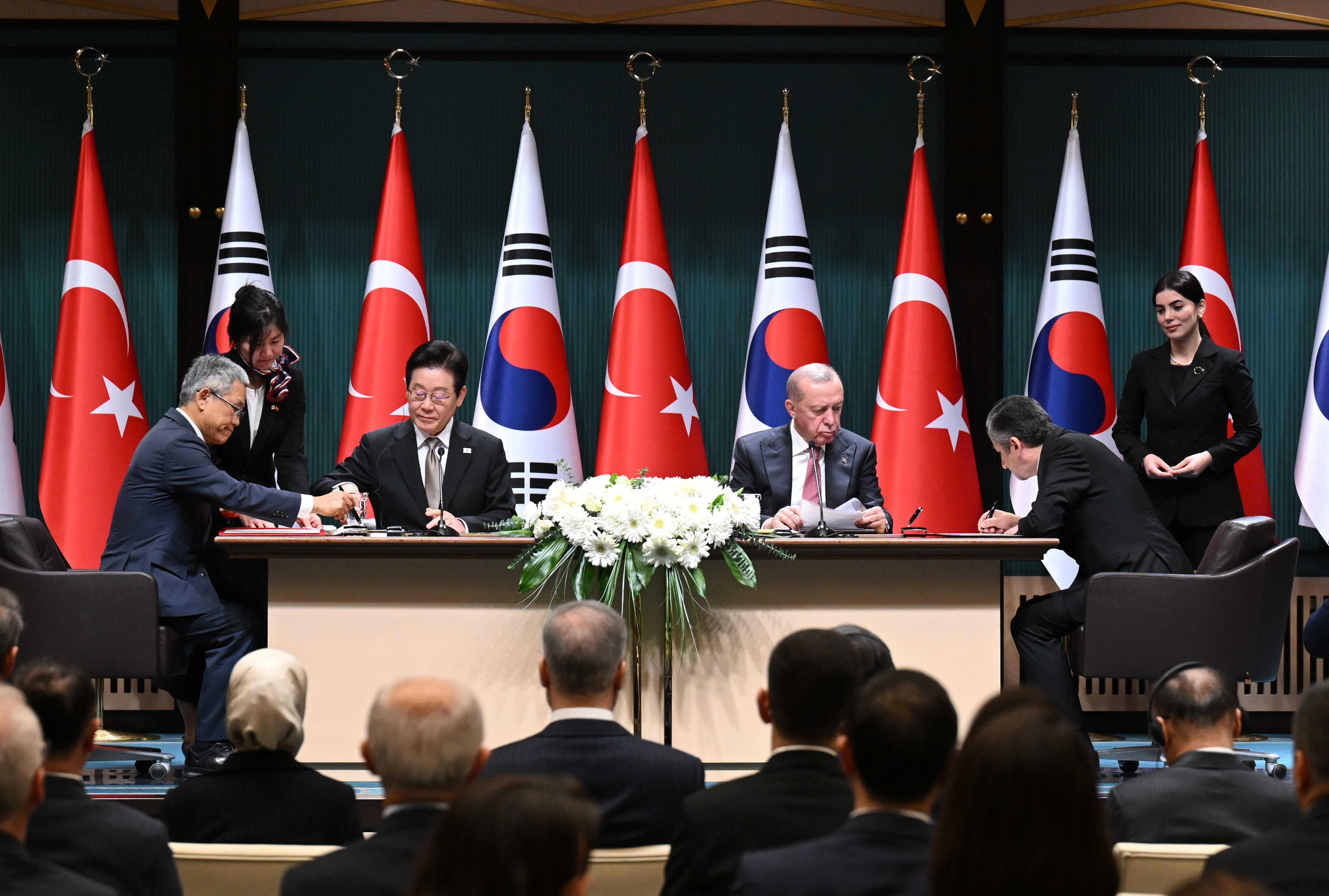
Representatives of Turkey’s TUNAS and South Korea’s KEPCO sign the Memorandum of Understanding on Nuclear Energy Cooperation in the presence of President Recep Tayyip Erdoğan (2nd R) and President Lee Jae-myung (2nd L) in Ankara, Turkey, on November 24, 2025. Photo by Mehmet Ali Ozcan/Anadolu via Getty Images.
How Close Is Turkey to a Bomb?
Those concerned about Turkey’s nuclear ambitions often point to several factors as evidence of both its interest in nuclear weapons and its potential technical capacity to pursue them. One is Turkey’s membership in the Nuclear Suppliers Group (NSG), which reflects, in part, its manufacturing capacity for materials with potential applications in the nuclear industry. Others point to its plans to build multiple nuclear power plants, Ankara’s unwillingness to commit to restrictions on enrichment and reprocessing (ENR) activities in its Section 123 nuclear agreement with the US, and Erdoğan’s statements that Turkey could develop uranium-enrichment capabilities if needed for its civilian nuclear program. Another point raised is Turkey’s effort to accelerate its long-range missile development program. Long-range ballistic missiles are commonly associated with nuclear weapons because they are considered an ideal delivery system for them. In January 2025, President Erdoğan said Turkey had “decided to … accelerate our missile development program with a range of 2,000 kilometers and above” to counter regional threats. Turkey has also recently unveiled a new missile, dubbed Yıldırımhan, that, once deployed, would give the country a long-range strike capability. At the same time, Ankara is investing in a spaceport in Somalia that could enable long-range ballistic-missile testing. Finally, Turkey joined Saudi Arabia’s mutual defense agreement with nuclear-armed Pakistan in early August. Although the agreement did not mention nuclear weapons, it has further reinforced the strategic ambiguity surrounding Turkey’s nuclear intentions.
Indeed, Turkey’s interest in civilian nuclear technology, which dates back to the 1950s, gives the country a relatively advanced nuclear infrastructure. It operates longstanding nuclear research facilities and has expanded its scientific and engineering expertise. Yet the IAEA’s 2025 reporting suggests that Turkey remains well short of the technical capabilities associated with nuclear latency. It has no commercial uranium mining or conversion facilities and, most importantly, no identified uranium-enrichment or spent-fuel reprocessing capability. Its existing front-end activities are limited largely to safeguarded laboratory-scale research, including uranium concentrate refining, conversion to uranium dioxide (UO2), and fuel-pellet production.
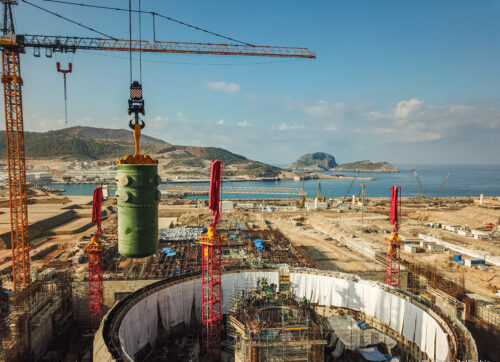
Turkey plans to build multiple nuclear power plants as part of its strategy to diversify its energy mix and reduce dependence on foreign suppliers. Once operational, these reactors will significantly deepen Turkey’s experience with nuclear technology and will generate spent fuel. But for now, they remain under construction, and the specific model Turkey chose to build its first plant at Akkuyu limits its ability to develop some of the key indigenous capabilities associated with nuclear latency.
The plant is being developed under a build-own-operate (BOO) model, an unprecedented arrangement in the nuclear industry. Akkuyu Nükleer is wholly owned by subsidiaries of Russia’s state-owned Rosatom, which is providing roughly $20 billion in financing. Russia is responsible for the plant’s design, construction, maintenance, and operation for 60 years, as well as the supply and use of nuclear fuel and the plant’s eventual decommissioning.
The BOO model reduces Turkey’s financial exposure but creates significant dependencies. Turkey will rely heavily on Russian personnel to operate the plant and on Russia for its nuclear fuel. More importantly, the arrangement limits the extent to which Akkuyu can help Turkey develop autonomous nuclear capabilities, particularly in sensitive parts of the fuel cycle that can have both civilian and military applications.
The Turkish government has publicly acknowledged this dependence. Energy Minister Alparslan Bayraktar told parliament’s budget committee on November 7, 2025, that Turkey relies entirely on Russia’s Rosatom for the uranium fuel that will power Akkuyu. He also signaled Ankara’s desire to diversify: “To overcome this dependence, we are talking about fuel cooperation both with the country we are currently working with and with others we are discussing new projects with.” Turkey is negotiating with other potential partners, including the US, Canada, France, and South Korea, over additional nuclear plants, and Turkish drone manufacturer Baykar is also working on small modular reactor (SMR) technology.
Ankara’s negotiations with Canada are particularly noteworthy. Turkey is in talks with Canada’s AtkinsRéalis, and Turkish officials have indicated an interest in Canadian involvement in its second and third nuclear power plants. The CANDU reactor design has several features that could provide a relatively direct technical pathway to a nuclear weapon while making proliferation activities more difficult to detect. Unlike conventional light-water reactors, CANDU heavy-water reactors can operate on unenriched natural uranium, reducing dependence on foreign enrichment services and giving the operator greater autonomy over the front end of the nuclear fuel cycle. More importantly, CANDU reactors can produce plutonium well suited for weapons purposes and can be refueled while operating, features that can complicate IAEA monitoring.
None of this means that acquiring a CANDU reactor would automatically put Turkey on a path to the bomb. Extracting plutonium would still require the ability to reprocess spent fuel, a capability Turkey does not currently possess. Speaking to the author, a Canadian diplomat said that the deal under discussion with Ankara includes “significant technology sharing,” but what, if anything, it would entail regarding reprocessing or spent-fuel separation remains unclear. What is clear is that Ankara wants greater control over its nuclear supply chain and, over time, to develop more indigenous capabilities. For now, however, the Akkuyu model constrains that ambition. As Aaron Stein has noted, if Turkey sought to divert Akkuyu toward a weapons program, it would first have to remove the foreign operator and then gain control of foreign-owned spent fuel stored at the site before it could even begin to contemplate extracting plutonium for a weapon — a difficult and highly visible undertaking. Akkuyu will therefore deepen Turkey’s experience with nuclear technology, but it does not by itself provide Ankara with the most proliferation-sensitive capabilities. Turkey currently lacks domestic uranium-enrichment and spent-fuel reprocessing capabilities, and the structure of the Akkuyu project does little to change that in the short term.
Another hurdle to building indigenous expertise and technical nuclear capacity in the short term is Turkey’s multivendor approach. Ankara may hope to use competition among suppliers as leverage to secure concessions that help it build indigenous nuclear capabilities. But if Turkey ultimately works with multiple suppliers that use not only different hardware but also entirely different engineering philosophies and regulatory codes, this approach could complicate and prolong its efforts to achieve greater autonomy in the nuclear field.
Currently, Turkey is still likely at least a decade away from being able to produce a nuclear weapon. But the many internal and international threats swirling around the country suggest that Ankara could move toward becoming a hedging state, taking steps to acquire the expertise and technical capabilities needed to preserve the option of eventually developing nuclear weapons. How far Ankara will move along that continuum remains uncertain. It could pursue relatively modest technical hedging or seek the more advanced capabilities associated with nuclear threshold status.
Whichever path it chooses, Turkey will most likely try to remain within the NPT, seeking to expand its nuclear options without openly crossing the line into weaponization while maintaining strategic ambiguity about its ultimate intentions. Even the most advanced point on the continuum of nuclear hedging — reaching nuclear threshold status, where a country is figuratively “one screwdriver’s turn away” from having a workable nuclear weapon — can, in principle, be maintained without withdrawing from the NPT. The treaty prohibits the acquisition of nuclear weapons but does not explicitly prohibit the development of a threshold capability, nor does it define a precise technical line separating threshold status from weapons possession. A state can therefore accumulate materials, technologies, components, and expertise that could substantially shorten the path to a weapon while remaining formally within the treaty.
Maintaining strategic ambiguity about its ultimate nuclear intentions would offer Ankara an additional advantage: preserving the deterrent and bargaining value of its growing capabilities while reducing some of the political and security costs of openly declaring a nuclear-weapons ambition, including the risk of accelerating a regional arms race.
Yet a hedging strategy carries risks of its own, particularly in a conflict-ridden region such as the Middle East. The proliferation of hedging could transform the nuclear order even without producing an increase in the number of nuclear-armed states. As more countries seek the capability to approach the nuclear threshold without crossing it, the distinction between nuclear and non-nuclear states becomes blurred. This could generate reciprocal hedging and arms-race dynamics, shorten breakout timelines, increase incentives for preventive military action, complicate intelligence assessments and safeguards, and ultimately erode the normative force of the NPT.
For Washington, the challenge is increasingly one of managing the nuclear trajectory of regional powers such as Turkey and Saudi Arabia rather than preventing them from acquiring greater nuclear capabilities altogether. The goal should be to prevent hedging from evolving into advanced threshold capabilities while addressing the security concerns that drive states to hedge in the first place.
Attempting to eliminate all nuclear latency or prohibit enrichment altogether is neither realistic nor sustainable. Instead, Washington should focus on preventing the emergence of proliferation-prone national enrichment programs while promoting multilateral, IAEA-supervised fuel-cycle arrangements. One option would be a regional fuel-cycle framework in which participating states host different elements of the nuclear fuel cycle but no single country controls the entire supply chain necessary to rapidly convert a civilian program into a weapons capability. Such an arrangement could accommodate regional demands for greater nuclear autonomy while reducing incentives for competitive national enrichment programs.
At the same time, Washington must address the insecurity driving hedging behavior. In Turkey’s case, this means strengthening extended deterrence and restoring Ankara’s confidence in the credibility of US security guarantees. Reassurance, however, should be coupled with clear nonproliferation red lines. Washington should make explicit that continued US security guarantees are tied to adherence to nonproliferation commitments and that moves toward weapons-relevant capabilities would carry consequences for the bilateral security relationship.
* There are various definitions and operationalizations of nuclear hedging in the literature. This article adopts Vipin Narang’s definition, as laid out in his book Seeking the Bomb. This section draws on his framework.
Gönül Tol is a senior fellow at the Middle East Institute, where she focuses on Turkish politics, US-Turkey relations, and regional dynamics in the Middle East.
Top image: An aerial view of the Akkuyu Nuclear Power Plant under construction in Mersin, Turkey, on May 24, 2026. Photo by Akkuyu Nucleer PP/Anadolu via Getty Images.
The Middle East Institute (MEI) is an independent, non-partisan, not-for-profit, educational organization. It does not engage in advocacy and its scholars’ opinions are their own. MEI welcomes financial donations, but retains sole editorial control over its work and its publications reflect only the authors’ views. For a listing of MEI donors, please click here.