As the United States and Israel’s war against Iran enters its second week, Gaza has been pushed to the margins of the regional conversation. Strategic attention has shifted to Iranian retaliation, Gulf vulnerability, energy markets, the future of Iran’s leadership, and the widening implications of Washington’s Operation Epic Fury and Israel’s Operation Roaring Lion. Reuters has described the current US campaign as the largest American military operation in the Middle East since the 2003 invasion of Iraq. That scale helps explain why Gaza has been effectively sidelined. It does not justify it.
Gaza is not a secondary file to revisit after the “real” war is over. It is the place where this regional cycle began, and it remains the place where neglect is most likely to produce the next round of instability. In a recent essay, this author argues that disarmament in Gaza should be treated as one of a parallel series of means toward achieving a governing transition, not as an isolated end in itself. That logic is even more urgent now. When Gaza disappears from strategic view, the result is not neutrality. It is deterioration: humanitarian, political, and institutional.
The humanitarian emergency
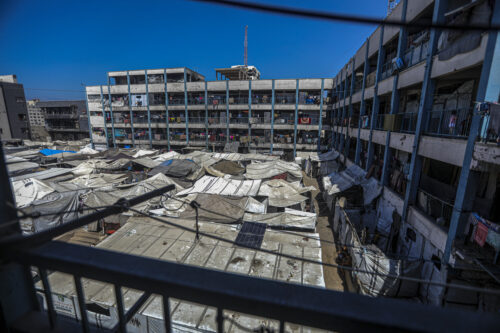
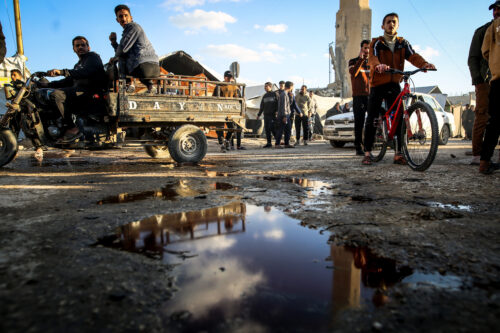
The humanitarian emergency in Gaza has not paused because policymakers are focused elsewhere. The United Nations Office for the Coordination of Humanitarian Affairs (UN OCHA) reported on February 27 that only 260 of 619 health service points across the Gaza Strip were functioning and that 90% of those were only partially operational. All hospitals remained dependent on backup generators, while delays in the entry of critical electrical components were affecting intensive care, dialysis, operating theaters, and laboratories.
That already-fragile baseline has been placed under further strain by the Iran war. On March 2, Israel closed Gaza’s crossings, prompting aid officials to warn that fuel could run out within days and that shortages of food staples could quickly worsen. Even where crossings partially reopen, the episode underscores a larger truth. Namely, the devastated coastal strip now exists on such a narrow margin of survival that regional distraction immediately translates into human risk. This is the first reason we must talk about Gaza now: because strategic distraction is itself becoming part of the crisis. The second reason is political. The architecture meant to move Gaza into a postwar transition is already showing signs of strain.
Political architecture under strain
At the inaugural Board of Peace meeting on February 19, Indonesia signaled that it was ready to contribute up to 8,000 troops to an international force for Gaza, potentially making it one of the most important Muslim-majority contributors to any stabilization effort. The broader plan also apparently envisioned a 20,000-troop force and the training of 12,000 police.
But that commitment now looks increasingly uncertain. On March 4, Reuters reported that Indonesia had put discussions with the Board of Peace “on hold” because of the Iran war. Two days later, President Prabowo Subianto announced, in an official government statement, that Jakarta would leave the Board of Peace if it failed to benefit Palestinians or align with Indonesian interests. That is not a minor diplomatic wobble. It is a warning sign. A viable Gaza transition was always going to require not only US sponsorship, but also sustained participation by Arab- and Muslim-majority states willing to provide political cover, manpower, and legitimacy. If those partners begin stepping back, the transition framework weakens before it has even begun to mature.
A strategic opening
And yet this same moment may also present a real opportunity.
Iran and the wider Axis of Resistance are under extraordinary pressure. Visible cracks are reportedly already emerging inside Iran’s leadership, following sustained US-Israeli bombardment and the killing of Supreme Leader Ali Khamenei, with tensions surfacing between hardline factions and more pragmatic elements around President Masoud Pezeshkian. At the same time, the conflict continues to widen across the region, with Iranian strikes on Gulf states and renewed Hizballah attacks helping pull more actors into the crisis. Whatever shape the next phase takes, the broader Iranian-led network is clearly under strain and operating in a much more disrupted environment than it was only weeks ago.
The Hamas paradox
That does not mean Hamas has disappeared. Far from it. According to locals in the Gaza Strip and various media reports, Hamas has for months been tightening its grip by placing loyalists in key administrative roles, collecting taxes, and paying salaries. Moreover, reporting by Reuters suggests that the US-backed National Committee for the Administration of Gaza — an interim, technocratic body established in January 2026 to manage civil affairs, public services, and reconstruction in the strip — had been unable to establish authority inside the enclave, while Hamas continued working to preserve its own influence over governance and policing. In other words, Hamas is weaker strategically but maintains enough of a local presence to shape realities on the ground.
This is the core strategic paradox of the moment. Hamas and the broader Tehran-supported axis are weaker than they have been in some time, but Gaza remains vulnerable enough for Hamas to weaponize abandonment. If civilians continue living amid hunger, rubble, uncertainty, and administrative vacuum, armed actors do not need to win outright. They only need to persuade people that no one else is willing or able to improve Palestinian life.
That is why postponing Gaza is not a neutral act. It strengthens the very narrative that should now be contested. Hamas can still argue that the world mobilizes around missiles, deterrence, and regional power balances, but not around Palestinian dignity, lawful governance, or recovery. If the Gaza Strip remains trapped in suspended reconstruction and political limbo, that argument will not just be rhetoric. It will draw power from lived experience.
The Israeli calculus
There is also an Israeli dimension that should not be ignored. After this display of force against Iran, some in Israel may conclude that there is little reason to take political risk on Gaza. If military pressure appears to be restoring deterrence elsewhere, why move on Palestinian governance, reconstruction, or meaningful humanitarian relief — especially with Israeli politics already shaped by electoral calculation? The broader political risks of a prolonged Iran war for Washington, including economic fallout and electoral pressures, are already becoming apparent. Similar political logic can easily harden rather than soften Israeli reluctance on Gaza.
But what started in Gaza cannot be strategically managed by sidelining it.
Why Gaza cannot wait
Leaving Gaza in extreme deprivation while waiting for a perfect security outcome will only regenerate the conditions that militant actors exploit. By contrast, visible positive change for ordinary Gazans would do more than relieve suffering. It would begin to undercut Hamas’ most potent remaining claim: that force is the only language the region understands, and that Palestinians are destined only for managed misery unless armed groups impose themselves as the sole defenders of the people.
That is why positive change in Gaza is not a concession to Hamas. It is one of the few available ways to weaken Hamas politically.
If Gazans begin to see real movement — steadier aid flows, functioning municipal services, credible civilian administration, accountable local policing, and a transition that makes armed rule less central to daily life — then the argument for perpetual militia dominance starts to erode. If, instead, Gaza remains a theater of abandonment while diplomats speak abstractly about stabilization, Hamas and others will continue to feed on the contradiction between regional rhetoric and Palestinian reality.
This is also a test of American credibility. President Donald Trump presented the Board of Peace as a framework for moving Gaza from war to transition, and participants announced more than $7 billion for a dedicated reconstruction fund at its first meeting. But diplomatic architecture alone does not create legitimacy. Credibility comes from whether people on the ground can see meaningful change in food access, medical care, shelter, policing, and political direction. A US-backed regional strategy that asks partners to help stabilize the war-ravaged territory while delivering too little visible improvement to Gazans themselves will not hold.
So yes, the current war with Iran is urgent. The attacks on states associated with the Board of Peace are serious. The regional stakes are high. But that is exactly why Gaza must be discussed now, not later.
Because the humanitarian emergency is still acute. Because the diplomatic coalition for transition is already fraying. Because Hamas is weak enough to be challenged but still present enough to exploit neglect. Because Israeli leaders may be tempted to mistake regional military success for a Gaza strategy. And because any serious effort to reshape the region will ultimately be judged by whether it produces meaningful change for the people of Gaza.
Gaza should not be the file everyone returns to once the “larger” crisis ends. The Gaza Strip is where the meaning of this moment will be decided. If this opening is used to move toward lawful Palestinian governance, humanitarian stabilization, and a political transition that reduces the relevance of armed rule, then the weakening of Iran’s regional network may yet create space for something better. If not, Gaza’s suffering will once again be converted into fuel for the next cycle of violence.
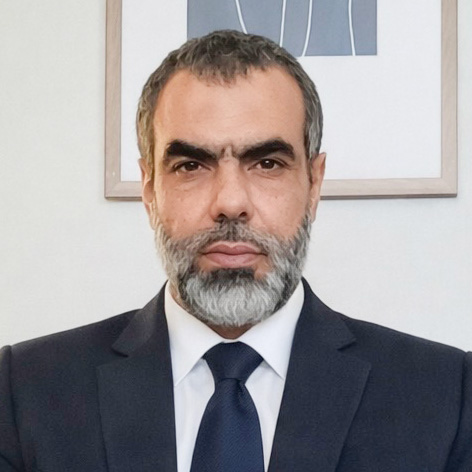
Jaser AbuMousa is a Senior Fellow at the Middle East Institute.
Photo by Saeed M. M. T. Jaras/Anadolu via Getty Images
The Middle East Institute (MEI) is an independent, non-partisan, not-for-profit, educational organization. It does not engage in advocacy and its scholars’ opinions are their own. MEI welcomes financial donations, but retains sole editorial control over its work and its publications reflect only the authors’ views. For a listing of MEI donors, please click here.