Brian Katulis is a senior fellow at the Middle East Institute, specializing in US foreign policy and national security. He authors the column “Making Sense: A Regular Take on US Foreign Policy.” Katulis draws on decades of experience living and working in the Middle East, where he has forged relationships of trust and confidence across the region with top leaders in government, the private sector, media, national security, and thought leaders from a wide variety of international organizations.
As a foreign policy strategist and senior fellow, Katulis has produced influential studies that have shaped key regional policy debates and provided expert testimony to congressional committees on his findings. Prior to MEI, he was a senior fellow at the Center for American Progress (CAP), where he built the center’s Middle East program. His career also includes significant experience at the National Security Council, the US Department of State, and the US Department of Defense.
Katulis co-authored The Prosperity Agenda (2008) with Nancy Soderberg, a book that examines how America’s economic advantages can be used to positively shape global dynamics. He is also frequently quoted in leading news publications and media outlets.
He holds a Master in Public Affairs from Princeton University’s School of Public and International Affairs and a BA in History and Arab and Islamic Studies from Villanova University. He was a Fulbright Scholar in Amman, Jordan from 1994-1995, where he conducted a research project on the peace process between Israel and Jordan.
Lebanon’s stability requires steadier US engagement
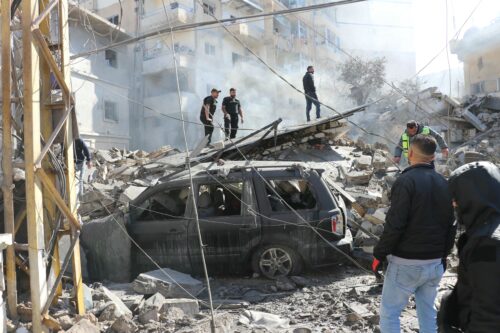
As most eyes stay trained on Iran, another front is presenting a crucial challenge to Middle East regional stability: Israel’s military campaign in Lebanon and the status of Hezbollah, Iran’s decades-long proxy partner.
Five Fundamental Questions for US Foreign Policy as the Iran War Enters Its Fourth Week
The US and Israeli conflict with Iran is currently just past the halfway mark, according to US President Donald Trump’s initial estimate that it would take four to six weeks to achieve his objectives, but for now there is no end in sight. Here are five fundamental, strategic questions that require more attention as the media and political debates fixate on the day-to-day breaking news and tactics of this war.
Surviving October 7th: Amir Tibon on Trauma, War, and Israel’s Future
Brian is joined by Amir Tibon, a journalist for Haaretz and the author of The Gates of Gaza: A Story of Betrayal, Survival, and Hope in Israel’s Borderlands and The Last Palestinian: The Rise and Reign of Mahmoud Abbas. On October 7, 2023, the Tibon family’s lives were changed forever when Hamas militants invaded Nahal Oz kibbutz, destroying their community, brutally killing their neighbors, and taking others hostage. Together, Brian and Amir examine the fallout from the events of October 7th, how public opinion in Israel and the United States has shifted over the past two and a half years, Israeli Prime Minister Benjamin Netanyahu’s political strategy, and what this all means for the future of Israel and its relationship with Palestinians and the broader region.
How to prevent the Iran war from becoming a vortex that draws in more countries
By attacking Iran without clear objectives or an exit strategy, the US and Israel turned what was the greatest strategic and chronic threat to regional security into an unpredictable set of imminent dangers. A fundamental task for US national security is to prevent this conflict from becoming a vortex that increasingly pulls in other powers.
After the Iran War: What Is America’s Long Game in the Middle East?
Brian is joined by Dana Stroul, Director of Research and Shelly and Michael Kassen Senior Fellow at the Washington Institute for Near East Policy, to examine US objectives in the Middle East in the midst of the ongoing war between the US, Israel, and Iran. Drawing on her extensive experience in US policymaking, most notably as the Pentagon’s top civilian official responsible for the Middle East from 2021 to 2023, Dana offers an insider’s perspective on this strategic moment. Together, Dana and Brian unpack the rapidly developing situation in Iran, the fragility of the ceasefires in Gaza and Lebanon, the shifting landscape in Syria after Assad, and the United States’ role in a region that may be on the cusp of transformation.
Iran looms large over Trump’s address to the nation
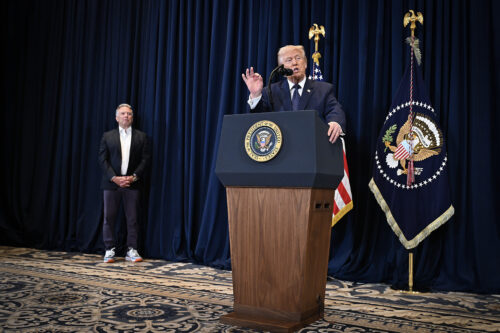
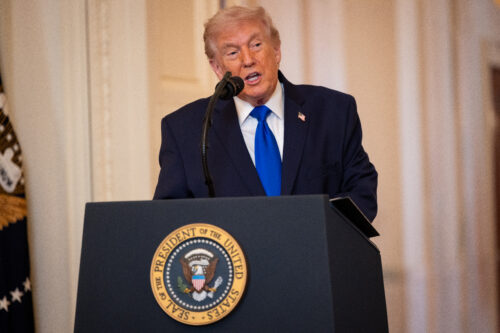
US President Donald Trump takes to the podium tonight to deliver the first State of the Union address of his second term.
“It’s going to be a long speech because we have a lot to talk about,” Trump said ahead of the address. The State of the Union—an annual speech delivered by the US president to Congress—typically focuses heavily on domestic policy issues, and that’s likely to be the case with tonight’s speech as well. Concerns about the health of America’s economy and growing public controversy about the Trump administration’s immigration policies are two of the domestic policy issues Trump will likely address.
Board of Peace Meets as Storm Clouds Gather for Another Possible Middle East War
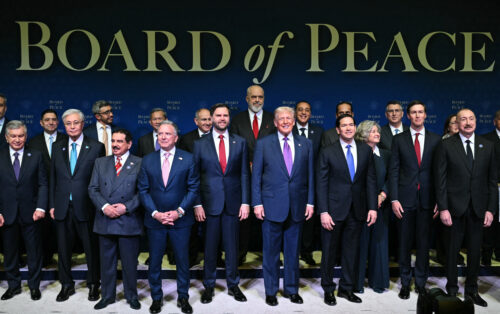
US President Donald Trump hosted an idiosyncratic gathering of global representatives in Washington on February 19 that included some key Middle East figures meeting under the banner of peace to discuss the next steps in Gaza just as the US was sending more military forces to the region to pressure and possibly target Iran.
Brian sits down with Holly Dagres, Libitzky Family Senior Fellow at the Washington Institute for Near East Policy, to discuss Iranian public opinion and protest movements. Dagres, who was born in Los Angeles and moved to Iran at age thirteen, offers a rare insider perspective on the views and aspirations of the Iranian people. The conversation explores the formative experiences of her teenage years in Iran, the roots of the country’s powerful women’s movements, the power of youth voices, and US policy toward Iran.
What Trump’s 2026 Mideast approach could look like
Donald Trump’s first year of his second presidential term has been a roller coaster of twists and turns both at home and abroad—particularly in the Middle East. His regional focus was driven by two main factors: first, Trump’s own ego and sense of possible place in history; and second, the volatile, dynamic events driven by actors in the region.
US Policy in the Middle East in the First Year of Trump 2.0: A Report Card
In the first year of his second term in office, US President Donald Trump focused considerable time and energy on the Middle East, but the results so far have been uneven. This report assesses the US government’s actions in the region over the past 12 months, from January 2025 through January 2026.
Against the backdrop of the Iranian government’s brutal crackdown on protestors, Brian is joined by Emad Shargi, an Iranian-American businessman who was unjustly detained by the regime in 2018 until his release in 2023. Shargi recounts his firsthand experience in the notorious Evin Prison and offers rare insights into the mentality and tactics of the Islamic Republic. He and Brian also discuss his recommendations for US engagement in Iran and his hopes for the country’s future.
From a US military build-up in the region to Trump’s growing unpopularity at home, several factors could influence his decision on whether or not to attack.
Brian sits down with Behnam Taleblu, Senior Fellow at the Foundation for Defense of Democracies, to unpack the ongoing protests in Iran and what this moment reveals about the long struggle between the state and the street. They discuss the regime’s brutal crackdown, the prospect of US intervention, and what both could mean for the future of the Islamic Republic. The episode centers on agency, imagination, and the possibilities facing Iranians at a critical juncture in the country’s history.