This individual is a guest contributor. MEI is not able to assist with contact requests.
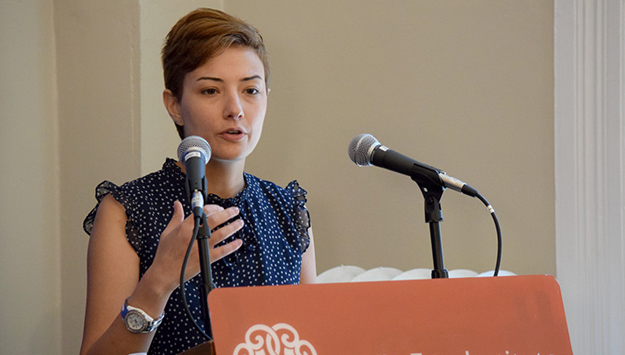
Rasha Elass has recently returned to the United States after covering the Middle East for over 10 years. She was based inside Syria to cover the uprising-turned-civil war as a freelancer for several media outlets, including Reuters, the Los Angeles Times, National Public Radio (NPR), The World (PRI / BBC Radio), and the International Business Times (IBT.com), often covering the war without a byline for security reasons.
Prior to this, she covered the Iraqi refugee crisis and Arab and Islamic affairs for various media including Reuters, Forbes Arabia, and The National. Her work includes columns and commentary on Islamic finance and local culture. Ms. Elass has also covered the drug wars in South America as a producer for Al Jazeera English before becoming a regular Syria Contributor for Al Jazeera America.
She holds an MS from Columbia University’s Graduate School of Journalism and an MS in finance from American University. Prior to her career in journalism, Ms. Elass worked in New York City as a market analyst.
As a global fellow with PS21, the Project for the Study of the 21st Century, Ms Elass contributes analysis pieces to several media outlets, including the newly launched Arab Weekly.
She has just launched the Voices Unheard Podcast, which draws on her experience in the Middle East to bring you stories from the Arab and Muslim world.
Ms. Elass is Syrian-American with native fluency in Arabic and proficiency in French.
Syria’s uprising-turned-war is the first to unfold on social media for the whole world to see in real time. While this gives unprecedented power for local, grassroots activists and citizen journalists, it also comes with challenges.
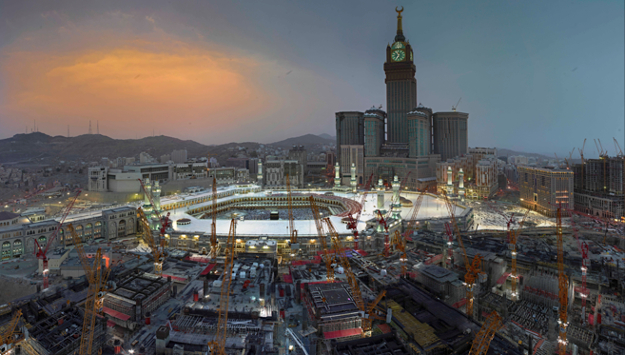
On a sub-level inside one of the Smithsonian’s art galleries in Washington, a man stood entranced by the Golden Hour, a six by eight foot photographic composition of Mecca.
The man noted the dozens of cranes and the Makkah Royal Clock Tower, a monstrous and controversial piece of architecture that dwarfs everything around it. Then, with his finger, the visitor carefully air circumnavigated around the Great Mosque.
“What’s this tiny black cube in the middle?” he asked, pointing to the Kaaba.
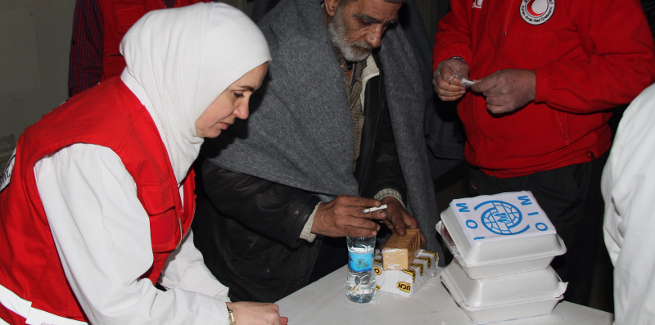
Five years of war have unexpectedly reset gender roles in Syria. With so many men killed or missing, women are finding themselves the main supporters of their families and communities, and are often breaking with tradition and cultural taboos.
“Activists that engaged with the revolution have experienced big differences in gender relations, especially among the most conservative women,” said a 30-year-old underground activist and filmmaker in government-held central Damascus. She goes by the name Rafia, and she spoke to this author by Skype.
A Mosque Grows in Lanham: New Institutions Seek to Rebrand Islam in America
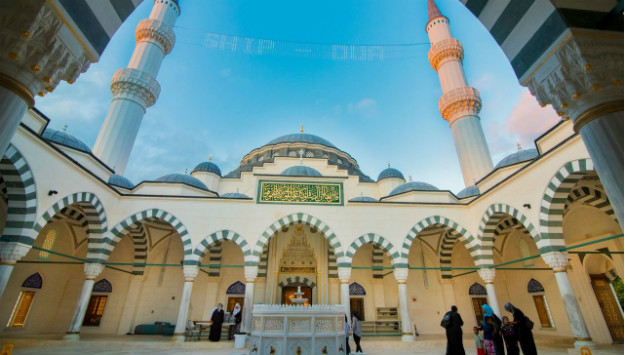
Something is different about Greater Washington’s new Islamic center in Lanham, Maryland, which recently opened after several years of construction. It boasts an aquatics hall complete with a swimming pool for doing laps and a traditional Turkish bathhouse with separate sections for men and women. It has outdoor tennis courts, a chess club, and several guest villas inspired by 16th century Ottoman architecture. A female chaplain is already on staff, ready to issue fatwas alongside her male colleagues.
Liberalism in the Arab World: Accounts from the Region
Ismael Mohammed of Egypt recalls the moment he lost his religion. It happened four years ago, at the age of 26, when he heard about the theory of evolution for the first time. He had come across it online by watching YouTube videos and reading all the material he could fit through Google Translate. He sent query emails to evolution scientists around the world, asking them if what they were saying was true. Some responded, sending him the nuts and bolts of Darwin’s work.