Skip to Content

Rebecca Anne Proctor

This individual is a guest contributor. MEI is not able to assist with contact requests.

Rebecca Anne Proctor is an independent journalist, editor, author, and broadcaster based in Dubai and Rome, from where she covers the Middle East and North Africa. She is the former editor-in-chief of Harper’s Bazaar Art and Harper’s Bazaar Interiors.

The Latest from Rebecca Anne Proctor
Filter by
9993 Results
Déjà vu all over again: The three “I”s of gasoline subsidies and social unrest in Iran
An Iranian man checks a scorched gas station that was set ablaze by protesters during a demonstration against a rise in gasoline prices in Eslamshahr, near the Iranian capital of Tehran, on November 17, 2019.
  • Analysis
  • Déjà vu all over again: The three “I”s of gasoline subsidies and social unrest in Iran

    Adding to the backdrop of economic mismanagement, corruption, and increasing rates of poverty and inequality, the recent gasoline rationing and price hikes have ignited widespread and violent protests inside Iran. Despite recent changes, the country’s energy subsidy regime remains highly inequitable, ineffective, and inefficient.

    November 25, 2019

    Iraq’s protests continue in force amid political turmoil
    Iraqi protesters chant slogans during a demonstration in Baghdad's al-Rasheed street near al-Ahrar bridge on November 24, 2019.
  • Commentary
  • Iraq’s protests continue in force amid political turmoil

    Although 350 Iraqis have died to date and close to 16,000 have been wounded, protesters are not going home. Yet, most of the ruling clique is still rejecting the idea of forcing the prime minister to resign.

    November 25, 2019

    A prisoner swap with the Taliban, but will it lead to anything?
    Security stands guard at the Ghani headquarters on September 29, 2019 in Kabul, Afghanistan.
  • Commentary
  • A prisoner swap with the Taliban, but will it lead to anything?

    Last week saw the Taliban’s release of two kidnapped professors in exchange for the Kabul government’s freeing of three prized Taliban prisoners. While the swap may have been necessary on humanitarian grounds, it was unfortunate otherwise. Rather than defending the swap on its own merits, Kabul and Washington are hailing the exchange as a possible breakthrough following the collapse of the Doha agreement and the stalling of planned intra-Afghan discussions.

    Algeria: A contested presidential election
    Algerians take part in an anti-government demonstration demanding the ouster of officials who served under ex-president Abdelaziz Bouteflika as they marked the 65th anniversary of the country's fight for independence from France.
  • Commentary
  • Algeria: A contested presidential election

    There are two contests underway. One is between the five presidential candidates, who make promises without much detail or even controversy. The larger contest pits the army, which needs a high voter turnout to lend the election credibility, against the hirak, which aims to reduce turnout and limit any boost to the system’s legitimacy.

    Why the Gulf states are investing in Central Asia and the South Caucasus
    Abu Dhabi Crown Prince Mohammed bin Zayed al-Nahayan (R) reviews an honour guard with Kazakhstan's President Nursultan Nazarbayev during a welcoming ceremony in Astana on July 4, 2018.
  • Analysis
  • Why the Gulf states are investing in Central Asia and the South Caucasus

    Following the sharp decline in oil prices in recent years, Central Asian and South Caucasus countries accelerated their efforts to diversify their economies away from oil and gas.They also began looking for additional investors. The wealthy states of the Persian Gulf were a natural fit, as they had the financial resources and were also interested in diversifying their economies away from petroleum. The United Arab Emirates (UAE) and Saudi Arabia have led the overseas investment charge.

    November 25, 2019

    Will Israeli politicians prove their responsibility and flexibility?
    A picture taken on October 3, 2019 shows a general view of the plenum during the swearing-in ceremony at the Knesset in Jerusalem. - Israel's parliament was sworn in today without a new government formed as a deadlocked general election left Netanyahu scrambling to find a path to extend his long tenure in power.
  • Commentary
  • Will Israeli politicians prove their responsibility and flexibility?

    It is clear that the Israeli political system has reached a peak in terms of the challenges it faces: two elections campaigns to date this year have not led to conclusive results and a third round may be right around the corner.

    November 25, 2019

    Leveraging the Current Uprising for Sustained Political Change
    Lebanese demonstrators raise a new giant sign of a fist that bears the Arabic word
  • Analysis
  • Leveraging the Current Uprising for Sustained Political Change

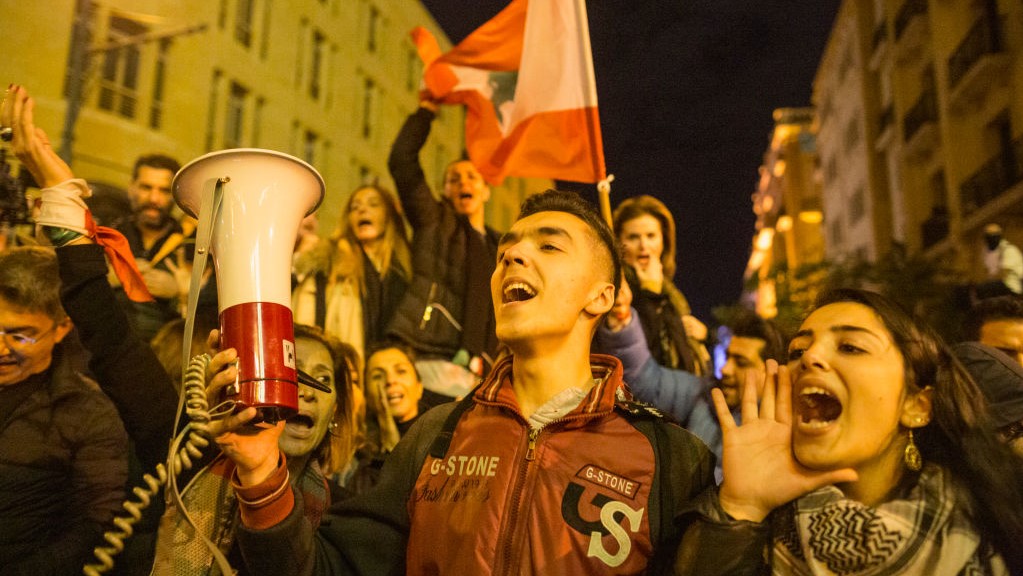
    The nationwide protests are the most significant domestic political development in Lebanon since the end of the civil war. It would be useful to examine both the short and long term political potential of this new awakening.

    In the short term, the protests have already mobilized the power of the public to bring down a corrupt and ineffective government, and to gain great leverage on the rejection or acceptance of any new government. They have also raised urgent national demands and forced the ruling class to confront these demands. 

    November 22, 2019

    Breaking each other’s fingers: Kurdish parties nervously watch Baghdad — and one another
    President of Iraqi Kurdish Regional Government (KRG), Nechirvan Barzani (C), President of Iraq Barham Salih (R) and Speaker of the parliament Rewaz Faiaq (L) attend a meeting on the current developments in Iraq on November 05, 2019 in Erbil, Iraq.
  • Analysis
  • Breaking each other’s fingers: Kurdish parties nervously watch Baghdad — and one another

    Since early October, the southern provinces of Iraq have been consumed by protests and strikes. While ruthlessly attempting to suppress protests, the Iraqi government has promised legal and political reforms. Yet some of the Kurdistan Region-Iraq’s elites are suspicious that the government’s reform agenda is a “conspiracy” against Kurdish entitlements masquerading as a good faith effort to placate the protestors. The region’s hegemonic parties are concerned that legal, constitutional, and procedural reforms may overhaul the institutions that guarantee their positions of influence in the federal government and secure their territorial claims.

    November 22, 2019

    Lebanon’s leap into the unknown
    Anti-government activists take part in a protest in downtown Beirut, demonstrations across Lebanon entered its 2nd months.
  • Analysis
  • Lebanon’s leap into the unknown

    On a recent trip to my native Lebanon I looked on its ongoing, unprecedented protests with both wonder and worry. The country is a month into widespread anti-government demonstrations. The protests’ scale ebbs and flows but the relative calm during my stay had a fleeting if not sinister quality to it. That calm is unraveling. However this chapter of Lebanon’s history unfolds, this complicated country has changed irreversibly.

    November 21, 2019

    Russia’s military police face their toughest challenge yet in north Syria
    TOPSHOT - Russian military police members stand outside an armoured personnel carrier (APC) along a road in the countryside near the northeastern Syrian town of Amuda in Hasakeh province on October 24, 2019, as part of a joint patrol between Russian forces and Syrian Kurdish Asayish internal security forces near the border with Turkey. - Russian forces have started patrols along the flashpoint frontier, filling the vacuum left by a US troop withdrawal that effectively returned a third of the country to the
  • Analysis
  • Russia’s military police face their toughest challenge yet in north Syria

    Russia’s ability to control the pace and scope of developments in Syria has been a moving target ever since its intervention four years ago. At varying times, Moscow has found itself both firmly in the driver’s seat and a helpless bystander — the latter most vividly illustrated by events such as the regular Israeli airstrikes on Russia’s Iranian and Syrian regime allies.

    November 21, 2019

    The Role of Women in Syria's Future

    The Role of Women in Syria's Future

    November 21, 2019, 12:30 PM – 2:00 PM

    The Middle East Institute, 1763 N Street NW, Washington, District of Columbia 20036

    Pompeo’s audience: The Trumpian base
    U.S. Secretary of State Mike Pompeo speaks during a press conference at the U.S. Department of State on November 18, 2019 in Washington, DC
  • Analysis
  • Pompeo’s audience: The Trumpian base

    It is not always recognized that Secretary of State Mike Pompeo’s Nov. 18 declaration that Israeli “settlements are not inconsistent with international law” was primarily political, not diplomatic, designed for domestic American consumption as part of the president’s reelection campaign. Secondarily, it was intended to strengthen Israeli Prime Minister Benjamin Netanyahu’s hand in the current coalition negotiations and/or the likely upcoming Knesset election, if coalition negotiations fail. Third on the list, almost an afterthought, is the effect on the Palestinians, whose future state’s boundaries it purports to impact.

    November 21, 2019

    Secularism and the Islamophobia Zeitgeist in India and Sri Lanka
    Middle East Institute
  • Analysis
  • Secularism and the Islamophobia Zeitgeist in India and Sri Lanka

    Islamist terrorism tends to normalize Islamophobia. For instance, Pakistan’s willingness to use jihadi forces to destabilize India in disputed Kashmir and the renascent Islamism connected to extremism worldwide cause anxiety and promote Islamophobia in states like India and Sri Lanka. In these instances, Islamophobia is induced from abroad. But a nationalist ideology rooted in religion can also fan it and unleash massive violence. This is what the Hindu nationalist ideology in India does by framing the country’s Muslims as a dangerous, predatory, and destabilizing “other.” Post-civil war, Sinhalese Buddhist nationalists resort to similar accusations as they seek to extend majoritarianism and manipulate Islamophobia for political gain.  

    November 21, 2019

    Traces of the 1979 assault on the Grand Mosque still roil the Middle East today
     Muslim pilgrims gather at the Grand Mosque in Saudi Arabia's holy city of Mecca on August 7, 2019, prior to the start of the annual Hajj pilgrimage in the holy city.
  • Commentary
  • Traces of the 1979 assault on the Grand Mosque still roil the Middle East today

    Four decades on, echoes of the November 1979 assault on the Grand Mosque in Mecca continue to reverberate. Coming on the heels of the Iranian revolution and days after the Iran hostage-taking, the Mecca attack, carried out by a group of several hundred Saudi extremist Islamists declaring a new Mahdi, shocked the Sunni world and pushed Muslims in a far more conservative direction.

    November 20, 2019

    Return to the northeast: Syrian Army deployments against Turkish forces
    Syrian government soldiers climb up a wooden pole with a Syrian government national flag while deploying for the first time in the eastern countryside of the city of Qamishli in the northeastern Hasakah province on November 5, 2019.
  • Analysis
  • Return to the northeast: Syrian Army deployments against Turkish forces

    In mid-October, five years after it was expelled from most of eastern Syria as ISIS swept in, the Syrian Arab Army (SAA) returned to much of the northeast as part of a deal between the Syrian Democratic Forces and Damascus struck just days after Turkey launched an offensive against the region. By examining the distribution and make-up of units sent to the northeast we can better understand the strength of the SAA in the region and the current state of its broader deployments across the country.

    November 20, 2019