

Skip to Content

Stephen W. Day

Professor

This individual is a guest contributor. MEI is not able to assist with contact requests.

Stephen W. Day

Stephen W. Day, Ph.D. is a professor of international affairs at Rollins College in Winter Park, FL, specializing in the Middle East with a focus on Yemen and the Arab peninsula. Over the past two decades, Dr. Day also taught at Indiana University, St. Lawrence University of New York, and Stetson University of Florida. He was designated a specialist in diplomacy and peace making by the Fulbright scholarship program between 2012 and 2014. He is author of the 2012 Cambridge University Press book, Regionalism and Rebellion in Yemen: A Troubled National Union, and in early 2020, Palgrave MacMillan will publish his new co-edited work on Yemen, entitled Global, Regional, and Local Dynamics in the Yemen Crisis

The Latest from Stephen W. Day

Filter by
3 Results
The Future Structure of the Yemeni State
A Yemeni waves a national flag during a rally celebrating the death of Yemeni ex-president Ali Abdullah Saleh a day after he was killed, in the capital Sanaa on December 5, 2017.
  • Analysis
  • The Future Structure of the Yemeni State

    After more than four years of fighting, the war in Yemen continues to drag on. Although the rival parties came to a deal at the end of 2018 in Stockholm, they have failed to fully abide by its terms due to ambiguity about the future Yemeni state. Currently, there are multiple, rival authorities in different regions of the country, and the individuals in power disagree whether there should be one state, two states, or multiple states. They also disagree whether the future states of Yemen should be independent or linked through a federal or confederal system of government. Profound questions about the country’s future remain unanswered, and before negotiations can move forward the parties will likely need to address the elephant in the room: the future structure of Yemen as a state.
    August 14, 2019

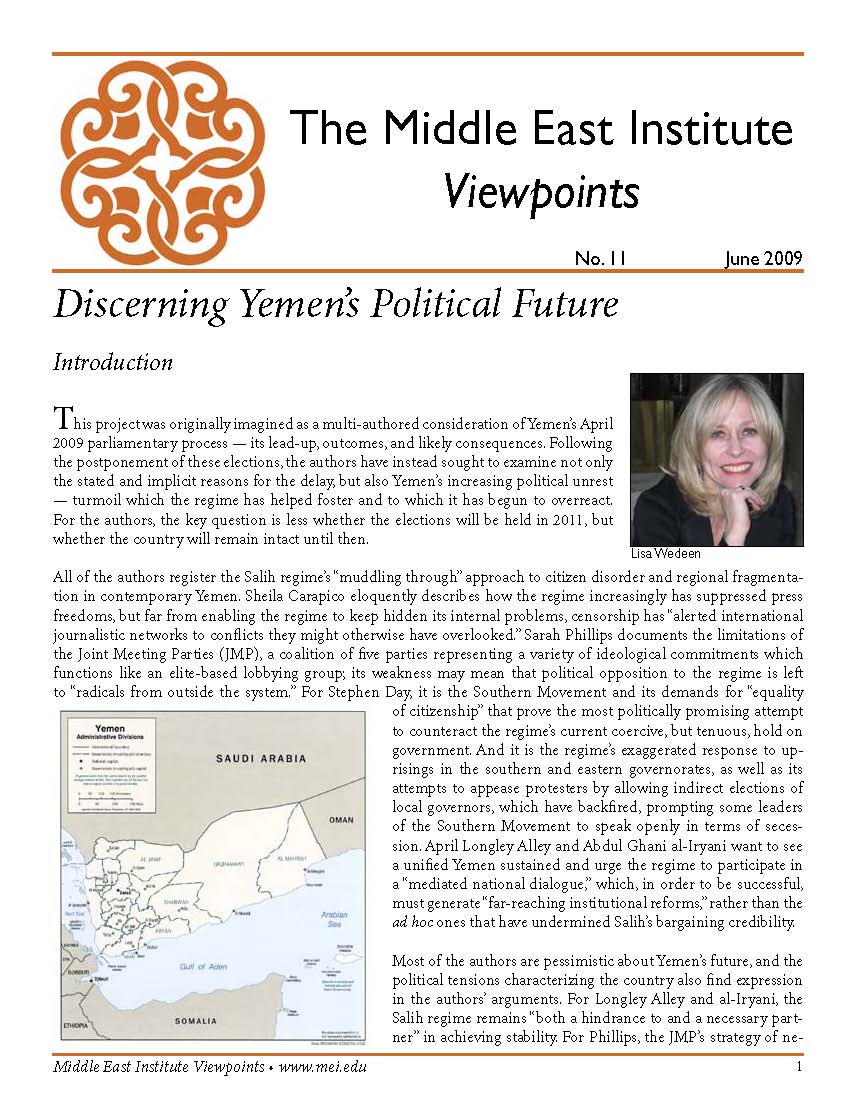
    Discerning Yemen's Political Future
  • Analysis
  • Discerning Yemen's Political Future

    This project was originally imagined as a multi-authored consideration of Yemen’s April 2009 parliamentary process — its lead-up, outcomes, and likely consequences. Following the postponement of these elections, the authors have instead sought to examine not only the stated and implicit reasons for the delay, but also Yemen’s increasing political unrest — turmoil which the regime has helped foster and to which it has begun to overreact. For the authors, the key question is less whether the elections will be held in 2011, but whether the country will remain intact until then.

    June 11, 2009



