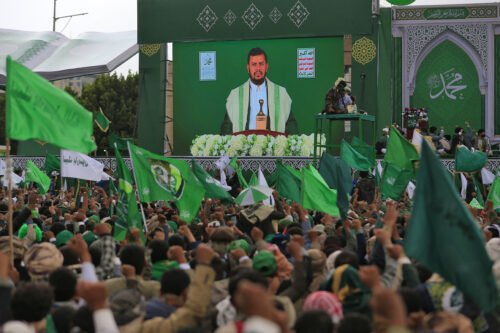
This article is part of a collection of short essays written by the Fellows of the Middle East Institute to explore aspects of the ongoing war with Iran. The intent of the collection is to help readers see new and unexpected elements of the dynamics and impact of the ongoing hostilities and to think harder, deeper, and broader about the implications of the conflict. To read the other essays from this collection, as well as download the full report, please click here.
The war with Iran has not yet resolved the contest between Tehran and Washington, but it has already begun to reshape the Middle East — and nowhere more clearly in the United States’ favor as in Lebanon. It is in Lebanon that Iran’s ability to project power through its proxies has suffered its most significant strategic setback following the decimation of the centerpiece of the Axis of Resistance, Hizballah. It is in Lebanon that Washington and its partners have the immediate opening to make that loss permanent. And it is in Lebanon that the wider struggle unfolding in the region between US-aligned states and the Iranian militias that hold them hostage faces a defining test: whether Washington and its partners have the determination to convert Iran’s material losses into lasting strategic change.
As Washington envisions the shape of the Middle East after the Iran war, Lebanon embodies three factors at once: evidence of what Iran’s waning power looks like on the ground, an opportunity to turn those hard-won defeats into permanent gains, and a test of wills Washington cannot afford to lose. Whatever comes next is not inevitable; it will be determined by the decisions Washington and its partners make before Tehran and its proxies can regroup. Getting Lebanon right sets the stage for what the US and the region can still choose: a new Middle East that replaces the Islamic Republic’s legacy of endless war, failed states, and economic ruin with a future led by sovereign states, prosperous economies, and lasting peace.
Moreover, as Washington searches for ways to impose disproportionate damage on Tehran to force its new, hardline leaders to agree to end the war on terms acceptable to the United States and its allies, stripping Hizballah of its arms — and thus its domination of Lebanon — stands out as an obvious, critical card for the Trump administration to play. Losing Hizballah would be a signal defeat for Tehran, one that could undermine the regime’s solidarity and offset any gains the Iranians could claim to have made.
Lebanon as Evidence of Iran’s Waning Power
Since the Hamas attack on Israel on October 7, 2023, a steady accumulation of political, economic, and security losses has weakened Hizballah’s position in Lebanon and exposed it and its Iranian patron to outright defeat. Hizballah was once the blueprint of Iran’s proxy network and the critical node that enabled Tehran to build a line of fire from Gaza to the Red Sea. But the group has emerged severely degraded from its back-to-back wars against Israel, which it undertook in support of Hamas and in revenge for the killing of Iranian Supreme Leader Ali Khamenei. In late June 2026, Israeli Prime Minister Benjamin Netanyahu claimed that Hizballah retained less than 10% of its pre-war missile arsenal and that Israel had killed around 9,000 of its fighters. Verifying such figures and quantifying Hizballah’s asymmetric threat are impossible without military intelligence; the trajectory these losses set, however, matters more than any number.
Israel’s ability to impose a security zone in southern Lebanon to map and destroy Hizballah’s tunnel networks and stockpiles as well as to eliminate entire military cadres largely at will demonstrates firm control of the escalation ladder and deep penetration of the Tehran-backed militia. Individually, each of these marks a momentous tactical setback; together, they shatter the premises underpinning Hizballah’s mirage of a deterrent — the premises that it could absorb more pain than Israel could inflict or the international community would allow, and that confronting it was not worth the cost.
Yet Hizballah continues to live and adapt in the space between what Israeli force alone cannot achieve and what Lebanese inaction allows. Iran has doubled down on smuggling arms, money, and Islamic Revolutionary Guard Corps (IRGC) personnel, taking a more explicitly direct role in reorganizing its crown jewel. Hizballah’s fiber-optic, first-person-view (FPV) drone program illustrates that adaptation. Parts can be smuggled or produced locally, and the drones surprise their Israeli targets and record the strike. The strike itself and the associated video footage are dual sources of propaganda. Aimed at Israel, the drone attacks evoke the image of an adversary that can bleed Israel gradually, while signaling to Lebanon that Hizballah alone can challenge Israel militarily.
That propaganda and adaptation reveal an adversary intent on recovering what it lost, but the narrative hits a hard wall when confronted with reality. It was American influence, not Hizballah’s drones or fighters, that halted Israel’s advance. Judged by what its arsenal is claimed to be able to accomplish, Hizballah is demonstrably failing. Hizballah’s weapons did not deter or defeat occupation; they invited it and cannot reverse it. And their power to deter the Lebanese state from asserting its sovereign authority, though still looming, is fading. The state has yet to confront Hizballah militarily, leaving space for the militia to regroup, but Lebanon’s government is reasserting its sovereignty in nearly every other respect.
Lebanon’s tightened control over its airport, ports, and borders, combined with the fall of Bashar al-Assad in Syria, poses a growing structural challenge to Iran’s ability to restore Hizballah as Beirut and Damascus consolidate state authority. American financial pressure, Israeli strikes, and Beirut’s restrictions on al-Qard al-Hassan — a critical pillar of Hizballah’s illicit economy — are straining Hizballah’s financial and social network. Washington has expanded its targeting of Hizballah’s smuggling networks and redesignated it “for service to the Iranian regime under the command of Iran’s Islamic Revolutionary Guard Corps-Qods Force.” US sanctions are also targeting Hizballah’s allies like former presidential candidate Sleiman Frangieh. Nonetheless, 40 years of penetration remain embedded through what the Lebanese call the deep state: the judges, the generals, public officials, and state bureaucrats high and low, who enable Hizballah to obstruct the state from within. As long as Lebanon’s cash economy thrives at the expense of the formal one, the informal networks that sustain Hizballah will endure. Though still incomplete, the direction being taken is what matters: a Lebanese state willing to act, backed by a United States unwilling to look away, is the key to permanently severing Hizballah’s lifelines.
Nothing illustrates that change more than the shifting political landscape. The loss of Hassan Nasrallah, Hizballah’s longtime secretary-general, deprived the organization of more than a charismatic leader. Nasrallah was the chief interlocutor between the public, Hizballah, and Tehran. He cast Hizballah as part of an ascending regional story and folded personal loss into a larger arc of victory. His killing, together with the elimination of the group’s founding military leadership, stripped Hizballah of the individuals who guided it through past defeats and allowed it to keep telling a story of triumph. Their deaths forced an IRGC unwilling to let go of its four decades’ investment to fill the vacuum. Iran’s more explicit direction, including reports of Iranian officers in Lebanon, further undermines Hizballah’s claim to be a Lebanese resistance force and deepens its image as a tool of Iranian occupation. This is a trend reinforced by the recent US redesignation of Hizballah.
In addition to losing its most persuasive storyteller, Hizballah has also lost the very appeal of its story. Its narrative of resistance and inevitable victory cannot survive the facts. The foreign wars it launched have left it on life support, its arsenal invites Israeli occupation and cannot end it, and the Shi’a community it claims to champion faces its most uncertain moment as a result. Its long war in Syria to prop up the Assad regime ended in full defeat. Hizballah’s entire project — its endless war with Israel packaged as resistance, servitude to the Islamic Republic that pits Lebanon against the Arab Gulf states, and dependence on the illicit economy in place of a rules-based one — has failed Lebanon.
It is also being overtaken by the rival story that can extinguish it: that Lebanon’s future belongs to the state. That narrative now commands the support and imagination of most Lebanese. While Hizballah remains a threat, it can no longer offer the Lebanese a future they are willing to accept. Hizballah has gone from an embodiment of an ascendant Iranian proxy empire to the harbinger of its fall: the axis’s lifeline is now its most vulnerable link.
The evidence of that loss of legitimacy is overwhelming. The vast majority of Lebanese favor Hizballah’s disarmament and reject war with Israel. Lebanon is not the case of a leadership bulldozing through decisions that serve the national interest despite their unpopularity. It is one where public opinion mostly favors that direction. The Lebanese public’s spike in support for a permanent end to war with Israel is one of the clearest examples. Unlike Egypt and Jordan, where President Anwar Sadat and King Hussein bin Talal signed peace agreements regardless of popular approval, Lebanon has mounting public support for peace. In the summer of 2025, after Hizballah’s war to save Hamas, Gallup found that 86% of Lebanese opposed war against Israel for a foreign cause and 79% wanted Hizballah disarmed. That was before the paramilitary group dragged Lebanon into an even more ruinous conflict. Having paid the price for Hizballah’s wars, the Lebanese are coming around to peace, and faster than anyone predicted: a year ago, 25% approved of an accord; that number has since doubled.
A distinct Lebanese identity, a reassertion of national sovereignty, a definitive end to war with Israel, and the primacy of the state, once the fault lines of 15 years of civil war, have today become points of common ground for the population and its leaders. That in turn shatters the rationale on which Hizballah justified its exceptionalism — that the state could never be that stable ground — and exposes Hizballah as the principal obstacle standing between Lebanon and the sovereign future its people want.
Time has proven to the Lebanese that a country dominated by Hizballah and hollowed out by mafias beholden to it can no longer be sustained. The crises that dysfunction has produced, from the 2019 economic meltdown to Hizballah’s latest war with Israel, continue to drive a mass exodus of Lebanese from the country, leaving for the Arab Gulf states, Europe, North America, and other globally connected economies. When livelihoods are at stake and personal and familial futures are decided, there is no more honest referendum on the Islamic Republic’s revolutionary and resistance project that Hizballah typifies than the destinations people choose. In the most consequential ways available to ordinary people, they are voting with their feet for states that offer sovereignty, the rule of law, and peaceful coexistence with the world around them.
Hizballah’s declining popular legitimacy and ability to hijack Lebanon’s future are also evident in what it can no longer prevent. In the past, when the state tried to assert its authority, Hizballah could paralyze governing and security institutions from within, mobilize waves of protests against the Lebanese government, assassinate opponents with impunity, and march its fighters in the capital. It was no longer able to block the state from going so far as to outlaw Hizballah’s military activities this past March or, in June, to sign the Trilateral Framework with Israel and the United States, laying out the roadmap to end the Israel-Lebanon conflict, ensure both countries’ sovereignty and security, and establish peaceful relations between them. Neither on the street nor in the halls of power, neither by force nor by persuasion, could Hizballah stop the Lebanese state from opting for a sovereign, peaceful future or delegitimize that choice. Hizballah has so far, however, retained the ability to delay and deter the Lebanese from implementing the most critical changes needed to deliver that future.
Lebanon as Opportunity
Washington’s opportunity in Lebanon stems from the rare alignment of having a willing partner in the Lebanese state, widespread support among the Lebanese people, and an adversary that is politically, economically, and militarily exposed. Hizballah’s conceit that to survive is to win, even as Lebanon lies in ruin, has lost its currency. In contrast, Washington has established the framework that spells out a clear and more convincing theory of victory that Lebanese and Israelis share: disarming Hizballah, securing a sovereign Lebanon, and ending the Israel-Lebanon conflict once and for all.
In the Lebanese state, Washington has a head of government, Prime Minister Nawaf Salam, and a head of state, President Joseph Aoun, who are outside Hizballah’s control and have committed to reclaiming their country. Lebanon’s parliament, whose dysfunction should not be discounted, is one in which Hizballah has lost its majority. Beirut has taken irreversible steps to demonstrate its will, outlawing Hizballah’s military activities, curbing illicit smuggling and finance networks, and signing the Trilateral Framework. Moreover, it has framed each step — holding a monopoly on force, border control, and authority over decisions of war and peace — as a national imperative. President Aoun’s trip to Washington in July marked the definitive decision by Lebanon’s leadership that it was banking on diplomacy and engagement with the US to reclaim its sovereignty rather than exploiting last June’s US-Iran Memorandum of Understanding that seemingly offered Tehran a vote on letting Lebanon backslide into servitude.
Washington’s role in all of this would not be to fight Lebanon’s fight but to empower the Lebanese state, backed by its people, to succeed in that national endeavor, dismantle Iran’s occupation by proxy, and permanently end the state of war with Israel once and for all. Washington has already achieved a diplomatic breakthrough by getting the Lebanese and Israelis to agree on how to get there.
The Trilateral Framework’s major achievement, as former US Ambassador to Beirut David Hale writes, has been to establish that restoring Lebanese sovereignty and lasting peace are mutually interlocking. It also charts a path to overcome the main challenge to get there — Hizballah’s disarmament — without tearing Lebanon apart. The agreement pairs Hizballah’s disarmament with Israeli withdrawal, in pilot zones, under robust verification. Negotiations over the details continue. And though action on the ground must be seen to be believed, the blueprint itself offers the ingredients for success: a phased approach that keeps the steps of disarmament, withdrawal, and verification manageable, quick, and replicable. The phased approach also makes it difficult for Hizballah to spoil progress, as it allows the Lebanese Armed Forces (LAF) to concentrate on clearing Hizballah’s footprint in each zone and keeping the group out, secures visible Israeli withdrawal, thus permitting Lebanese to return home, and raises the costs of Hizballah confronting the Lebanese state or the LAF as it does the job.
While Hizballah excels at leveraging targeted coercion to maximum political effect, it cannot fire first without major backlash — 2026 is not 2008, when Hizballah marched on Beirut and brought the state to heel as the world looked away. Its back-to-back wars have left it degraded and unpopular, while the LAF enjoys broad public support. Hizballah is surrounded by enemies on both borders, restricted by a state choking off its resupply lines, and faced with regular assassinations and airstrikes in its ongoing war with Israel.
Washington is also assembling the sticks and carrots to enable Lebanese-led success. For instance, the bipartisan Lebanon Sanctions, Stabilization, and Support Act conditions US assistance for the LAF on its performance in disarming Hizballah, supports Lebanese-led recovery and reconstruction, and sanctions and isolates Hizballah. The intent of the act is to increase the space for the Lebanese state to consolidate its authority and limit the room for Hizballah’s allies to undermine it from within. In Lebanon today, Washington will find the leadership, the public, the framework, and the leverage to achieve victory. All that remains is for the United States to follow through. Perhaps the least appreciated opportunity is that on the Hill and in the White House, in an otherwise polarized capital, a growing bipartisan consensus holds that securing a sovereign Lebanon is in America’s interests.
Lebanon as a Test
Favorable as the context is, it does not guarantee a positive outcome. Iran continues to reorganize, fund, and rearm Hizballah. The group remains a disciplined, ideologically coherent, and determined force whose residual coercive power, influence inside Lebanese institutions, and fearsome reputation have so far deterred the state from militarily confronting it. But that hesitation can be overcome. By building the LAF into a force capable of and willing to enforce sovereignty, making the pilot zones work, denying Hizballah the means to regenerate, and shifting, irreversibly, the political calculus toward the state and away from the militia, Washington can supply the last ingredient victory requires.
Washington must confront that hesitation at its root, and the framework’s phased design is built to help. Each pilot zone is a manageable space in which the Lebanese can prove they are willing and able to dismantle Hizballah’s infrastructure and keep it out, Israel can prove it is committed to Lebanese sovereignty by withdrawing in return, and the entire process can be verified so that trust and momentum hold. While the pilot zones confine the space of confrontation, the step is politically irreversible, and precisely because so much hinges on it, it must be made to succeed and cannot be taken half-heartedly.
Empowering the Lebanese to take that step requires both the capability to do the job and the confidence that they will not be left alone as they confront Hizballah and Iran. The newly introduced bill in Congress is a step in the right direction, and the US has already tested an applicable model of success in Iraq, when it empowered the Iraqi military to defeat the Islamic State (ISIS). As MEI’s Vice President for Policy Kenneth Pollack has laid out in more detail, providing American advisers and trainers, along with intelligence, logistics, and fire support, would do for the LAF what Operation Inherent Resolve did for the Iraqis who took on ISIS and won.
As decisive as US backing is, Lebanese action also depends on military leadership with a mindset equal to the mission, one matching that of President Aoun and Prime Minister Salam. The LAF’s initiative in securing Beirut’s airport is exactly the assertiveness that must be reflected at all levels of command. Personnel is policy. If the LAF is to enforce sovereignty, it must demonstrate, at the top, that it has left the old posture of being a balancing institution behind and is committed to enforcing the state’s directives. The result would be a self-reinforcing dynamic: greater US presence and support, paired with more assertive Lebanese military leadership, would embolden those within the LAF prepared to act, and an assertive posture would prevail with each step forward.
Especially because of the legacy of failure of the United Nations Interim Force in Lebanon (UNIFIL), getting verification right, as the Washington Institute’s Senior Fellow Matt Levitt notes, is essential to operationalizing the Trilateral Framework. US leadership of a credible international mission is critical to verify success, identify deficiencies, and see failures addressed promptly and decisively. Washington has the trust and credibility to work with Lebanon, Israel, and a new international verification mission, providing the intelligence and operational advice needed to confirm Hizballah has been cleared from each zone, Israel has withdrawn, and the LAF has moved in to take their place and keep them out.
Beyond the military front, dismantling Hizballah’s embedded network of influence is necessary to extirpate it. Building on US sanctions against Hizballah’s networks and allies, and its redesignation as Washington rolls out its “economic D-Day” against Iran, Washington must also target exchange houses that funnel Iranian money to the group, compromised bureaucrats obstructing the state from within, and judges who grant it impunity, as Hanin Ghaddar has argued. The stick needs a carrot. Lebanese American University economist Walid Marrouch has similarly explained that Washington and its international partners should complement greater pressure on spoilers and scrutiny of Lebanese institutions to uphold their responsibilities with targeted support to bolster the state’s capacity to uphold the rule of law, govern its economy, resolve its financial crisis, and control its borders, ports, and airports. Every institution the state rehabilitates — its central bank, its courts, its customs — is a gain for sovereignty and a loss for Hizballah’s rule of chaos.
The tools, the framework, and the partners to achieve victory in Lebanon are all in place. What will now be tested is the will of Washington and Beirut to act with the resolve the moment demands and lock in the first re-ordering of the Middle East after the Iran war. A sovereign Lebanon and the defeat of Hizballah are within reach. Just as the Lebanese decided that their future belongs to the state, not to a militia beholden to Iran, success in Lebanon would signal to a region still hedging and an America seemingly hesitant to see through what it started that Iran’s defeat, and the reordering of the Middle East, can be made permanent. In Lebanon, all of the evidence indicates that the combination of local partners committed to restoring their sovereignty, a weakened Islamic Republic, and a steadfast United States can together secure a future that serves the Middle East and America alike.
Fadi Nicholas Nassar is a Senior Fellow at the Middle East Institute.
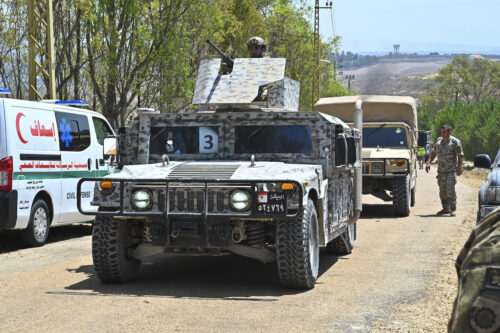
Top image: Lebanese army troops deploy in the town of Western Zawtar in southern Lebanon on July 23, 2026, to conduct search and inspection operations following the withdrawal of Israeli forces. Photo by Fadel Itani/NurPhoto via Getty Images.
The Middle East Institute (MEI) is an independent, non-partisan, not-for-profit, educational organization. It does not engage in advocacy and its scholars’ opinions are their own. MEI welcomes financial donations, but retains sole editorial control over its work and its publications reflect only the authors’ views. For a listing of MEI donors, please click here.
The Mecca Alliance Meets the Red Sea – Saudi Arabia’s New Defense Pact Faces Its First Major Test