Brian is joined by His Excellency Talal Al Rahbi, the ambassador of the Sultanate of Oman to the United States of America, to discuss what it means to represent the “Switzerland of the Middle East” and the role of Oman’s quiet diplomacy. He also reflects on growing up during Oman’s transformation, his time spent in the United States, and why the two nations’ long-standing partnership matters today.
After decades of political setbacks, Iran’s former Revolutionary Guards commander has returned to the center of power. Is he an incidental beneficiary of war, or have observers underestimated him all along?
The Unavoidable Neighbor: Managing Iran Beyond the War
Gulf states and their partners are increasingly looking beyond their most immediate interests of containing the war with Iran. While recent talks between Saudi Arabia, Turkey, Pakistan, and Iran have kept de-escalation on the agenda, a broader regional security framework and non-aggression pact has also emerged, envisioning a longer-lasting solution to regional conflicts. The talks have yet to produce a settlement, but they reflect a growing recognition that Gulf security cannot depend entirely on Washington. Iran will still be there, and its neighbors will have to find ways of living with it.
A United States Marine's View of the Artesh and IRGC
United States military forces use standard procedures for planning operations against other militaries. These procedures differentiate between different branches, or units, of an opposing force depending on their capabilities and limitations. This article presents one such analysis of the Iranian Military, where there are vast differences between the Islamic Revolutionary Guard Corps (IRGC)and the Artesh, or the regular Iranian armed forces. The article then draws parallels to the planning for Operation Iraqi Freedom that led to the defeat of the Iraqi Republican Guard and regular Iraqi
As the United States and its allies have tightened sanctions on Iran, they have sought in particular to isolate the Islamic Revolutionary Guard Corps, the regime’s most aggressive institution. The IRGC, known in Persian as the Pasdaran, fields its own army, navy, and air force, and dominate a large and increasing share of Iran’s national economy.
Iran’s regular military, the Artesh, receives virtually no attention from international media or scholars on Iran. By contrast, its political rival, the Islamic Revolutionary Guard Corps (IRGC, also known in Persian as the Pasdaran), is scrutinized constantly by analysts for its visible, high-profile role in Iran’s political system, its economic resources and corporate activities, and its role as a spearhead of Iran’s regional policies.
Introduction to The Artesh: Iran's Marginalized Regular Military
As the US-Iran showdown continues, among Western analysts there is an infinite desire for more data and analysis relating to the workings of the Islamic Republic. From a US standpoint, a better understanding of the various organs and players in the Iranian regime setup is imperative as Washington weighs its options and sets out to formulate its policies.
MEI scholar Randa Slim led a discussion about Hezbollah and its reaction to shifting regional dynamics in the wake of the Arab Spring. Although Lebanon has not experienced the same levels of unrest as its neighbors, Hezbollah is not immune from the regional instability resulting from the revolutions roiling the Middle East. Hezbollah is currently the principal orchestrator of a new governing coalition that is rife with internal divisions.
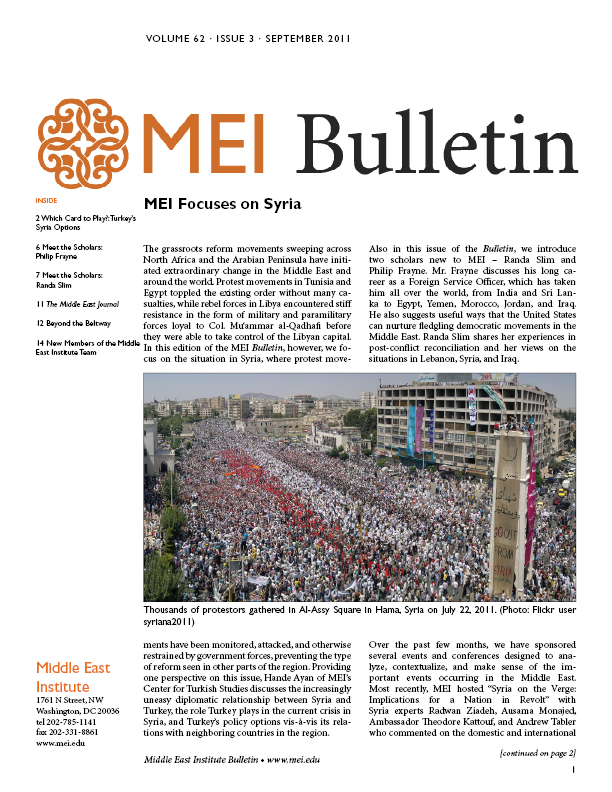
Amidst ongoing violence against protestors in Syria, Hande Ayan of the Center for Turkish Studies discusses the uneasy diplomatic relationship between Turkey and Syria and Turkey’s role in the political situation there. The September 2011 Bulletin also introduces MEI scholars Philip Frayne, who speaks on his Foreign Service career and offers his insights on how the US can support democratic transitions in the Middle East, and Randa Slim, who is interviewed on her experience in post-conflict reconciliation.
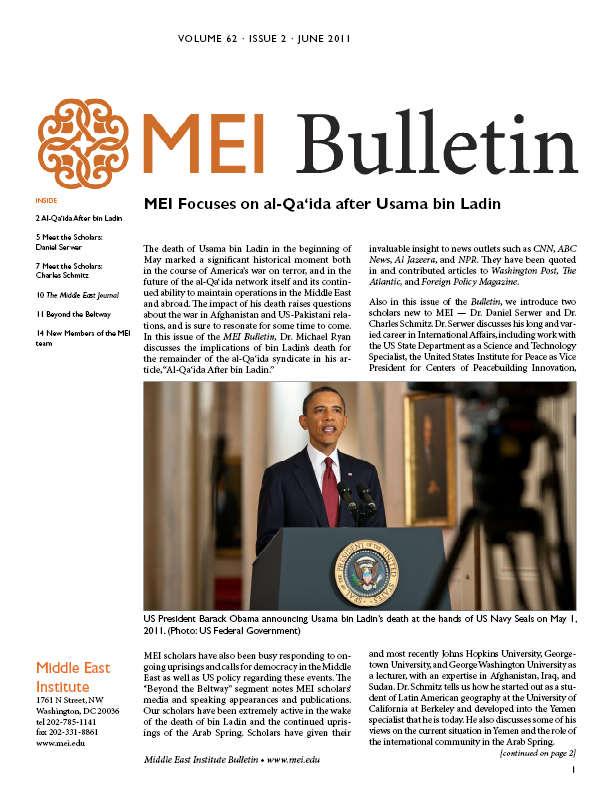
In the June 2011 Bulletin, Dr. Michael Ryan discusses the implications of bin Ladin’s death for the remainder of the al-Qa’ida network. It also introduces new MEI scholars Dr. Daniel Serwer, who is interviewed on his career in technology and peacebuilding, and Dr. Charles Schmitz, who speaks about his work on Yemen.
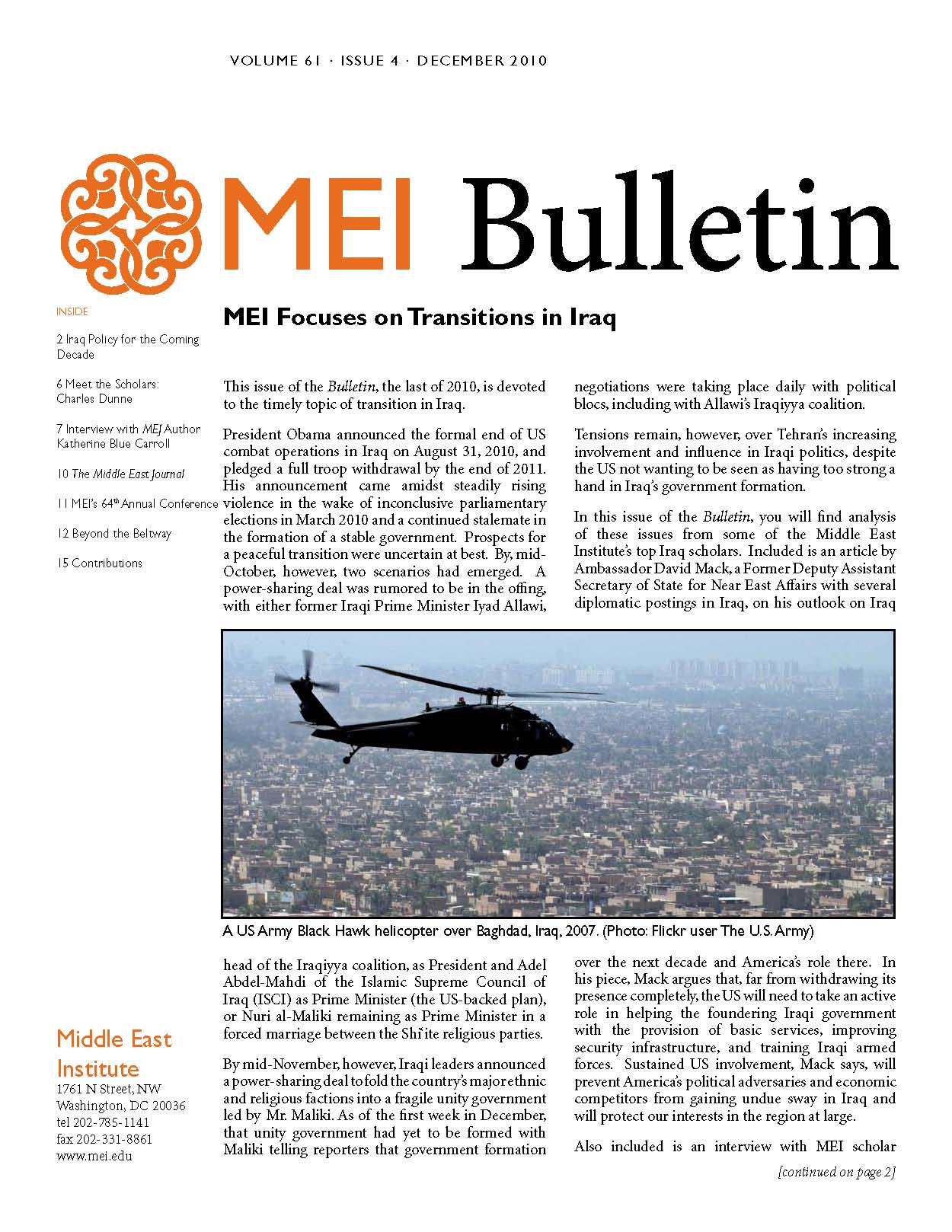
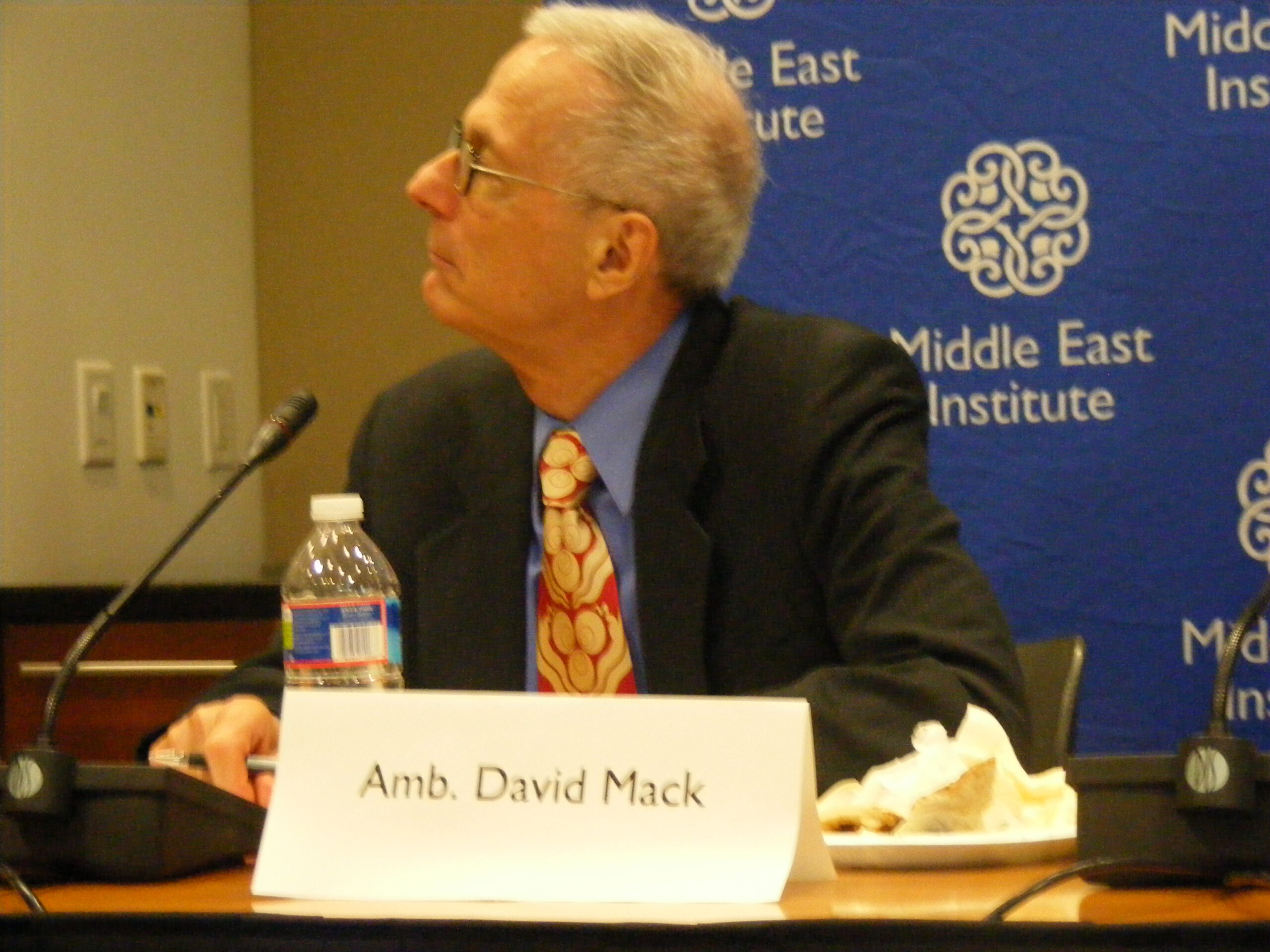
In the wake of the August 31 drawdown of US forces and the formation of a fragile unity government after months of negotiations, the December 2010 Bulletin features an argument from Ambassador David Mack for sustained US assistance to the Iraqi government, interviews with MEI Scholar Charles Dunne the political situation in Iraq and with Katherine Blue Carroll on her forthcoming MEJ article, and a summary of MEI’s 64th Annual Conference.
A View From the Gulf: A Discussion of Gulf Politics and Security
Dr. Abdelaziz Sager, Dr. Mustafa Alani, and Dr. Christian Koch of the Gulf Research Center share their perspectives on regional events and the Arab Spring.
This Commentary was first published as an op-ed in the Daily Beast on September 7, 2011
The events of that day were so jarring that they are recorded in our memories as if they had taken place last week. But it has been a long decade, one in which we have made as many mistakes as we have had successes. Now, and not after we suffer another major terrorist attack, is good time to pause, look back, learn lessons, and begin to chart a path away from the past.
The oldest peer-reviewed publication dedicated to the study of the modern Middle East, MEI’s flagship journal covers politics, society, and culture in the region.