The Americans Are Gone. Will Iraq’s Militias Disarm?
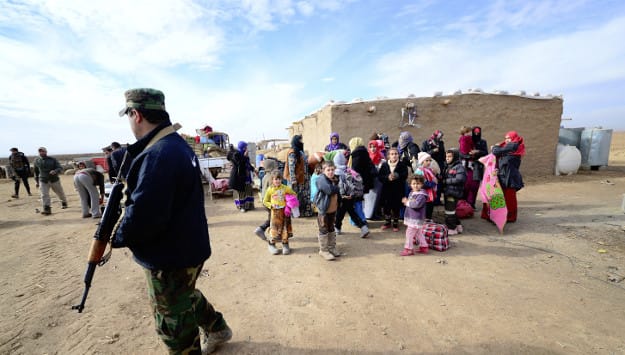
On September 30, the US completed its military withdrawal from Iraq, ending a 12-year-long mission to combat ISIS that began in 2014. The date was also meant to be the deadline for disarming the largely Iranian-backed militias known as the Popular Mobilization Forces (PMF), but Prime Minister Ali al-Zaidi has now pushed that cutoff back to June 30, 2027. MEI Distinguished Diplomatic Fellow Amb. (ret.) Robert S. Ford joins hosts Alistair Taylor and Matthew Czekaj to discuss what the US military withdrawal means for Iraqi security and the nature of the bilateral relationship going forward. They also speak about what it will take for Baghdad to bring the PMF militias to heel, and how Iraq may navigate the post-Iran war era.
Jordan’s Economy Weathers Iran War’s Shocks and Finds New Opportunities
In the summer of 2003, King Abdullah II told Bloomberg Jordan sits “between Iraq and a hard place,” a play on words designed to describe the kingdom’s challenging environment to an American audience amid the US-led Iraq war to the east and the lingering Palestinian-Israeli conflict to the west. Jordan is grappling with a much “harder place” today.
Proponents of the war with Iran have taken recent increases in crude-oil flows through the Strait of Hormuz as proof that the US strategy is finally working. President Trump is so confident in this that he recently rejected a seven-day plan, set forward by Iran’s foreign ministry, to end the war and open the strait. The United States is “winning tremendously,” Trump boasted.
Interview with Indian Ambassador (ret.) Ranjit Gupta: Jeddah, Saudi Arabia ― The Second Posting (1976-1978)
Soon after arriving, I was surprised to find out from long-serving local staff at the Embassy and a few Indians who had resided in Saudi Arabia for more than three decades that I was the first non-Muslim Foreign Service Officer to serve in the Indian Embassy in Saudi Arabia.
The Asia Cooperation Dialogue (ACD): Progress and Potential
The Asia Cooperation Dialogue’s (ACD) future looks promising. The 11-year-old ACD has taken important steps in becoming a relevant, constructive pan-Asian body with a forward-looking agenda, concrete plans and projects underway, and some noteworthy accomplishments.
Learning from Iraq: A New Model for Stability and Reconstruction Operations
Tue, 5/21/2013 12:00 pm to 1:00 pm The Middle East Institute is pleased to welcome Stuart Bowen, the Special Inspector General for Iraq Reconstruction, to discuss his proposals for how best to conduct Stability and Reconstruction Operations. Stability and Reconstruction Operations, or (SROs), entail governmental efforts to rebuild crucial infrastructure, implement rule of law, and ensure security in developing countries before, during, and after armed conflict. As Mr.
Learning from Iraq: A New Model for Stability and Reconstruction Operations
Tue, 5/21/2013 12:00 pm to 1:00 pm The Middle East Institute is pleased to welcome Stuart Bowen, the Special Inspector General for Iraq Reconstruction, to discuss his proposals for how best to conduct Stability and Reconstruction Operations. Stability and Reconstruction Operations, or (SROs), entail governmental efforts to rebuild crucial infrastructure, implement rule of law, and ensure security in developing countries before, during, and after armed conflict. As Mr.
Learning from Iraq: A New Model for Stability and Reconstruction Operations
Tue, 5/21/2013 12:00 pm to 1:00 pm The Middle East Institute is pleased to welcome Stuart Bowen, the Special Inspector General for Iraq Reconstruction, to discuss his proposals for how best to conduct Stability and Reconstruction Operations. Stability and Reconstruction Operations, or (SROs), entail governmental efforts to rebuild crucial infrastructure, implement rule of law, and ensure security in developing countries before, during, and after armed conflict. As Mr.
Learning from Iraq: A New Model for Stability and Reconstruction Operations
Tue, 5/21/2013 12:00 pm to 1:00 pm The Middle East Institute is pleased to welcome Stuart Bowen, the Special Inspector General for Iraq Reconstruction, to discuss his proposals for how best to conduct Stability and Reconstruction Operations. Stability and Reconstruction Operations, or (SROs), entail governmental efforts to rebuild crucial infrastructure, implement rule of law, and ensure security in developing countries before, during, and after armed conflict. As Mr.
Learning from Iraq: A New Model for Stability and Reconstruction Operations
Tue, 5/21/2013 12:00 pm to 1:00 pm The Middle East Institute is pleased to welcome Stuart Bowen, the Special Inspector General for Iraq Reconstruction, to discuss his proposals for how best to conduct Stability and Reconstruction Operations. Stability and Reconstruction Operations, or (SROs), entail governmental efforts to rebuild crucial infrastructure, implement rule of law, and ensure security in developing countries before, during, and after armed conflict. As Mr.
China’s Iraq Oil Strategy Comes Into Sharper Focus
“…Despite the inherent risks in dealing with complex and unstable markets such as Iraq, Chinese investors have been gaining a foothold in the country’s energy sector and in doing so have begun to face a unique set of challenges. In addition to having to navigate a tumultuous political and security environment, China is engaging a country that for a long period of time remained effectively under U.S. military occupation even as the central Iraqi government operated under a framework of limited sovereignty …
Gulf Arab Foreign Direct Investment (FDI): ASEAN Targets of Opportunity
Although China and India have been new favorable destinations for Arab investors, Southeast Asian countries offer distinctive and profitable investment markets, featuring high demand and relatively low labor costs. In recent years, investments from the Gulf Cooperation Council (GCC) to the Association of Southeast Asian Nations (ASEAN) have surged.
Challenging Stereotypes: Educational Aspirations of Emirati and Indian Muslim Women
Many Muslim women do not choose to forego education, but rather are unable to access this basic right mainly due to a lack of opportunity and socio-political constraints. The sharply contrasting cases of India and the United Arab Emirates (UAE) are illuminating in this respect. While the Indian case presents a stark picture, the Emirati case presents a bright and more hopeful one.
Interview with Indian Ambassador (ret.) Ranjit Gupta: Cairo, Egypt — The First Posting (1965-1968)
Even before I left India for Cairo, I had the impression that there was a special relationship between India and Egypt. Indeed, within a few weeks of my arrival in Cairo, I found tangible manifestations that it was indeed so and discovered many more in due course.
Companies from Asia are beating their European and American rivals in investments in Iraq. Being more prone to risk-taking, they are cashing in on the opportunity to establish businesses that would be profitable in the long-term.
The oldest peer-reviewed publication dedicated to the study of the modern Middle East, MEI’s flagship journal covers politics, society, and culture in the region.