Skip to Content

Iran

A Strategic Conundrum: Pakistan’s Transit Corridor to Iran as Lifeline or Liability
  • Analysis
  • A Strategic Conundrum: Pakistan’s Transit Corridor to Iran as Lifeline or Liability

    The US-Iran standoff over the Strait of Hormuz — disruptive to global trade and energy flows, and devastating for debt-burdened economies — has handed Pakistan an unexpected geoeconomic opportunity, one that may persist even if the framework agreement announced on June 14 results in a lasting peace and permanent reopening of the strait. But seizing it will have interlocking consequences for Islamabad’s ties with Tehran, Washington, and the Gulf states.

    June 17, 2026

    Iran: What’s Next for US Policy as the Region Seeks to Move On
  • Analysis
  • Iran: What’s Next for US Policy as the Region Seeks to Move On

    As the US and Iran move to reopen the Strait of Hormuz, the war’s real lesson lies in how Gulf states rapidly adapted — building pipelines, ports, and rail to bypass the chokepoint. Washington should seize this momentum, pursuing a “long game” of regional connectivity that serves shared security and economic interests.

    Filter by
    2744 Results
    Toward a Regional Framework for the Middle East: Takeaways from other Regions
  • Analysis
  • Toward a Regional Framework for the Middle East: Takeaways from other Regions

    Regional Cooperation Series

    This Policy Paper is part of the Middle East Institute’s Regional Cooperation Series. Throughout 2016, MEI will be releasing several policy papers by renowned scholars and experts exploring possibilities to foster regional cooperation across an array of sectors. The purpose is to highlight the myriad benefits and opportunities associated with regional cooperation, and the high costs of the continued business-as-usual model of competition and intense rivalry.

    Trump’s Iran Gift to China?
  • Analysis
  • Trump’s Iran Gift to China?

    Most observers are still trying to figure out president-elect Donald Trump’s likely Iran policy. Whatever it might be as an approach, it will probably be nothing as accommodating as has been the case in the Obama era. And if Washington starts to earnestly squeeze Tehran from January 21, 2017, the Iranians no doubt will turn to Russia and China for protection.

    New Basij Chief Tasked to Counter “Enemy Plots”
    Middle East Institute
  • Analysis
  • New Basij Chief Tasked to Counter “Enemy Plots”

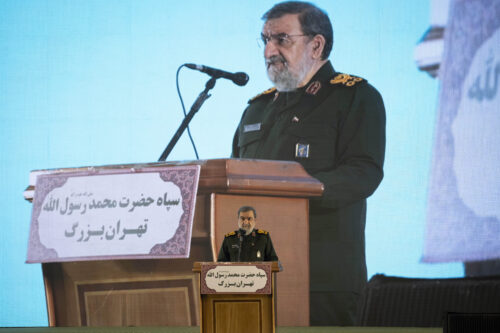
    On December 7, Iran’s Supreme Leader Ali Khamenei appointed Brigadier General Gholamhossein Ghaib-Parvar as the new commander of Iran’s Basij organization. Brigadier General Mohammad Reza Naqdi, former head of Basij, will direct the Islamic Revolution Guards Corps (IRGC’s) cultural and social affairs.

    December 7, 2016

    Shell Latest Energy Giant to Return to Iran after Nuclear Deal
  • Analysis
  • Shell Latest Energy Giant to Return to Iran after Nuclear Deal

    Despite uncertainty surrounding the future of the 2015 Iran nuclear deal, international energy giants are competing fiercely to invest in Iran’s rich oil and natural gas sectors.

    December 7, 2016

    Rouhani Warns Trump: You Can’t Tear up Nuclear Deal
  • Analysis
  • Rouhani Warns Trump: You Can’t Tear up Nuclear Deal

    Iran’s President Hassan Rouhani said he would not allow President-elect Donald Trump to tear up the 2015 nuclear agreement and warned of “bitter response” if the next US administration failed to honor the deal.

    December 6, 2016

    Reformists and Hardliners at Loggerheads over Opposition Leaders’ Arrest
  • Analysis
  • Reformists and Hardliners at Loggerheads over Opposition Leaders’ Arrest

    More than seven years since the 2009 presidential elections in Iran, controversies related to the disputed polls and the regime’s subsequent crackdown of the protest movement continue to haunt the Islamic Republic. As the country is gearing up for next year’s presidential vote, Iranian conservatives and reformists are yet again at loggerheads over the house arrest of Green Movement leaders Mir Hossein Mousavi and Mehdi Karroubi.

    December 6, 2016

    Monday Briefing: OPEC Deal a Win for Iran
  • Analysis
  • Monday Briefing: OPEC Deal a Win for Iran

    In this week’s Monday Briefing, MEI experts Herman Franssen, Charles Lister, W. Robert Pearson, and Marvin G. Weinbaum provide analysis on recent and upcoming events including OPEC’s agreement to reduce oil output, the continuing offensive in Aleppo, Erdogan’s increasing executive powers, and deteriorating relations between Pakistan and India.

    OPEC Deal a Win for Iran
    Herman Franssen, MEI Scholar

    Strengthening U.S.-Arab Cyber Security Policy Cooperation
    Middle East Institute

    Strengthening U.S.-Arab Cyber Security Policy Cooperation

    December 5 – January 1, 1970, December 5 - 1:30 PM – 12:00 AM
    January 1 - 1:30 PM – 12:00 AM

    Carnegie Endowment - Root Room, 1779 Massachusetts Avenue NW, Washington, District of Columbia 20036

    Tycoon's Death Penalty Points to Oil Corruption in Iran
  • Analysis
  • Tycoon's Death Penalty Points to Oil Corruption in Iran

    The Iranian media reports that the country’s Supreme Court has upheld the death sentence for Babak Zanjani, an Iranian billionaire convicted in a high-profile oil corruption case. In March, a court in Iran had convicted him of being “

    December 5, 2016

    The OPEC Deal and Iran’s Moderates
  • Analysis
  • The OPEC Deal and Iran’s Moderates

    In Tehran, the November 30 decision by OPEC to cut oil production by member states was predictably a big deal. This, however, was not just about the economics of the event. Sure, the price of crude oil shot up by 10% on the announcement. It was the first time in eight years that OPEC states had agreed to a collective production cut.

    But in Tehran, the other big news was that Iran – OPEC’s third-biggest producer – had escaped the call for it to cut back its production. On the other hand, Iran’s biggest regional rival, Saudi Arabia, agreed to a steep cut.

    Iranian Authorities Intensify Acts of Repression against Artists
  • Analysis
  • Iranian Authorities Intensify Acts of Repression against Artists

    Mehdi Rajabian, an Iranian musician serving a three-year jail term at Tehran’s Evin prison, is being treated for internal bleeding at a hospital. But the country’s judiciary has demanded that he return to prison, disregarding his serious medical condition.

    A Revolutionary Court in 2015 found Rajabian, his filmmaker brother Hossein Rajabian, and their musician friend Yousel Emadi guilty of “insulting Islamic sanctities” and “illegal audio-visual activities.”

    December 2, 2016

    Syria and Allies Setting Up New Commando Force
    Middle East Institute
  • Analysis
  • Syria and Allies Setting Up New Commando Force

    Iran’s Fars News Agency (FNA) reports that Syria’s army has formed a new elite force called the Al-Filq Al-Khamis-Eqteham (Fifth Assault Corps) and is calling on volunteers to join the group.

    December 2, 2016

    Read the Middle East Journal

    The oldest peer-reviewed publication dedicated to the study of the modern Middle East, MEI’s flagship journal covers politics, society, and culture in the region.