Lebanon is America’s next foreign policy win — if Washington acts now. The US has committed blood and treasure to neutralize Iran’s ability to project power and destabilize the Middle East. Lebanon is now the clearest opening to convert those investments into strategic gains and permanently dislodge the Islamic Republic from its most important regional foothold. Securing a sovereign Lebanon, achieving a lasting Israel-Lebanon peace, and dismantling Hizballah — the blueprint of Iran’s proxy model — would irreversibly weaken Tehran’s threat and consolidate a new regional order led by America’s partners before Iran has a chance to reverse its losses.
Scenarios of Change and Possibilities of Reform in Lebanon
The recent spate of bombings in Beirut underline the degree to which Lebanon has become entangled in the wider regional conflict being fought in and around Syria, but the paralysis of Lebanon’s political institutions indicate an equally deep domestic dysfunction. There is no doubt that part of Lebanon’s problems derive from its difficult geostrategic environment and require external developments and changes, and part of them come from the weaknesses of its domestic political and socioeconomic system and require internal reform.
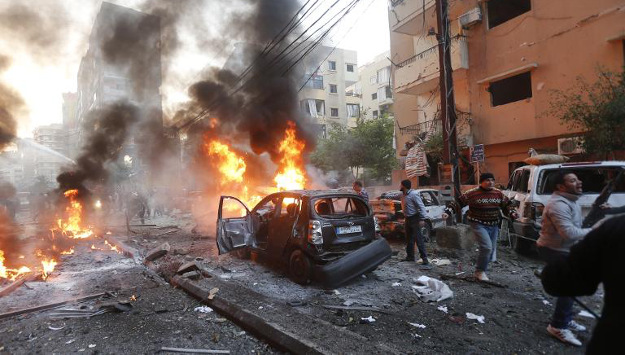
On January 2, only days after a car bomb in Beirut took the life of former Finance Minister Mohamad Chatah and several bystanders on December 27, another bomb struck the capital’s southern suburbs. With initial reports of four dead and 40 wounded, this latest, and possibly retaliatory, attack fits into an ominous pattern as Syria’s conflict spills into Lebanon.
On Wednesday, December 4, Hassan Laqees, a Lebanese Hezbollah leader who was reportedly involved in the group’s weapons procurement and development, was assassinated south of Beirut. On Sunday, another Hezbollah military commander was killed in Syria, bringing the number of Hezbollah dead in the Syrian conflict into the hundreds.
Earlier today, double explosions near the Iranian embassy in Beirut killed at least 23, including an Iranian diplomat. The Abdullah Azzam Brigades, an Islamist group with links to al-Qa`ida, took responsibility for the attack. MEI sat down with its Vice President for Policy and Research, Paul Salem, to discuss the significance of the bombings in Lebanon as well as their regional and global implications.
Tell us about the bombing and the group that claimed responsibility for it.
Helsinki and US-Russian Cooperation in the Middle East
Andrey Kortunov, director general of the Russian International Affairs Council, and Randa Slim, director of MEI’s program on Conflict Resolution and Track II Dialogues, join host Paul Salem to discuss the Helsinki Summit and takeaways from the latest meeting of the US-Russia Middle East Dialogue in Berlin, where participants outlined challenges and opportunities for US-Russian cooperation in Syria and elsewhere in the region.
The sun is beating down and it isn’t even midday. Clutching the all-important paperwork that will get them coveted UN food vouchers, Syrian refugees look harried. The women pull at their children to hurry through the litter-filled yard of the sports club in the town of Bar Elias that serves as a distribution center for the UN’s hard-pressed World Food Program (WFP). Unlike their men, who head for the shade to smoke and exchange news, the women don’t dally, making for the snaking lines into a crowded hall where they will be called in groups by registration numbers.
Randa Slim, MEI Scholar and adjunct research fellow at the New America Foundation, discusses the implications of Hezbollah's growing role in Syria for Lebanese politics and Lebanon's Shiite community.
The Middle East Institute is pleased to welcome MEI Scholar Randa Slim for a discussion on the implications of Hezbollah’s growing role in Syria for Lebanese politics and Lebanon’s Shiite community. Recently returned from a trip to the region, Slim will examine Hezbollah’s potential end game in Syria, and whether Lebanon will be able to resist being drawn into the conflict following Hezbollah’s plunge into the Syrian abyss.
The Middle East Institute is pleased to welcome MEI Scholar Randa Slim for a discussion on the implications of Hezbollah’s growing role in Syria for Lebanese politics and Lebanon’s Shiite community. Recently returned from a trip to the region, Slim will examine Hezbollah’s potential end game in Syria, and whether Lebanon will be able to resist being drawn into the conflict following Hezbollah’s plunge into the Syrian abyss.
The Middle East Institute is pleased to welcome MEI Scholar Randa Slim for a discussion on the implications of Hezbollah’s growing role in Syria for Lebanese politics and Lebanon’s Shiite community. Recently returned from a trip to the region, Slim will examine Hezbollah’s potential end game in Syria, and whether Lebanon will be able to resist being drawn into the conflict following Hezbollah’s plunge into the Syrian abyss.
The Middle East Institute is pleased to welcome MEI Scholar Randa Slim for a discussion on the implications of Hezbollah’s growing role in Syria for Lebanese politics and Lebanon’s Shiite community. Recently returned from a trip to the region, Slim will examine Hezbollah’s potential end game in Syria, and whether Lebanon will be able to resist being drawn into the conflict following Hezbollah’s plunge into the Syrian abyss.
The oldest peer-reviewed publication dedicated to the study of the modern Middle East, MEI’s flagship journal covers politics, society, and culture in the region.