As a result of the Iran war, Turkish thinking about nuclear weapons appears to be shifting. Iran’s emergent ability to threaten regional states (and possible determination to acquire a nuclear weapon itself), growing concern about Israeli aggressiveness, doubts about US security guarantees, and greater Saudi nuclear autonomy are all pushing Ankara to consider a future nuclear option.
In less than two decades, a string of offshore discoveries has turned the Eastern Mediterranean into a significant gas-producing region, making Israel an exporter, twice lifting Egypt into the ranks of liquefied natural gas (LNG) exporters, and giving Cyprus finds it has yet to bring to market. This backgrounder explores the potential and challenges of exploiting and managing LNG resources in the region.
The Mecca Joint Défense Agreement: A New Geometry of Middle Eastern Power?
On August 7, 2026, Saudi Arabia, Turkey, and Pakistan signed the Mecca Joint Défense Agreement, a collective-defense pact widely compared to NATO’s Article 5. This essay argues that the comparison is misleading. Mecca borrows NATO’s language of solidarity without yet possessing NATO’s institutional machinery, and the Houthi offensive against Saudi Arabia in September 2026 provided an early and revealing test of what the agreement actually means in practice. Neither Pakistan nor Turkey automatically entered the fight on Saudi Arabia’s behalf, and Washington, despite an initial reluctance to strike directly, remained indispensable through intelligence support and a major proposed F-35 sale. Drawing on realist alliance theory — Hans Morgenthau, Kenneth Waltz, Stephen Walt, Glenn Snyder, and Steven David — and on the precedent of the Central Treaty Organization (CENTO), the essay contends that the Middle East is not dividing into rival blocs but moving from hierarchy toward a looser, overlapping geometry of hedged partnerships, in which American exclusivity is eroding considerably faster than American primacy.
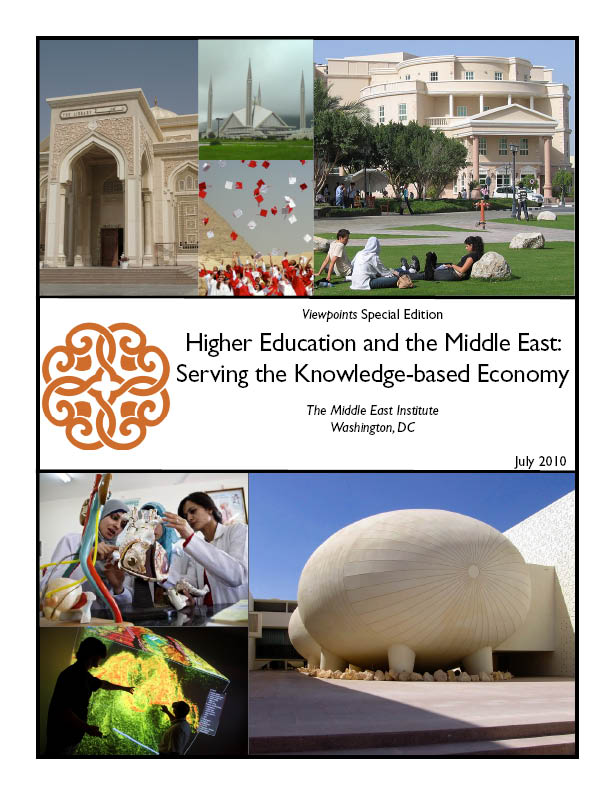
Higher Education and the Middle East: Serving the Knowledge-based Economy
This is the first of three volumes examining the internationalization of higher education and the Middle East. The 12 essays included in this volume explore some of the changes that are taking place and the challenges that lie ahead as Middle Eastern countries seek to build sustainable higher education systems and strengthen their economies. Within the dynamic global higher education landscape, is the Middle East a stagnant backwater or a center of creative initiative? What are, and should be the roles of foreign partners and providers?
United States Will Pay a Heavy Price for the Gaza Flotilla Incident
Asserting its need to be secure from future terrorism launched from Gaza, Israel used force last week to maintain a blockade that has been creating a humanitarian cataclysm for the people of Gaza. In the early days following the attack on the aid flotilla, the Israeli military interpretation of events dominated much of the popular media coverage in the United States. Gradually, though, attention shifted to the incident’s negative impact on Israel’s international standing and the security implications of continued international and regional uproar.
Turkey and the Middle East: Ambitions and Constraints
Hugh Pope, Turkey/Cyprus Project Director for the International Crisis Group (ICG), discussed the issue of recent speculation regarding Turkey’s “shift away from the West.”
Turkey and Israel: What Lies Behind the Recent Volte Face
In recent months, the Israeli-Turkish relationship, strong and stable during the 1990s, has been placed under severe pressure. Tensions began in January 2009 when Israel launched military operations in Gaza, later prompting Turkish Prime Minister Recep Tayyip Erdogan to walk out of a televised debate with Israeli President Shimon Peres following a heated exchange over the issue.
This Commentary first appeared as an op-ed on BitterLemons-International.org, October 22, 2009
Syria could not be more ecstatic at the row that has recently developed between Turkey and Israel. Turkey, once among Israel's staunchest allies, now sees eye-to-eye with Syria regarding the difficulties in dealing with Israel and Israel's abusive treatment of Palestinians.
Bilateral relations between Turkey and Iran have been marked by relative peace and stability for the past four centuries. Since the founding of the modern Republic of Turkey in 1923 and the creation of an absolutist monarchy in Iran in 1925, the ruling regimes of both countries have sought to consolidate their domestic power and to pursue an independent foreign policy. Neither Turkey nor Iran has viewed one another as an immediate threat to the attainment of these vital objectives.
From Conflict Transformation to Conflict Resolution?
Originally posted June 2008
Intra-basin dynamics amongst the Euphrates and Tigris co-riparians — Iraq, Syria, and Turkey — are better described as leading to conflict transformation rather than conflict resolution. The process of interaction has effectively seen the de-securitization of water issues, but the roots of the conflict have not yet been fully addressed.
The oldest peer-reviewed publication dedicated to the study of the modern Middle East, MEI’s flagship journal covers politics, society, and culture in the region.